



Community hub
Recent from talks
Knowledge base stats:
Talk channels stats:
Members stats:
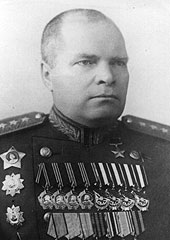
Ivan Maslennikov
Ivan Ivanovich Maslennikov (Russian: Ива́н Ива́нович Ма́сленников; September 16, 1900 – April 16, 1954), General of the Army, was a Soviet military and NKVD commander of Army and Front level during World War II. A career Red Army officer, Maslennikov was transferred to NKVD system in 1928, and remained there until the German invasion of 1941, progressing from a counter-guerrilla squadron commander to the chief of NKVD troops. After a mixed career in field troops of World War II and three post-war years, Maslennikov returned to NKVD in 1948 and stayed there, despite political changes, until his suicide in 1954.
Ivan Maslennikov, born on a remote railroad station in present-day Saratov Oblast, joined the pro-bolshevik Red Guards in 1917, fighting near Astrakhan. He served in the Red Army in southern theaters throughout the Civil War, progressing to commander of cavalry brigade in 1921. During the post-war demobilisation of the army, he accepted the lower role of squadron commander, and in 1928 was transferred from the regular army to OGPU Border Troops on the Central Asian frontier - initially commanding a squadron, later regiment. Maslennikov's units were instrumental in crushing the remaining basmachi warlords - Utan Beck (October 1928 - 1929), Ibrahim Beck (1931), Ahmet Beck (1933).
In 1935 colonel Maslennikov graduated at Frunze Military Academy and for the next two years was stationed with the Border Troops of Azerbaidzhan, then promoted to command Border Troops in Belarus. In February 1939, newly appointed NKVD chief Lavrentiy Beria promoted Maslennikov to the position of Deputy NKVD Commissar for the troops, placing him in control of Soviet Border Troops as well as Internal Troops. According to Sergo Beria, the choice was made based on the simple fact that Maslennikov was an experienced combat commander. The exact degree of Maslennikov's affiliation with Beria remains unknown; some modern authors tend to include Maslennikov in Beria's "inner circle" (with Bogdan Kobulov, Vladimir Dekanozov and others) based on circumstantial evidence (like Pavel Sudoplatov's account of his meeting with Beria in October 1939); others (Viktor Suvorov) treat him as a NKVD henchman despite his experience and formal training in the regular army.
Maslennikov's border troops took part in the occupation of Poland in September 1939. In October of the same year, Maslennikov was engaged in the planning of occupation of the Baltic states and in the German-Soviet commission on repatriation from former Poland and Baltic states. According to the German reports, Maslennikov openly admitted that the Soviets "need no wealthy Ukrainians and Belarusians, only the proletariat"; this, incidentally, led Germans to assume that the Soviets did not care about the Jews at all.
In July 1941, when his troops on the western borders were crushed by the German offensive, lieutenant general Maslennikov was placed in command of the 29th Army, manned with NKVD staff and subordinate to Reserve Front HQ and later to Kalinin Front HQ. The move from Moscow offices to HQ in Bologoye occurred between July 4 (the date when Maslennikov approved a "Decree of prisoners of war") and July 6, when, according to future air marshal Sergei Rudenko, he was inspecting the Army's units. Despite the appointment, Maslennikov retained the position of one of nine deputies to NKVD commissar.
The Army first encountered German offensive July 21, falling back from Toropetz area to Rzhev; here it incorporated the remains of dismembered 31st Army. October 12, Germans enveloped the 29th Army, but it managed to break through to the northern bank of Volga. According to Ivan Konev, commander of Kalinin Front in October 1941, Maslennikov used Beria's influence to sabotage Konev's marching orders to 29th Army; Maslennikov's insubordination led to the fall of Tver.
On December 5, 1941, Maslennikov's 29th Army opened the offensive phase of Battle of Moscow, striking south-west from German-occupied Tver. 8 days later 29th and 31st armies closed the pocket around the city; it was taken December 16. However, in the beginning of the offensive Maslennikov was suddenly relieved of his command and assigned to command the newly formed 39th Army, concentrating in Torzhok area. Post-war Soviet sources give credits for taking Tver to general Vasily Yushkevich, commander of 31st army.
The 39th army lacked armor but was well manned by Soviet standards; its six infantry divisions averaged over 9,000 men each. January 7, 1942 the 39th army became a northern spearhead of the 1941-1942 winter offensive, piercing thin German front line in Torzhok area and proceeding south-west to Rzhev-Sychevka, crushing German 9th Army. 29th and 31st armies, following initial success of the 39th, were responsible for taking Rzhev, enveloping German Army Group Center. However, the Soviet pincers failed while Walter Model managed to restore the German front line. For half a year the 39th army operated deep in the German rear, relying on guerrilla tactics. In February 1942 the Germans destroyed the 29th army; Operation Seydlitz, launched June 30, led to complete isolation and dismemberment of the 39th army. By July 17, the army was reduced to 8,000 men; the next night Maslennikov and his staff, instructed by Stavka, escaped from the pocket in Po-2s. In the following week 3,500 men of 39th Army broke through to main Soviet forces; the rest perished.
Hub AI
Ivan Maslennikov AI simulator
(@Ivan Maslennikov_simulator)
Ivan Maslennikov
Ivan Ivanovich Maslennikov (Russian: Ива́н Ива́нович Ма́сленников; September 16, 1900 – April 16, 1954), General of the Army, was a Soviet military and NKVD commander of Army and Front level during World War II. A career Red Army officer, Maslennikov was transferred to NKVD system in 1928, and remained there until the German invasion of 1941, progressing from a counter-guerrilla squadron commander to the chief of NKVD troops. After a mixed career in field troops of World War II and three post-war years, Maslennikov returned to NKVD in 1948 and stayed there, despite political changes, until his suicide in 1954.
Ivan Maslennikov, born on a remote railroad station in present-day Saratov Oblast, joined the pro-bolshevik Red Guards in 1917, fighting near Astrakhan. He served in the Red Army in southern theaters throughout the Civil War, progressing to commander of cavalry brigade in 1921. During the post-war demobilisation of the army, he accepted the lower role of squadron commander, and in 1928 was transferred from the regular army to OGPU Border Troops on the Central Asian frontier - initially commanding a squadron, later regiment. Maslennikov's units were instrumental in crushing the remaining basmachi warlords - Utan Beck (October 1928 - 1929), Ibrahim Beck (1931), Ahmet Beck (1933).
In 1935 colonel Maslennikov graduated at Frunze Military Academy and for the next two years was stationed with the Border Troops of Azerbaidzhan, then promoted to command Border Troops in Belarus. In February 1939, newly appointed NKVD chief Lavrentiy Beria promoted Maslennikov to the position of Deputy NKVD Commissar for the troops, placing him in control of Soviet Border Troops as well as Internal Troops. According to Sergo Beria, the choice was made based on the simple fact that Maslennikov was an experienced combat commander. The exact degree of Maslennikov's affiliation with Beria remains unknown; some modern authors tend to include Maslennikov in Beria's "inner circle" (with Bogdan Kobulov, Vladimir Dekanozov and others) based on circumstantial evidence (like Pavel Sudoplatov's account of his meeting with Beria in October 1939); others (Viktor Suvorov) treat him as a NKVD henchman despite his experience and formal training in the regular army.
Maslennikov's border troops took part in the occupation of Poland in September 1939. In October of the same year, Maslennikov was engaged in the planning of occupation of the Baltic states and in the German-Soviet commission on repatriation from former Poland and Baltic states. According to the German reports, Maslennikov openly admitted that the Soviets "need no wealthy Ukrainians and Belarusians, only the proletariat"; this, incidentally, led Germans to assume that the Soviets did not care about the Jews at all.
In July 1941, when his troops on the western borders were crushed by the German offensive, lieutenant general Maslennikov was placed in command of the 29th Army, manned with NKVD staff and subordinate to Reserve Front HQ and later to Kalinin Front HQ. The move from Moscow offices to HQ in Bologoye occurred between July 4 (the date when Maslennikov approved a "Decree of prisoners of war") and July 6, when, according to future air marshal Sergei Rudenko, he was inspecting the Army's units. Despite the appointment, Maslennikov retained the position of one of nine deputies to NKVD commissar.
The Army first encountered German offensive July 21, falling back from Toropetz area to Rzhev; here it incorporated the remains of dismembered 31st Army. October 12, Germans enveloped the 29th Army, but it managed to break through to the northern bank of Volga. According to Ivan Konev, commander of Kalinin Front in October 1941, Maslennikov used Beria's influence to sabotage Konev's marching orders to 29th Army; Maslennikov's insubordination led to the fall of Tver.
On December 5, 1941, Maslennikov's 29th Army opened the offensive phase of Battle of Moscow, striking south-west from German-occupied Tver. 8 days later 29th and 31st armies closed the pocket around the city; it was taken December 16. However, in the beginning of the offensive Maslennikov was suddenly relieved of his command and assigned to command the newly formed 39th Army, concentrating in Torzhok area. Post-war Soviet sources give credits for taking Tver to general Vasily Yushkevich, commander of 31st army.
The 39th army lacked armor but was well manned by Soviet standards; its six infantry divisions averaged over 9,000 men each. January 7, 1942 the 39th army became a northern spearhead of the 1941-1942 winter offensive, piercing thin German front line in Torzhok area and proceeding south-west to Rzhev-Sychevka, crushing German 9th Army. 29th and 31st armies, following initial success of the 39th, were responsible for taking Rzhev, enveloping German Army Group Center. However, the Soviet pincers failed while Walter Model managed to restore the German front line. For half a year the 39th army operated deep in the German rear, relying on guerrilla tactics. In February 1942 the Germans destroyed the 29th army; Operation Seydlitz, launched June 30, led to complete isolation and dismemberment of the 39th army. By July 17, the army was reduced to 8,000 men; the next night Maslennikov and his staff, instructed by Stavka, escaped from the pocket in Po-2s. In the following week 3,500 men of 39th Army broke through to main Soviet forces; the rest perished.