Hubbry Logo
IvujivikIvujivikMain
Open search
Ivujivik
Community hub
Ivujivik
logo
8 pages, 0 posts
0 subscribers
Be the first to start a discussion here.
Ivujivik
Ivujivik
from Wikipedia

Ivujivik (Inuktitut: ᐃᕗᔨᕕᒃ Inuktitut pronunciation: [ivujivik], meaning "Place where ice accumulates because of strong currents", or "Sea-ice crash Area") is a northern village (Inuit community) in Nunavik, Quebec, and the northernmost settlement in any Canadian province, although there are settlements further north in the territories. Its population in the 2021 Canadian census was 412.

Key Information

Policing for Ivujivik is provided by the Kativik Regional Police Force.[5]

Geography

[edit]
Satellite image of Digges Sound with Ivujivik marked "A" (click image for full legend)

Ivujivik is located in the Nunavik region of the province, some 2,000 km (1,200 mi) north of Montreal. It is only 28 km (17 mi) south-west from Cape Wolstenholme, the northernmost tip of the Ungava Peninsula, which is in turn the northernmost part of the Labrador Peninsula. It is near Digges Sound, where Hudson Strait meets Hudson Bay. The municipal boundaries include an area of 35.21 km2 (13.59 sq mi).

The area is ice-free for 20 working days a year in the summer. There are no road links to the North American road system, nor is this (or any other) Nunavik community linked by road to any of the other villages in the region. The village is served by Ivujivik Airport.

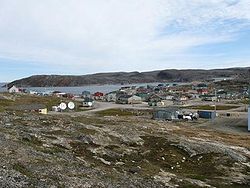
The village itself is located on a small sandy cove between imposing cliffs that drop steeply into Digges Sound. Here the strong currents from Hudson Bay and the Hudson Strait clash, sometimes even crushing trapped animals between the ice floes. Directly north across the sound are West and East Digges Islands. Farther north in the Hudson Strait are Nottingham and Salisbury Islands.[6]

History

[edit]

Archaeological dating estimates nearly 3000 years since the arrival in the area of Thule People, ancestors of today's Inuit, from Baffin Island. This place would have been the starting point of Inuit migration into Quebec, explaining the presence of the Inuit along the coast of Hudson Bay.[1] On nearby Digges Island was the spot of the first encounter between Europeans and the Inuit of Nunavik. This occurred in 1610 on Henry Hudson's last mission.[6]

The Hudson's Bay Company established a trading post on Erik Cove near Cape Wolstenholme in 1909. A Catholic mission was established on the village's current site in 1938. But both locations only remained seasonal camps. In 1947, the HBC post at Erik Cove closed and a new outpost was set up in Ivujivik. This marked the beginning of the modern village as nomadic Inuit finally began to settle permanently.[1] Not until the 1960s did the Government of Canada begin to deliver health and social services.[6] In 1962, the Inuit established a cooperative that has allowed the community to better structure its local economy and develop new activities such as sculpture, crafts, and tourism focusing on hunting and fishing.[1]

Ivujivik, along with Puvirnituq, was one of two Inuit villages that refused to sign the 1975 James Bay and Northern Quebec Agreement. In protest, it formed the Inuuqatigiit Tunngavingat Nunamini (ITN) movement. Nonetheless, it was gradually represented by the Kativik Regional Government,[6] and it officially joined the agreement in 2015.[7]

2006 bear attack

[edit]

In February 2006, the Ivujivik resident Lydia Angiyou saved her seven-year-old son and two of his friends from a polar bear attack outside the local youth centre by placing herself between the bear and the children. A local hunter, Sirqualuk Ainalik, heard the noise, ran over, and saved her by shooting the bear as it attacked. It is thought that she may have benefited from a phenomenon known as hysterical strength in fighting with the bear. The presence of a polar bear in a populated area is an unusual occurrence. Angiyou was awarded the Medal of Bravery by the Governor General for her actions.[8]

Demographics

[edit]

In the 2021 Census of Population conducted by Statistics Canada, Ivujivik had a population of 412 living in 123 of its 136 total private dwellings, a change of -0.5% from its 2016 population of 414. With a land area of 35.15 km2 (13.57 sq mi), it had a population density of 11.7/km2 (30.4/sq mi) in 2021.[9]

In 2001, 285 of the 298 (about 96%) persons were considered aboriginal. As with many Inuit villages, there is a large youth contingent. In 2006, 42.9% of the population was below the age of fifteen. The median age was 19.1.[10]

In 2001, unemployment was at 18.2 percent. The median income for the same census was $14,624 (in Canadian dollars.) 72 percent of the workforce walked or biked to work.

Historical census populations – Ivujivik
YearPop.±%
1986 208—    
1991 263+26.4%
1996 274+4.2%
2001 298+8.8%
YearPop.±%
2006 349+17.1%
2011 370+6.0%
2016 414+11.9%
2021 412−0.5%
Source: Statistics Canada

Education

[edit]

The Kativik School Board operates the Nuvviti School.[11]

In 1980 there was a community boycott against the Kativik School Board as people in the community disliked the James Bay Agreement and therefore shunned the school district as they perceived it as close to the people who accepted the agreement. That year, the government of Quebec planned to open its own school there.[12]

References

[edit]
[edit]
Revisions and contributorsEdit on WikipediaRead on Wikipedia
from Grokipedia

Ivujivik is a northern village municipality and Inuit community in the Nunavik region of Quebec, Canada, positioned at the province's northwestern extremity along the eastern shore of Hudson Strait near the entrance to Digges Sound. As Quebec's northernmost settlement, it lies approximately 2,000 kilometers north of Montreal and supports a primarily Inuit population engaged in traditional activities such as hunting and fishing amid a subarctic environment characterized by steep cliffs and turbulent waters. The community, established as a permanent village in the late 20th century following historical nomadic Inuit patterns in the area, recorded a population of 412 in the 2021 Canadian census, reflecting modest growth from prior enumerations.

Ivujivik's remote location necessitates reliance on air and sea transport, with no road connections to southern , underscoring its isolation and the challenges of infrastructure development in the periphery. The village's economy centers on subsistence hunting of marine mammals, birds, and fish, supplemented by limited local services and government programs tailored to under the Kativik Regional Government. Ecologically, the surrounding Digges Sound hosts significant avian populations, including one of the largest colonies, which bolsters seasonal harvesting practices integral to community sustenance. Policing is handled by the Kativik Regional Police Force, addressing the unique demands of frontier .

Geography

Location and Topography


Ivujivik is positioned at approximately 62°25′N 77°55′W along the northeastern shore of Hudson Bay, near the entrance to Hudson Strait. This places it as the northernmost permanently inhabited community in Quebec and the northernmost settlement in any Canadian province south of Nunavut. The village lies on the Ungava Peninsula's northwest tip, exposed to the dynamic marine environment where strong currents and tides converge.
The local topography features Arctic tundra characterized by rocky, barren shores and elevated cliffs that descend sharply into adjacent waters, including Digges Sound to the north. Vegetation is sparse, dominated by tundra species on ridges and raised beaches, with sedges in depressions, while epigenetic permafrost underlies much of the landscape, forming cryoturbation features and ice-wedge polygons in finer sediments. The nearby Digges Islands, known for their steep rocky cliffs, contribute to the rugged coastal profile. Access to Ivujivik is limited to via its gravel runway airport or marine approaches during short ice-free windows in summer, when Hudson Strait's heavy seas and colliding ice fragments pose significant navigational challenges. This isolation amplifies the logistical difficulties inherent to its high-Arctic setting, with no road connections to southern regions.

Climate and Environment

Ivujivik lies within a subarctic climate zone (Köppen Dfc), marked by prolonged cold winters and fleeting mild summers, with extreme temperature swings driven by its high latitude and proximity to Hudson Strait. Monthly mean temperatures in January typically range from -25°C to -20°C, reflecting the harsh polar continental influence, while July averages hover around 5°C to 10°C for highs, limiting vegetation growth to brief periods. Annual precipitation totals under 300 mm, predominantly as snow, contribute to low humidity and frequent clear skies, though wind chill from northerly gales can exacerbate perceived severity. Daylight cycles follow the latitude of approximately 62.4°N, yielding extended twilight winters with the shortest days in December lasting about 3.5 to 4 hours of potential sunlight, and correspondingly long summer days exceeding 20 hours by June, though without true midnight sun south of the Arctic Circle. Hudson Strait adjacent to Ivujivik features persistent landfast sea ice formation beginning in early December and persisting until breakup in late May or June, influencing local heat exchange and moisture transport. These ice dynamics exhibit variability, with recent trends showing earlier thaws linked to atmospheric oscillations, heightening exposure to open-water storms. The ecological context is tundra-dominated, with sparse flora such as lichens, mosses, and low shrubs adapted to permafrost and short growing seasons, constraining biomass and primary productivity. Fauna includes migratory caribou herds, ringed and harp seals reliant on seasonal ice for whelping, and polar bears that den on nearby shores, their populations and accessibility governed by ice stability and prey cycles rather than human factors. This environmental determinism underscores resource scarcity in winter, when sea ice extent dictates marine mammal proximity, while summer migrations of beluga and fish align with ice retreat.

History

Pre-Modern Inuit Presence

The culture, direct ancestors of modern , migrated eastward from across the Canadian Arctic, reaching the region, including the area near Ivujivik, approximately 700 to 800 years ago. This expansion followed initial Thule movements around 1000 AD, facilitated by technological adaptations such as umiaks and harpoons for exploiting marine resources in open-water environments. Archaeological sites along , such as those in Diana Bay, document Thule reoccupation of earlier Dorset locations for seasonal hunting of ringed seals, beluga whales, and , with evidence of semi-subterranean houses constructed from whalebone and sod. In the Ivujivik vicinity, Paleoeskimo and Thule remains indicate intermittent use rather than continuous settlement, reflecting a strategy of mobility dictated by the seasonal availability of sea mammals and caribou in a resource-scarce coastal tundra. Zooarchaeological assemblages from Nunavik Thule sites emphasize reliance on marine hunting, with tools like toggling harpoons and blubber lamps supporting short-term camps during summer whale migrations and winter seal hunts on sea ice. No evidence exists for large-scale pre-contact villages, consistent with the adaptive nomadism required in the low-productivity Arctic ecosystem, where groups of 20-50 individuals followed migratory prey patterns to avoid depletion of local stocks. Inuit oral traditions preserved by Nunavik elders describe ancestral seasonal encampments in the Ivujivik area, focused on temporary sod or skin tents at key hunting locales like Digges Sound, rather than fixed habitations, underscoring a causal link between environmental flux and dispersal to ensure sustenance. These accounts align with archaeological patterns of dispersed, low-density occupations, prioritizing survival through opportunistic resource pursuit over sedentary aggregation, which would have been unsustainable given the region's sparse biomass and extreme seasonality.

Modern Settlement and Development

Ivujivik's modern settlement emerged in the mid-20th century as nomadic Inuit families consolidated around established trading posts and missions, driven by declining viability of traditional hunting patterns amid the collapse of the fur trade and introduction of rifles that altered prey migration dynamics. The Hudson's Bay Company relocated its post to the site in 1947 following closures elsewhere, attracting residents previously dispersed in seasonal camps, while a Catholic mission founded in 1938 provided initial services until federal authorities assumed responsibility in the 1960s. Provincial and federal interventions post-1950s, including subsidized housing programs initiated in the late 1960s, addressed population pressures from post-World War II growth and tuberculosis epidemics that necessitated southern treatments and disrupted mobile lifestyles, fostering permanent residency over transhumance. By 1967, local Inuit established a cooperative store, replacing the HBC outpost and signaling economic self-organization amid government-encouraged sedentarization. Infrastructure development accelerated in the 1970s and 1980s under federal-provincial agreements linked to the 1975 James Bay and Northern Quebec Agreement, with a small airstrip constructed in 1970 and progressively extended—reaching 500 meters by 1982—to enable reliable air access for freight and medical evacuations, culminating in a 1984 improvement program extending it to 1,070 meters at a cost of $6.7 million. These efforts transitioned Ivujivik from a temporary outpost to a formalized northern village municipality, with population growing at 2.8% annually to 197 Inuit residents by 1982, supported by enhanced services that reduced isolation but entrenched reliance on external subsidies.

Notable Events and Incidents

In February 2006, resident Angiyou intervened in a attack outside the local in Ivujivik, positioning herself between the animal and her seven-year-old son and two friends to allow their escape; she sustained injuries including bites to her arms and legs during the confrontation but repelled the bear until a hunter arrived and shot it. The incident, occurring in a community reliant on where occasionally approach settlements due to their proximity to habitats, resulted in no fatalities and underscored the physical risks posed by wildlife in remote areas. On August 1–2, 2015, approximately 14,200 litres of spilled from a storage tank at the generating station serving Ivujivik, with a portion flowing into a nearby creek and reaching Digges Sound before containment efforts using berms and absorbents limited further environmental spread. coordinated cleanup with community authorities, confirming no long-term ocean contamination, though local residents expressed concerns over potential impacts to nearby water sources used for traditional activities. In March 2017, a polar bear entered Ivujivik and attacked sled dogs, prompting a resident to shoot the animal after it posed an immediate threat within the settlement; the bear was described as thin, reflecting seasonal foraging challenges near Hudson Strait. Such encounters, managed through local firearm use and coordination with wildlife authorities, illustrate Ivujivik's self-reliant response to infrequent but hazardous wildlife intrusions without broader disruptions. The community has experienced no major industrial accidents, political conflicts, or large-scale disasters, with incidents typically addressed via resident initiative and external support from regional agencies.

Demographics

In the 2021 Census of Population, Ivujivik had a total population of 412 residents. This marked a marginal decline of 0.5% from the 2016 census figure of 414. Historical data indicate steady growth prior to this, with the population rising from 350 in 2006 to 414 in 2016, an increase of 18.3%.
Census YearPopulation
2006350
2016414
2021412
The observed trends reflect a pattern of natural increase dominating over the period, with Nunavik's regional birth rate at 25.4 live births per 1,000 population in 2016, supporting annual growth rates of roughly 1.5-1.8% from 2006 to 2016. The slight post-2016 stagnation aligns with decelerating fertility in the broader region, where birth rates fell from 26.0 per 1,000 in 2006. Ivujivik's population features a pronounced youth skew, with 30.1% under 15 years, 63.9% aged 15-64, and 4.9% 65 and older as of 2021. This distribution exceeds Canadian norms, where the under-15 share was 15.7% nationally, underscoring elevated dependency ratios characteristic of high-fertility Inuit communities. Net interprovincial and intraprovincial migration has exerted downward pressure, with regional outflows partially offsetting natural gains, though specific Ivujivik net rates remain low-negative amid cultural retention factors.

Ethnic Composition and Languages

The residents of Ivujivik are overwhelmingly of ethnic origin, with 97.6% (405 individuals) reporting as their ethnic or cultural background in the 2021 Census of . Indigenous identity is near-universal, encompassing 100% of the in private households (410 individuals), all aligning with -specific affiliation under Canadian census categories for First Nations, , or . Non- residents remain negligible, typically limited to short-term non-Indigenous personnel such as government or service workers, reflecting the community's isolation and self-sustaining social structure in remote . Inuktitut dominates as the mother tongue and home language, spoken by 405 residents (over 98% of the population) according to 2021 census data on languages used most often at home. This reflects the local variant of Inuktitut prevalent in Nunavik, characterized by regional phonetic and lexical features adapted to the eastern Arctic environment, which sustains oral traditions and daily communication. English and French serve secondary roles in administrative, educational, and external interactions, but proficiency and daily use in these colonial languages lag, with census indicators showing limited literacy and fluency beyond basic levels among Inuit speakers. This linguistic persistence underscores resistance to assimilation, as Inuktitut remains the vehicle for cultural transmission in a setting where intergenerational use preserves dialectal integrity against external pressures.

Government and Administration

Local Governance Structure

Ivujivik operates as a northern village municipality under Quebec's Act respecting Northern villages and the Kativik Regional Government, which establishes it as an Inuit community with local autonomy tailored to the region's unique needs. The municipal council comprises a mayor, who serves as head and chief executive, and 2 to 6 councillors, with the exact number determined by local by-law subject to elector approval. All members must be Canadian citizens of full age residing in the village for at least 36 months prior to election. Elections occur every three years on the first Wednesday of November via secret ballot, with the mayor selected by the highest number of votes and councillors by the highest votes for available seats. Terms end upon swearing in of the new mayor or the first post-election council meeting. One councillor is designated as a regional representative to the Kativik Regional Government (KRG) council, ensuring coordination on regional matters such as land use planning and service delivery, including policing through the Kativik Regional Police Force. The council exercises authority through by-laws and resolutions over municipal affairs, including public order, health, and welfare, with all enactments transmitted to the KRG for review to prevent conflicts with regional ordinances. Local by-laws may address community-specific issues, such as ordinances promoting adherence to regional hunting quotas, as demonstrated by past mayoral efforts to encourage compliance among residents. The municipal budget depends heavily on transfers from federal, provincial, and KRG sources to fund operations, reflecting the fiscal constraints of remote Inuit governance.

Intergovernmental Relations

Ivujivik, as part of the Nunavik region, falls under the Nunavik Inuit Land Claims Agreement (NILCA), ratified in 2008 through negotiations led by the Makivvik Corporation representing Nunavik Inuit, the Government of Canada, and Quebec. The agreement establishes co-management regimes for wildlife harvesting and marine resources via institutions like the Nunavik Marine Region Wildlife Board, while allocating Category I Inuit-owned lands and providing financial compensation exceeding CAD 200 million over 14 years. However, it limits Inuit entitlements to resource royalties, capping subsurface rights on Category II lands and prioritizing federal-provincial oversight for development projects, which has constrained local economic leverage from extraction activities. Intergovernmental tensions have arisen particularly over resource extraction, such as nickel mining at the Raglan Mine operated by Glencore in northern Nunavik, where consultations under NILCA have been criticized for insufficient Inuit input on environmental and social impacts, including influxes of non-local workers exacerbating community strains like substance abuse and family disruptions. Critics, including Inuit organizations, argue that federal and provincial impact-benefit agreements fail to causally mitigate these harms, as evidenced by elevated rates of social issues in mining-adjacent communities, prompting calls for stricter adherence to the Nunavik Inuit Mining Policy's objectives for cultural preservation and equitable revenue sharing. Federal subsidies to Nunavik communities, delivered through programs like Nutrition North Canada and infrastructure funding totaling billions annually across Inuit regions, have faced critiques for paternalistic structures that prioritize bureaucratic oversight over community autonomy, fostering dependency by distorting local incentives and limiting self-reliant development. The 2022 Inuit Nunangat Policy, co-developed with Inuit Tapiriit Kanatami, pledges enhanced self-determination through integrated federal decision-making and prosperity initiatives, yet implementation in remote areas like Ivujivik remains delayed, with ongoing directives in 2025 highlighting persistent gaps in on-the-ground application despite policy endorsements.

Economy

Primary Economic Activities

The economy of Ivujivik relies heavily on subsistence activities, including ringed seals, Arctic char, and caribou, which remain vital for and cultural continuity in this remote community. These traditional practices provide a significant portion of local caloric intake through country foods, supplementing store-bought provisions amid high import costs. Harvest levels are supported by communal hunter assistance programs, enabling year-round access despite seasonal variations and environmental challenges. Wage employment supplements subsistence, primarily through public sector roles in local government administration and operations at Ivujivik , which handles regional flights and logistics. Average annual for full-time workers reached approximately $40,000 in 2020, reflecting these stable but limited opportunities. Unemployment in Ivujivik aligns with regional averages of 20-30%, influenced by seasonal hunting cycles, skill gaps, and low labor force participation rates around 40-50% for adults. Commercial ventures are minimal due to Ivujivik's isolated location, with no large-scale or industry feasible. Local artisans produce stone carvings in styles ranging from abstract to realistic, sold sporadically through regional outlets like Art Nunavik. Emerging , such as guided eco-tours focused on and experiences, offers supplementary income but remains underdeveloped, constrained by logistics and weather.

Challenges and Self-Reliance Efforts

High affects approximately 40% of households in communities like Ivujivik, stemming primarily from low formal levels—where high school completion rates lag far behind Quebec's 80% average—and chronic scarcity of wage in such isolated locales. These internal factors, compounded by a post-1980 relocation history that disrupted prior nomadic self-provisioning patterns without fully rebuilding skill sets for modern economies, foster reliance on government transfers rather than productive work. Quebec's social assistance programs, while intended as safety nets, have been critiqued for creating disincentives to traditional self-sufficiency, such as or small-scale , by prioritizing income supplementation over skill-building incentives that could bridge gaps. Poverty rates in Ivujivik exceed provincial averages, with Nunavik-wide figures showing 43% of households below the low-income threshold in early 2010s data, compared to 17% province-wide, causally tied to these educational and locational barriers that limit access to non-subsistence jobs. Remote job scarcity persists due to the community's position at 62°25′N, where transportation costs inflate living expenses and deter private investment, reinforcing a cycle where formal skill deficits hinder diversification beyond seasonal or roles. To counter these hurdles, Ivujivik has pursued through community cooperatives, which manage distribution and retail to enhance amid high import costs—supplementing rather than replacing individual in a region where such models have sustained economic activity since the . Additionally, training initiatives in aim to curtail dependence on imported , with Nunavik-wide efforts like the 2017 Makivvik-FCNQ establishing Tarquti Energy to develop hydro, solar, and projects tailored to remote sites, including potential Ivujivik implementations that could lower costs by up to 30% through localized . These steps prioritize practical capacity-building over external aid, addressing fuel import vulnerabilities exacerbated by the community's coastal isolation in Digges Sound.

Culture and Society

Traditional Inuit Practices

Traditional Inuit practices in Ivujivik encompass performative arts such as katajjaniq (throat singing), drum dancing, and storytelling, which reinforce social bonds and align with the seasonal rhythms of hunting, fishing, and migration. Throat singing, a dyadic vocal tradition primarily performed by women, mimics environmental sounds like animal calls and wind, serving both entertainment and skill-testing purposes during winter gatherings. Drum dancing, typically led by men using a frame drum made from caribou skin, accompanies narrative songs that recount personal exploits or ancestral tales, often celebrating milestones like a successful hunt or birth. These activities, revived after suppression by early missionaries, persist as mechanisms for cultural transmission, with elders integrating them into teachings on survival skills. Elders hold a pivotal role in perpetuating practical knowledge of sea ice navigation and animal behaviors, drawing from empirical observations accumulated across generations to guide safe travel and resource procurement. In Ivujivik, this includes discerning ice thickness and currents in Digges Sound for spring hunts, where historical patterns of freeze-thaw cycles informed qamutiik (sled) routes and kayak launches. Knowledge of wildlife, such as walrus migration timing and beluga pod responses to tidal shifts, is conveyed through direct demonstration and oral accounts, emphasizing cues like wind direction and celestial positions for prediction. Such expertise, rooted in causal patterns of environmental variability rather than abstract theory, remains vital amid observed shifts in ice stability since the mid-20th century. Spiritual observances blend residual animistic elements—such as rituals honoring animal spirits to ensure hunt success—with Christian influences from Anglican missions established in by the 1930s. Traditional shamanic mediation with natural forces has diminished post-conversion, yet practices like offering seal innards to the sea persist alongside church services, reflecting pragmatic adaptation to colonial impositions. Gender divisions in labor sustain efficiency: men focus on pursuing seals and caribou using harpoons or , while women specialize in skinning carcasses, scraping from hides with ulus, and rendering for preservation, maximizing caloric yield from each kill. These roles, evolved from environmental necessities, underscore complementary contributions to household viability without rigid exclusion.

Community Life and Social Dynamics

In Ivujivik, as in broader Nunavik Inuit communities, tight-knit kinship networks facilitate mutual aid through extensive sharing of food, goods, and resources, which helps mitigate the region's high living costs and promotes social resilience. These networks, rooted in traditional Inuit practices of reciprocity and extended family obligations, extend support beyond immediate households to include distant relatives and community members during hardships such as illness or hunting shortfalls. Familial structures in Nunavik, including Ivujivik, feature a high prevalence of single-parent households, at approximately 41% compared to 17% provincially in Quebec, often correlating with greater dependence on social assistance due to economic pressures and disrupted family units. This configuration, predominantly headed by mothers (31% of families), stems from factors like early partnerships, separations, and historical disruptions, contributing to cycles of vulnerability in child-rearing and resource allocation. Community cohesion is reinforced through events such as post-hunt feasts, where successful harvests of seal, caribou, or beluga are shared communally, echoing traditional values of ilusirsusiarniq (mutual respect and support) and strengthening interpersonal bonds. However, these practices contrast with growing youth disconnection from ancestral traditions, evidenced by rising among those aged 18-34, amid shifts toward urban influences and erosion of elder-youth knowledge transmission. While Nunavik reports relatively low rates of certain property crimes and no murders in recent years, suicide rates remain elevated at around 12 times the Quebec provincial average, causally tied to intergenerational trauma from colonial policies like forced relocations and residential schooling, compounded by accessible alcohol and substance abuse that exacerbates mental health crises. These dynamics highlight a tension between enduring kinship strengths and persistent social fractures, where substance misuse—prevalent in 32% of users at risk levels—fuels isolation and self-harm, particularly among males.

Infrastructure and Services

Education and Youth Programs

Nuvviti School provides primary and secondary education ( through Secondary 5) to approximately 117 students in Ivujivik, operating under the Kativik Ilisarniliriniq school board with a focus on immersion in early grades before transitioning to French or English instruction. The school recently underwent a 600 m² extension and renovation, adding classrooms, a space, and a 240 m² playground to accommodate growing needs. Secondary graduation rates for the Kativik School Board, which includes Ivujivik, stood at 23.5% in the 2023-2024 school year, reflecting broader challenges such as chronic low attendance—often below 50% in communities—and curricula that prioritize provincial standards over integration of local knowledge, leading to disengagement and cultural disconnects. Post-secondary opportunities for Ivujivik youth are supported by Kativik Ilisarniliriniq's , which offer logistical, academic, and financial aid through the Nunavik Scholarship Fund for vocational programs in trades, targeting beneficiaries who relocate south for training due to limited local options. The Suilaaqivik youth center in Ivujivik, managed by the Nunavik Youth Houses Association, provides recreational and social programs for ages 5-19 to address idleness and foster skill-building, including open events and guided activities, though staffing shortages and remote logistics limit consistent outcomes.

Health, Housing, and Utilities

The Inuulitsivik Health Centre, based in , oversees primary health services for Ivujivik through a local CLSC staffed primarily by nurse practitioners and workers, handling routine care such as vaccinations, chronic management, and minor emergencies. Serious cases, including trauma or advanced illnesses, necessitate medical evacuations by air to regional hospitals, with transfers coordinated between villages and larger facilities in Inukjuak or . Tuberculosis incidence in Nunavik, including Ivujivik, remains among the highest globally, with 83 confirmed cases region-wide by September 2025 projecting rates over 800 per 100,000—more than 1,000 times Quebec's non-Inuit average—facilitated by household crowding that accelerates airborne transmission. This density-dependent spread underscores how substandard housing correlates with elevated respiratory disease burdens, independent of vaccination or treatment access alone. Housing in Ivujivik consists of approximately 125 private dwellings for a of around 410, with 20 households (16%) exceeding one person per room per 2021 metrics, indicating core functional that strains family structures and maintenance. Regionally, faces a 1,039-unit shortfall amid , perpetuating multi-generational occupancy beyond design capacities and amplifying interpersonal conflicts alongside health risks like TB. Utilities rely on diesel-fired generators operated by Hydro-Québec, supplying power for heating and electricity but prone to disruptions, as evidenced by a 10,000-litre spill in August 2015 that prompted containment efforts without confirmed ocean contamination yet raised local water quality concerns. Water is sourced from rivers or melted snow, treated via basic filtration, with frequent boil-water advisories due to bacterial risks; sanitation infrastructure is constrained by permafrost, limiting piped sewage and relying on trucked waste or pit systems that challenge year-round reliability. These dependencies heighten vulnerability to fuel shortages or climate variability, though no full transition to renewables has occurred locally.

Recent Developments

Environmental and Wildlife Issues

Thinning in has reduced safe access for traditional hunting from Ivujivik, with earlier break-up shortening the geese-hunting season and increasing risks for dog-sled travel over unstable surfaces. Local hunters report more open water areas post-2020, rendering sledges unsafe and limiting harvest of marine mammals like seals, as documented in Nunavimmiut knowledge studies. These changes align with regional trends of declining ice volume by up to 82% from 1979 to 2023, though Ivujivik-specific data emphasize localized travel disruptions over broader . Polar bear encounters near Ivujivik have increased, with incidents including a thin, hungry bear entering the community in March 2017 and a sighting at a residential porch in April 2025, prompting local alerts. Such events reflect nutritional stress in bears amid variable ice conditions, managed through quotas set by co-management boards involving Inuit organizations and federal authorities to balance conservation and community safety. Permafrost thaw poses risks to infrastructure stability in Nunavik, including Ivujivik, with ground-ice mapping from 2020-2023 revealing high vulnerability in coastal areas leading to potential building subsidence and erosion. The Makivik Corporation's 2024 adaptation strategy highlights thawing as a priority for protecting essential services, based on multi-technique assessments showing uneven degradation rates across communities. Mercury releases from thaw remain lower than anticipated, per 2025 Laval University findings, mitigating some contamination concerns but not structural threats. Local observations note caribou population fluctuations challenging subsistence hunting, with shifts in migration patterns reported in since 2020, though over-harvesting by Indigenous hunters lacks empirical support as a primary cause compared to habitat and predation factors. These trends, drawn from resident knowledge rather than global models, underscore reliance on alternative species amid variable dynamics without evidence of total collapse.

Community Initiatives and Adaptations

Inuit-led entrepreneurship in Nunavik has received support through Canada Economic Development (CED) funding, with nearly $1,750,000 allocated in June 2024 to five regional organizations for projects enhancing local business skills, innovation, and market access, including pilots in crafts and tourism applicable to communities such as Ivujivik. These initiatives prioritize self-sustaining ventures over reliance on external subsidies, drawing on traditional knowledge of resource use to develop culturally relevant enterprises that reduce economic vulnerability to remote logistics costs. To address food insecurity exacerbated by high import expenses, Makivvik Corporation has advanced hydroponic greenhouse systems across since acquiring specialized technology, enabling year-round local production of and building on harvesting resilience to supplement country foods. Complementary efforts include explorations of solar-hybrid micro-grids for off-grid energy decarbonization in northern Indigenous communities, aiming to lower diesel dependence and operational costs through renewable integration tailored to harsh conditions. The ongoing Parnasimautik consultation process facilitates input on resource development, with communities like Ivujivik advocating revenue-sharing arrangements from and projects to foster fiscal rather than perpetual . This approach, informed by recent Nunavik-wide climate adaptation strategies, emphasizes pragmatic local decision-making to mitigate environmental risks while capturing economic benefits directly.

References

Add your contribution
Related Hubs
User Avatar
No comments yet.