


Community hub
Recent from talks
Contribute something
Nothing was collected or created yet.
Drift ice
View on Wikipedia

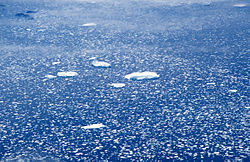
Drift ice, also called brash ice, is sea ice that is not attached to the shoreline or any other fixed object (shoals, grounded icebergs, etc.).[1][2][3] Unlike fast ice, which is "fastened" to a fixed object, drift ice is carried along by winds and sea currents, hence its name. When drift ice is driven together into a large single mass (>70% coverage), it is called pack ice.[1] Wind and currents can pile up that ice to form ridges up to dozens of metres in thickness. These represent a challenge for icebreakers and offshore structures operating in cold oceans and seas.
Drift ice consists of ice floes, individual pieces of sea ice 20 metres (66 ft) or more across. Floes are classified according to size: small – 20 metres (66 ft) to 100 metres (330 ft); medium – 100 metres (330 ft) to 500 metres (1,600 ft); big – 500 metres (1,600 ft) to 2,000 metres (6,600 ft); vast – 2 kilometres (1.2 mi) to 10 kilometres (6.2 mi); and giant – more than 10 kilometres (6.2 mi).[4][5]
Drift ice affects:
- Security of navigation
- Climatic impact (see Polar ice packs)
- Geological impact
- Biosphere influence (see Ecology of sea ice)
Drift ice can exert tremendous forces when rammed against structures, and can shear off rudders and propellers from ships and strong structures anchored to the shore, such as piers. These structures must be retractable or removable to avoid damage. Similarly, ships can get stuck between drift ice floes.
The two major ice packs are the Arctic ice pack and the Antarctic ice pack. The most important areas of pack ice are the polar ice packs formed from seawater in the Earth's polar regions: the Arctic ice pack of the Arctic Ocean and the Antarctic ice pack of the Southern Ocean. Polar packs significantly change their size during seasonal changes of the year. Because of vast amounts of water added to or removed from the oceans and atmosphere, the behavior of polar ice packs has a significant impact on global changes in climate.
Seasonal ice drift in the Sea of Okhotsk by the northern coast of Hokkaidō, Japan, has become a tourist attraction,[6] and is one of the 100 Soundscapes of Japan. The Sea of Okhotsk is the southernmost area in the Northern Hemisphere where drift ice may be observed.[7]
Gallery
[edit]-
 The icebreaker Kontio, which in this picture became stuck in drift ice while towing a cargo ship in pack ice in the northern Baltic Sea
 -
 Ice floes / pack ice
 -

-
 Drift ice in the Sea of Okhotsk
 -
 Aboard the Aurora icebreaker in the Sea of Okhotsk


See also
[edit]- Drifting ice station – Research stations built on the ice of the high latitudes of the Arctic Ocean
- Iceberg – Large piece of freshwater ice broken off a glacier or ice shelf and floating in open water
- Ice shove – Ice pushed onshore due to water movements or wind
- Lead (sea ice) – Fracture that opens up in an expanse of sea ice
- Polynya – Area of unfrozen sea within an ice pack
- Pressure ridge (ice) – Linear accumulation of ice blocks resulting from the convergence between floes
- Seabed gouging by ice – Outcome of the interaction between drifting ice and the seabed
- Sea ice – Outcome of seawater as it freezes
- Shelf ice – Ice formed on a lake and washed up on the shore
References
[edit]- ^ a b WMO Sea-Ice Nomenclature
- ^ Weeks, Willy F. (2010). On Sea Ice. University of Alaska Press. p. 2. ISBN 978-1-60223-101-6.
- ^ Leppäranta, M. 2011. The Drift of Sea Ice. Berlin: Springer-Verlag.
- ^ NSIDC All About Sea Ice
- ^ Environment Canada Ice Glossary
- ^ "A Port's Ice Is Thinning, and So Is Its Tourist Trade", The New York Times, March 14, 2006.
- ^ "Honda, Meiji, Koji Yamazaki, Hisashi Nakamura, Kensuke Takeuchi, 1999: Dynamic and Thermodynamic Characteristics of Atmospheric Response to Anomalous Sea-Ice Extent in the Sea of Okhotsk. J. Climate, 12, 3347–3358". Journal of Climate. 12. Journals.ametsoc.org: 3347. 1999. doi:10.1175/1520-0442(1999)012<3347:DATCOA>2.0.CO;2. ISSN 1520-0442.
External links
[edit]- "Ice in the Sea" : chapter from Nathaniel Bowditch's American Practical Navigator
- Cryosphere Today : Current Arctic sea ice conditions Archived 2011-02-23 at the Wayback Machine
- Data source for sea ice picture
- Marine Modeling and Analysis Branch Archived 2011-04-02 at the Wayback Machine
- Everything you ever wanted to know about sea ice but were afraid to ask
- Animation of the movement of sea ice, September 2003 through May 2004
- Atlas of Antarctic Sea Ice Drift
- The Papers of Paul Gordienko on Ice and Ice Drifts at Dartmouth College Library


| International | |
|---|---|
| National | |
| Other | |

Drift ice
View on GrokipediaDrift ice consists of detached fragments of sea ice that float freely on the ocean surface and are transported by winds and currents, distinguishing it from fast ice attached to coasts or the seafloor.[1][2] These fragments, often forming extensive fields of floes larger than 20 meters across, originate from the breakup of larger ice sheets and accumulate as pack ice through compression and ridging processes.[3] Predominantly occurring in polar regions such as the Arctic and Antarctic Oceans, drift ice dynamics are driven by wind forcing, typically resulting in drift speeds of 1-3% of wind velocity when winds exceed 5 m/s, modulated by ocean currents and internal ice interactions.[4][5] In oceanography and climate science, it regulates heat flux between the ocean and atmosphere, enhances albedo to reflect solar radiation, and influences global thermohaline circulation through freshwater export upon melting.[6] Ecologically, drift ice serves as critical habitat for marine mammals like seals and polar bears, supporting breeding and foraging, while posing navigational challenges that require specialized vessels such as icebreakers to traverse affected waters safely.[6][3]
Definition and Classification
Core Definition
Drift ice consists of sea ice floes that are not attached to the shoreline or sea bottom and move freely in response to winds, ocean currents, and other forces.[7] This distinguishes it from fast ice, which remains stationary by being anchored to coastal features or the ocean floor.[8] Drift ice forms accumulations known as pack ice, where floes interact through collision, ridging, and rafting, creating dynamic fields with varying concentrations and openness.[7] The term "drift ice" emphasizes the mobility of these ice masses, which can range from small fragments to vast sheets covering thousands of square kilometers.[9] Floes in drift ice typically exceed 20 meters in diameter, though smaller pieces may aggregate into larger formations.[10] This mobility leads to continuous deformation, with leads—open water channels—forming and closing between floes due to divergent and convergent motions.[8] Drift ice is a critical component of polar oceanography, influencing heat exchange between the ocean and atmosphere, marine ecosystems, and navigation.[11] Its presence modulates solar radiation absorption through high albedo and affects global climate patterns by exporting freshwater and influencing thermohaline circulation.[5] Observations indicate that drift speeds often correspond to about 2-3% of wind velocity, deflected to the right in the Northern Hemisphere due to Coriolis effects.[12]Floe Size Categories and Types
Drift ice consists of floating sea ice floes detached from the coast and in motion, classified primarily by size under the World Meteorological Organization's (WMO) sea ice nomenclature. A floe is defined as any relatively flat piece of sea ice 20 meters or greater in horizontal extent, with smaller fragments termed ice cakes (less than 20 meters across) or small ice cakes (less than 2 meters).[13] These size categories facilitate standardized observation and reporting in ice charts, such as through the egg code system, where predominant floe sizes are denoted to assess navigability and ice conditions.[14] The WMO delineates floe sizes as follows:| Category | Size Range |
|---|---|
| Small floe | 20–100 m across |
| Medium floe | 100–500 m across |
| Big floe | 500–2,000 m across |
| Vast floe | 2–10 km across |
| Giant floe | >10 km across |
Formation and Physical Processes
Origin from Sea Ice
Drift ice originates from sea ice, which forms through the thermodynamic freezing of seawater at the ocean surface when air temperatures drop below the freezing point of saline water, approximately -1.8°C.[17] This process begins in polar regions during autumn and winter as heat loss to the atmosphere cools the surface layer, leading to the nucleation of ice crystals.[18] In calm conditions, frazil ice—loose, needle-like crystals—accumulates to form a thin, elastic sheet known as nilas, which can grow laterally and vertically through congelation growth, where ice platelets form at the ice-water interface due to continued heat extraction.[8] During this freezing, salts are largely excluded from the ice lattice, resulting in sea ice with lower salinity than the underlying seawater, which concentrates brine in leads and enhances ocean density-driven convection.[19] In turbulent or wavy conditions, frazil crystals collide and form circular pancake ice floes, typically 0.3 to 3 meters in diameter, which aggregate into larger sheets or rafts through freezing and mechanical interactions.[20] These initial formations constitute young sea ice, which thickens over time—reaching up to 1-2 meters in first-year ice—primarily through thermodynamic growth influenced by snow cover, air temperature, and ocean heat flux.[8] Once formed in open water or detached from coastal fast ice by winds, currents, or thermal expansion, this sea ice breaks into discrete floes that become mobile drift ice, distinguishing it from stationary fast ice attached to land or the seabed.[18] The transition to drift ice typically occurs in the marginal ice zone, where wave action and shear from winds fragment the ice cover into packs that advect with ocean currents and atmospheric forcing.[21]Breakup Mechanisms and Initial Drifting
Breakup of sea ice, transitioning it into mobile drift ice, is predominantly driven by mechanical stresses from winds, ocean currents, and waves, which fracture the ice cover when exceeding its compressive or shear strength.[22] Thinner ice, often resulting from prior thermodynamic thinning, exhibits reduced resistance to these forces, facilitating widespread fragmentation during storms. For instance, a 2013 winter event in the Beaufort Sea involved strong southerly winds dispersing thin ice over distances exceeding 100 km in days, as simulated by the neXtSIM model incorporating sea ice rheology.[22] Wave action plays a key role in the marginal ice zone, where irregular ocean swells propagate into the ice pack, inducing flexural stresses that initiate cracks and floe breakup.[23] Laboratory experiments with model ice under unidirectional waves confirm that breakup begins at wave antinodes due to horizontal shear forces, propagating fractures that reduce floe sizes and enhance lateral melting.[24] Thermal mechanisms, such as diurnal temperature fluctuations causing expansion cracks, contribute marginally but are secondary to dynamic forcing in large-scale events.[25] Following detachment from fast ice or pack reconfiguration, initial drifting commences as floes become unattached and respond to wind drag and surface currents, with ice velocity typically 1-3% of wind speed for winds above 5 m/s.[4] This phase marks a shift from rigid fast ice to deformable pack ice, where floes interact via collisions and ridging, governed by plastic drift regimes that allow divergence and convergence under external stresses.[2] Early drift trajectories are highly sensitive to local wind variability, often leading to lead formation and enhanced heat flux, as observed in Arctic winter storms where breakup mobilizes ice over scales of tens of kilometers within hours.[26]Dynamics and Movement
Driving Forces
The primary driving forces of drift ice movement are wind stress on the upper surface and drag from underlying ocean currents, which together impart momentum to the ice pack. Wind drag arises from friction between the atmosphere and protruding ice features, typically causing floes to drift at speeds of about 2% of the surface wind velocity in compact ice conditions, though this ratio can vary with ice concentration and regional wind patterns. Ocean currents, such as the East Sakhalin Current in the Sea of Okhotsk, contribute by advecting ice with the water mass velocity, often dominating in areas of low wind forcing or thick pack ice.[27][28] In the dynamical balance, these external stresses interact with the Coriolis force, which deflects ice motion to the right in the Northern Hemisphere (and left in the Southern), and internal stresses from floe collisions, ridging, and deformation that resist divergence or convergence. Observations indicate that geostrophic winds account for roughly 60% of drift variance in the Southern Ocean, with the remainder influenced by ocean drag and ice rheology. Internal stresses become prominent in consolidated pack ice, limiting free drift and promoting features like leads and pressure ridges during high winds.[29][30][9] Secondary factors, including sea surface height gradients (inducing gravitational forces) and tidal currents, exert localized influences but are generally subordinate to winds and major currents in open pack ice regimes. For example, in the central Arctic basin, wind and induced surface currents drive most motion, while coastal fast ice boundaries amplify internal stress gradients. These forces collectively produce characteristic drift trajectories, such as the transpolar drift stream exporting ice from the Siberian shelf toward the Fram Strait.[31][2]Structural Features and Interactions
Drift ice features structural elements arising from the dynamic interactions of floating ice floes propelled by winds and ocean currents. These interactions primarily manifest as mechanical deformations, including collisions that lead to ridging and rafting, which alter the ice cover's thickness and topography beyond thermodynamic growth alone.[9] In regions of high ice concentration, such as pack ice where floe coverage exceeds 70%, these processes consolidate loose drift ice into more rigid formations, enhancing overall structural complexity.[3] Ridging occurs when compressive forces cause ice floes to buckle, fracture, and pile upward into linear features known as sails, with corresponding submerged extensions called keels that can extend several times deeper than the sails' height. The submerged keel volume is typically about nine times that of the exposed sail, and ridges in the Arctic can achieve thicknesses up to 20 meters through repeated deformation events.[9] This process is prevalent in thicker, first-year or multi-year ice under sustained pressure from divergent floe motions.[32] Rafting, in contrast, involves one floe overriding another due to shear or pressure, commonly observed in thinner new or young ice stages, such as nilas or grey ice up to 30 cm thick. This sliding mechanism produces stepped or layered structures without the extensive fracturing seen in ridging, and it predominates in early formation phases before ice thickens sufficiently for ridging to dominate.[9][3] Floe-floe collisions also generate secondary features like hummocks—small mounds of broken ice—and contribute to the formation of pancake ice in wave-influenced marginal zones, where circular floes develop raised perimeters from repeated impacts. These interactions not only redistribute mass vertically but also influence horizontal connectivity, creating rubble fields that impede free drift and amplify resistance to external forcing.[9][33]Geographical Distribution
Arctic Ocean Patterns
Drift ice in the Arctic Ocean exhibits distinct circulation patterns dominated by the Beaufort Gyre and the Transpolar Drift Stream, which together govern the majority of sea ice motion across the basin. The Beaufort Gyre, centered in the Canada Basin, forms a clockwise vortex driven primarily by persistent anticyclonic winds, trapping sea ice and freshwater in its interior for extended periods, often several years, promoting ice thickening through ridging and deformation.[34][35] In contrast, the Transpolar Drift Stream originates from ice formation on the broad Eurasian continental shelves, particularly the Laptev and East Siberian Seas, and conveys floes northward across the central Arctic toward the Fram Strait, facilitating export of younger, thinner ice into the North Atlantic typically within one to two years.[9][36] These patterns result in asymmetric sea ice distribution, with extensive multiyear ice accumulation in the Beaufort Gyre region contrasting against more dynamic, export-prone flows along the Transpolar Drift pathway. Wind forcing accounts for the primary driver of ice drift, with ocean currents contributing secondarily, leading to multiscale variations including interannual cycles of approximately 1, 2, 4, and 8 years in drift speed and direction.[37][38] Seasonally, maximum ice extent and ridging occur in winter under stronger winds and thermodynamic growth, while summer melt reduces concentration and resistance, accelerating drift velocities, particularly along the Transpolar route where ice export peaks.[39][9] Historical observations indicate that the Beaufort Gyre retains a significant portion of Arctic sea ice, historically comprising thick, deformed floes up to several meters, while the Transpolar Drift exports roughly 80-90% of the ice volume leaving the Arctic basin through the Fram Strait annually, with flux varying by 20-30% interannually due to atmospheric pressure anomalies like the Arctic Oscillation.[39] Interactions between these regimes include occasional spillover, where gyre-trapped ice can advect eastward into the drift stream during negative Arctic Oscillation phases, altering regional patterns.[9] Overall, these dynamics maintain a quasi-stable export-import balance under pre-2000 conditions, though wind-driven accelerations have increased basinwide drift speeds by up to 20% from 1982 to 2009.[39]Southern Ocean Patterns
In the Southern Ocean, drift ice patterns are dominated by three spatially distinct cyclonic regimes centered over the Amundsen, Riiser-Larsen, and Davis Seas, each driven by the location and intensity of recurring atmospheric low-pressure systems.[30] These regimes produce convergent motion in the Weddell Sea, where a clockwise gyre traps ice floes, fostering multiyear ice persistence through recirculation and limited export, and divergent or zonal flows elsewhere, such as along East Antarctica's coastal currents.[30][9] Geostrophic winds account for approximately 60% of drift variance across these patterns, with ice motion speeds averaging 1.4% of wind velocity—about 50% higher than in the Arctic due to the encircling open ocean, which permits freer northward advection into warmer latitudes without extensive ridging.[30][38] Seasonal dynamics amplify drift during winter ice advance, when meridional winds and the Antarctic Circumpolar Current enhance mobility in the marginal ice zone, contrasting with reduced deformation in spring retreat phases characterized by pancake ice floe interactions and shear-dominated flows.[30][40] Interannual variability correlates with the Southern Annular Mode (SAM) and Southern Oscillation, modulating low-pressure depths and thus ice export; for instance, stronger SAM phases intensify zonal drift and polynya formation tied to dense water export in the Weddell Gyre.[30] Overall, these patterns support annual near-total melt, with winter maximum extent averaging 18.5 million km² and summer minimum around 2.5 million km², reflecting thermodynamic growth and wind-forced dispersion rather than persistent multi-year cover seen in enclosed basins.[38] From 1982 to 2015, satellite-derived records show an overall increase in Antarctic sea ice extent, accompanied by regionally opposing drift trends—divergence in the Amundsen-Bellingshausen sector versus retention in the Weddell—but statistically insignificant net export changes from the Ross (∼77 × 10³ km² per decade) and Weddell (∼45 × 10³ km² per decade) Seas.[30][41] Post-2015 observations reveal abrupt declines, with summer extents tying record lows in 2024, potentially linked to altered wind-ice coupling and reduced drift convergence, though causal attribution remains under investigation amid ongoing variability.[42][43]Seasonal and Interannual Variations
In the Arctic Ocean, drift ice extent follows a marked seasonal cycle, expanding to a winter maximum of approximately 15.5 million square kilometers in March due to freezing temperatures and reduced daylight, then retreating to a summer minimum of around 7 million square kilometers in September as solar heating and upwelling of warmer ocean waters dominate melt processes.[38] [44] This cycle reflects the interplay of thermodynamic growth in cold, dark months and dynamic breakup from winds and currents, with pack ice floes aggregating into consolidated covers during expansion and fragmenting into dispersed drift during contraction. In the Southern Ocean, the pattern is reversed relative to seasons in the Northern Hemisphere, with drift ice peaking at about 18.5 million square kilometers in September–October amid austral winter cooling and extending equatorward via wind-driven advection, before diminishing to roughly 3.1 million square kilometers in February as summer insolation erodes edges and promotes divergence.[38] [45] Interannual variations in Arctic drift ice extent arise primarily from anomalies in atmospheric circulation, such as the Arctic Oscillation and North Atlantic Oscillation, which modulate ice drift and export through Fram Strait, alongside air temperature fluctuations that amplify summer melt variability.[46] [47] Over recent decades, satellite records since 1979 document a net decline in summer minima, with September 2012 marking the lowest extent at 44% below the 1981–2010 average, though winter maxima show less consistent trends amid persistent high variability tied to large-scale ice motion.[48] In the Antarctic, interannual fluctuations exhibit even greater relative amplitude, historically featuring no overall trend until 2016 but shifting to record lows thereafter, including the third-smallest winter peak in 2025 at the end of July; these shifts correlate with variations in sea ice drift speed and wind patterns rather than uniform temperature drivers.[49] [50] [51] Such variations influence drift ice dynamics, with stronger interannual signals in export pathways like the Transpolar Drift Stream, where thickness and extent fluctuate by up to 1 meter annually due to ocean-atmosphere coupling and preconditioning from prior winters.[52] Empirical data from passive microwave satellite observations underscore these patterns, revealing that while seasonal cycles remain robust, interannual extremes—such as accelerated Arctic retreat or Antarctic persistence anomalies—stem from episodic forcing like El Niño-Southern Oscillation teleconnections, though causal attribution requires disentangling dynamic from thermodynamic contributions.[53] [54]Historical Context
Early Observations and Records
Early records of drift ice in the Arctic derive primarily from Norse accounts during the colonization of Greenland around 986 AD, when settlers documented seasonal incursions of pack ice and associated seal migrations that influenced hunting practices and navigation. These observations, preserved in medieval Icelandic sagas and supported by archaeological evidence of coastal adaptations, highlight drift ice as a recurrent barrier to eastern settlements, often blocking fjords and complicating transatlantic voyages from Iceland.[55] Indigenous Inuit knowledge, transmitted orally for millennia, similarly emphasized the dynamic movement of floes driven by currents and winds, though written European records formalized these patterns later.[56] In the 16th century, European Arctic expeditions provided the first detailed ship logs of drift ice encounters. Dutch explorer Willem Barentsz, during his 1596–1597 voyage seeking the Northeast Passage, became entrapped in shifting pack ice off Novaya Zemlya, forcing the first documented European overwintering amid drifting floes that compressed and deformed the vessel. English navigator Henry Hudson's 1607–1611 attempts to find the Northwest Passage likewise recorded extensive drift ice fields in Baffin Bay, with logs noting floe interactions that impeded progress and posed crushing risks to hulls. These pre-instrumental accounts, drawn from preserved journals, established drift ice as a primary navigational hazard, with floe sizes ranging from meters to kilometers and movements averaging several kilometers per day under prevailing winds.[57] Antarctic observations emerged later, with British explorer James Cook's second circumnavigation (1772–1775) yielding the earliest systematic records of extensive drift ice belts encircling the continent. Cook's logs describe northerly pack ice limits reaching approximately 55°S in the Atlantic sector, far beyond modern averages, comprising vast fields of loosely aggregated floes that halted southward probes and evidenced strong zonal drift patterns. Russian admiral Fabian Bellingshausen's 1819–1821 expedition corroborated these findings, noting dense drift ice concentrations around 65°S, including interactions with fast ice edges and iceberg admixtures, which limited access to continental margins despite favorable seasonal conditions. These voyages, analyzed from original journals, reveal drift ice extents 5–10° latitude more northerly than 20th-century norms, underscoring early variability before industrial-era influences.[58]Role in Polar Exploration
Drift ice presented formidable obstacles to early polar explorers, often trapping vessels and compelling prolonged immobilizations that tested human endurance and resources. In the 1845 Franklin expedition, British ships HMS Erebus and HMS Terror, seeking the Northwest Passage, became beset in pack ice northwest of King William Island during the winter of 1846–1847, drifting southward with the ice flow until their abandonment in April 1848 after Captain Sir John Franklin's death in June 1847.[59] [60] The expedition's 129 members perished due to lead poisoning, scurvy, starvation, and exposure, underscoring the lethal pressures exerted by converging ice floes on wooden hulls and the isolation imposed by drifting pack ice.[59] [60] Norwegian explorer Fridtjof Nansen innovated by exploiting drift ice dynamics for advancement toward the North Pole in the 1893–1896 Fram expedition. The purpose-built ship Fram, reinforced to withstand ice pressure by rising over it rather than crushing, entered the pack ice north of the New Siberian Islands in September 1893 and drifted westward across the Arctic Ocean via the Transpolar Drift Stream, covering approximately 2,000 nautical miles before emerging off Spitsbergen in August 1896.[61] [62] This confirmed Nansen's hypothesis of a natural ice drift from Siberia toward Greenland, reaching a farthest north of 86°14′N during a mid-expedition sledge journey by Nansen and Hjalmar Johansen in 1895, though they turned back short of the pole due to deteriorating conditions.[61] [63] The Fram's successful drift validated ship design adaptations like rounded hulls and provided invaluable oceanographic and meteorological data from continuous ice-embedded observations.[61] Subsequent efforts built on this approach, with Soviet expeditions establishing the first manned drifting ice stations for Arctic exploration starting in 1937. North Pole-1 (NP-1), air-dropped onto a large floe in the Arctic Basin, operated for nine months, drifting over 2,000 kilometers while conducting geophysical surveys and proving the feasibility of stationary research amid mobile pack ice.[64] Later stations like NP-2 in 1950 extended this method, enabling systematic mapping of ice thickness, currents, and bathymetry previously inaccessible by ship alone, though logistical challenges from unpredictable ridging and floe breakup persisted.[64] These platforms transformed drift ice from mere hazard to strategic asset, facilitating deeper penetration into the central Arctic Basin for both navigational reconnaissance and scientific validation of polar routes.[64]Modern Drifting Stations and Research
Following the cessation of large-scale Cold War-era programs, Russia revived manned drifting stations in the Arctic Ocean in 2003 with North Pole-35 (NP-35), establishing semi-permanent research camps on thick ice floes equipped with modular habitats, scientific instruments, and helicopter landing pads for crew rotations.[65] These stations, continuing the Soviet-era North Pole series, have since included NP-36 through NP-40 by 2019, with crews of 15-20 researchers conducting year-round observations of ice dynamics, ocean currents, atmospheric conditions, and marine biology, often drifting 2,000-3,000 kilometers over 9-12 months before evacuation via icebreakers.[66] By September 2025, Russia operated NP-42, where the crew had covered approximately 3,000 kilometers since deployment, with a net displacement of 1,000 kilometers, focusing on geophysical and climatic data amid thinning ice conditions.[67] A landmark international effort, the Multidisciplinary drifting Observatory for the Study of Arctic Climate (MOSAiC) expedition (2019-2020), froze the German icebreaker Polarstern into the central Arctic pack ice on September 19, 2019, at 85°N, enabling a 12-month drift southward through the Fram Strait while serving as a central observatory complemented by distributed ice floe camps.[68] Involving over 600 scientists from 20 nations, MOSAiC collected comprehensive data on coupled atmosphere-ice-ocean processes, including sea ice thickness measurements averaging 1-2 meters in summer and up to 3-4 meters in winter, snow cover variations, and microbial ecosystems, revealing accelerated ice melt rates linked to warm Atlantic inflows.[69] The expedition's autonomous buoys and remote sensing extended observations beyond the manned phase, contributing to models of Arctic amplification with empirical baselines for sea ice export and heat flux quantification.[68] These modern platforms have advanced understanding of drift ice behavior under contemporary conditions, with Russian stations providing longitudinal datasets on transpolar drift trajectories—typically 85°E to 0° longitude over a year—and MOSAiC emphasizing interdisciplinary integration, though challenges like unpredictable ice ridging and crew safety have prompted hybrid ship-ice floe designs over purely land-based camps.[70] Data from these efforts underscore natural variability in ice motion driven by the Beaufort Gyre and Transpolar Drift Stream, informing forecasts of reduced station viability as perennial ice extent declined from 7-8 million km² in the 1980s to 4-5 million km² by the 2020s.[71]Environmental and Ecological Roles
Support for Marine Ecosystems
Drift ice, particularly in the form of pack ice, hosts sympagic communities of algae, bacteria, and protozoa within its brine channels and on undersurfaces, initiating primary production that underpins polar marine food webs.[72] These ice-associated organisms provide an early-season pulse of organic carbon, preceding pelagic phytoplankton blooms and supporting grazers such as copepods and amphipods.[73] In the Arctic, sea ice algae serve as key primary producers, contributing to the marine ecosystem's energy base and representing about 10-15% of global continental shelf photosynthesis.[73] Analysis of biomarkers from over 2,300 individuals across 156 species at more than 60 sites between 1982 and 2019 demonstrates year-round incorporation of sea ice-derived carbon into food webs, with 67% of organisms exhibiting greater than 50% ice particulate organic carbon (iPOC) signatures.[74] This carbon fuels zooplankton like Calanus spp. and sustains benthic storage, enabling persistence through periods of low pelagic production.[74] In the Antarctic, pack ice provides overwintering habitat for Antarctic krill (Euphausia superba) larvae, offering refuge from predators via ice complexity (e.g., floe thickness of 0.5–1 m and ridging) and access to under-ice algae under light levels sufficient for growth (≥0.45 W m⁻²).[75] Fatty acid trophic marker and stable isotope analyses from samples collected between 14 August and 16 October 2013 in the Weddell-Scotia Confluence reveal that ice algae contribute up to 88% of larval krill carbon budgets in late winter, with compound-specific estimates averaging 39% for larvae overall.[76] This dependency decreases ontogenetically to below 56% in adults but remains vital for recruitment, channeling energy to higher trophic levels including seals, penguins, and baleen whales.[76][75]