Hubbry Logo
search
logo
1381805

JS Chōkai

logo
Community Hub0 Subscribers
Read side by side
from Wikipedia
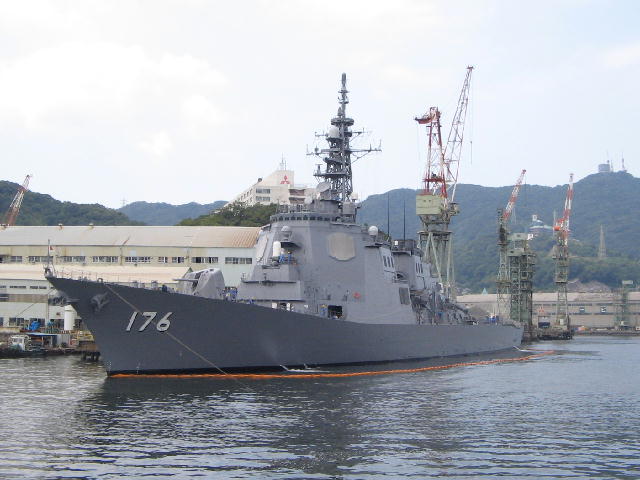
JS Chōkai docked on 28 September 2005
History
Japan
Name
  • Chōkai
  • (ちょうかい)
NamesakeMount Chōkai
Ordered1993
BuilderIHI Corporation
Laid down29 May 1995
Launched27 August 1996
Commissioned20 March 1998
Home portSasebo
Identification
StatusActive
General characteristics
Class & typeKongō-class destroyer
Displacement
  • 7500 tons standard
  • 9500 tons full load
Length528.2 ft (161.0 m)
Beam68.9 ft (21.0 m)
Draft20.3 ft (6.2 m)
Propulsion
Speed30 knots (56 km/h)
Range
  • 4,500 nautical miles at 20 knots
  • (8,334 km at 37 km/h)
Complement300
Sensors &
processing systems
  • AN/SPY-1D
  • OPS-28 surface search radar
  • OQS-102 bow mounted sonar
Electronic warfare
& decoys
NOLQ-2 intercept / jammer
Armament
Aircraft carried1 × SH-60K helicopter

JS Chōkai (DDG-176) is a Kongō-class guided missile destroyer in the Japan Maritime Self-Defense Force (JMSDF). Chōkai was named after Mount Chōkai. She was laid down by IHI Corporation in Tokyo on 29 May 1995 and was launched on 27 August 1996. Commissioning happened on March 20, 1998.

Service

[edit]

Following her commissioning in March 1998, she was dispatched to Hawaii for the Aegis System Equipment Qualification Test (SQT) until November 4, 1998

From May 16 to August 3, 2001, she participated in US dispatch training with the destroyers Hiei and Samidare.

Chōkai, along with the destroyer Ōnami and supply ship Hamana were assigned to the Indian Ocean in November 2004 to provide assistance to the Japanese Iraq Reconstruction and Support Group. She returned to Japan in March 2005.

From May 16 to August 1, 2007, she participated in US dispatch training with the destroyers Kurama and Inazuma.

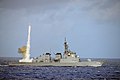
From 9 September 2008 to December 8, 2008, she participated in ballistic missile defense tests for equipment certification, during which an interception from her RIM-161 Standard Missile 3 failed due to a malfunction of the warhead's orbit and attitude control system.

This ship was one of several in the JMSDF fleet participating in disaster relief after the 2011 Tōhoku earthquake and tsunami.[1]

In 2012, Chōkai, along with Kongō and Myōkō were deployed in cooperation with the US Navy in preparation for the Democratic Republic of Korea to test the Kwangmyŏngsŏng-3 Unit 2. However, the ships were withdrawn after the satellite did not violate Japanese airspace.[2]

From June 7 to August 23, 2016, she participated in the biannual Exercise RIMPAC, conducted in the sea and airspace around Hawaii and the United States West Coast, accompanied by the helicopter carrier Hyūga.[3]

In 2019, Chōkai participated in the Malabar naval exercise. She represented the JMSDF along with the Kaga, Samidare and a Kawasaki P-1. During this exercise, she took part in combat training, anti-submarine warfare training, naval gunnery training, anti-aircraft training, as well as offshore supply training.[4]

Later in 2019, between October 15 and 17, Chōkai, along with the destroyer Shimakaze took part in the Canadian and Japanese joint exercise known as KAEDEX19-2 near Yokosuka, working alongside HMCS Ottawa.[5]

As of April 2020, Chōkai is based in Sasebo.

According to a press conference, Chōkai will be Tomahawk-missile capable by March 2026.[6]

[edit]

Notes

[edit]
[edit]
Revisions and contributorsEdit on WikipediaRead on Wikipedia
from Grokipedia
JS Chōkai (DDG-176) is a Kongō-class guided-missile destroyer commissioned in 1998 and operated by the Japan Maritime Self-Defense Force (JMSDF), featuring the Aegis combat system for integrated air defense and ballistic missile defense (BMD) operations.[1][2] With a displacement of approximately 9,500 tonnes at full load and a maximum speed of 30 knots, it is armed with vertical launch systems for Standard Missile-2 (SM-2) and SM-3 interceptors, enabling sea-based BMD against short- and intermediate-range ballistic threats.[2][3] Named after Mount Chōkai in northern Japan, the vessel has conducted successful BMD flight tests, including intercepts using SM-3 missiles, and participated in trilateral exercises with the United States and Republic of Korea to enhance regional missile defense coordination.[4][5] In 2025, JS Chōkai deployed to San Diego for a year-long program to integrate U.S.-sourced Tomahawk land-attack cruise missiles, positioning it as the first JMSDF destroyer with long-range strike capability by March 2026 and reflecting Japan's evolving defense posture amid regional threats.[6][7] This upgrade expands its role beyond defensive intercepts to potential counterstrike missions, supported by modifications to its Aegis system and vertical launchers.[6]

Design and Construction

Class Background and Specifications

The Kongō-class destroyers originated from Japan's efforts in the late 1980s to acquire advanced Aegis-equipped warships, marking the Japan Maritime Self-Defense Force's (JMSDF) entry into integrated air and missile defense capabilities. Drawing adaptations from the U.S. Navy's Arleigh Burke-class design, including a vertical mast and streamlined superstructure, the class was tailored for enhanced anti-air warfare to protect Japanese airspace and escort naval task forces against aerial threats.[2][8] This development responded to evolving regional security needs, prioritizing radar superiority and rapid missile response over traditional anti-submarine focus in earlier JMSDF vessels.[9] JS Chōkai (DDG-176), the fourth and final unit of the Kongō class, derives its name from Mount Chōkai, a stratovolcano in northern Japan emblematic of enduring presence and vigilance, aligning with JMSDF naming conventions for geographic features symbolizing steadfast defense. Constructed by IHI Corporation, Chōkai completed the series initiated with JS Kongō in 1993, solidifying Japan's Aegis fleet foundation without aviation facilities to maximize vertical launch system integration for surface and air defense roles.[10][11] Key physical specifications include a length of 161 meters, beam of 21 meters, and draft of 6.2 meters, with a standard displacement of approximately 7,250 tons and full load of 9,500 tons. Propulsion consists of four General Electric LM2500-30 gas turbines producing 100,000 shaft horsepower, achieving speeds exceeding 30 knots, while the crew numbers around 300. This configuration emphasizes multi-mission versatility, forgoing a permanent helicopter hangar in favor of expanded missile storage and deck operations for embarked aircraft.[10][2]

Building and Commissioning

The keel of JS Chōkai (DDG-176) was laid down by Ishikawajima-Harima Heavy Industries (IHI) at its shipyard in Tokyo on 29 May 1995, as the final unit in the Kongō-class series of Aegis-equipped guided missile destroyers constructed for the Japan Maritime Self-Defense Force (JMSDF).[1] The vessel was launched on 28 August 1996, initiating the outfitting phase that included installation and integration of the baseline Aegis combat system tailored for Japanese requirements, along with vertical launch systems and propulsion components.[1] [2] Following launch, Chōkai underwent extensive fitting-out and builder's trials at IHI's facilities, focusing on verifying the interoperability of the ship's gas turbine propulsion—comprising four General Electric LM2500 units providing 100,000 shaft horsepower—and initial sensor arrays before transfer to JMSDF oversight.[2] The destroyer was formally commissioned into JMSDF service on 27 March 1998, completing the four-ship Kongō class and enhancing Japan's surface fleet with advanced air defense capabilities derived from U.S. Aegis technology licensed for domestic production.[1] Post-commissioning, Chōkai conducted shakedown cruises to validate propulsion reliability, maneuverability, and basic radar and sonar functionality under operational conditions, prior to achieving full combat systems readiness.[2] These trials included deployment to Hawaiian waters for Aegis System Equipment Qualification Testing (SQT), a critical evaluation of missile guidance and tracking integration that extended through early November 1998, confirming the ship's baseline performance ahead of assignment to the JMSDF Fleet Escort Force.[2]

Operational History

Early Service and Routine Operations (1998–2000s)

Following its commissioning in 1998, JS Chōkai integrated into the Japan Maritime Self-Defense Force fleet, undertaking initial training and operational evaluations to establish proficiency in fleet defense roles and anti-submarine warfare tactics. Assigned primarily to operations from Yokosuka, the destroyer focused on baseline missions supporting maritime security in the Western Pacific, including participation in annual JMSDF fleet reviews that showcased naval assets and capabilities.[10]) JS Chōkai conducted routine patrols in the Sea of Japan and East China Sea, contributing to regional vigilance heightened by North Korea's Taepodong-1 missile test on August 31, 1998, which prompted increased JMSDF monitoring activities without escalating to specialized defense postures. These patrols emphasized standard surveillance and presence operations to deter potential threats and maintain sea lane security. Concurrently, the ship engaged in bilateral drills with the U.S. Navy, fostering interoperability through joint maneuvers in the Western Pacific. A notable instance occurred on December 10, 2002, when JS Chōkai performed replenishment at sea alongside USS Kitty Hawk, demonstrating logistical coordination essential for combined task force operations.[12] Early maintenance cycles in the late 1990s and 2000s addressed initial integration challenges with the Aegis combat system, including software refinements to ensure reliable performance during routine exercises and patrols. These refits were typical for newly introduced Aegis-equipped vessels, prioritizing system stability for sustained operational readiness without major disruptions.[13]

Ballistic Missile Defense and Multilateral Exercises (2000s–2010s)

In the mid-2000s, JS Chōkai received upgrades to its Aegis Weapon System, integrating ballistic missile defense (BMD) functionality that allowed for the firing of RIM-161 Standard Missile-3 (SM-3) interceptors against short- to intermediate-range ballistic threats.[14][15] This retrofit, approved by the U.S. Defense Security Cooperation Agency in June 2007, made Chōkai the second Kongō-class destroyer equipped for sea-based BMD operations within the U.S.-Japan cooperative framework.[15][16] The enhancements included software modifications to Aegis baseline 3.6.1, enabling midcourse interception capabilities focused on regional threats, primarily from North Korea.[16] On November 19, 2008, Chōkai conducted a joint U.S.-Japan BMD flight test (JFTM-2) from the Pacific Missile Range Facility off Hawaii, launching an SM-3 Block IA against an air-launched ballistic missile target simulating a medium-range threat.[17][4] The missile launch and initial flight phases performed nominally, but the intercept failed due to a guidance anomaly in the final seconds, marking the sole unsuccessful BMD test among Japan's four upgraded Aegis destroyers at the time.[4][12] This event underscored Chōkai's role in validating the system's reliability, despite the outcome, and contributed to iterative improvements in Japan's layered defense posture.[12] Throughout the 2000s and 2010s, Chōkai supported deployments for ballistic missile monitoring, particularly in response to North Korean launches, operating alongside U.S. forces to track and assess trajectories using its SPY-1D radar.[16] The destroyer participated in multilateral exercises such as RIMPAC and ANNUALEX, including formations with U.S. and allied navies to practice integrated air and missile defense scenarios./CHIPS/ArticleDetails.aspx?ID=8193)[18] These operations emphasized interoperability, with Chōkai demonstrating coordinated tracking and engagement procedures against simulated hypersonic and ballistic threats in layered defense architectures./CHIPS/ArticleDetails.aspx?ID=8193) In the 2010s, Chōkai contributed to Japan Maritime Self-Defense Force efforts in verifying compliance with UN sanctions through maritime patrols, focusing on potential ship-to-ship transfers related to prohibited cargo.[19]

Recent Deployments and Modernization Efforts (2020s)

In September 2025, JS Chōkai conducted preparatory training for Tomahawk cruise missile integration as part of Japan's evolving counterstrike posture. On September 26, the destroyer performed a mock loading drill using dummy Tomahawk munitions at Yokosuka Naval Base, with assistance from U.S. Navy personnel to simulate handling and integration procedures.[20][21] The vessel then embarked on a year-long deployment to San Diego, California, departing Yokosuka on September 26, 2025, and expected to conclude in mid-September 2026. This assignment involves hardware modifications to its Aegis weapon system and intensive crew training to support Tomahawk Block V launches from vertical launch system cells previously dedicated to defensive missiles.[7][22] As the inaugural platform among eight planned JMSDF Aegis destroyers, Chōkai's upgrades align with Japan's January 2024 agreement to procure 400 Tomahawk missiles (including Block IV and V variants) from the United States, enabling standoff strike capabilities. U.S. and Japanese officials anticipate the destroyer achieving initial operational readiness, potentially including live-fire tests, by March 31, 2026, pending successful modifications and certification.[6][23]

Armament, Sensors, and Capabilities

Weapons Systems

The primary armament of JS Chōkai consists of 90 Mk 41 Vertical Launch System (VLS) cells configured for strike-length missiles, enabling a flexible loadout for multi-role operations. These cells accommodate RIM-66 SM-2MR Block IIIA/IV surface-to-air missiles for medium-range air defense, RIM-161 SM-3 Block IA for ballistic missile defense intercepts in the midcourse phase, and RUM-139 VL-ASROC anti-submarine rockets for standoff submarine engagement.[20] The VLS setup emphasizes area air and missile defense, with SM-3 providing exo-atmospheric interception capability against short- and medium-range ballistic threats, as demonstrated in live firings.[24] Surface strike and close-in defense are handled by eight RGM-84 Harpoon anti-ship missiles launched from two quadruple canister mounts, capable of engaging enemy vessels at ranges exceeding 120 kilometers. The ship mounts a single 127 mm Mk 45 Mod 4 naval gun for surface gunfire support and anti-surface warfare, supplemented by two triple-tube torpedo launchers firing Mk 46 lightweight torpedoes for anti-submarine warfare.[24] Two Phalanx 20 mm Close-In Weapon Systems provide last-line defense against incoming missiles and aircraft.[24] Ammunition capacities support extended Pacific patrols, with the 90 VLS cells allowing sustained missile engagements without immediate replenishment, though reloads typically occur in port due to the system's design.[20] JS Chōkai lacks dedicated anti-ship ballistic missiles, relying instead on Harpoon for kinetic surface effects, prioritizing defensive postures in contested maritime environments.

Electronic Systems and Aegis Integration

The JS Chōkai employs the AN/SPY-1D multi-function phased-array radar as its primary sensor for air and surface surveillance, offering 360-degree coverage with the capacity to detect and track over 200 targets simultaneously at ranges exceeding 250 nautical miles.[2][9] This radar operates in the E/F-bands and integrates seamlessly with the ship's Aegis Combat System, which functions as the core command-and-control architecture for networked warfare, processing sensor data to enable real-time threat assessment and coordinated responses across allied platforms.[21][6] The Aegis system on Chōkai utilizes Baseline 5, an evolution from earlier configurations such as Baseline 3.5, incorporating Japan-specific enhancements like J3, J5, and J7 for improved ballistic missile defense tracking and cooperative engagement capabilities without altering the fundamental radar hardware.[24][25] These upgrades facilitate integration with external sensors and effectors, prioritizing detection fidelity in high-threat density scenarios over standalone firing control.[26] For underwater threat detection, Chōkai is fitted with the OQS-102 bow-mounted low-frequency sonar, optimized for active and passive anti-submarine warfare operations, alongside a towed array sonar that extends detection ranges against submerged targets.[2] The OYQ-series combat data subsystem interfaces these acoustic sensors with the Aegis framework, fusing sonar inputs for comprehensive situational awareness in layered defense postures.[2] Electronic warfare capabilities include the NOLQ-2 suite for signal interception, direction finding, and jamming, enhancing survivability by disrupting incoming threats and supporting decoy deployment protocols.[2] Towed torpedo countermeasures provide active deception against acoustic homing weapons, while the overall system draws on the ship's four LM2500 gas turbine generators to deliver the sustained electrical power—approximately 6 MW total—and liquid cooling essential for uninterrupted radar and processor performance amid electronic countermeasures in contested littoral environments.[2][8]

Planned and Ongoing Upgrades

In September 2025, JS Chōkai departed Yokosuka for a year-long deployment to the United States, marking the first such effort to integrate U.S.-sourced Tomahawk Block V cruise missiles into a Japan Maritime Self-Defense Force (JMSDF) surface combatant.[6][20] The deployment, scheduled to conclude in mid-September 2026, involves hardware modifications to the ship's Mk 41 vertical launch system (VLS) for compatibility with the missile's dimensions and fire control requirements, alongside intensive crew training at U.S. Navy facilities in San Diego.[24][22] Prior to departure, the crew conducted exercises with inert Tomahawk rounds at Yokosuka on September 25, 2025, simulating launch sequences.[27] The upgrades enable Chōkai to achieve initial operational capability for Tomahawk launches by March 31, 2026, with live-fire validation tests planned for summer 2026 in U.S. waters.[6][28] This adaptation leverages the Aegis combat system's existing software baselines, which support networked fire control for precision strikes up to 1,000 miles, while ensuring interoperability with U.S. forces via link-16 data sharing for cooperative target designation.[27][21] Upon return, the destroyer will feature certified personnel and updated VLS configurations, paving the way for fleet-wide rollout to Japan's eight Aegis-equipped vessels by 2027.[29][26] Ongoing enhancements to Chōkai's Aegis Baseline 5.0 configuration continue to refine ballistic missile defense (BMD) capabilities, building on prior SM-3 Block IA intercepts—such as the successful 2008 firing that neutralized a target at over 100 miles altitude—to validate progressive software updates for simultaneous threat tracking and engagement with U.S. assets.[30] These modifications prioritize seamless data fusion in joint operations, without altering core sensor arrays.[27]

Strategic Role and Assessments

Contributions to Regional Security

JS Chōkai primarily contributes to Japan's regional security by defending vital sea lanes of communication and safeguarding the archipelago against ballistic missile threats from North Korea. As an Aegis-equipped destroyer, it performs BMD patrols in waters proximate to the Korean Peninsula, maintaining 24/7 surveillance and intercept readiness against IRBMs, including demonstrations of capability through SM-3 launches.[31][24] Its operational posture directly supports deterrence by ensuring rapid response to launches, as evidenced by heightened alert statuses during North Korean tests.[32] The destroyer's presence in the East China Sea bolsters stability by providing credible escalation control against potential Chinese incursions near the Senkaku Islands, where its advanced sensors and vertical launch systems enable monitoring and threat neutralization without reliance on external forces. This internal JMSDF capability deters adventurism through demonstrated reliability, with Chōkai sustaining high operational availability since its 1998 commissioning, underscoring the Kongō-class's proven endurance in extended patrols.[33][11] Under Japan's 2015 security legislation, which authorizes proactive Self-Defense Forces engagement to neutralize imminent threats, Chōkai has transitioned to active defense roles, permitting preemptive missile intercepts and enhancing overall threat response efficacy. Ongoing modifications, including integration of Tomahawk cruise missiles by March 2026, further amplify its deterrent value by adding precision strike options against missile launch sites.[34][6] This evolution reflects empirical adaptations to escalating missile proliferation, with the ship's exercise successes in simulated salvo engagements validating its contributions to regional balance.[35]

International Partnerships and Interoperability

The JS Chōkai exemplifies the core U.S.-Japan alliance through Aegis BMD architecture integration, where shared sensor and engagement capabilities enable coordinated defense against ballistic threats. In November 2008, during the Japan Flight Test Mission-2 (JFTM-2), Chōkai detected, tracked, and fired an SM-3 missile to intercept a separating ballistic missile target launched from the Pacific Missile Range Facility, demonstrating successful joint fire control solution development with U.S. oversight.[36] This event built on prior tests like JFTM-1 with JS Kongō, affirming doctrinal alignment in layered missile defense. Recent interoperability extends to offensive capabilities via U.S.-Japan pacts for Tomahawk cruise missile acquisition. In September 2025, Chōkai departed Yokosuka for a year-long U.S. deployment to San Diego, encompassing vertical launch system modifications, crew training on mock munitions initiated September 25, and operational firing preparation, with full capability targeted by March 2026.[7][6] U.S. Navy training, which began for JMSDF personnel in March 2024, supports this integration on Chōkai as the initial platform among eight Aegis-equipped destroyers.[20] Bilateral exercises such as Keen Sword have validated Chōkai's role in multinational scenarios, including post-exercise formations with USS Mustin and JS Ariake in the East China Sea following Keen Sword preparations in November 2012. These drills emphasize tactical deconfliction via compatible data links like Link-16, standard across U.S. and JMSDF Aegis platforms for real-time threat sharing in the Pacific.[37] Trilateral engagements with the Republic of Korea Navy, as in Pacific Dragon BMD tracking events, further test Chōkai-class contributions to Indo-Pacific stability, though specific ship participation varies.[38] U.S. forward basing facilitates Chōkai's logistical sustainment, as evidenced by the 2025 deployment leveraging San Diego facilities for upgrades and reducing risks in extended JMSDF operations.[22] This arrangement enhances operational endurance without sole reliance on Japanese infrastructure, aligning with alliance sustainment protocols.[25]

Policy Debates and Capability Evaluations

The planned integration of Tomahawk cruise missiles on JS Chōkai, with crew training using mock rounds initiated in 2025 and operational readiness targeted for 2026, addresses gaps in standoff strike range amid threats from North Korea's nuclear-armed missiles and China's DF-17 hypersonic glide vehicles, publicly fielded in October 2019.[39] [40] [41] Proponents of this capability enhancement cite empirical deterrence effects from Chōkai's forward deployments, where Aegis surveillance and BMD patrols signal credible denial of aggression, correlating with reduced provocation incidents in monitored zones per JMSDF operational data.[42] Pacifist critiques, rooted in Article 9's renunciation of war potential, argue that arming Aegis destroyers like Chōkai with offensive munitions shifts Japan toward preemptive postures, risking escalation in an arms race fueled by regional dynamics.[43] [44] These views, often amplified in left-leaning outlets framing such moves as revived militarism, face rebuttals from realist analyses highlighting China's and North Korea's combined arsenal exceeding 800 Japan-reachable ballistic missiles, necessitating adaptive countermeasures over rigid constitutional literalism.[40] [45] Evaluations of Chōkai's BMD role underscore SM-3 intercept success rates of 82% in controlled tests, validating cost-benefit ratios for Aegis upgrades despite opportunity costs versus indigenous hypersonic defenses.[46] Right-leaning assessments prioritize sovereignty gains from interoperability with U.S. systems, while broader debates weigh fiscal trade-offs against proliferation timelines, with no evidence that defensive enhancements alone provoke adversaries absent underlying territorial aggressions.[47] [48]

References

User Avatar
No comments yet.