



Community hub
Recent from talks
Knowledge base stats:
Talk channels stats:
Members stats:
Jack the Ripper Stalks His Victims
Jack the Ripper Stalks His Victims is the first collection by British designer Alexander McQueen, produced as the thesis collection for his master's degree in fashion at Central Saint Martins (CSM) art school.
The collection's narrative was inspired by the victims of 19th-century London serial killer Jack the Ripper, with aesthetic inspiration from the fashion, erotica, and prostitution practices of the Victorian era. The collection was presented on the runway at London Fashion Week on 16 March 1992, as the second-to-last of the CSM graduate collections. Editor Isabella Blow was fascinated by the runway show and insisted on purchasing the entire collection, later becoming McQueen's friend and muse.
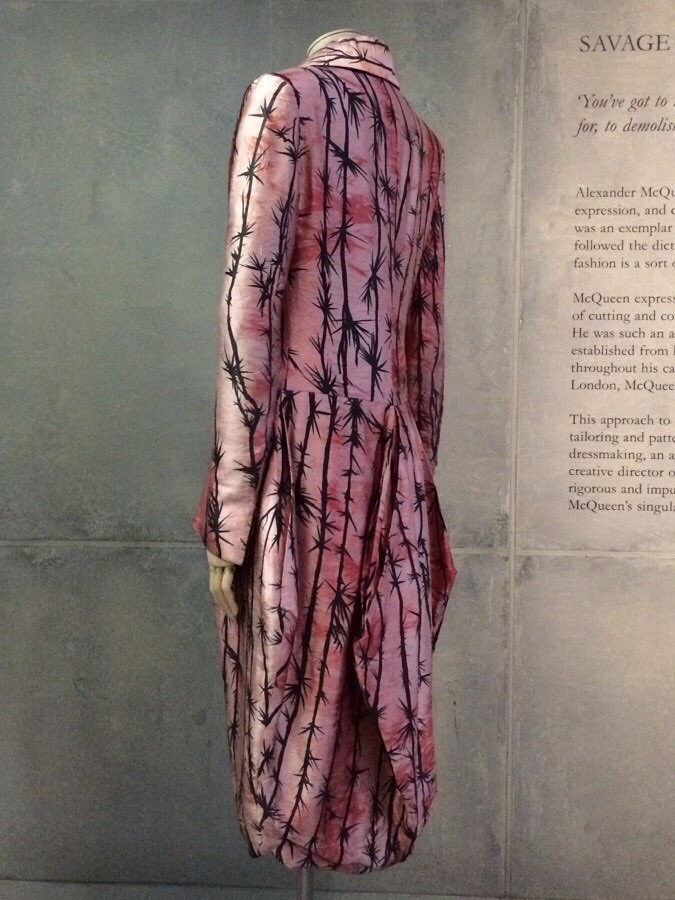
Jack the Ripper remains an object of critical analysis for its violent concept and styling. McQueen held on to the narrative and aesthetic tendencies he established in Jack the Ripper throughout his career, earning a reputation for producing narratively-driven collections inspired by macabre aspects of history, art, and his own life. Items from Jack the Ripper, including a pink frock coat with a thorn print, have appeared in the retrospectives Alexander McQueen: Savage Beauty (2011 and 2015) and Isabella Blow: Fashion Galore! (2013).
British designer Alexander McQueen (born Lee Alexander McQueen; 1969–2010) was known in the fashion industry for his imaginative, sometimes controversial, designs and dramatic fashion shows. McQueen had a lifelong fascination with history, sexuality, violence, and death, which he translated into his designs from the beginning of his nearly twenty-year career to the very end. McQueen's work was highly autobiographical: he incorporated elements of his memories, feelings, and family history into his designs and runway shows. In his early career, McQueen was often accused of misogyny for his extreme designs, a characterisation to which he consistently objected.
The son of a London taxicab driver and a teacher, McQueen grew up in one of the poorer neighbourhoods in London's East End. His upbringing was traumatic: he was a victim of childhood sexual abuse and witnessed his sisters experiencing domestic violence from their partners. He began his career in fashion in 1984 as an apprentice with Savile Row tailors Anderson & Sheppard before briefly joining Gieves & Hawkes as a pattern cutter. His work on Savile Row earned him a reputation as an expert tailor. McQueen left Savile Row in 1988, and spent the next two years in various entry-level positions in fashion. He worked briefly for the theatrical costumiers Angels and Bermans. In 1989, at the age of 20, he was hired by experimental Mayfair-based designer Koji Tatsuno. He next worked under designer John McKitterick, gaining experience with fetishwear; first at Red or Dead, then at McKitterick's own label.
McQueen sought further experience in the industry, and McKitterick recommended he try for an apprenticeship in Italy, then the centre of the fashion world. From March to July 1990, McQueen worked in Milan at the atelier of designer Romeo Gigli. After resigning, he returned to McKitterick's label in London by August. When McQueen expressed interest in learning more about the fashion industry, McKitterick suggested he see Bobby Hillson, the founder and head of the masters course in fashion at London art school Central Saint Martins (CSM).
McQueen turned up at CSM with a pile of sample clothing and no appointment, seeking a job teaching pattern cutting. Hillson considered him too young for this, but based on the strength of his portfolio – and despite his lack of formal qualifications – accepted McQueen into the eighteen-month masters-level fashion design course. Unable to afford the tuition, he borrowed £4000 from his aunt Renee to cover it. McQueen met a number of his future collaborators at CSM, including Simon Ungless, a friend and later roommate.
CSM students at the master's level were expected to produce a graduation collection of at least six outfits as their thesis. McQueen told Hillson that he intended to present clothing that was distressed and stained, so the models would look like survivors of a violent attack. Although Hillson was dubious about the idea, she agreed to mentor him. Among other things, this meant quietly providing him with quality fabric from the CSM stores. He could not afford to buy his own, and lower-quality fabric would not have withstood the level of distressing McQueen was applying.
Hub AI
Jack the Ripper Stalks His Victims AI simulator
(@Jack the Ripper Stalks His Victims_simulator)
Jack the Ripper Stalks His Victims
Jack the Ripper Stalks His Victims is the first collection by British designer Alexander McQueen, produced as the thesis collection for his master's degree in fashion at Central Saint Martins (CSM) art school.
The collection's narrative was inspired by the victims of 19th-century London serial killer Jack the Ripper, with aesthetic inspiration from the fashion, erotica, and prostitution practices of the Victorian era. The collection was presented on the runway at London Fashion Week on 16 March 1992, as the second-to-last of the CSM graduate collections. Editor Isabella Blow was fascinated by the runway show and insisted on purchasing the entire collection, later becoming McQueen's friend and muse.
Jack the Ripper remains an object of critical analysis for its violent concept and styling. McQueen held on to the narrative and aesthetic tendencies he established in Jack the Ripper throughout his career, earning a reputation for producing narratively-driven collections inspired by macabre aspects of history, art, and his own life. Items from Jack the Ripper, including a pink frock coat with a thorn print, have appeared in the retrospectives Alexander McQueen: Savage Beauty (2011 and 2015) and Isabella Blow: Fashion Galore! (2013).
British designer Alexander McQueen (born Lee Alexander McQueen; 1969–2010) was known in the fashion industry for his imaginative, sometimes controversial, designs and dramatic fashion shows. McQueen had a lifelong fascination with history, sexuality, violence, and death, which he translated into his designs from the beginning of his nearly twenty-year career to the very end. McQueen's work was highly autobiographical: he incorporated elements of his memories, feelings, and family history into his designs and runway shows. In his early career, McQueen was often accused of misogyny for his extreme designs, a characterisation to which he consistently objected.
The son of a London taxicab driver and a teacher, McQueen grew up in one of the poorer neighbourhoods in London's East End. His upbringing was traumatic: he was a victim of childhood sexual abuse and witnessed his sisters experiencing domestic violence from their partners. He began his career in fashion in 1984 as an apprentice with Savile Row tailors Anderson & Sheppard before briefly joining Gieves & Hawkes as a pattern cutter. His work on Savile Row earned him a reputation as an expert tailor. McQueen left Savile Row in 1988, and spent the next two years in various entry-level positions in fashion. He worked briefly for the theatrical costumiers Angels and Bermans. In 1989, at the age of 20, he was hired by experimental Mayfair-based designer Koji Tatsuno. He next worked under designer John McKitterick, gaining experience with fetishwear; first at Red or Dead, then at McKitterick's own label.
McQueen sought further experience in the industry, and McKitterick recommended he try for an apprenticeship in Italy, then the centre of the fashion world. From March to July 1990, McQueen worked in Milan at the atelier of designer Romeo Gigli. After resigning, he returned to McKitterick's label in London by August. When McQueen expressed interest in learning more about the fashion industry, McKitterick suggested he see Bobby Hillson, the founder and head of the masters course in fashion at London art school Central Saint Martins (CSM).
McQueen turned up at CSM with a pile of sample clothing and no appointment, seeking a job teaching pattern cutting. Hillson considered him too young for this, but based on the strength of his portfolio – and despite his lack of formal qualifications – accepted McQueen into the eighteen-month masters-level fashion design course. Unable to afford the tuition, he borrowed £4000 from his aunt Renee to cover it. McQueen met a number of his future collaborators at CSM, including Simon Ungless, a friend and later roommate.
CSM students at the master's level were expected to produce a graduation collection of at least six outfits as their thesis. McQueen told Hillson that he intended to present clothing that was distressed and stained, so the models would look like survivors of a violent attack. Although Hillson was dubious about the idea, she agreed to mentor him. Among other things, this meant quietly providing him with quality fabric from the CSM stores. He could not afford to buy his own, and lower-quality fabric would not have withstood the level of distressing McQueen was applying.