
Recent from talks
Frock coat
Knowledge base stats:
Talk channels stats:
Members stats:
Frock coat
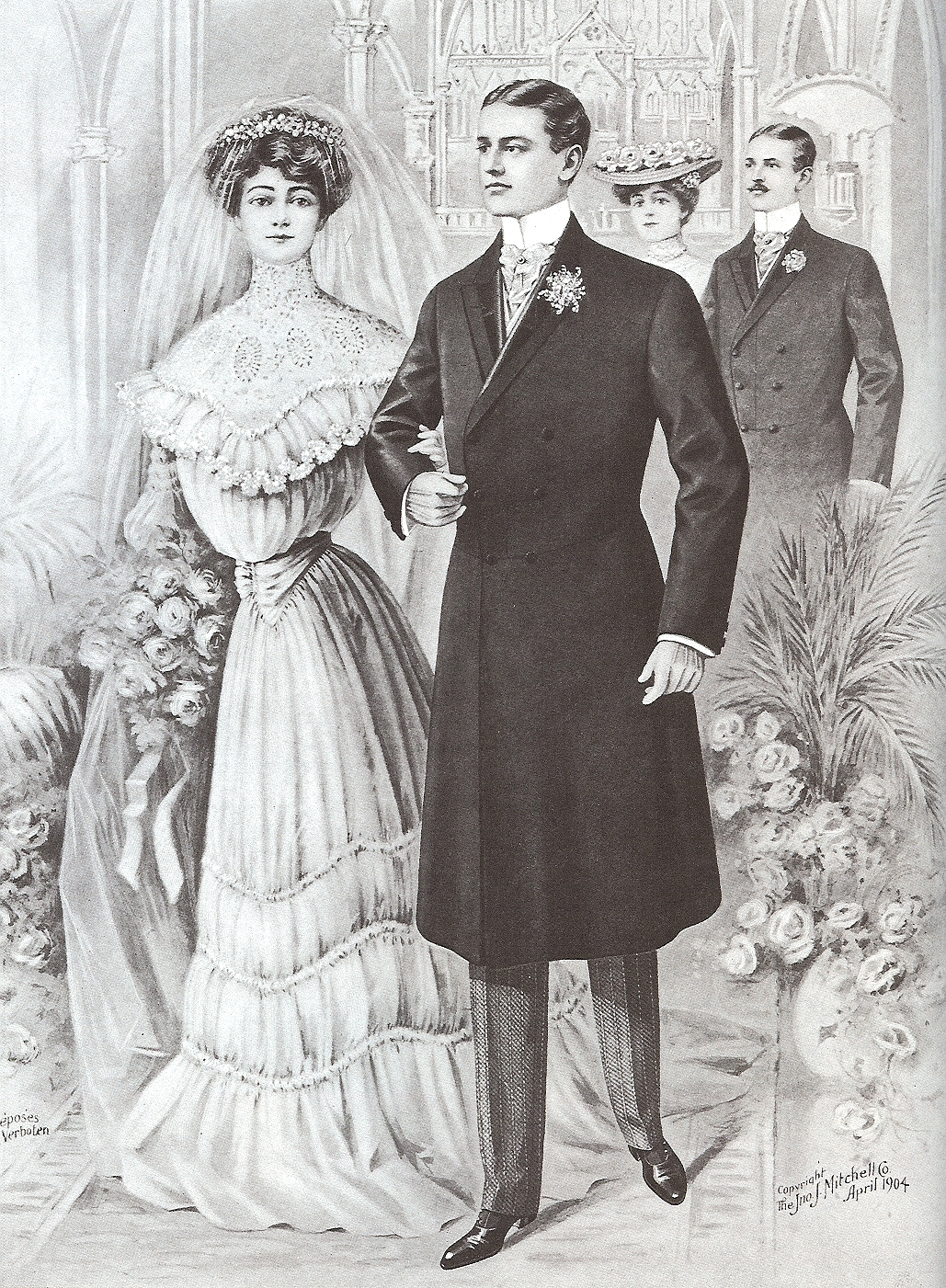
A frock coat is a formal men's coat characterised by a knee-length skirt cut all around the base just above the knee, popular during the Victorian and Edwardian periods (1830s–1910s). It is a fitted, long-sleeved coat with a centre vent at the back and some features unusual in post-Victorian dress. These include the reverse collar and lapels, where the outer edge of the lapel is often cut from a separate piece of cloth from the main body and also a high degree of waist suppression around the waistcoat, where the coat's diameter around the waist is less than around the chest. This is achieved by a high horizontal waist seam with side bodies, which are extra panels of fabric above the waist used to pull in the naturally cylindrical drape. As was usual with all coats in the 19th century, shoulder padding was rare or minimal.
In the Age of Revolution around the end of the 18th century, men abandoned the justaucorps with tricorne hats for the directoire style: dress coat with breeches or increasingly pantaloons, and top hats. However, by the 1820s, the frock coat was introduced along with full-length trousers (pants), perhaps inspired by the then casual country leisure wear frock. Early frock coats inherited the higher collars and voluminous lapels of the dress coat style at the time, and were sometimes offered in different, albeit increasingly dark, colours. Within a few years, though, plain black soon became the only established practice, and with a moderate collar. The top hat followed suit.
Although black trousers did occur, especially at daytime, the black frock coat was commonly worn with charcoal grey, pin-striped or checked formal trousers. The single-breasted frock coat sporting the notched (step) lapel was more associated with day-to-day professional informal wear. Yet, from the end of the 19th century, with the gradual introduction of the lounge suit, the frock coat came to embody the most formal wear for daytime. Especially so when double-breasted with peaked lapels, a style sometimes called a Prince Albert after Prince Albert, consort to Queen Victoria. The formal frock coat only buttoned down to the waist seam, which was decorated at the back with a pair of buttons. The cassock, a coat that is buttoned up to the neck, forming a high, stand-up Roman style collar for clergymen, was harmonized to the style of the contemporary frock coat.
By the late 19th century, the knee-length dress coat, morning coat, and shorter-cut lounge suit were all standardized. While the dress coat and the morning coat are knee-length coats like the frock coat and traditionally share the waist seam of the precursor, they are distinguished by the cutaway of the skirt which gives dress coats and morning coats tails at the back. From the 1920s, the frock coat was increasingly replaced as day formal wear by the cut-away morning coat. In 1936, it was suspended from the protocol of audiences at the British royal court. While effectively relegated to a rarity in formal wear ever since, it does occur in certain formal marriages and traditional processions.
The name frock coat appeared out from the earlier frock.
Earlier terminology also used redingote (or redingotte, redingot), derived from a French alteration of the English "riding coat", an example of re-borrowing.
Frock coats emerged during the Napoleonic Wars, where they were worn by officers in the Austrian and various German armies during campaign. They efficiently kept the wearer warm as well as protecting his uniform. Privates and non-commissioned officers would wear greatcoats on campaign.
During the mid-17th century, the older doublets, ruffs, paned hose, and jerkins were replaced by the precursor to the three-piece suit, comprising waistcoat, tight breeches, and a long coat called a justacorps, topped by a powdered wig and tricorne hat. This coat, popularized by Louis XIII of France and Charles II of England, was knee-length and looser fitting than the later frock coat, with turn-back cuffs and two rows of buttons. English and French noblemen often wore expensive brocade coats decorated with velvet, gold braid, embroidery, and gold buttons to demonstrate their wealth.
Hub AI
Frock coat AI simulator
(@Frock coat_simulator)
Frock coat
A frock coat is a formal men's coat characterised by a knee-length skirt cut all around the base just above the knee, popular during the Victorian and Edwardian periods (1830s–1910s). It is a fitted, long-sleeved coat with a centre vent at the back and some features unusual in post-Victorian dress. These include the reverse collar and lapels, where the outer edge of the lapel is often cut from a separate piece of cloth from the main body and also a high degree of waist suppression around the waistcoat, where the coat's diameter around the waist is less than around the chest. This is achieved by a high horizontal waist seam with side bodies, which are extra panels of fabric above the waist used to pull in the naturally cylindrical drape. As was usual with all coats in the 19th century, shoulder padding was rare or minimal.
In the Age of Revolution around the end of the 18th century, men abandoned the justaucorps with tricorne hats for the directoire style: dress coat with breeches or increasingly pantaloons, and top hats. However, by the 1820s, the frock coat was introduced along with full-length trousers (pants), perhaps inspired by the then casual country leisure wear frock. Early frock coats inherited the higher collars and voluminous lapels of the dress coat style at the time, and were sometimes offered in different, albeit increasingly dark, colours. Within a few years, though, plain black soon became the only established practice, and with a moderate collar. The top hat followed suit.
Although black trousers did occur, especially at daytime, the black frock coat was commonly worn with charcoal grey, pin-striped or checked formal trousers. The single-breasted frock coat sporting the notched (step) lapel was more associated with day-to-day professional informal wear. Yet, from the end of the 19th century, with the gradual introduction of the lounge suit, the frock coat came to embody the most formal wear for daytime. Especially so when double-breasted with peaked lapels, a style sometimes called a Prince Albert after Prince Albert, consort to Queen Victoria. The formal frock coat only buttoned down to the waist seam, which was decorated at the back with a pair of buttons. The cassock, a coat that is buttoned up to the neck, forming a high, stand-up Roman style collar for clergymen, was harmonized to the style of the contemporary frock coat.
By the late 19th century, the knee-length dress coat, morning coat, and shorter-cut lounge suit were all standardized. While the dress coat and the morning coat are knee-length coats like the frock coat and traditionally share the waist seam of the precursor, they are distinguished by the cutaway of the skirt which gives dress coats and morning coats tails at the back. From the 1920s, the frock coat was increasingly replaced as day formal wear by the cut-away morning coat. In 1936, it was suspended from the protocol of audiences at the British royal court. While effectively relegated to a rarity in formal wear ever since, it does occur in certain formal marriages and traditional processions.
The name frock coat appeared out from the earlier frock.
Earlier terminology also used redingote (or redingotte, redingot), derived from a French alteration of the English "riding coat", an example of re-borrowing.
Frock coats emerged during the Napoleonic Wars, where they were worn by officers in the Austrian and various German armies during campaign. They efficiently kept the wearer warm as well as protecting his uniform. Privates and non-commissioned officers would wear greatcoats on campaign.
During the mid-17th century, the older doublets, ruffs, paned hose, and jerkins were replaced by the precursor to the three-piece suit, comprising waistcoat, tight breeches, and a long coat called a justacorps, topped by a powdered wig and tricorne hat. This coat, popularized by Louis XIII of France and Charles II of England, was knee-length and looser fitting than the later frock coat, with turn-back cuffs and two rows of buttons. English and French noblemen often wore expensive brocade coats decorated with velvet, gold braid, embroidery, and gold buttons to demonstrate their wealth.
Recent media