Hubbry Logo
logo
Jacques Fath
Community hub

Jacques Fath

logo
0 subscribers
Read side by side
from Wikipedia

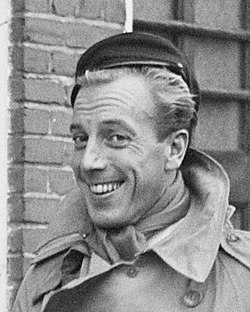
Fath in 1950
Fath with his wife Giovanna in 1950

Jacques Fath (6 September 1912 in Maisons-Laffitte, France – 13 November 1954 in Paris, France)[1][2] was a French fashion designer who was considered one of the three dominant influences on immediate postwar haute couture, the others being Christian Dior and Pierre Balmain.[3] The playwright Georges Fath was his great-grandfather.

Career

[edit]

The son of André Fath, an Alsatian-Flemish insurance agent, Fath came from a creative family. His paternal great-grandparents, Caroline and Georges Fath, were fashion illustrators and writers, and his paternal grandfather, Rene-Maurice Fath, was a landscape painter.[1]

Fath presented his first collection in 1937, working out of a two-room salon on Rue de la Boetie. The studio was later moved to a second location on Rue Francois Premier in 1940 before settling into a third location at 39 Avenue Pierre-ler-de-Serbie in 1944.[4] Among his models was Lucie Daouphars (1921 or 1922–1963), a.k.a. Lucky, a former welder who eventually became the top house model for Christian Dior.[5]

A self-taught designer who learned his craft from studying museum exhibitions and books about fashion, Fath hired a number of young designers as assistants and apprentices, some of which later went on to form their own houses, including Hubert de Givenchy, Guy Laroche,[6] and Valentino Garavani.[7]

A popular and occasionally innovative designer known for dressing "the chic young Parisienne", Fath utilized such materials as hemp sacking and sequins made of walnut and almond shells.[8] His 1950 collection was called Lily, and its skirts were shaped to resemble flowers. For eveningwear, he advocated velvet gowns. During World War II, Fath was known for "wide fluttering skirts" which, The New York Times explained, "he conceived for the benefit of women forced to ride bicycles during gasoline rationing". His clients included Ava Gardner, Greta Garbo, and Rita Hayworth, who wore a Fath dress for her wedding to Prince Aly Khan.

Jacques Fath also dressed Eva Perón. In one of the few remaining paintings of the 1940s and 1950s not destroyed by the Revolución Libertadora in 1955 (three years after Evita's death), when Perón was ousted from power, Evita is depicted beside General Perón wearing a white evening dress designed by Fath. This same dress is showcased beside the painting on a mannequin under a protected glass cover in the Museo del Bicentenario in Buenos Aires, Argentina.[9][10]

Fashion house

[edit]

Fath’s wife Genevieve ran the Fath house after Fath’s 1954 death from leukemia. She presented her first well-regarded collection for the fashion house in 1955, and worked with three of her husband's former associates: Catherine Brivet (who previously had worked for Paul Poiret, Jean Patou, Pierre Balmain, Coco Chanel, and Cristóbal Balenciaga); Pierrey Metthey; and Suzanne Renoult (a fabric expert who had worked for Lucien Lelong; Elsa Schiaparelli; and Gaston Worth). The haute couture division was closed in 1957.[1][2]

Key Information

After the company's haute couture operations ceased, it went into business producing perfumes, gloves, hosiery, and other accessories.

The house returned in 1992 with Fall ready-to-wear and resort collections under the creative direction of Tom van Lingen, it was owned by Altus Finance part of Credit Lyonnais.[11] In 1994 the brands sales rose to around USD$10 Million.[11]

The company was purchased by Groupe Emmanuelle Khanh in 1997 and Lingen was replaced by Elena Nazaroff.[12] A year later, Nazaroff was replaced by Octavio Pizarro.[2][13]

In 2001, Mounir Moufarrige and François Barthes (owner of EK Finances, known previously as Groupe Emmanuelle Khanh) started the France Luxury Group which Jacques Fath became a part of alongside the brands Emmanuelle Khanh, Jean-Louis Scherrer and Harel.[14][15] In February 2002 Lizzy Disney was appointed as the chief designer of Jacques Fath.[16][17] Alain Dumenil purchased a majority stake in the group in November 2002 and in December he purchased 100% of the company.[15] Disney and the firm parted ways in 2003.[18] In 2004 France Luxury Group was rebranded to Alliance Designers Group.[19] In 2007 started plans for a relaunch of Jacques Fath as an accessories line and appointed Laurence Dumenil as creative designer, the line launched in 2010 but soon closed.[20]

The fragrance license was held by L'Oréal from 1964 until 1992.[citation needed] Altus Finance purchased the perfume licenses in 1993.[11] In January 1998 Star Fragrance International acquired the perfume license.[21] In 2008 the Panouage Group acquired the perfume license and started making fragrances under the Jacques Fath name.[22]

In 2025 a Jacques Fath Parfums boutique opened on Paris' Avenue Victor-Hugo.[23]

The company has produced a number of scents, including Chasuble (1945), Iris Gris (1946), Green Water (1947), Canasta (1950), Fath de Fath (1953), Fath's Love (1968), Expression (1977), Pour L'Homme (1998), Yin (1999), Yang (1999), Red Shoes (2018). Green Water and Fath de Fath were reformulated and re-released in 1993.[citation needed] In 2018 Iris Gris was re-released as L'Iris de Fath.[24]

Marriage

[edit]

Fath, who has been described by Italian journalist Bonaventuro Calora as extremely effeminate and a former lover of the French film director Léonide Moguy, married, in 1939, Geneviève Boucher. The bride was a photographer's model who had been Coco Chanel's secretary. They had one son, Philippe (born 1943). According to Fath's friend Princess Giovanna Pignatelli Aragona Cortés, Geneviève Fath, who directed the business side of her husband's firm during his lifetime, was a lesbian.[25][26]

Geneviève Fath married, on 21 October 1967, a 27-year-old Turkish interior decorator, Kudret Ismaïl Talay, at Saint-Martin-des-Champs, in Yvelines, France.[27] They later divorced.

Film career

[edit]

Fath appeared in Scandal on the Champs-Élysées (1949, directed by Roger Blanc).

He designed costumes for several films:[28]

Military service

[edit]

Fath served as a gunner, second class,[clarification needed] in the French Army. He received the Croix de Guerre with silver star[1] and the Légion d'honneur. He also was held as a prisoner of war for a month,[29] and was discharged in August 1940.[1][30]

Death

[edit]

Fath died of leukemia on 13 November 1954,[1][2] which he'd been diagnosed in 1952.[30] Approximately 4,000 people attended his funeral at St. Pierre de Chaillot Church in Paris.

Documentary film

[edit]

Fath was the subject of a 1994 documentary film by Pascal Franck called Les Folies de Fath.[31]

References

[edit]
[edit]
Revisions and contributorsEdit on WikipediaRead on Wikipedia
from Grokipedia
Jacques Fath (1912–1954) was a self-taught French couturier who established his haute couture house in Paris in 1937 and emerged as a pivotal figure in the revival of French fashion following World War II.[1][2] Renowned for his innovative designs, including glamorous suits, asymmetrically draped sheath dresses, and contributions to the popularity of the "New Look" silhouette, Fath influenced postwar haute couture alongside contemporaries like Christian Dior and Pierre Balmain.[3][4] His career included pioneering elements such as lace-top hosiery and glove-fitting ensembles, as well as launching fragrances, while his house employed hundreds and dressed international elites.[5] Fath served in the French military during the war, was captured by Nazi forces but returned to Paris, and participated in initiatives like the 1945 Théâtre de la Mode exhibition to promote French fashion abroad.[5][6] He died prematurely at age 42 from leukemia, after which his widow, former model Geneviève Fath, briefly managed the house before it shifted focus.[7][8]

Early Life

Family Origins and Childhood

Jacques Fath was born on 6 September 1912 in Maisons-Laffitte, a affluent suburb northwest of Paris, France.[2][6] He was the son of André Fath, an insurance agent whose ancestry traced to Alsatian and Flemish Protestant roots in eastern France and Flanders.[9][10] The Fath family exhibited creative inclinations across generations: Fath's paternal great-grandfather, Georges Fath (also known as Theodore-Georges Fath), worked as a playwright and illustrator, while his great-grandmother Caroline served as a dressmaker to Empress Eugénie, wife of Napoleon III, introducing early ties to haute couture craftsmanship.[6][10] Details of Fath's childhood remain limited in historical records, but he grew up in a bourgeois household where his father's profession in insurance shaped expectations for a conventional career path, contrasting with the family's latent artistic heritage.[9][6]

Self-Education in Fashion

Jacques Fath, born on September 11, 1912, in Paris, demonstrated an early interest in fashion design influenced by his family's historical ties to the industry, including his great-grandmother's role as a dressmaker to Empress Eugénie.[11] Despite this background, Fath pursued no formal couture education, opting instead for self-directed learning starting around age 21 in 1933.[2] He immersed himself in fashion history by studying books, museum exhibitions on costumes and historical garments, and contemporary designs, which formed the foundation of his technical and aesthetic knowledge.[12][9] To grasp garment construction practically, Fath dissected and examined the seams and inner workings of dresses belonging to his mother and sisters, reverse-engineering their assembly without professional apprenticeship.[12][13] This hands-on method supplemented limited basic instruction in pattern-making and sketching, which he undertook informally but did not extend to comprehensive design training.[6] By 1937, when he established his couture house, Fath's self-acquired expertise enabled him to produce original silhouettes, distinguishing him from designers reliant on atelier pedigrees.[14] His approach emphasized empirical observation over institutionalized methods, yielding innovative techniques like structured waists and fluid draping derived from historical precedents.[12]

Establishment of Career

Opening the Couture House

Jacques Fath established his haute couture house in Paris in 1937, at the age of 25, operating initially from a modest two-room salon at 32 Rue de la Boétie in the 8th arrondissement.[12] [3] With a starting staff of 10 workers, Fath presented his debut collection of 20 models, emphasizing tailored suits, dresses, and coats that reflected his self-taught affinity for structured silhouettes and playful details.[11] This launch predated the New Look era by a decade, positioning Fath among emerging Parisian designers amid the interwar fashion scene dominated by houses like Chanel and Schiaparelli.[3] The early operations focused on custom-made garments for a niche clientele, with Fath handling much of the design and fitting personally to ensure precision in cut and proportion.[15] Financial backing came partly from his family's resources, allowing investment in quality fabrics and skilled ateliers despite the modest setup.[12] By 1940, as wartime pressures mounted, Fath relocated the house to larger premises at 46 Rue François Ier, expanding capacity to accommodate growing orders and incorporating more elaborate eveningwear.[6] This move marked the transition from startup to established operation, though full commercial viability emerged only post-World War II.[3]

Initial Successes and Challenges

Jacques Fath launched his couture house in Paris in 1937 at the age of 25, operating from a modest two-room salon at 32 Rue de la Boétie with an initial staff of 10 workers. His debut collection comprised 20 designs, emphasizing youthful, feminine silhouettes that departed from the era's more rigid styles, and it received positive reception among affluent Parisian social circles, marking an early success in establishing his name in haute couture.[16][12][11] Despite this promising start, the house encountered financial constraints in its pre-war phase, operating on a small scale with limited resources until Fath's marriage to Geneviève Brousse in 1939. Geneviève, a former model and secretary to Coco Chanel, provided crucial business acumen and dowry funds that enabled expansion and stabilization, transforming the operation from a nascent venture into a more viable enterprise.[17][11] The outbreak of World War II in September 1939 posed immediate challenges, including material shortages and economic uncertainty, though the house briefly paused before reopening its salon in 1940 amid the German occupation of Paris. Fath's light-hearted, movement-oriented designs offered a counterpoint to wartime austerity, helping to sustain client interest, but operations remained constrained until postwar recovery.[10][12][16]

Design Philosophy and Innovations

Signature Styles and Techniques

Jacques Fath's signature styles emphasized an hourglass silhouette characterized by constricted waists and cascading skirts, often incorporating asymmetry and plunging necklines to distinguish his work from contemporaries like Christian Dior.[18] His designs highlighted feminine proportions with particular focus on the bosom and hips, promoting overtly glamorous and structured forms suited for postwar revival.[19][2] A key technique employed by Fath involved direct draping of fabrics onto mannequins or live models, such as his wife Geneviève, allowing for organic shaping and precise fit without reliance on patterns, a method reflective of his self-taught approach.[20] He frequently experimented with pleating, volume, and asymmetrical elements in both day and evening wear, creating dynamic fullness in skirts that flowed from tightly cinched waists.[21] This innovative manipulation of fabric contributed to the architectural quality of his garments, as seen in structured evening dresses that exposed internal boning and lacing akin to modernist construction.[22] Fath pioneered thematic collections infused with narrative concepts, marking an early integration of storytelling into haute couture presentations and enhancing the interpretive depth of his designs.[12] His techniques prioritized volume and form, often using traditional elements like lacing in unconventional ways to blend historical references with modern sensuality, solidifying his role as one of the trio of influential postwar designers alongside Dior and Pierre Balmain.[2]

Key Collections and Influences

Fath's inaugural collection in 1937 comprised 20 designs, launched from a modest two-room salon at 32 Rue de la Boétie in Paris, marking the founding of his couture house.[16][12] The house expanded during the late 1930s and remained open through much of World War II, sustaining French haute couture amid wartime constraints.[16] Postwar, Fath contributed four designs to the Théâtre de la Mode in 1945, a touring exhibition of miniature fashion dolls that showcased Paris's resilience and revival to international audiences.[6] His collections from this era featured glamorous tailored suits and asymmetrically draped sheath dresses, emphasizing structured hourglass silhouettes with pleats and low necklines for slender, statuesque figures.[3][16] Notable examples include a circa 1940 ballgown of silk velvet with gold sequins, pearls, and an autumnal-toned skirt; a 1949–1950 evening dress in black silk velvet and taffeta with an officer's collar and bows; and day dresses from circa 1952–1954 in black duchess satin or wool crepe with V-necks and asymmetric detailing.[3] In 1949, Fath entered an agreement with Joseph Halpert to produce two annual ready-to-wear collections, broadening access to his styles beyond bespoke couture.[16] He innovated by introducing thematic collections—the first by any couturier to incorporate narrative-driven concepts, often evoking drama and movement.[12] Fath's self-taught approach drew from 19th-century historical motifs, such as bustles and corsetry, reinterpreted through playful, undulating lines that flattered the body while adding sensuality.[6] Personal elements shaped his vision, including childhood recollections of his grandparents' gardens in Maisons-Laffitte, which inspired organic, flowing forms, and collaborative input from his wife, Geneviève Boucher, a former model whose aesthetic preferences influenced garment construction and femininity.[12] His affinity for cinema further informed bold, theatrical silhouettes suited to glamorous clients like Hollywood stars.[6]

Business Development

Client Base and International Expansion

Fath's couture house, established in Paris in 1937, initially drew a client base of affluent Parisian socialites and members of the French aristocracy, reflecting the designer's roots in traditional elegance tailored to elite tastes.[12] By the late 1940s, following wartime disruptions, this clientele expanded significantly to encompass Hollywood actresses and global figures, leveraging Fath's post-war collections that emphasized feminine silhouettes with playful, structured elements.[23] Prominent clients included Rita Hayworth, who commissioned a custom wedding gown from Fath for her 1949 marriage to Prince Aly Khan; Ava Gardner; Greta Garbo; Marlene Dietrich; Katharine Hepburn; and Gene Tierney.[24] [25] International appeal further manifested through patrons like Eva Perón, the First Lady of Argentina, who wore Fath designs in official portraits, underscoring the designer's reach into political and diplomatic circles beyond Europe.[25] This diverse, high-profile clientele not only boosted the house's prestige but also facilitated transatlantic visibility, as American media coverage of star-studded wardrobes amplified Fath's name in the U.S. market.[5] To formalize expansion into the United States, Fath signed a licensing contract in 1948 with an American firm, committing to supply two annual collections comprising 15 to 20 designs each for local production and distribution.[6] This agreement marked a strategic pivot from exclusive haute couture to broader commercialization, adapting Parisian confections for American consumers while maintaining oversight on aesthetic integrity.[23] The initiative capitalized on post-World War II demand for French fashion exports, positioning Fath as one of the era's key exporters alongside contemporaries like Dior, though on a smaller scale focused on licensed adaptations rather than full salon operations abroad.[6]

Licensing and Parfumerie Ventures

In 1948, Jacques Fath entered into a licensing agreement with American manufacturer Joseph Halpert to produce ready-to-wear collections under the Jacques Fath name, marking one of the earliest instances of a French haute couture house licensing designs for mass-market adaptation in the United States.[16] [9] This deal entailed delivering two seasonal collections annually, each comprising 15 to 20 designs adapted from Fath's couture lines, which facilitated broader accessibility to his signature glamorous style beyond bespoke clients.[6] [18] The arrangement expanded Fath's commercial footprint internationally while preserving the core aesthetic of his Paris atelier, though it predated more widespread ready-to-wear diffusion lines in postwar fashion.[26] Parallel to his couture expansion, Fath ventured into perfumery in the mid-1940s, launching Parfums Jacques Fath as a dedicated fragrance line to capitalize on the growing luxury scent market. The inaugural release, Chasuble, debuted in 1945 as a woody-floral oriental composition, followed by landmark scents such as Iris Gris in 1947, renowned for its extravagant use of natural iris absolute that rendered it among the costliest perfumes of its era.[27] [28] Additional early offerings included Green Water (a collaboration yielding a fresh, aromatic cologne) and Torrent, establishing Fath's olfactory identity through collaborations with master perfumers who emphasized opulent, timeless formulations aligned with his fashion ethos of joyful elegance.[27] These perfumes were produced and distributed via dedicated channels, contributing significantly to the maison's revenue diversification amid postwar economic recovery, with Iris Gris in particular gaining cult status for its rarity and sensory depth.[29]

Personal Life

Marriage and Partnership with Geneviève

Jacques Fath married Geneviève Boucher de la Bruyère in 1939.[12][13] Geneviève, a fashion model from an aristocratic family and former secretary to Coco Chanel, became Fath's muse and primary model.[30][4] Their union positioned them as a prominent couple in Parisian fashion circles, with Geneviève frequently showcasing Fath's designs at social events, including horse races.[12][4] The couple had one son, Philippe, born in 1943.[30] Geneviève played an active role in the House of Fath, serving not only as a model but also contributing to its operations and public image.[31] In 1948, she accompanied Fath on a tour of the United States, where her extensive wardrobe of his designs served as promotional material, highlighting their collaborative promotion of the brand.[32] Geneviève maintained independence as a personality beyond her husband's shadow, engaging in business decisions and sustaining the couture house after Fath's death in 1954 for several years.[33][31] Their partnership exemplified a blend of personal and professional synergy, with her background in modeling and administrative experience from Chanel aiding the firm's growth.[12][2]

Involvement in Cinema

Jacques Fath extended his influence into cinema through costume design and a brief acting role, leveraging his expertise in dramatic, voluminous silhouettes inspired by theater and ballet. He created the non-ballet wardrobe for ballerina Moira Shearer in the 1948 British film The Red Shoes, directed by Michael Powell and Emeric Pressburger, featuring tailored suits and flowing evening gowns that complemented the film's narrative of artistic ambition and complemented Shearer's on-screen elegance.[34][35][36] These designs, executed in collaboration with Malli of London, highlighted Fath's signature pleating and asymmetry, earning recognition for bridging haute couture with cinematic storytelling.[37] Fath also supplied costumes for several French productions in 1949, including Portrait d'un assassin (Portrait of a Killer), directed by Bernard Roland, and Entre onze heures et minuit (Between Eleven and Midnight), directed by Henri Decoin, where his garments emphasized sophisticated, post-war femininity amid thriller plots.[34] That same year, he made a cameo appearance as himself in Scandale aux Champs-Élysées, directed by Roger Blanc, portraying a fashion designer in a lighthearted comedy set against Parisian high society.[34] While Fath occasionally dressed Hollywood stars like Rita Hayworth for personal events—such as her 1949 wedding trousseau to Prince Aly Khan, which influenced her public image—his direct cinematic contributions remained centered on European films, prioritizing bespoke couture over studio contracts.[38] This selective involvement reflected his preference for artistic control, as evidenced by his wartime avoidance of broader Hollywood opportunities in favor of rebuilding his Paris atelier.[36]

Military Service

World War II Enlistment

Jacques Fath, born in 1912, had completed his mandatory French military service prior to World War II but was mobilized again following the outbreak of hostilities in Europe.[10] In September 1939, as France declared war on Germany and implemented general mobilization, Fath was drafted into the French Army, where he served in the artillery as a canonnier de 2e classe (gunner, second class).[32][8] This rank indicated a basic operational role in handling field artillery pieces, consistent with the rapid expansion of French forces to counter the German threat along the Maginot Line and in the Saar Offensive.[2] Fath's enlistment interrupted the early growth of his couture house, established in Paris in 1937, amid a period when many French designers balanced civilian careers with national defense obligations.[21] His unit likely participated in the Phoney War (Drôle de guerre) phase, characterized by limited action until the German invasion of France in May 1940.[13] Reports from contemporary accounts note that Fath saw active duty, reflecting the widespread conscription of able-bodied men aged 20 to 48 under France's mobilization laws.[6]

Wartime Experiences and Return

Fath served in the French Army during the early stages of World War II, enlisting as a gunner second class in the artillery unit.[10][11] Amid the rapid German advance in May 1940, he was captured by Nazi forces during the Battle of France.[5] Following his capture, Fath managed to return to Paris under the Vichy regime's armistice conditions, where many French prisoners were repatriated or released in waves starting in late 1940.[21] He resumed operations at his couture house on a limited scale, navigating material shortages and restrictions imposed by the German occupation authorities.[21][13] To adapt to wartime constraints, including fuel rationing that forced many women to cycle for transport, Fath designed practical yet elegant wide, fluttering skirts that allowed greater freedom of movement.[14] These innovations sustained his business among a clientele of Parisian women resisting the era's hardships, supported by networks opposed to the occupation.[5] After the liberation of Paris on August 25, 1944, Fath swiftly expanded his operations, leveraging his intact reputation and pre-war clientele to reestablish the house as a key player in French fashion.[11] His return marked one of the earlier full restarts among Parisian couturiers, enabling international licensing deals and collections that emphasized feminine silhouettes amid post-war recovery.[5]

Post-War Revival and Achievements

Rebuilding the Fashion House

Following the liberation of Paris in August 1944, Jacques Fath expanded his operations beyond the wartime constraints, moving the fashion house to a luxurious hôtel particulier at 39 Avenue Pierre Ier-de-Serbie.[20] This relocation supported increased production and visibility amid the post-war recovery of the Parisian couture industry. Fath, who had maintained limited operations during the occupation after a brief imprisonment as a prisoner of war, focused on youthful, elegant designs that emphasized feminine silhouettes with pleats, low necklines, and accentuations on the bosom and hips.[8][32] Fath's contributions to the revival included innovative, colorful collections that attracted international clients, positioning him alongside Christian Dior and Pierre Balmain as one of the dominant influences in immediate post-war haute couture.[18] In 1948, he toured the United States to cultivate a transatlantic clientele and secured licensing agreements with American manufacturer Joseph Halpert for mass-market adaptations, producing two annual collections of approximately 40 designs each.[32] These efforts diversified revenue and extended Fath's reach beyond elite custom clients. Between 1950 and 1953, the house underwent further modernization with the opening of a Paris boutique, the launch of two new perfumes, and the introduction of Jacques Fath Université, a high-end ready-to-wear line aimed at broadening accessibility while preserving couture prestige.[32] Such expansions capitalized on post-war optimism and Hollywood-inspired glamour, with notable commissions like Rita Hayworth's 1949 wedding gown for her marriage to Prince Aly Khan enhancing global prestige.[21] These strategic developments solidified the house's recovery and peak influence in the late 1940s and early 1950s.

Peak Influence in Haute Couture

Following World War II, Jacques Fath solidified his position as one of the three dominant figures in Parisian haute couture, alongside Christian Dior and Pierre Balmain, exerting significant influence on the industry's postwar revival. His designs emphasized feminine opulence, featuring structured silhouettes that highlighted the bust and hips, which resonated with the era's desire for extravagance after wartime rationing. Fath's house produced glamorous suits and asymmetrically draped sheath dresses, often tailored for tall, slender figures, establishing him as a key innovator in restoring Paris's preeminence as the global fashion capital.[3][4][13] Fath's collections during this period incorporated bold prints, tartan combinations, and modern materials, appealing to a youthful, cosmopolitan clientele including international elites and performers. In 1948, he designed costumes for ballerina Moira Shearer, boosting his visibility among high-profile figures. His aesthetic contributed to the broader adoption of the "New Look" style, prioritizing volume and elegance over utilitarian wartime fashions. By prioritizing dramatic, seductive lines inspired by historical elements like bustles and corsetry, Fath differentiated his work from contemporaries, fostering a playful yet controlled femininity.[6][21][4][6] From 1950 to 1953, Fath expanded his reach by opening a Paris boutique, launching two new perfumes, and introducing Jacques Fath Université, a premium ready-to-wear line that democratized his designs without diluting couture exclusivity. These ventures, peaking just before his health declined, underscored his commercial acumen and sustained influence, with annual collections showcasing inventive polka-dot patterns and structured evening gowns that epitomized mid-century glamour. His wartime adaptations, such as wide fluttering skirts for bicycle-riding women, evolved into postwar signatures of mobility and allure, cementing Fath's legacy in shaping immediate postwar trends.[32][39][23]

Death and Legacy

Final Years and Illness

In 1952, Fath was diagnosed with leukemia, a blood cancer that progressively undermined his health over the subsequent two years.[40] Despite the severity of the disease, he remained actively involved in his fashion house, sketching designs for multiple seasons in advance to ensure its continuity amid his deteriorating condition.[41] This foresight allowed the atelier to produce collections reflecting his signature style, including a notable symphony of designs presented in his final months.[42] Fath's illness did not immediately halt his professional engagements; in August 1954, he facilitated sales of custom dresses to Marlene Dietrich, demonstrating sustained client interaction even as symptoms intensified.[42] Contemporary reports indicated he had been visibly ill for approximately a year prior to his passing, with the acute phase confining him in the weeks immediately preceding it, though he battled the blood disease privately to maintain public productivity.[8][7] His wife, Geneviève, increasingly supported operations as his strength waned, bridging the house's leadership through this period.[43]

House Continuation and Modern Iterations

Following Jacques Fath's death from leukemia on September 13, 1954, his widow Geneviève Fath, previously a model and his business partner, directed the haute couture operations for three additional years until the house closed in 1957.[16] During this period, the atelier produced limited collections, but financial and market challenges amid postwar competition from designers like Christian Dior contributed to its shuttering.[26] The fashion house lay dormant for haute couture until 1992, when it relaunched under new ownership by Altus Finance with a focus on ready-to-wear, resort, and pre-fall lines directed by Dutch designer Tom van Lingen.[43] Van Lingen, who joined amid initial trepidation over succeeding Fath's legacy, introduced graphic, youthful collections blending historical motifs with contemporary sportswear influences, such as the St. Moritz-inspired ski-themed pieces for autumn/winter 1996 featuring bold patterns and groovy silhouettes.[44] Ownership shifted in 1996 to Banque Saga Group, which continued supporting van Lingen's output, but the revival proved short-lived, with fashion activities ceasing by the early 2000s as the brand failed to regain sustained commercial traction.[16] Modern iterations center on perfumery, a division Fath pioneered in 1946 with scents like Green Water and Fath's Chocolat, which persisted post-1957 through licensing.[12] Acquired by Panouge Group in 2008, the perfume house underwent a structured revival, reissuing archival fragrances such as Iris Ustral and introducing niche compositions like Musc Couture (2023) under perfumer Rania Jattane, emphasizing Fath's original bold, sensual aesthetic while expanding via a dedicated Paris boutique opened in August 2025 at 12 Avenue Victor Hugo.[27][45] This iteration prioritizes olfactory heritage over apparel, with no active haute couture or ready-to-wear production as of 2025.[29]

References

User Avatar
No comments yet.