


Community hub
Recent from talks
Contribute something
Nothing was collected or created yet.
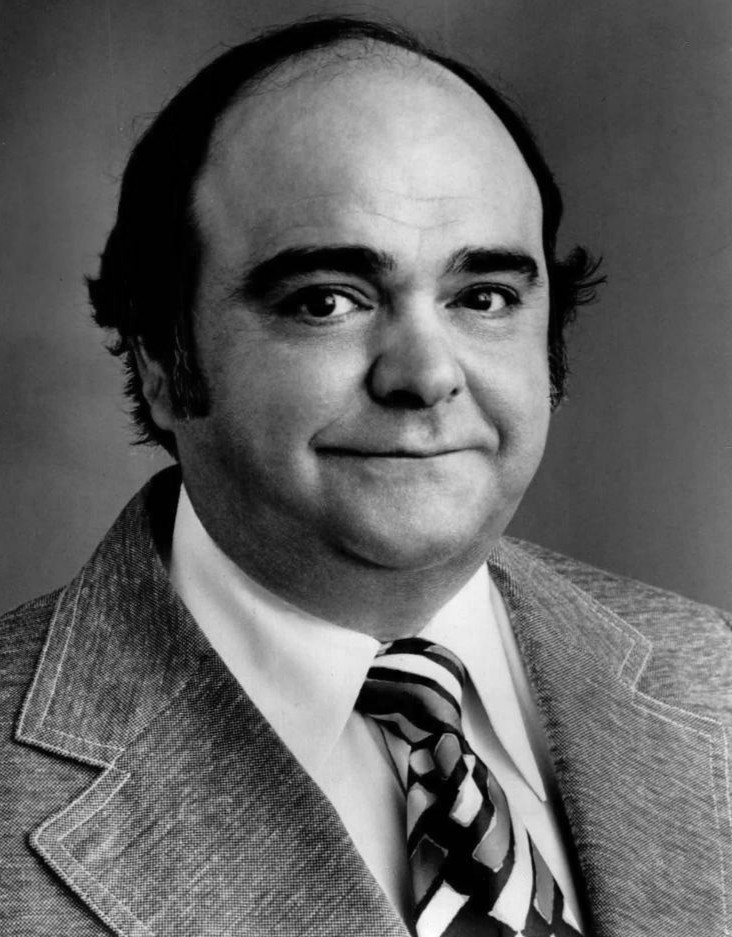
James Coco
View on Wikipedia
 | This article needs additional citations for verification. (May 2011) |
James Emil Coco (March 21, 1930 – February 25, 1987) was an American stage and screen actor. He was the recipient of a Primetime Emmy Award, a Drama Desk Award, a Cable ACE Award and three Obie Awards, as well as nominations for a Tony Award, an Academy Award and two Golden Globe Awards. Coco is remembered for his supporting roles in the films Man of La Mancha (1972), Murder by Death (1976) and Only When I Laugh (1981).
Key Information


Early life and career
[edit]Born in the Little Italy section of Manhattan,[1] Coco was the son of Felice Lescoco, a shoemaker, and Ida Detestes Lescoco (Coco being a shortened version of his birth name).
The family moved to the Pelham Bay section of the Bronx when he was an infant, where he lived until his late teens.[1]
James began acting straight out of high school.[2] He received his acting training at HB Studio[3] in New York City. As an overweight and prematurely balding adult, he found himself relegated to character roles. He made his Broadway debut in Hotel Paradiso in 1957, but his first major recognition was for Off-Broadway's The Moon in Yellow River by Denis Johnston, for which he won an Obie Award.[4]
In 1964 Coco toured with a production of The Irregular Verb to Love, with Cyril Richard, and they appeared at the oldest Summer stock theater, Denver's Elitch Theatre.
Coco's first modern collaboration with playwright Terrence McNally was a 1968 Off-Broadway double-bill of the one-act plays Sweet Eros and Witness, followed by Here's Where I Belong, a disastrous Broadway musical adaptation of East of Eden that closed on opening night. They had far greater success with their next project, Next, a two-character play with Elaine Shore, which ran for more than 700 performances and won Coco the Drama Desk Award for Outstanding Performance. Sixteen years later, the two reunited for the Manhattan Theatre Club production of It's Only a Play.[4]
Coco also achieved success with Neil Simon, who wrote The Last of the Red Hot Lovers (1969) specifically for him. It earned him a Tony Award nomination as Best Actor in a Play. The two later joined forces for a Broadway revival of the musical Little Me and the films Murder by Death (1976), The Cheap Detective (1978) and Only When I Laugh (1981), for which he was both Oscar-nominated and Razzie-nominated.[5]
Coco, a veteran of many failed diets, was the author of the bestselling book The James Coco Diet, released on February 1, 1983, which documented his successful experience of the Structure House Weight Loss Plan, developed by Gerard Musante. However, he only lived four years after the release of his book.[6]
Film and television roles
[edit].jpg)
Coco's additional film credits include Ensign Pulver (1964), The Patty Duke Show (1965). End of the Road (1970), The Strawberry Statement (1970), Tell Me That You Love Me, Junie Moon (1970), A New Leaf (1971), Such Good Friends (1971), Man of La Mancha (1972), The Wild Party (1975), Charleston (1977), Scavenger Hunt (1979), Wholly Moses! (1980) and The Muppets Take Manhattan (1984).
Several of his films were released posthumously, including: Hunk (1987) and That's Adequate (1989).[5][7]
On television, Coco starred on two unsuccessful 1970s series, Calucci's Department and The Dumplings, and made guest appearances on many series, including ABC Stage 67, NBC Children's Theater, The Edge of Night, Marcus Welby, M.D., Trapper John, M.D., Medical Center, Maude, Fantasy Island, Alice, The Eddie Capra Mysteries, Murder, She Wrote, The Muppet Show, The Carol Burnett Show, The Love Boat, $weepstake$, and St. Elsewhere, for which he won an Emmy Award. One of his later television assignments was a recurring role as Nick Milano on the sitcom Who's the Boss?.[7] Coco died[8][1] exactly one day after[9] what was his final appearance on Who's the Boss? was broadcast.[5]
Awards and nominations
[edit]| Year | Award | Category | Nominated work | Result |
|---|---|---|---|---|
| 1961 | 6th Obie Awards | Distinguished Performance by an Actor | The Moon in the Yellow River
|
Won |
| 1968 | 13th Obie Awards | Distinguished Performance | Fragments
|
Won |
| 1969 | 14th Drama Desk Awards | Outstanding Performance | Adaptation/Next
|
Won |
| 1970 | 24th Tony Awards | Best Actor in a Play | Nominated | |
| 1973 | 30th Golden Globe Awards | Best Supporting Actor – Motion Picture | Nominated | |
| 1977 | 22nd Obie Awards | Distinguished Performance | The Transfiguration of Benno Blimpie
|
Won |
| 1982 | 39th Golden Globe Awards | Best Supporting Actor – Motion Picture | Nominated | |
| 54th Academy Awards | Best Supporting Actor | Nominated | ||
| 2nd Golden Raspberry Awards | Worst Supporting Actor | Nominated | ||
| 1983 | 35th Primetime Emmy Awards | Outstanding Supporting Actor in a Drama Series | St. Elsewhere, (Episode: "Cora and Arnie")
|
Won |
| 1985 | 7th CableACE Awards | Best Actor in a Dramatic Series | The Ray Bradbury Theater, (Episode: "Marionettes, Inc.")
|
Won |
Personal life
[edit]Death
[edit]Coco died at St. Vincent's Hospital, Manhattan, on February 25, 1987, at age 56 after suffering a heart attack at his Greenwich Village home.[2] He is buried in St. Gertrude's Roman Catholic Cemetery in Colonia, New Jersey.[11]
Works
[edit]- Coco, James; Paone, Marion (1984). The James Coco Diet. Bantam Books. ISBN 978-0-553-05024-0.[6]
Filmography
[edit]- Ensign Pulver (1964) - Skouras
- Patty Duke Show (1965) - Director
- Generation (1969) - Mr. Blatto
- End of the Road (1970) - School Man
- The Strawberry Statement (1970) – Grocer
- Tell Me That You Love Me, Junie Moon (1970) – Mario
- A New Leaf (1971) – Uncle Harry
- Such Good Friends (1971) – Timmy
- Man of La Mancha (1972) – Sancho Panza / Cervantes's Manservant
- VD Blues (1972) – Himself
- Calucci's Department (1973) – Joe Calucci
- The Wild Party (1975) – Jolly Grimm
- Murder by Death (1976) – Milo Perrier
- Charleston (1977) – Joe Lo Monaco
- Bye Bye Monkey (1978) – Andreas Flaxman
- The Cheap Detective (1978) – Marcel
- The Muppet Show (1978) - Himself (Special Guest Star)
- Scavenger Hunt (1979) – Henri
- Wholly Moses! (1980) – Hyssop
- Only When I Laugh (1981) – Jimmy Perrino
- The Muppets Take Manhattan (1984) – Mr. Skeffington
- Johnny Dangerously (1984) – Moronie's Bouncer (uncredited)
- The Ray Bradbury Theater (1985) – "Marionettes, Inc." (Season 1, Episode 1), John Braling
- Hunk (1987) – Dr. D (posthumous release)
- The Chair (1988) – Dr. Harold Woodhouse Langer (posthumous release)
- That's Adequate (1989) – Max Roebling (final film role, posthumous release)
References
[edit]- ^ a b c McQuiston, John T. (February 26, 1987). "James Coco, Movie, TV And Stage Actor, Dies". The New York Times. Retrieved March 5, 2019.
- ^ a b Bennetts, Leslie (February 26, 1987). "James Coco, Character Actor On Stage and TV and in Films". The New York Times. p. 19.
- ^ "Alumni". HB Studio. Retrieved September 7, 2022.
- ^ a b James Coco at the Internet Off-Broadway Database (archived)
- ^ a b c "Emmy Award-Winning Actor James Coco, 56, Dies of Heart Attack". Los Angeles Times. Associated Press. February 26, 1987. Retrieved June 28, 2018.
- ^ a b "The James Coco Diet". Kirkus Reviews. February 1, 1983. Retrieved September 6, 2022.
- ^ a b James Coco at IMDb
- ^ Zibart, Eve (February 26, 1987). "Character Actor James Coco Dies At Age 56". The Washington Post.
- ^ "James Coco dead at 56". United Press International. February 26, 1987. Retrieved September 7, 2022.
- ^ Hadleigh, Boze (1996). Hollywood Gays: Conversations with, Cary Grant, Liberace, Tony Perkins, Paul Lynde, Cesar Romero, Brad Davis, Randolph Scott, James Coco, William Haines, David Lewis. New York: Barricade Books. p. 111. ISBN 978-1-5698-0083-6.
- ^ Wilson, Scott (September 16, 2016). Resting Places: The Burial Sites of More Than 14,000 Famous Persons (Third ed.). McFarland. p. 144. ISBN 978-1-4766-2599-7. Retrieved June 27, 2018.
External links
[edit]- James Coco at IMDb
- James Coco at the Internet Broadway Database
- James Coco at the Internet Off-Broadway Database (archived)
- James Coco at the TCM Movie Database
- James Coco at Find a Grave

| International | |
|---|---|
| National | |
| Academics | |
| Artists | |
| People | |
| Other | |
James Coco
View on GrokipediaEarly life
Childhood and family background
James Coco was born on March 21, 1930, in the Little Italy section of Manhattan, New York City, to Italian immigrant parents Felice Coco, a shoemaker, and Ida Testai Coco, a homemaker.[13][14] His father had emigrated from Bronte, Sicily, while his mother, of Italian descent, was born in São Paulo, Brazil.[15] Shortly after his birth, Coco's family relocated to the Pelham Bay section of the Bronx, where he spent his formative years in a modest, working-class household.[16] He had an older sister, Lucia, and an older brother, Francis, and the family navigated the economic hardships of the Great Depression, with his father's occupation as a shoemaker providing limited stability amid widespread unemployment and poverty in immigrant communities.[14] As a child, Coco often assisted his father by shining shoes, an experience that underscored the family's socioeconomic challenges and fostered his early resilience.[13] Growing up in this environment, Coco developed an early interest in performance and entertainment, influenced by the vibrant cultural life of his Italian-American neighborhood and the escapist allure of theater during tough times.[13] These childhood aspirations, rooted in a desire to transcend his humble origins, later propelled him toward acting pursuits following high school.[13]Education and acting training
James Coco attended Evander Childs High School in the Bronx, where he developed an early interest in acting inspired by films he watched as a child.[17] Upon graduating in the late 1940s, he chose not to pursue higher education, instead committing directly to a career in performance, driven by his family's modest circumstances as the son of an Italian immigrant shoemaker.[17][11] Coco received his formal acting training at the HB Studio in Greenwich Village, New York City, founded by Herbert Berghof and later co-led by Uta Hagen.[18] There, he studied under Hagen and Berghof, who emphasized method acting techniques focused on emotional authenticity and character immersion, skills that became central to his versatile portrayals.[3] This rigorous program honed his abilities in scene work and improvisation, preparing him for professional opportunities. While building his skills, Coco supported himself through odd jobs, including working as a toy demonstrator at Macy's, all while actively auditioning in the competitive New York theater scene.[11] He gained foundational experience through minor roles in community theater workshops, notably joining the Clare Tree Major Children's Theater group shortly after high school, where he performed in productions for young audiences and toured locally.[17] These early, unpaid engagements allowed him to practice ensemble work and build confidence in front of live audiences, laying the groundwork for his transition to professional stages.[16]Stage career
Debut and early theater roles
James Coco began his professional acting career following training at the HB Studio in New York City, where he honed his craft under influential teachers.[18] Coco made his Broadway debut in 1957 as the professor Tabu in George Feydeau's farce Hotel Paradiso, directed by Robert Lewis and co-starring Bert Lahr and Angela Lansbury; the production ran for 95 performances at the Henry Miller Theatre.[19][20] His breakthrough came in 1961 with an Obie Award for Distinguished Performance by an Actor as Tausch, the humorless German scientist, in Denis Johnston's The Moon in the Yellow River at the East End Theatre, marking his first major critical acclaim in experimental Off-Broadway work.[21][22][17] As a character actor of Italian descent from a working-class Bronx family, Coco faced challenges breaking into the predominantly Anglo-dominated theater scene of the 1950s and early 1960s, often limited to supporting roles due to his premature balding and stocky build, which typecast him early in ethnic or comedic character parts.[17]Major Broadway and off-Broadway productions
James Coco achieved prominence in American theater through a series of standout performances in both Broadway and off-Broadway productions during the 1960s and 1970s, often showcasing his gift for comedic timing and character depth. His breakthrough off-Broadway role came in Terrence McNally's one-act comedy Next (1969), where he starred as Max Brasch, a middle-aged, out-of-shape history teacher enduring a humiliating army physical examination, earning widespread praise for his physical comedy and vulnerability. Directed by Elaine May at the New Theater in Greenwich Village, the production ran for 707 performances and highlighted Coco's ability to blend humor with pathos in intimate settings.[23] Transitioning to Broadway, Coco delivered a career-defining performance as Barney Cashman in Neil Simon's The Last of the Red Hot Lovers (1969–1971), portraying a mild-mannered fishmonger attempting middle-aged romantic escapades across three encounters with different women. The play, directed by Robert Moore at the Eugene O'Neill Theatre, enjoyed a successful run of 706 performances, with critics lauding Coco's nuanced comedic delivery and emotional authenticity as central to its appeal.[24][25] In 1977, Coco earned his third Obie Award for his portrayal of the titular character in Albert Innaurato's The Transfiguration of Benno Blimpie, a dark comedy about a Philadelphia man's grotesque obsessions and downfall, presented as part of the double bill Monsters at the Astor Place Theatre.[26][27] Coco's off-Broadway contributions extended his reputation for versatility beyond mainstream comedy, as seen in his Obie-winning turn in Murray Schisgal's Fragments (1967), a fragmented ensemble piece at the Theater de Lys that showcased his dramatic intensity amid avant-garde staging. These roles underscored Coco's adaptability in innovative, non-commercial theater throughout the era.[12][28] In the 1980s, Coco continued to shine in revivals that capitalized on his versatile character work. He took on the boisterous role of Boris Kolenkhov, the flamboyant Russian wrestling instructor, in the Lincoln Center Theater revival of George S. Kaufman and Moss Hart's You Can't Take It With You (1983–1984) at the Plymouth Theatre, directed by Ellis Rabb, where his energetic portrayal added fresh vitality to the classic comedy during its 312-performance run.[29][30] Similarly, in the Mary Tyler Moore-starring revival of Neil Simon and Cy Coleman's Little Me (1982) at the Eugene O'Neill Theatre, Coco played multiple roles—including the pompous Amos Pinchley, the lecherous Otto Schnitzler, and the aristocratic Prince Cherney—demonstrating his chameleon-like range in a production that ran for 36 performances under the direction of Martin Charnin.[31][32]Screen career
Film performances
James Coco began his film career in 1964 with the role of Skouras in Ensign Pulver, directed by Joshua Logan, and gained prominence in the 1970s, leveraging his Broadway experience to portray character roles that emphasized his versatile comic timing and emotional depth in ensemble-driven narratives. His early films included a supporting part in The Strawberry Statement (1970), but it was his stage-to-screen adaptation that marked his breakthrough.[1] In Man of La Mancha (1972), directed by Arthur Hiller, Coco reprised his Tony-nominated Broadway role as Sancho Panza, the loyal and earthy squire to Peter O'Toole's Don Quixote. Drawing from his original stage performance, Coco infused the character with a grounded realism and wry humor, balancing the film's musical fantasy elements while highlighting the duo's improbable friendship amid the Spanish Inquisition's grim setting. Critics noted his ability to humanize the role, making Sancho a poignant counterpoint to Quixote's delusions, which helped the adaptation resonate despite mixed reviews on its overall execution.[33][34][35] Coco's comedic flair shone in Murder by Death (1976), a Neil Simon-scripted parody of detective fiction directed by Robert Moore. He played Milo Perrier, a flamboyant Belgian sleuth spoofing Hercule Poirot, complete with exaggerated mannerisms and a neurotic Pomeranian sidekick. As part of an all-star cast including Peter Falk and Eileen Brennan, Coco's performance added chaotic energy to the whodunit ensemble at a mysterious mansion, where literary archetypes clash in absurd twists. His timing and physical comedy were praised for elevating the film's satirical bite, contributing to its status as a cult favorite for blending farce with genre homage.[36][37][38] A shift to more dramatic territory came with Only When I Laugh (1981), where Coco portrayed Jimmy, the devoted but struggling gay actor and confidant to Marsha Mason's recovering alcoholic Georgia. Directed by Glenn Jordan from a Neil Simon screenplay, the film explored themes of friendship and resilience in New York City's theater world. Coco's nuanced depiction of Jimmy's quiet loyalty and unspoken vulnerabilities provided emotional anchor to the ensemble, showcasing his range beyond comedy and earning acclaim for its heartfelt authenticity in supporting the lead's journey toward sobriety.[39][40][41] Throughout the decade, Coco appeared in supporting capacities in films like The Cheap Detective (1978) and Scavenger Hunt (1979), often bringing his signature warmth to quirky ensemble pieces that underscored his reliability as a character actor in Hollywood's character-driven comedies and dramas.[1]Television roles and series
Coco's transition to television was bolstered by his rising film profile in the early 1970s, allowing him to secure lead roles in sitcoms that highlighted his everyman charm and comedic timing. His small-screen debut as a series regular came in Calucci's Department (1973), a CBS comedy where he portrayed Joe Calucci, the exasperated supervisor of a bustling Manhattan unemployment office staffed by an eclectic group of characters.[42][43] Created by Joseph Bologna and Renée Taylor, the show aired 18 episodes from September to December 1973, focusing on the daily absurdities and interpersonal dynamics of blue-collar life, but it failed to attract sufficient viewership and was axed after three months.[43] In 1976, Coco took the lead in another short-lived family-oriented sitcom, The Dumplings on NBC, playing Joe Dumpling, a jovial, overweight everyman who co-owned Dudley's Take-Out, a modest Manhattan restaurant, with his devoted wife Angela (Geraldine Brooks).[44][45] Produced by Norman Lear, the series depicted the couple's loving but chaotic home life above the eatery, interspersed with quirky neighbors and workplace antics, running for just 10 episodes during the 1975–76 season before cancellation amid low ratings.[45] Despite their brevity, both series demonstrated Coco's ability to anchor ensemble comedies with his warm, relatable portrayals of working-class figures. Coco achieved greater recognition for his recurring role as the compassionate priest Father Robert Caldwell on the NBC medical drama St. Elsewhere from 1982 to 1987. His performance earned him the Primetime Emmy Award for Outstanding Supporting Actor in a Drama Series in 1983.[46] Beyond starring vehicles, Coco frequently appeared as a guest on popular television programs, leveraging his Italian-American heritage for colorful, humorous supporting roles in ethnic-themed storylines.[1] Notable spots included an episode of the Norman Lear spin-off Maude (1976), where he played Dr. Channing McGrath in a plot involving swinging couples, as well as appearances on Murder, She Wrote (1984) and The Love Boat.[47] These roles underscored his versatility on the small screen, often bringing levity to dramatic or ensemble formats. Coco's last significant television work was a recurring turn as Nick Milano, the boisterous father-in-law of Tony Micelli (Tony Danza), on the ABC sitcom Who's the Boss? from 1985 to 1987.[48][49] Appearing in several episodes across seasons three and four, he infused the character with his signature blend of gruff affection and comic bluster, including a memorable storyline in "Diet in Cell Block 11" (1987) where Nick schemes from prison.[50] Tragically, Coco passed away from a heart attack on February 25, 1987, just one day after that episode aired, with the subsequent installment dedicated to his memory.[51][49]Awards and honors
Theater awards and nominations
James Coco received significant recognition for his stage work, particularly in off-Broadway productions, where his versatile performances in comedic and dramatic roles earned him three Obie Awards, the highest honor for off-Broadway theater.[21] His first Obie came in 1961 for his portrayal of Tausch in Denis Johnston's The Moon in the Yellow River at the Circle in the Square Theatre, where critics praised his ability to infuse the character with a mix of humor and pathos, highlighting his early promise as a character actor.[12] In 1968, he won another Obie for Distinguished Performance in Murray Schisgal's Fragments, a double bill of one-act plays that showcased his timing in absurd, satirical sketches.[28] Coco's third Obie arrived in 1977 for his role in The Transfiguration of Benno Blimpie by Albert Innaurato, earning acclaim for his empathetic depiction of a misfit seeking transcendence amid urban decay.[26] Transitioning to more mainstream recognition, Coco's star turn in Terrence McNally's Next (1969) at the New York City Center garnered him the Drama Desk Award for Outstanding Performance, underscoring his comedic brilliance as a middle-aged man navigating a blind date with awkward charm.[52] The production's success, running over 700 performances, solidified his reputation for blending vulnerability with sharp wit in intimate theater settings.[53] On Broadway, Coco's only Tony Award nomination came in 1970 for Best Actor in a Play for his lead role as Barney Cashman in Neil Simon's The Last of the Red Hot Lovers, where he portrayed a fish-out-of-water middle-aged man attempting extramarital affairs, capturing the era's shifting social mores with relatable insecurity.[54] Though he did not win—the award went to Fritz Weaver for Child's Play—the nomination affirmed his crossover appeal from off-Broadway innovation to commercial success.[55] These honors collectively reflect Coco's influence in elevating character-driven theater during the 1960s and 1970s, emphasizing his skill in humanizing flawed protagonists.Film and television awards and nominations
James Coco received significant recognition for his screen work, particularly in the 1980s, where his performances in film and television earned him prestigious awards alongside some satirical critiques. His transition from stage to screen culminated in a career-defining Emmy win, highlighting his versatility in dramatic roles.[56] In 1983, Coco won the Primetime Emmy Award for Outstanding Supporting Actor in a Drama Series for his guest appearance as Arnie, a poignant hospital patient suffering from memory loss, in the St. Elsewhere episode "Cora and Arnie." This role, drawn from his brief but impactful television stint on the medical drama, showcased his ability to convey deep emotional vulnerability.[57][58] Coco's film performances also garnered major nominations. He received an Academy Award nomination for Best Supporting Actor in 1982 for his role as Jimmy in Only When I Laugh (1981), a dramedy about addiction and recovery where he played a loyal, wisecracking friend to the protagonist.[59] This marked his only Oscar nod and underscored his supporting strengths in ensemble casts. Complementing the Oscar recognition, Coco earned two Golden Globe nominations. In 1973, he was nominated for Best Supporting Actor – Motion Picture for his portrayal of Sancho Panza in Man of La Mancha (1972), a screen adaptation of the Broadway musical. He received another nomination in 1982 for Best Supporting Actor – Motion Picture for Only When I Laugh.[60]| Year | Award | Category | Work | Result |
|---|---|---|---|---|
| 1983 | Primetime Emmy Awards | Outstanding Supporting Actor in a Drama Series | St. Elsewhere ("Cora and Arnie") | Won[57] |
| 1982 | Academy Awards | Best Supporting Actor | Only When I Laugh | Nominated[59] |
| 1982 | Golden Globe Awards | Best Supporting Actor – Motion Picture | Only When I Laugh | Nominated[60] |
| 1973 | Golden Globe Awards | Best Supporting Actor – Motion Picture | Man of La Mancha | Nominated |
| 1985 | Cable ACE Awards | Actor in a Dramatic Series | The Ray Bradbury Theater ("Marionettes, Inc.") | Won[61] |
| 1982 | Golden Raspberry Awards | Worst Supporting Actor | Only When I Laugh | Nominated |