



Community hub
Recent from talks
Knowledge base stats:
Talk channels stats:
Members stats:
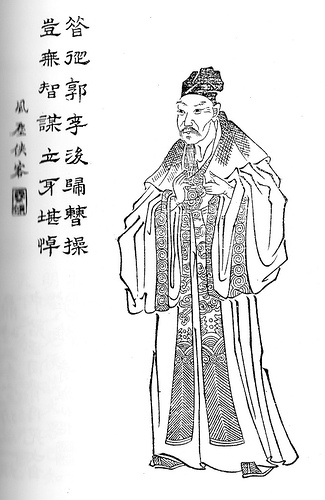
Jia Xu
Jia Xu (147 – 11 August 223), courtesy name Wenhe, was an official of the state of Cao Wei during the early Three Kingdoms period of China. He started his career in the late Eastern Han dynasty as a minor official. In 189, when the warlord Dong Zhuo took control of the Han central government, he assigned Jia Xu to the unit led by Niu Fu, his son-in-law. In May 192, after Dong Zhuo was assassinated by Lü Bu, Jia Xu advised Li Jue, Guo Si and Dong Zhuo's loyalists to fight back and seize control of the imperial capital, Chang'an, from a new central government headed by Lü Bu and Wang Yun. After Li Jue and the others defeated Lü Bu and occupied Chang'an, Jia Xu served under the central government led by them. During this time, he ensured the safety of the figurehead Han emperor, Emperor Xian, who was being held hostage by Li Jue. He also attempted to prevent internal conflict between Li Jue and Guo Si, but with limited success. After Emperor Xian escaped from Chang'an, Jia Xu left Li Jue and briefly joined the general Duan Wei before becoming a strategist of the warlord Zhang Xiu. While serving under Zhang Xiu, he advised his lord on how to counter invasions by the warlord Cao Cao, who had received Emperor Xian in 196 and taken control of the central government. In 200, during the Battle of Guandu between Cao Cao and his rival Yuan Shao, Jia Xu urged Zhang Xiu to reject Yuan Shao's offer to form an alliance and instead surrender to Cao Cao. Zhang Xiu heeded his advice. Jia Xu then became one of Cao Cao's strategists.
During his service under Cao Cao, Jia Xu made three important contributions. First, during the Battle of Guandu, he urged Cao Cao to switch from being on the defensive to adopting an offensive stance, which ultimately led to Cao Cao's decisive victory over Yuan Shao. Second, during the Battle of Tong Pass in 211, he suggested to Cao Cao to pretend to agree to make peace with the northwestern warlords Han Sui and Ma Chao, and then sow discord between them. Cao Cao heeded his suggestion, successfully stirred up internal conflict among the warlords, and then used the opportunity to defeat them. Thirdly, in the 210s, when Cao Cao's sons Cao Pi and Cao Zhi were fighting to be their father's successor, Jia Xu indirectly helped Cao Pi by giving him advice and hinting to Cao Cao that he should choose the older son to be his heir apparent. After Cao Cao's death in 220, Cao Pi ended the Eastern Han dynasty by forcing Emperor Xian to abdicate the throne to him, and founded the state of Cao Wei with himself as the emperor. As an expression of gratitude to Jia Xu, Cao Pi appointed him as Grand Commandant – one of the top three positions in the Wei government – and promoted him to a district marquis. Between 220 and 223, Jia Xu advised Cao Pi against attacking Cao Wei's rival states, Eastern Wu and Shu Han, and focus on internal development. However, Cao Pi ignored his advice and invaded Wu, but ended up sustaining heavy losses and not making any significant gains. Jia Xu died in 223.
Jia Xu was from Guzang County (姑臧縣), Wuwei Commandery (武威郡), which is in present-day Wuwei, Gansu. In his youth, he was unimpressive and unheard of. However, Yan Zhong (閻忠), an official from Hanyang Commandery (漢陽郡; around present-day Gangu County, Gansu), felt that Jia Xu was extraordinary and even remarked that Jia had the brilliance of Zhang Liang and Chen Ping, two famous strategists of the early Western Han dynasty.
Jia Xu was nominated as a xiaolian to serve in the Eastern Han government as a Gentleman Cadet (郎). However, due to illness, he quit his job and went home. On the way back, he was captured by Di rebels at Qian County (汧縣; in present-day Long County, Shaanxi) along with several other travellers. He told the rebels: "I am a maternal grandson of Lord Duan. If you let me live, my family will reward you handsomely." "Lord Duan" referred to Duan Jiong (段熲), who held the position of Grand Commandant (太尉) in the Han imperial court. As Duan Jiong had served for years as a general guarding the Han Empire's western regions, he was well known among the people living in the area. Jia Xu knew that the Di rebels were afraid of Duan Jiong, so he pretended to be Duan Jiong's maternal grandson. As he expected, the rebels treated him respectfully and released him. The other travellers were all killed.
In 189, the warlord Dong Zhuo entered the imperial capital, Luoyang, and took control of the central government. Jia Xu was then serving as the Commandant (都尉) of Pingjin (平津) and an assistant official in the Grand Commandant's office. He was promoted to Colonel Who Attacks Barbarians (討虜校尉) and assigned to the unit led by Dong Zhuo's son-in-law, Niu Fu.
In 192, Dong Zhuo was assassinated by Lü Bu in the imperial capital, Chang'an, while Niu Fu was murdered by his subordinates. The rest of Dong Zhuo's loyalists, including Li Jue, Guo Si and Zhang Ji, became fearful and wanted to disband and return to their respective home commanderies. Jia Xu told them: "I heard that the new government in Chang'an is planning to exterminate everyone from Liang Province. If all of you break up and travel alone, even a tingzhang can arrest you. Why don't you retreat to the west together? There you can gather and reorganise your forces, and then attack Chang'an to avenge Lord Dong. If you succeed, you can make use of imperial authority to conquer the rest of the Empire. If you fail, it's still not too late to escape." Dong Zhuo's loyalists agreed with Jia Xu and did as he suggested. They managed to defeat the new central government in Chang'an led by Lü Bu and Wang Yun, and then took control of the city.
Pei Songzhi, who annotated Jia Xu's biography in the Sanguozhi, strongly criticised Jia Xu for offering this suggestion. He argued that Dong Zhuo's death marked the end of his tyranny and a possible revival of the declining Eastern Han dynasty. However, due to Jia Xu's suggestion, the Han Empire became even more chaotic after Dong Zhuo's death.
When Jia Xu later served as Left Adjunct (左馮翊), Li Jue and Dong Zhuo's loyalists wanted to reward him by making him a marquis, but Jia Xu said, "That suggestion I made was meant to save your lives. What merit have I achieved to deserve a reward?" He declined to accept the marquis title. Later on, when he was nominated to serve as a Supervisor of the Masters of Writing (尚書僕射), he said: "The Supervisor of the Masters of Writing is like a tutor to officials. I don't have a strong reputation so I am afraid I might not be able to convince people that I am suited for this appointment. What will become of the imperial court if I accept this appointment for my personal glory?" He was then assigned to be a Master of Writing (尚書) instead, and was tasked with selecting candidates to serve in the government. Li Jue and the others regarded him highly but were also wary of him. The candidates Jia Xu chose tend to be officials who formerly served in the previous administration. Jia Xu was praised for this mode of selecting government officials by retaining some continuity in appointments. When there were tensions between Li Jue, Guo Si and Fan Chou, with their respective subordinates urging them to go to war, Jia Xu reprimanded them for their behaviour and tried to persuade them to avoid conflict. They listened to him.
Hub AI
Jia Xu AI simulator
(@Jia Xu_simulator)
Jia Xu
Jia Xu (147 – 11 August 223), courtesy name Wenhe, was an official of the state of Cao Wei during the early Three Kingdoms period of China. He started his career in the late Eastern Han dynasty as a minor official. In 189, when the warlord Dong Zhuo took control of the Han central government, he assigned Jia Xu to the unit led by Niu Fu, his son-in-law. In May 192, after Dong Zhuo was assassinated by Lü Bu, Jia Xu advised Li Jue, Guo Si and Dong Zhuo's loyalists to fight back and seize control of the imperial capital, Chang'an, from a new central government headed by Lü Bu and Wang Yun. After Li Jue and the others defeated Lü Bu and occupied Chang'an, Jia Xu served under the central government led by them. During this time, he ensured the safety of the figurehead Han emperor, Emperor Xian, who was being held hostage by Li Jue. He also attempted to prevent internal conflict between Li Jue and Guo Si, but with limited success. After Emperor Xian escaped from Chang'an, Jia Xu left Li Jue and briefly joined the general Duan Wei before becoming a strategist of the warlord Zhang Xiu. While serving under Zhang Xiu, he advised his lord on how to counter invasions by the warlord Cao Cao, who had received Emperor Xian in 196 and taken control of the central government. In 200, during the Battle of Guandu between Cao Cao and his rival Yuan Shao, Jia Xu urged Zhang Xiu to reject Yuan Shao's offer to form an alliance and instead surrender to Cao Cao. Zhang Xiu heeded his advice. Jia Xu then became one of Cao Cao's strategists.
During his service under Cao Cao, Jia Xu made three important contributions. First, during the Battle of Guandu, he urged Cao Cao to switch from being on the defensive to adopting an offensive stance, which ultimately led to Cao Cao's decisive victory over Yuan Shao. Second, during the Battle of Tong Pass in 211, he suggested to Cao Cao to pretend to agree to make peace with the northwestern warlords Han Sui and Ma Chao, and then sow discord between them. Cao Cao heeded his suggestion, successfully stirred up internal conflict among the warlords, and then used the opportunity to defeat them. Thirdly, in the 210s, when Cao Cao's sons Cao Pi and Cao Zhi were fighting to be their father's successor, Jia Xu indirectly helped Cao Pi by giving him advice and hinting to Cao Cao that he should choose the older son to be his heir apparent. After Cao Cao's death in 220, Cao Pi ended the Eastern Han dynasty by forcing Emperor Xian to abdicate the throne to him, and founded the state of Cao Wei with himself as the emperor. As an expression of gratitude to Jia Xu, Cao Pi appointed him as Grand Commandant – one of the top three positions in the Wei government – and promoted him to a district marquis. Between 220 and 223, Jia Xu advised Cao Pi against attacking Cao Wei's rival states, Eastern Wu and Shu Han, and focus on internal development. However, Cao Pi ignored his advice and invaded Wu, but ended up sustaining heavy losses and not making any significant gains. Jia Xu died in 223.
Jia Xu was from Guzang County (姑臧縣), Wuwei Commandery (武威郡), which is in present-day Wuwei, Gansu. In his youth, he was unimpressive and unheard of. However, Yan Zhong (閻忠), an official from Hanyang Commandery (漢陽郡; around present-day Gangu County, Gansu), felt that Jia Xu was extraordinary and even remarked that Jia had the brilliance of Zhang Liang and Chen Ping, two famous strategists of the early Western Han dynasty.
Jia Xu was nominated as a xiaolian to serve in the Eastern Han government as a Gentleman Cadet (郎). However, due to illness, he quit his job and went home. On the way back, he was captured by Di rebels at Qian County (汧縣; in present-day Long County, Shaanxi) along with several other travellers. He told the rebels: "I am a maternal grandson of Lord Duan. If you let me live, my family will reward you handsomely." "Lord Duan" referred to Duan Jiong (段熲), who held the position of Grand Commandant (太尉) in the Han imperial court. As Duan Jiong had served for years as a general guarding the Han Empire's western regions, he was well known among the people living in the area. Jia Xu knew that the Di rebels were afraid of Duan Jiong, so he pretended to be Duan Jiong's maternal grandson. As he expected, the rebels treated him respectfully and released him. The other travellers were all killed.
In 189, the warlord Dong Zhuo entered the imperial capital, Luoyang, and took control of the central government. Jia Xu was then serving as the Commandant (都尉) of Pingjin (平津) and an assistant official in the Grand Commandant's office. He was promoted to Colonel Who Attacks Barbarians (討虜校尉) and assigned to the unit led by Dong Zhuo's son-in-law, Niu Fu.
In 192, Dong Zhuo was assassinated by Lü Bu in the imperial capital, Chang'an, while Niu Fu was murdered by his subordinates. The rest of Dong Zhuo's loyalists, including Li Jue, Guo Si and Zhang Ji, became fearful and wanted to disband and return to their respective home commanderies. Jia Xu told them: "I heard that the new government in Chang'an is planning to exterminate everyone from Liang Province. If all of you break up and travel alone, even a tingzhang can arrest you. Why don't you retreat to the west together? There you can gather and reorganise your forces, and then attack Chang'an to avenge Lord Dong. If you succeed, you can make use of imperial authority to conquer the rest of the Empire. If you fail, it's still not too late to escape." Dong Zhuo's loyalists agreed with Jia Xu and did as he suggested. They managed to defeat the new central government in Chang'an led by Lü Bu and Wang Yun, and then took control of the city.
Pei Songzhi, who annotated Jia Xu's biography in the Sanguozhi, strongly criticised Jia Xu for offering this suggestion. He argued that Dong Zhuo's death marked the end of his tyranny and a possible revival of the declining Eastern Han dynasty. However, due to Jia Xu's suggestion, the Han Empire became even more chaotic after Dong Zhuo's death.
When Jia Xu later served as Left Adjunct (左馮翊), Li Jue and Dong Zhuo's loyalists wanted to reward him by making him a marquis, but Jia Xu said, "That suggestion I made was meant to save your lives. What merit have I achieved to deserve a reward?" He declined to accept the marquis title. Later on, when he was nominated to serve as a Supervisor of the Masters of Writing (尚書僕射), he said: "The Supervisor of the Masters of Writing is like a tutor to officials. I don't have a strong reputation so I am afraid I might not be able to convince people that I am suited for this appointment. What will become of the imperial court if I accept this appointment for my personal glory?" He was then assigned to be a Master of Writing (尚書) instead, and was tasked with selecting candidates to serve in the government. Li Jue and the others regarded him highly but were also wary of him. The candidates Jia Xu chose tend to be officials who formerly served in the previous administration. Jia Xu was praised for this mode of selecting government officials by retaining some continuity in appointments. When there were tensions between Li Jue, Guo Si and Fan Chou, with their respective subordinates urging them to go to war, Jia Xu reprimanded them for their behaviour and tried to persuade them to avoid conflict. They listened to him.