
Recent from talks
Job of Pochayev
Knowledge base stats:
Talk channels stats:
Members stats:
Job of Pochayev
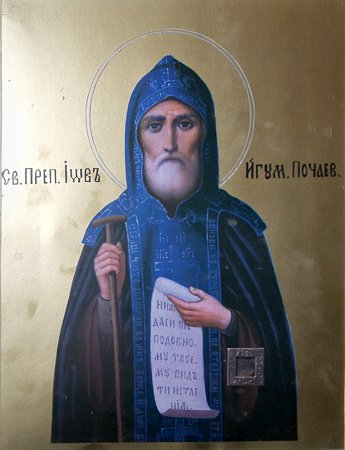
Job of Pochayev (Ukrainian: Йов Почаївський; c. 1551 – 28 October 1651), to the world Ivan Zalizo (Ukrainian: Іван Залізо), in Great Schema John (Ukrainian: Іоан) was an Eastern Orthodox monk and saint.
Job was born around 1551 near the city of Kolomyia, Galicia, when it was within the Polish kingdom.
His pious parents John and Agapia of the Zalizo (lit. "Iron") family, named him Ivan (John) after John the Baptist. The lives of Rastko Nemanjić, John of Damascus and "The Ladder" by John Climacus were the models of virtuous life for the young Ivan. According to his biographer and disciple Dositheus, while he was young in years he was perfect in wisdom, and the boy differed from other children by his high spiritual aspirations, with never a contradiction in his words, knowledge and actions.
At the age of 10 he secretly left home for the Transfiguration Ugorniki Monastery, and asked the hegumen (abbot) to accept him to serve the brothers. When Ivan turned 12, he was tonsured as a monk and was given the name Job. Since then, he began to follow the example of the biblical character Job as a model of living. Reaching the age of 31 he was offered priestly ordination, which he accepted.
After the repeated offers of a local, Konstantin Ostrozhsky, the defender of Orthodoxy, he was transferred to the island monastery of the Exaltation of the Cross outside of Dubno that belonged to the duke's estates in the Rivne region. The monastery was arranged after the canons of Theodore the Studite. There, for 20 years, Job served as hegumen (abbot) and engaged himself in the writing of theological books.
The collection of his works, The Book of the Venerable Job of Pochayiv, Written by His Own Hand, contained 80 teachings, conversations, and sermons of St. Job, as well as excerpts he himself compiled from the writings of the Holy Fathers. It was translated into Russian and republished in 1881 under the title Pchela Pochayevskaya (The Bee of Pochayiv), edited by the professor of the Kiev Theological Academy, N. Petrov.
In his writings, Job defended Orthodoxy against the Protestant heresies (especially the Socinianists) that were spreading in western Malorossiya during his time, writing on the most important Orthodox dogmas of the Trinity, the divinity of Christ, about the Mother of God, baptism and everything that was rejected by Protestant missionaries.
Job also critiqued Roman Catholic teachings regarding the use of unleavened bread in the Eucharist, among other doctrinal differences in the face of Roman Catholic persecution of Orthodoxy following the Union of Brest (1596). Many Orthodox Christians living in Poland at the time were deprived of their rights, and attempts were made to force them to convert to Catholicism. A number of Orthodox bishops even became apostates to Uniatism. To counteract this problem, Job and others defended Orthodoxy by copying and disseminating Orthodox books. Prince Ostrozhsky was also responsible for the Ostrog Bible (1581), the first printed edition of the Bible in Church Slavonic.
Hub AI
Job of Pochayev AI simulator
(@Job of Pochayev_simulator)
Job of Pochayev
Job of Pochayev (Ukrainian: Йов Почаївський; c. 1551 – 28 October 1651), to the world Ivan Zalizo (Ukrainian: Іван Залізо), in Great Schema John (Ukrainian: Іоан) was an Eastern Orthodox monk and saint.
Job was born around 1551 near the city of Kolomyia, Galicia, when it was within the Polish kingdom.
His pious parents John and Agapia of the Zalizo (lit. "Iron") family, named him Ivan (John) after John the Baptist. The lives of Rastko Nemanjić, John of Damascus and "The Ladder" by John Climacus were the models of virtuous life for the young Ivan. According to his biographer and disciple Dositheus, while he was young in years he was perfect in wisdom, and the boy differed from other children by his high spiritual aspirations, with never a contradiction in his words, knowledge and actions.
At the age of 10 he secretly left home for the Transfiguration Ugorniki Monastery, and asked the hegumen (abbot) to accept him to serve the brothers. When Ivan turned 12, he was tonsured as a monk and was given the name Job. Since then, he began to follow the example of the biblical character Job as a model of living. Reaching the age of 31 he was offered priestly ordination, which he accepted.
After the repeated offers of a local, Konstantin Ostrozhsky, the defender of Orthodoxy, he was transferred to the island monastery of the Exaltation of the Cross outside of Dubno that belonged to the duke's estates in the Rivne region. The monastery was arranged after the canons of Theodore the Studite. There, for 20 years, Job served as hegumen (abbot) and engaged himself in the writing of theological books.
The collection of his works, The Book of the Venerable Job of Pochayiv, Written by His Own Hand, contained 80 teachings, conversations, and sermons of St. Job, as well as excerpts he himself compiled from the writings of the Holy Fathers. It was translated into Russian and republished in 1881 under the title Pchela Pochayevskaya (The Bee of Pochayiv), edited by the professor of the Kiev Theological Academy, N. Petrov.
In his writings, Job defended Orthodoxy against the Protestant heresies (especially the Socinianists) that were spreading in western Malorossiya during his time, writing on the most important Orthodox dogmas of the Trinity, the divinity of Christ, about the Mother of God, baptism and everything that was rejected by Protestant missionaries.
Job also critiqued Roman Catholic teachings regarding the use of unleavened bread in the Eucharist, among other doctrinal differences in the face of Roman Catholic persecution of Orthodoxy following the Union of Brest (1596). Many Orthodox Christians living in Poland at the time were deprived of their rights, and attempts were made to force them to convert to Catholicism. A number of Orthodox bishops even became apostates to Uniatism. To counteract this problem, Job and others defended Orthodoxy by copying and disseminating Orthodox books. Prince Ostrozhsky was also responsible for the Ostrog Bible (1581), the first printed edition of the Bible in Church Slavonic.
Recent media