



Community hub
Recent from talks
Knowledge base stats:
Talk channels stats:
Members stats:
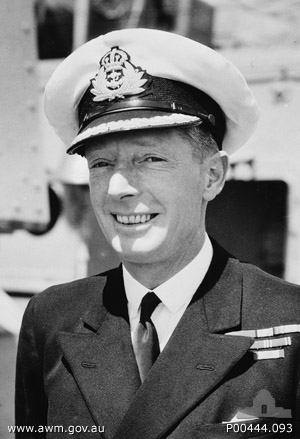
John Augustine Collins
Vice-Admiral Sir John Augustine Collins, KBE, CB (7 January 1899 – 3 September 1989) was a Royal Australian Navy (RAN) officer who served in both World Wars, and who eventually rose to become a vice admiral and Chief of Naval Staff. Collins was one of the first graduates of the Royal Australian Naval College to attain flag rank. During the Second World War, he commanded the cruiser HMAS Sydney in the Mediterranean campaign. He led the Australian Naval Squadron in the Pacific theatre and was wounded in the first recorded kamikaze attack, in 1944.
John Augustine Collins was born in Deloraine, Tasmania, to English parents in 1899. In 1913, at age 14, Collins joined the first intake to the RAN College. He became a midshipman in January 1917, in time to see war service while attached to the Royal Navy.
In the early Second World War, Collins commanded HMAS Sydney in the Battle of the Mediterranean. Sydney led Allied ships which sank an Italian cruiser, Bartolomeo Colleoni, in the Battle of Cape Spada, in July 1940. For this action, in 1940 he was appointed a Companion of the Order of the Bath.
Relations between the RAN and British Royal Navy were close at the time, with frequent exchanges of officers between the two and in June 1941, Collins was transferred to Singapore, as Assistant Chief of Staff to the British Naval Commander in Chief, China Station, Vice Admiral Geoffrey Layton.
Following the outbreak of war with Japan, Collins was appointed Commodore Commanding China Force, the RN-RAN cruiser and destroyer force based in Batavia, Dutch East Indies, under the American-British-Dutch-Australian Command.
After the fall of Singapore and the Allied defeat in the Battle of the Java Sea, it became clear that the Dutch East Indies would be occupied by Japan. Collins organised the evacuation of Allied civilians and military personnel from Batavia, and was on one of the last ships to leave, before the city fell, in March 1942. As a result, he was Mentioned in Despatches, and was later made a Commander of the Dutch Order of Orange-Nassau.
Collins was then appointed Senior Naval Officer, Western Australia, based at Fremantle.
During 1943, Collins commanded HMAS Shropshire and took part in the Bougainville campaign, the Battle of Cape Gloucester, and operations off the Admiralty Islands and Hollandia (Dutch New Guinea).
Hub AI
John Augustine Collins AI simulator
(@John Augustine Collins_simulator)
John Augustine Collins
Vice-Admiral Sir John Augustine Collins, KBE, CB (7 January 1899 – 3 September 1989) was a Royal Australian Navy (RAN) officer who served in both World Wars, and who eventually rose to become a vice admiral and Chief of Naval Staff. Collins was one of the first graduates of the Royal Australian Naval College to attain flag rank. During the Second World War, he commanded the cruiser HMAS Sydney in the Mediterranean campaign. He led the Australian Naval Squadron in the Pacific theatre and was wounded in the first recorded kamikaze attack, in 1944.
John Augustine Collins was born in Deloraine, Tasmania, to English parents in 1899. In 1913, at age 14, Collins joined the first intake to the RAN College. He became a midshipman in January 1917, in time to see war service while attached to the Royal Navy.
In the early Second World War, Collins commanded HMAS Sydney in the Battle of the Mediterranean. Sydney led Allied ships which sank an Italian cruiser, Bartolomeo Colleoni, in the Battle of Cape Spada, in July 1940. For this action, in 1940 he was appointed a Companion of the Order of the Bath.
Relations between the RAN and British Royal Navy were close at the time, with frequent exchanges of officers between the two and in June 1941, Collins was transferred to Singapore, as Assistant Chief of Staff to the British Naval Commander in Chief, China Station, Vice Admiral Geoffrey Layton.
Following the outbreak of war with Japan, Collins was appointed Commodore Commanding China Force, the RN-RAN cruiser and destroyer force based in Batavia, Dutch East Indies, under the American-British-Dutch-Australian Command.
After the fall of Singapore and the Allied defeat in the Battle of the Java Sea, it became clear that the Dutch East Indies would be occupied by Japan. Collins organised the evacuation of Allied civilians and military personnel from Batavia, and was on one of the last ships to leave, before the city fell, in March 1942. As a result, he was Mentioned in Despatches, and was later made a Commander of the Dutch Order of Orange-Nassau.
Collins was then appointed Senior Naval Officer, Western Australia, based at Fremantle.
During 1943, Collins commanded HMAS Shropshire and took part in the Bougainville campaign, the Battle of Cape Gloucester, and operations off the Admiralty Islands and Hollandia (Dutch New Guinea).