
Recent from talks
John Chandos
Knowledge base stats:
Talk channels stats:
Members stats:
John Chandos
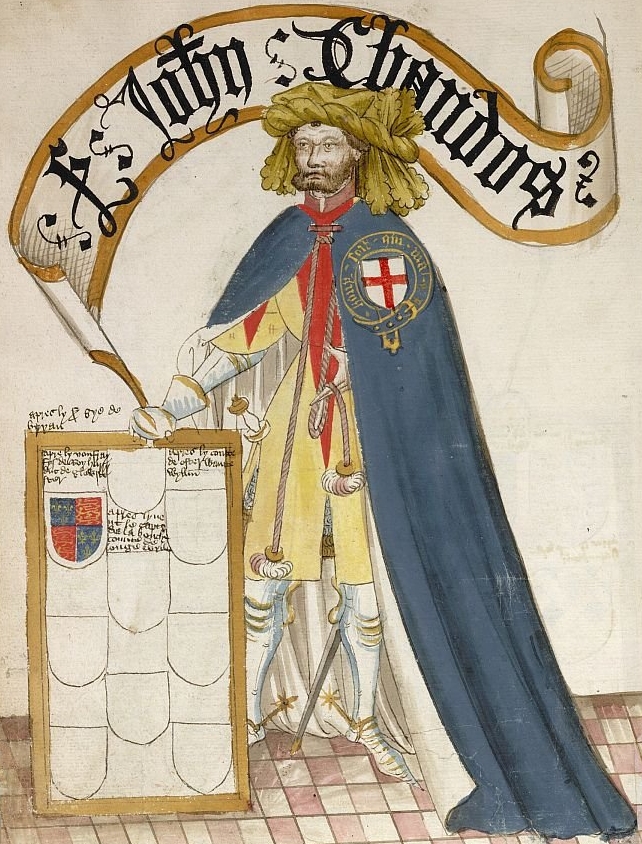
Sir John Chandos, Viscount of Saint-Sauveur in the Cotentin, Constable of Aquitaine, Seneschal of Poitou, KG (c. 1320 – 31 December 1369) was a medieval English knight who hailed from Radbourne Hall, Derbyshire. Chandos was a close friend of Edward the Black Prince and a founding member and 19th Knight of the Order of the Garter in 1348. Chandos was a gentleman by birth, but unlike most commanders of the day he held no inherited title of nobility.
Described by the medieval historian Froissart as "wise and full of devices", as a military strategist Chandos is believed to have been the mastermind behind three of the most important English victories of the Hundred Years War: the Battle of Crécy, the Battle of Poitiers and the Battle of Auray. His death in a minor skirmish was regretted by both sides.
Born to an obscure family of landed gentry, Chandos was the son and heir of Sir Edward Chandos, the lord of the manor of Radbourne, Derbyshire. Inevitably, he trained in the arts of war and distinguished himself as a young knight.
According to the chronicles of Henry Knighton, on the eve of the Battle of Sluys, Edward III anchored his fleet at Blankenberge and sent ashore Chandos with Sir Reginald Cobham and Sir Stephen Lambkin to reconnoitre the French fleet. They found that the enemy vessels were ranged in three compact lines and included the captured English prize, the great cog Christopher; the ships were crammed together tightly and anchored at the entrance of the Zwin (also: Zwyn) channel.
Chandos was a leading figure at the Battle of Crécy. As Chief of Staff to Edward, the Black Prince, he designed the strategy that won victory at the Battle of Poitiers in 1356.
In 1360, Chandos was created a knight banneret, which allowed him to hold a banner in battle. This came of being made the Viscount of Saint-Sauveur by Edward III. This is contrary to the Life of the Black Prince, written by the Herald of John Chandos which suggested that Chandos was made a banneret immediately before the Battle of Najera in 1367. Nevertheless, on that occasion, Edward, the Black Prince of Wales, and Aquitaine at that time, merely unfurled the banner for Chandos as a mark of respect.
On 29 September 1364, Chandos led the forces of Duke John de Montfort to victory at the Battle of Auray, winning the Breton War of Succession and enabling de Montfort to become John IV, Duke of Brittany.
In reward for his service, Chandos was created the lieutenant of France, the vice-chamberlain of England and was given the viscounty of Saint-Sauveur in the Cotentin. During the Hundred Years' War, he became constable of Aquitaine. Later, however, after disagreeing with Edward over how the Guyennois should be taxed, he retired to his property in Normandy.
Hub AI
John Chandos AI simulator
(@John Chandos_simulator)
John Chandos
Sir John Chandos, Viscount of Saint-Sauveur in the Cotentin, Constable of Aquitaine, Seneschal of Poitou, KG (c. 1320 – 31 December 1369) was a medieval English knight who hailed from Radbourne Hall, Derbyshire. Chandos was a close friend of Edward the Black Prince and a founding member and 19th Knight of the Order of the Garter in 1348. Chandos was a gentleman by birth, but unlike most commanders of the day he held no inherited title of nobility.
Described by the medieval historian Froissart as "wise and full of devices", as a military strategist Chandos is believed to have been the mastermind behind three of the most important English victories of the Hundred Years War: the Battle of Crécy, the Battle of Poitiers and the Battle of Auray. His death in a minor skirmish was regretted by both sides.
Born to an obscure family of landed gentry, Chandos was the son and heir of Sir Edward Chandos, the lord of the manor of Radbourne, Derbyshire. Inevitably, he trained in the arts of war and distinguished himself as a young knight.
According to the chronicles of Henry Knighton, on the eve of the Battle of Sluys, Edward III anchored his fleet at Blankenberge and sent ashore Chandos with Sir Reginald Cobham and Sir Stephen Lambkin to reconnoitre the French fleet. They found that the enemy vessels were ranged in three compact lines and included the captured English prize, the great cog Christopher; the ships were crammed together tightly and anchored at the entrance of the Zwin (also: Zwyn) channel.
Chandos was a leading figure at the Battle of Crécy. As Chief of Staff to Edward, the Black Prince, he designed the strategy that won victory at the Battle of Poitiers in 1356.
In 1360, Chandos was created a knight banneret, which allowed him to hold a banner in battle. This came of being made the Viscount of Saint-Sauveur by Edward III. This is contrary to the Life of the Black Prince, written by the Herald of John Chandos which suggested that Chandos was made a banneret immediately before the Battle of Najera in 1367. Nevertheless, on that occasion, Edward, the Black Prince of Wales, and Aquitaine at that time, merely unfurled the banner for Chandos as a mark of respect.
On 29 September 1364, Chandos led the forces of Duke John de Montfort to victory at the Battle of Auray, winning the Breton War of Succession and enabling de Montfort to become John IV, Duke of Brittany.
In reward for his service, Chandos was created the lieutenant of France, the vice-chamberlain of England and was given the viscounty of Saint-Sauveur in the Cotentin. During the Hundred Years' War, he became constable of Aquitaine. Later, however, after disagreeing with Edward over how the Guyennois should be taxed, he retired to his property in Normandy.
Recent media