



Community hub
Recent from talks
Knowledge base stats:
Talk channels stats:
Members stats:
John Dory
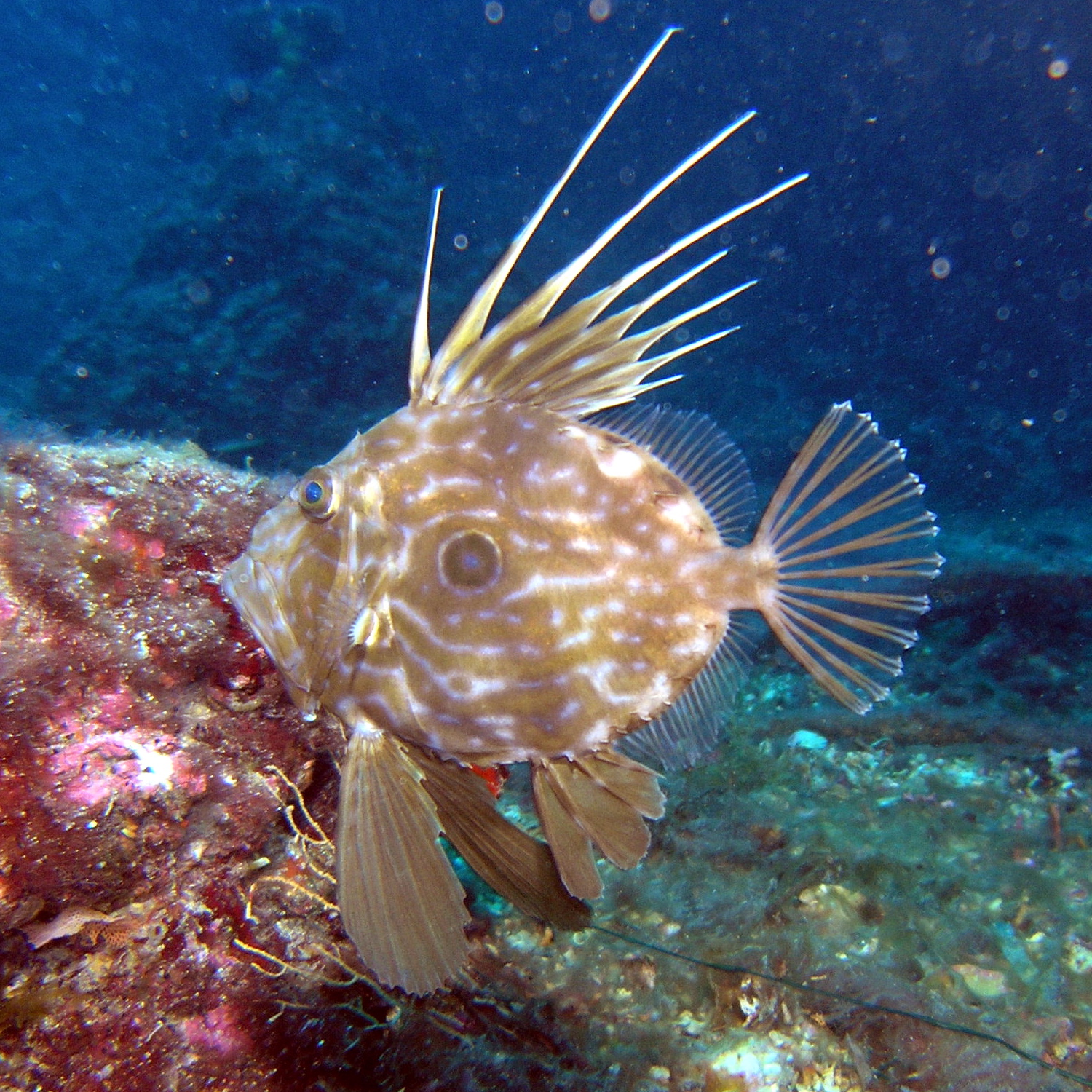
John Dory, St Pierre, or Peter's fish, refers to fish of the genus Zeus, especially Zeus faber, of widespread distribution. It is an edible demersal coastal marine fish with a laterally compressed olive-yellow body which has a large dark spot, and long spines on the dorsal fin. Its large eyes at the front of the head provide it with binocular vision and depth perception, which are important for predators. The John Dory's eye spot on the side of its body also confuses prey, which are scooped up in its large mouth.
In New Zealand, Māori know it as kuparu, and on the East Coast of the North Island, they gave some to Captain James Cook on his first voyage to New Zealand in 1769. Several casks of them were pickled.
The John Dory belongs to an ancient lineage of fish known from fossils since the Late Cretaceous, with fossils of the genus Zeus being known as far back as the Oligocene. Formerly, fossils from the Oligocene of Poland and the Late Miocene of Italy & Algeria were attributed to this species, but more recent studies have now consider these to be their own species: Zeus jerzmanskae and Zeus primaevus. The only fossils known of Z. faber itself are from the Pleistocene of Italy.
The name dory is attested from 1440, derived from the French dorée 'gilded', a French name for the fish. The addition of "John" appears in 1609, and probably comes from a 17th-century song about a sea captain, John Dory. Etymologies claiming it comes from the French jaune dorée (meaning "golden yellow") which sounds like 'John Dory' in English, or the Italian gianitore 'janitor' are now rejected.
A legend says that the dark spot on the fish's flank is St. Peter's thumbprint. In the north coast of Spain, it is known commonly as San Martiño, or San Martín. The Māori-language name for the fish, kuparu, appears to be unique to New Zealand, as there are no cognates found in other Polynesian languages.
The John Dory grows to a maximum size of 65 cm (26 in) and a maximum weight of 5 kg (11 lb). It has 10 long spines on its dorsal fin and 4 spines on its anal fin. It has microscopic, sharp scales that run around the body. The fish is an olive green color with a silver white belly and has a dark spot on its side. Its eyes are near the top of its head. It has a flat, round body shape and is a poor swimmer.[citation needed]
The John Dory catches prey by stalking it, then extending its jaw forward in a tube-like structure to suck the fish in with some water. The water then flows out through the gills; the pre-maxillary bone, the only tooth-bearing bone in this fish, is used to grind the food.
The John Dory has a high laterally compressed body – its body is so thin it can hardly be seen from the front. The large eyes at the front of the head provide it with the binocular vision and depth perception it needs to catch prey. This eye spot also confuses prey, which can then be sucked into its mouth.
Hub AI
John Dory AI simulator
(@John Dory_simulator)
John Dory
John Dory, St Pierre, or Peter's fish, refers to fish of the genus Zeus, especially Zeus faber, of widespread distribution. It is an edible demersal coastal marine fish with a laterally compressed olive-yellow body which has a large dark spot, and long spines on the dorsal fin. Its large eyes at the front of the head provide it with binocular vision and depth perception, which are important for predators. The John Dory's eye spot on the side of its body also confuses prey, which are scooped up in its large mouth.
In New Zealand, Māori know it as kuparu, and on the East Coast of the North Island, they gave some to Captain James Cook on his first voyage to New Zealand in 1769. Several casks of them were pickled.
The John Dory belongs to an ancient lineage of fish known from fossils since the Late Cretaceous, with fossils of the genus Zeus being known as far back as the Oligocene. Formerly, fossils from the Oligocene of Poland and the Late Miocene of Italy & Algeria were attributed to this species, but more recent studies have now consider these to be their own species: Zeus jerzmanskae and Zeus primaevus. The only fossils known of Z. faber itself are from the Pleistocene of Italy.
The name dory is attested from 1440, derived from the French dorée 'gilded', a French name for the fish. The addition of "John" appears in 1609, and probably comes from a 17th-century song about a sea captain, John Dory. Etymologies claiming it comes from the French jaune dorée (meaning "golden yellow") which sounds like 'John Dory' in English, or the Italian gianitore 'janitor' are now rejected.
A legend says that the dark spot on the fish's flank is St. Peter's thumbprint. In the north coast of Spain, it is known commonly as San Martiño, or San Martín. The Māori-language name for the fish, kuparu, appears to be unique to New Zealand, as there are no cognates found in other Polynesian languages.
The John Dory grows to a maximum size of 65 cm (26 in) and a maximum weight of 5 kg (11 lb). It has 10 long spines on its dorsal fin and 4 spines on its anal fin. It has microscopic, sharp scales that run around the body. The fish is an olive green color with a silver white belly and has a dark spot on its side. Its eyes are near the top of its head. It has a flat, round body shape and is a poor swimmer.[citation needed]
The John Dory catches prey by stalking it, then extending its jaw forward in a tube-like structure to suck the fish in with some water. The water then flows out through the gills; the pre-maxillary bone, the only tooth-bearing bone in this fish, is used to grind the food.
The John Dory has a high laterally compressed body – its body is so thin it can hardly be seen from the front. The large eyes at the front of the head provide it with the binocular vision and depth perception it needs to catch prey. This eye spot also confuses prey, which can then be sucked into its mouth.