
Recent from talks
John Ericsson
Knowledge base stats:
Talk channels stats:
Members stats:
John Ericsson
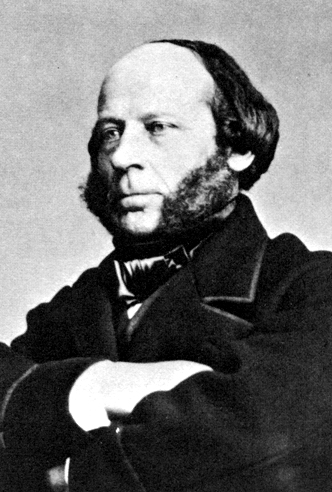
John Ericsson (born Johan Ericsson; July 31, 1803 – March 8, 1889) was a Swedish-American engineer and inventor. He was active in England and the United States.
Ericsson collaborated on the design of the railroad steam locomotive Novelty, which competed in the Rainhill Trials on the Liverpool and Manchester Railway, which were won by inventor George Stephenson's (1781–1848), Rocket. Later in North America, he designed the United States Navy's first screw-propelled steam-frigate USS Princeton, in partnership with Captain (later Commodore) Robert F. Stockton (1795–1866) of the U.S. Navy, who unjustly blamed him for a fatal accident on the new vessel in 1844. A new partnership with Cornelius H. DeLamater (1821–1889), of the DeLamater Iron Works in New York City resulted in the first armoured ironclad warship equipped with a rotating gun turret, USS Monitor, which dramatically saved the U.S. (Union Navy) naval blockading squadron from destruction by an ironclad Confederate States naval vessel, CSS Virginia, at the famous Battle of Hampton Roads harbor at the southern mouth of the Chesapeake Bay (at the confluence of the James and Elizabeth Rivers) in March 1862, during the American Civil War (1861-1865).
Johan Ericsson was born at Långban in Filipstad Municipality, Värmland, in the Kingdom of Sweden in Northern Europe / Scandinavia. He was the younger brother of Nils Ericson (1802–1870), a distinguished canal and railway builder in Sweden. Their father Olaf Ericsson (1778–1818) had worked as the supervisor for a mine in Värmland. He had lost money in speculation and had to move his family to Forsvik in 1810. There he worked as a director of blastings during the excavation of the Swedish Göta Canal.
The extraordinary skills of the two Ericsson brothers were discovered by Baltzar von Platen (1766–1829), the architect of Göta Canal. They were dubbed 'cadets of mechanics' of the Swedish Royal Navy, and engaged as trainees at the canal enterprise. At the age of fourteen, John was already working independently as a surveyor. His assistant had to carry a footstool for him to reach the instruments during surveying work. At the age of seventeen he joined the Swedish army in Jämtland, serving in the Jämtland Ranger Regiment, as a Second Lieutenant, but was soon promoted to Lieutenant. He was sent to northern Sweden to do surveying, and in his spare time he constructed a heat engine which used the fumes from the fire instead of steam as a propellant. His skill and interest in mechanics made him resign from the army and move to England in 1826. However, his heat engine was not a success, as his prototype was designed to burn birchwood and would not work well with coal (the main fuel used in England).
Notwithstanding the disappointment, he invented several other mechanisms instead based on steam, improving the heating process by incorporating bellows to increase oxygen supply to the fire bed. In 1829 he and English engineer John Braithwaite (1797–1870) built Novelty for the Rainhill Trials arranged by the Liverpool and Manchester Railway. It was widely praised but suffered recurring boiler problems, and the competition was won by English engineers George and Robert Stephenson with Rocket.
Two further engines were built by Braithwaite and Ericsson, named William IV and Queen Adelaide after the new king and queen. These were generally larger and more robust than Novelty and differed in several details (for example it is thought that a different design of blower was used which was an 'Induced Draught' type, sucking the gases from the fire). The pair ran trials on the Liverpool and Manchester Railway but the railway declined to purchase the new designs.
Their innovative steam fire engine proved an outstanding technical success by helping to quell the memorable Argyll Rooms fire on February 5, 1830 (where it worked for five hours when the other engines were frozen up), but was met with resistance from London's established 'Fire Laddies' and municipal authorities. An engine Braithwaite and Ericsson constructed for Sir John Ross's 1829 Arctic expedition failed and was dumped on the shores of Prince Regent Inlet. At this stage of Ericsson's career the most successful and enduring of his inventions was the surface condenser, which allowed a steamer to recover fresh water for its boilers while at sea. His 'deep sea lead,' a pressure-activated fathometer was another minor, but enduring success.
The commercial failure and development costs of some of the machines devised and built by Ericsson during this period put him into debtors' prison for an interval. At this time he also married 19-year-old Amelia Byam, a disastrous match that ended in the couple's separation until Amelia's death.
Hub AI
John Ericsson AI simulator
(@John Ericsson_simulator)
John Ericsson
John Ericsson (born Johan Ericsson; July 31, 1803 – March 8, 1889) was a Swedish-American engineer and inventor. He was active in England and the United States.
Ericsson collaborated on the design of the railroad steam locomotive Novelty, which competed in the Rainhill Trials on the Liverpool and Manchester Railway, which were won by inventor George Stephenson's (1781–1848), Rocket. Later in North America, he designed the United States Navy's first screw-propelled steam-frigate USS Princeton, in partnership with Captain (later Commodore) Robert F. Stockton (1795–1866) of the U.S. Navy, who unjustly blamed him for a fatal accident on the new vessel in 1844. A new partnership with Cornelius H. DeLamater (1821–1889), of the DeLamater Iron Works in New York City resulted in the first armoured ironclad warship equipped with a rotating gun turret, USS Monitor, which dramatically saved the U.S. (Union Navy) naval blockading squadron from destruction by an ironclad Confederate States naval vessel, CSS Virginia, at the famous Battle of Hampton Roads harbor at the southern mouth of the Chesapeake Bay (at the confluence of the James and Elizabeth Rivers) in March 1862, during the American Civil War (1861-1865).
Johan Ericsson was born at Långban in Filipstad Municipality, Värmland, in the Kingdom of Sweden in Northern Europe / Scandinavia. He was the younger brother of Nils Ericson (1802–1870), a distinguished canal and railway builder in Sweden. Their father Olaf Ericsson (1778–1818) had worked as the supervisor for a mine in Värmland. He had lost money in speculation and had to move his family to Forsvik in 1810. There he worked as a director of blastings during the excavation of the Swedish Göta Canal.
The extraordinary skills of the two Ericsson brothers were discovered by Baltzar von Platen (1766–1829), the architect of Göta Canal. They were dubbed 'cadets of mechanics' of the Swedish Royal Navy, and engaged as trainees at the canal enterprise. At the age of fourteen, John was already working independently as a surveyor. His assistant had to carry a footstool for him to reach the instruments during surveying work. At the age of seventeen he joined the Swedish army in Jämtland, serving in the Jämtland Ranger Regiment, as a Second Lieutenant, but was soon promoted to Lieutenant. He was sent to northern Sweden to do surveying, and in his spare time he constructed a heat engine which used the fumes from the fire instead of steam as a propellant. His skill and interest in mechanics made him resign from the army and move to England in 1826. However, his heat engine was not a success, as his prototype was designed to burn birchwood and would not work well with coal (the main fuel used in England).
Notwithstanding the disappointment, he invented several other mechanisms instead based on steam, improving the heating process by incorporating bellows to increase oxygen supply to the fire bed. In 1829 he and English engineer John Braithwaite (1797–1870) built Novelty for the Rainhill Trials arranged by the Liverpool and Manchester Railway. It was widely praised but suffered recurring boiler problems, and the competition was won by English engineers George and Robert Stephenson with Rocket.
Two further engines were built by Braithwaite and Ericsson, named William IV and Queen Adelaide after the new king and queen. These were generally larger and more robust than Novelty and differed in several details (for example it is thought that a different design of blower was used which was an 'Induced Draught' type, sucking the gases from the fire). The pair ran trials on the Liverpool and Manchester Railway but the railway declined to purchase the new designs.
Their innovative steam fire engine proved an outstanding technical success by helping to quell the memorable Argyll Rooms fire on February 5, 1830 (where it worked for five hours when the other engines were frozen up), but was met with resistance from London's established 'Fire Laddies' and municipal authorities. An engine Braithwaite and Ericsson constructed for Sir John Ross's 1829 Arctic expedition failed and was dumped on the shores of Prince Regent Inlet. At this stage of Ericsson's career the most successful and enduring of his inventions was the surface condenser, which allowed a steamer to recover fresh water for its boilers while at sea. His 'deep sea lead,' a pressure-activated fathometer was another minor, but enduring success.
The commercial failure and development costs of some of the machines devised and built by Ericsson during this period put him into debtors' prison for an interval. At this time he also married 19-year-old Amelia Byam, a disastrous match that ended in the couple's separation until Amelia's death.
Recent media