


Community hub
Recent from talks
Contribute something
Nothing was collected or created yet.
Johnny Raper
View on Wikipedia
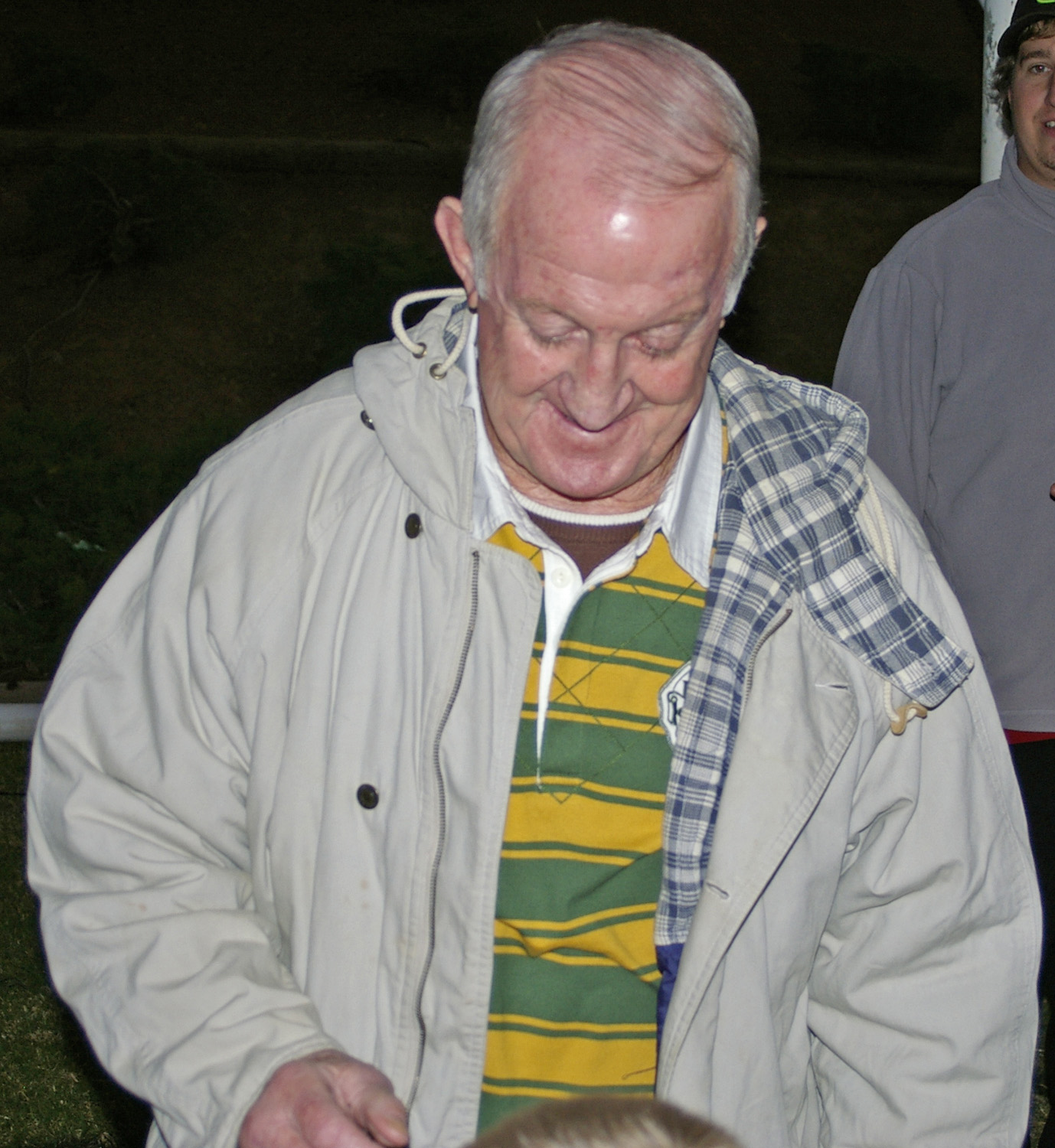
John William Raper MBE (12 April 1939 – 9 February 2022) was an Australian professional rugby league footballer and coach. Nicknamed "Chook", he was a lock-forward who earned a then-record of 33 Test caps in the Australia national team between 1959 and 1968. He also played six World Cup games between 1960 and 1968.[2] Raper captained Australia on eight occasions from 1967 to 68 and played in eight consecutive NSWRFL first-grade grand final victories for the St George Dragons club. He was named as one of the nation's finest footballers of the 20th century.[3]
Key Information


Early life
[edit]Raper was born in Camperdown and grew up in Revesby in south-western Sydney in a working-class family with nine boys. He played his junior rugby league for the Camperdown Dragons before representing Newtown's President's Cup side in 1956.[4]
Professional playing career
[edit]Sydney
[edit]Raper joined and made his first grade debut for Newtown in 1957 as an eighteen-year-old.[5] Despite becoming a much lauded lock forward, in his 1957 debut season with the Newtown “Bluebags” (as the team was known then) Raper played in the second row in all of his first grade appearances except one when he played at five-eighth.[6] And throughout the 1958 season for Newtown first grade he played at five-eighth except for one game at centre and one game in the second row.[7] During the 1958 season he had his first taste of representative football against elite opposition when selected to play for combined Sydney against the visiting Great Britain team and then for New South Wales Colts against the British tourists. In both these representative games Raper played at lock forward and opposed one of the great locks of that era in Britain’s Vince Karalius.[8]
In 1959 Raper joined St George as a lock forward and in this position he became an international rugby league star. His legendary cover defence and ball skills saw him acknowledged during his playing career as the best loose-forward the world had ever seen. He played in eight Grand final wins with St George between 1959 and 1966.[2]
Raper attributed his success to a training discipline and fitness fanaticism that was ahead of its time. While St George's early adoption of circuit training in the late 1950s was a major contributing factor in their eleven-year premiership run, Raper's own commitment to additional running and weights every day and often alone, enabled him to achieve a personal goal of being the fittest player in the fittest team in the competition.[9] In 1959–60 he made the first of his three Kangaroo tours, scoring a try on debut in the third Test loss vs Great Britain at Wigan. For the next ten years he was rarely, except for injury, out of the Australian Test team.
Raper's performance in the second Test of the 1963 tour at Swinton which saw the Kangaroos register the biggest win in Anglo-Australian Test history and become the first Australian touring team in fifty years to win the Ashes was pivotal. In the 50–12 victory, Raper had a hand in the first seven tries in the opening 25-minute routing and he gave the final pass in four of them.[10]
In his third Kangaroo tour of 1967–68 Raper suffered a cheekbone fracture in the opening 16–11 Test loss causing him to miss the second Test won by Australia to keep the series alive. Captain-coach Reg Gasnier had broken a leg in the first Test so Raper upon his return to fitness, was deputised and earned the ultimate Australian rugby league honour captaining his country in the 11–3 win over Great Britain played in icy conditions on a frozen ground in Swinton on 21 October 1967.
Raper went on to captain Australia in the first and third Tests against France in 1967–68. Queenslander Peter "Pedro" Gallagher was the captain for the second Test when Raper was injured. For the 1968 World Cup Raper captained Australia in their four undefeated games of the tournament including the 20–2 victory against France in the final at the Sydney Cricket Ground.
Raper's last season with St. George was in 1969 as captain-coach. In 1969 he appeared as a guest player for Auckland in a match against the New Zealand national rugby league team to mark the New Zealand Rugby League's diamond jubilee.[11] Raper was awarded Life Membership of the St. George Dragons Club in 1971.[12]
Newcastle
[edit]Raper played three seasons with the Western Suburbs Rosellas in the Newcastle competition from 1970 to 1972. He captain coached the club and took them to victory in the 1970 grand final.[13] He finished his playing career with Kurri Kurri from 1973 to 1974.[2]
Statistics
[edit]Point scoring summary
| Games | Tries | Goals | F/G | Points |
|---|---|---|---|---|
| 223 | 57 | 4 | – | 179 |
Coaching career
[edit]Raper returned to Sydney as coach of the Cronulla-Sutherland Sharks in 1975 and 1976, commencing an association with that club later carried on by his sons Stuart and Aaron. He also coached a Lane Cove Rugby Union Club team to victory in the Judd Cup suburban competition in 1977.[14] After five games of the 1978 NSWRFL season and internal turmoil leading to the resignation of first-grade coach Paul Broughton,[15] Raper took over as coach of the Newtown Jets in a caretaker capacity.
Post football life and accolades
[edit]In retirement Raper for a time played a larger-than-life celebrity role: making a record, appearing in commercials for a tyre company and the Liberal party and as an in-demand speaker and guest on radio and TV talk shows. Much higher honours were to follow: an award of a Member of the Order of the British Empire; selection in 1985 as one of the initial four post-war "Immortals" of the Australian game with Churchill, Gasnier and Fulton; appointment in 1988 as an Australian Test selector and representative of the New South Wales Rugby League. Raper was also inducted into the Sport Australia Hall of Fame in 1985.[16] Always regarded as a larrikin in his playing days, Raper is now seen as one of Rugby League's most ardent ambassadors and senior statesmen. In 2000, his portrait was entered into the Archibald Prize. In 2002 Raper was inducted into the Australian Rugby League Hall of Fame. In 2007 he was selected by a panel of experts at lock in an Australian 'Team of the 50s'.[17]
In February 2008, Raper was named in the list of Australia's 100 Greatest Players (1908–2007) which was commissioned by the NRL and ARL to celebrate the code's centenary year in Australia.[18][19] Raper went on to be named as lock in Australian rugby league's Team of the Century. Announced on 17 April 2008, the team is the panel's majority choice for each of the thirteen starting positions and four interchange players.[20][21] While playing football, Raper also served in the New South Wales Police Force and in 2008, rugby league's centenary year in Australia, he was named at lock-forward in a NSW Police team of the century. In 2008 New South Wales announced their rugby league team of the century also, and again Raper was named at lock.[22] Raper was named captain and second-row forward in the Western Suburbs Rosellas’ team of the century. On 20 July 2022, Raper was named in the St. George Dragons District Rugby League Clubs team of the century at lock.[23]
Death
[edit]Raper spent the last four years of his life in a nursing home, having been diagnosed with dementia. He died on 9 February 2022 in Caringbah, Sydney, at the age of 82.[24]
Footballing relatives
[edit]A number of Raper's brothers had success in top-grade rugby league. Ron played a 128-game career for Canterbury over seven seasons from 1966, kicking a field-goal from the halfway line in their 1967 Grand final loss to South Sydney. He played out the end of his career as captain/coach at Wests Brisbane and made two representative appearances for Queensland in 1973. Maurie Raper played eighty-seven first grade matches for Penrith and Cronulla in an eight-year career; Gerard made two first grade appearances for Canterbury in 1977; and Peter, two appearances for Newtown while Michael played in lower grades.[25]
Johnny's son Aaron played as a hooker for Cronulla and Parramatta from 1990 to 1998. During Aaron's exceptional 1992 season he was touted to become the top hooker in Australia, however, an exceptionally bad run with injuries, including a severe blood clot that threatened his life during 1994, prevented Aaron from ever reaching the greater heights. Aaron played representative rugby league only during the Super League war in 1995. He later moved to England but in 2010 made a return to Sydney and played in the Illawarra competition.
Sources
[edit]- Whiticker, Alan (2004) Captaining the Kangaroos, New Holland, Sydney
- Writer, Larry (1995) Never Before, Never Again, Pan MacMillan, Sydney
- Whiticker, Alan & Hudson, Glen (2006) The Encyclopedia of Rugby League Players, Gavin Allen Publishing, Sydney
Footnotes
[edit]- ^ John Raper rugbyleagueproject.org
- ^ a b c Whiticker/Hudson p. 451
- ^ Century’s Top 100 Players Archived 25 February 2008 at the Wayback Machine
- ^ Pemier and Cabinet (17 February 2022). "State Funeral at SCG for rugby league Immortal John Raper MBE | NSW Government". Archived from the original on 17 February 2022.
- ^ Toby Creswell and Samantha Trenoweth (2006). 1001 Australians You Should Know. Australia: Pluto Press. p. 422. ISBN 978-1-86403-361-8.
- ^ See weekly team listings in The Rugby League News available at trove.nla.gov.au under Magazines & Newsletters
- ^ See weekly team listings in The Rugby League News available at trove.nla.gov.au under Magazines & Newsletters
- ^ See The Rugby League News for May 31 and August 14, 1958, available at trove.nla.gov.au under Magazines & Newsletters
- ^ Writer p.300
- ^ SMH Obituary 10Feb2022 Roy Masters
- ^ Coffey, John and Bernie Wood Auckland, 100 years of rugby league, 1909–2009, 2009. ISBN 978-1-86969-366-4. p.p.207-208
- ^ The Sydney Morning Herald: 9 December 1971 (page 13)
- ^ "West Rosellas RLFC Newcastle – Team of the Century". westrosellas.com.au. West Rosellas RLFC. Retrieved 30 April 2011.
- ^ Rugby League Week, 10 September 1977
- ^ 'Raper takes over the reins'; in Sydney Morning Herald; 28 April 1978; p. 18
- ^ "John Raper". Sport Australia Hall of Fame. Retrieved 25 September 2020.
- ^ AAP (1 August 2007). "Team of the 50s named". The Daily Telegraph. Australia: News Limited. Retrieved 6 October 2010.
- ^ Peter Cassidy (23 February 2008). "Controversy reigns as NRL releases top 100 players". Macquarie National News. Archived from the original on 25 February 2008. Retrieved 23 February 2008.
- ^ "Centenary of Rugby League – The Players". NRL & ARL. 23 February 2008. Archived from the original on 26 February 2008. Retrieved 23 February 2008.
- ^ Todd Balym (17 April 2008). "Johns, Meninga among Immortals". Fox Sports Australia. Archived from the original on 7 September 2012. Retrieved 17 April 2008.
- ^ "Team of the Century Announced". NRL & ARL. 17 April 2008. Archived from the original on 21 May 2010. Retrieved 17 April 2008.
- ^ ARL (2008). "Australian Rugby Football League 2008 Annual Report" (PDF). Australian Rugby Football League Limited. p. 30. Archived from the original (PDF) on 17 March 2012. Retrieved 19 July 2009.
- ^ "Gasnier joins Immortals in St George Dragons 'Team of the Century'". www.nrl.com. 20 July 2022.
- ^ "Rugby league Immortal Johnny Raper dead at 82". Sydney Morning Herald. 9 February 2022.
- ^ Whiticker/Hudson p. 452
External links
[edit]
| International | |
|---|---|
| National | |
| People | |

Johnny Raper
View on GrokipediaEarly life
Childhood and family
Johnny Raper was born on 12 April 1939 in Camperdown, New South Wales, to working-class parents Arthur and Irene Raper.[4][5] As the eldest of nine boys, Raper grew up in a large family.[6][7] The family resided in inner-city suburbs including Camperdown and Newtown, where the socio-economic environment was marked by modest housing, industrial work, and resilient community ties amid economic recovery. The family later moved to Revesby in south-western Sydney.[8] In these edgy, pre-gentrified Newtown streets, Raper and his brothers engaged in rough street play and physical activities that honed their toughness, with the constant presence of siblings fostering a competitive family dynamic centered on outdoor exertion.[8] This upbringing, influenced by his father's labor-intensive background and the boisterous energy of eight brothers, sparked Raper's early passion for sports as a natural outlet for the family's high-spirited, active lifestyle.[6]Junior football
Johnny Raper began his organized rugby league journey in the early 1950s with the Camperdown Dragons, a junior club in the Canterbury-Bankstown district, where he honed his skills amid the competitive local scene.[4] As the eldest of nine brothers raised in Sydney's working-class suburbs, Raper's early exposure to the sport built the toughness that defined his later career.[9] By 1956, at age 17, Raper transferred to the Newtown Jets' junior system, joining their President's Cup representative team after providing a false address to meet eligibility requirements.[10] Initially experimenting with backline roles such as centre and five-eighth, he demonstrated versatility before transitioning to the forwards, where his physicality began to shine.[10] That year, Raper contributed significantly to Newtown's President's Cup premiership victory, a key achievement that showcased his potential and paved the way for higher-level opportunities.[8] In 1957, at 18 years old, Raper was graded by the Newtown Jets, marking the start of his professional pathway as he prepared for senior competition.[4]Club playing career
Newtown Jets
Johnny Raper began his first-grade career with the Newtown Jets in 1957, making his debut at age 18 after playing juniors for the Camperdown Dragons.[1] He played two seasons with Newtown as a versatile back, appearing in 37 first-grade games and scoring 10 tries.[11] During this time, he honed his skills before transferring to St. George in 1959.[2]St. George Dragons
Johnny Raper transferred to the St. George Dragons in 1959 after two seasons with Newtown, where he had honed his skills as a versatile back, convinced by club secretary Frank Facer to join the premiership contenders.[2] He played 185 first-grade games for the Dragons from 1959 to 1969, primarily as a second-rower and lock, becoming a cornerstone of one of rugby league's greatest dynasties.[1] Raper played a pivotal role in St. George's unprecedented run of eight consecutive NSWRFL premierships from 1959 to 1966, appearing in every grand final during that period and contributing to the team's dominance through his defensive tenacity and forward momentum. In the 1962 grand final, a rain-soaked 9-6 victory over Western Suburbs Magpies at the Sydney Cricket Ground, Raper covered multiple positions, including lock and five-eighth, helping secure the win with his all-around play amid slippery conditions.[12] His experience from Newtown provided a solid foundation for thriving in St. George's high-stakes environment.[4] Renowned for his copybook tackling technique—featuring scything low dives that neutralized attackers—and instinctive ball-handling that created opportunities for teammates, Raper exemplified the forward's craft during St. George's golden era.[2] He formed key partnerships in the backline and forwards, notably with fullback Graeme Langlands, whose long-range kicks complemented Raper's cover defense and offloads, enhancing the team's fluid attacking dynamics. Raper's perpetual motion and leadership in the pack were instrumental in maintaining St. George's edge, as seen in his eight consecutive tackles in a single sequence during a match, underscoring his relentless contribution to the club's success.[13]Newcastle
In 1970, after concluding his Sydney-based career, Johnny Raper relocated to Newcastle and took on the role of captain-coach for Western Suburbs in the Newcastle Rugby League.[14][10] Under his leadership, Western Suburbs reached the grand final that season and secured victory over Maitland by a score of 21–14, marking a successful debut year in the regional competition.[14] Raper played 40 games for Western Suburbs across three seasons (1970–1972), transitioning from the high-stakes intensity of the New South Wales Rugby Football League to the more community-oriented Newcastle Rugby League.[14][4] He continued his playing career in 1973–1974 as captain-coach for Kurri Kurri, retiring at the end of the 1974 season after five years total in the Newcastle competition.[15][4] Raper's storied premiership success with St. George earned him immediate admiration among local players and fans in Newcastle.[4]Career statistics
Johnny Raper's club career in first-grade rugby league primarily occurred in the New South Wales Rugby Football League (NSWRFL) premiership, where he amassed 222 appearances across two clubs, scoring 57 tries and 4 goals for a total of 179 points. As a forward, his scoring was limited, reflecting his role focused on defense and ball-winning rather than attack. He predominantly played as a lock, with additional games in the second row position, contributing to his reputation for tireless work rate in an era without advanced metrics like tackles, though contemporary accounts highlight his exceptional involvement in every play.[1][16][13] Raper's NSWRFL first-grade record is broken down by club as follows:| Club | Seasons | Games | Tries | Goals | Points |
|---|---|---|---|---|---|
| Newtown | 1957–1958 | 37 | 10 | 0 | 30 |
| St. George | 1959–1969 | 185 | 47 | 4 | 149 |
| Total | 1957–1969 | 222 | 57 | 4 | 179 |