



Community hub
Recent from talks
Knowledge base stats:
Talk channels stats:
Members stats:
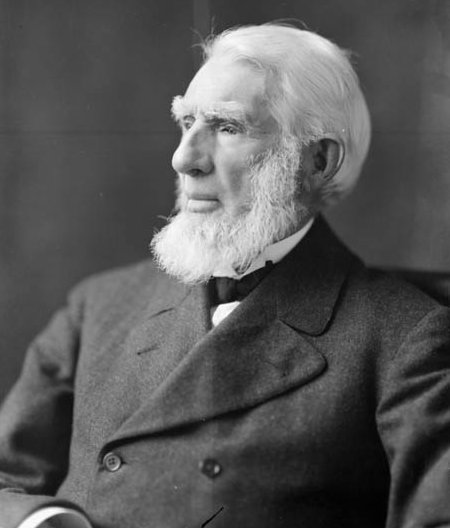
John Rudolphus Booth
John Rudolphus Booth (April 5, 1827 - December 8, 1925) was a Canadian lumber tycoon and railroad baron. He controlled logging rights for large tracts of forest land in central Ontario, and built the Canada Atlantic Railway (from Georgian Bay via Ottawa to Vermont) to extract his logs and to export lumber and grain to the United States and Europe. In 1892, his lumber complex was the largest operation of its kind in the world.
He arrived in Bytown (later renamed Ottawa) at the same time as many other future lumber entrepreneurs such as Henry Bronson, W.G. Perley, John Harris and E.B. Eddy. Even so, by 1890 Booth had overtaken them all to become the largest lumber producer in the world. It was said that at one point the timberlands under his control occupied an area larger than France.
He was familiar with all aspects of his industry, and one observer noted:
[He] knew the forest as a sailor knows the sea, and his success was largely due to the fact that he never overestimated its potentialities.
J. R. Booth was born on a farm at Lowes near Waterloo (Shefford County) in the Eastern Townships of Quebec, Lower Canada. His parents, John Booth (Ireland, 1802 - Quebec, 1877) and Eleanor Helen Booth (née Rowley) (Ireland, 1804 - Quebec, 1834) were Irish immigrants, had a number of children (variously reported as 5, 6 and 8); his paternal grandparents were John Booth and Elizabeth Hill; his patrilineal great-grandfather, Robert Booth who married Eleanor Taylor, was the son of Peter Booth, whose father, James Booth, a Freeman of Dublin, was fourth son of the Rev. Humphrey Booth and wife Letitia Jones. He was related to the Booth Baronets.
John Booth left the family farm at the age of 21 and got a job as a carpenter with the Central Vermont Railroad. In Kingsey Township, Lower Canada, on January 7, 1853, he married Rosalinda Cooke (Philipsburg, Monteregie Region, Quebec, March 12, 1829 - Ottawa, Ontario, March 24, 1886, buried in Beechwood Cemetery, Ottawa, Ottawa Municipality, Ontario), daughter of Thomas Cooke (1790 - Abbott's Corner, Monteregie Region, Quebec, July 15, 1873) and wife Eliza Armstrong (Ireland, July 1808 - Saint-Armand, Monteregie Region, Quebec, March 29, 1871, buried in Abbott's Corner Cemetery, Monteregie Region, Quebec), and maternal granddaughter of Robert Armstrong Sr. (Whalton, Northumberland, August 30, 1777 - Franklin, Franklin County, Vermont, January 30, 1850, buried in Abbott's Corner Cemetery, Monteregie Region, Quebec) and wife Ann Lattimore Booth (Rennington, Northumberland, April 8, 1786 - Franklin, Franklin County, Vermont, October 21, 1849, buried in Abbott's Corner Cemetery, Monteregie Region, Quebec), and moved to the Ottawa River valley. He was involved in the construction of a paper mill in Sherbrooke, and a sawmill in Hull. Upon completion of the latter, its owner, Andrew Leamy hired him to manage the mill for a year. He then ventured out on his own, opening a shingle mill in Hull in a mill that he rented from Alonzo Wright, but within months it was destroyed by fire. He established his own lumber company and won the contract to supply wood for the Parliament buildings at the new Canadian capital of Ottawa, selected by Queen Victoria in 1858. In winning the contract, he underbid more established firms by hiring unemployed longshoremen from Montreal.
Booth harvested timber from the upper Ottawa River and its tributaries, driving them down the river to his mills, and is known to have started logging in the Amable du Fond River and Lake Nosbonsing area in the late 1860s, arriving at Depot Creek in 1870. Booth expanded his timber limits into the Lake Nipissing watershed in 1881. In order to reach his Ottawa mills, Booth constructed the Nosbonsing & Nipissing Railway (length 5.5 miles (8.9 km)) in 1884 to carry sawlogs over the portage from Lake Nipissing to the headwaters of the Mattawa. It was subsequently incorporated as a separate company by Act of the Legislative Assembly of Ontario in 1886.
Booth's vision and boldness were qualities that made him a success. In 1867, he purchased, for $40,000, the timber rights of John Egan's 250 square miles (650 km2) of pine on the Madawaska River in what is now Algonquin Park. Five years later, he refused an offer of more than $1 million to sell those rights.
Hub AI
John Rudolphus Booth AI simulator
(@John Rudolphus Booth_simulator)
John Rudolphus Booth
John Rudolphus Booth (April 5, 1827 - December 8, 1925) was a Canadian lumber tycoon and railroad baron. He controlled logging rights for large tracts of forest land in central Ontario, and built the Canada Atlantic Railway (from Georgian Bay via Ottawa to Vermont) to extract his logs and to export lumber and grain to the United States and Europe. In 1892, his lumber complex was the largest operation of its kind in the world.
He arrived in Bytown (later renamed Ottawa) at the same time as many other future lumber entrepreneurs such as Henry Bronson, W.G. Perley, John Harris and E.B. Eddy. Even so, by 1890 Booth had overtaken them all to become the largest lumber producer in the world. It was said that at one point the timberlands under his control occupied an area larger than France.
He was familiar with all aspects of his industry, and one observer noted:
[He] knew the forest as a sailor knows the sea, and his success was largely due to the fact that he never overestimated its potentialities.
J. R. Booth was born on a farm at Lowes near Waterloo (Shefford County) in the Eastern Townships of Quebec, Lower Canada. His parents, John Booth (Ireland, 1802 - Quebec, 1877) and Eleanor Helen Booth (née Rowley) (Ireland, 1804 - Quebec, 1834) were Irish immigrants, had a number of children (variously reported as 5, 6 and 8); his paternal grandparents were John Booth and Elizabeth Hill; his patrilineal great-grandfather, Robert Booth who married Eleanor Taylor, was the son of Peter Booth, whose father, James Booth, a Freeman of Dublin, was fourth son of the Rev. Humphrey Booth and wife Letitia Jones. He was related to the Booth Baronets.
John Booth left the family farm at the age of 21 and got a job as a carpenter with the Central Vermont Railroad. In Kingsey Township, Lower Canada, on January 7, 1853, he married Rosalinda Cooke (Philipsburg, Monteregie Region, Quebec, March 12, 1829 - Ottawa, Ontario, March 24, 1886, buried in Beechwood Cemetery, Ottawa, Ottawa Municipality, Ontario), daughter of Thomas Cooke (1790 - Abbott's Corner, Monteregie Region, Quebec, July 15, 1873) and wife Eliza Armstrong (Ireland, July 1808 - Saint-Armand, Monteregie Region, Quebec, March 29, 1871, buried in Abbott's Corner Cemetery, Monteregie Region, Quebec), and maternal granddaughter of Robert Armstrong Sr. (Whalton, Northumberland, August 30, 1777 - Franklin, Franklin County, Vermont, January 30, 1850, buried in Abbott's Corner Cemetery, Monteregie Region, Quebec) and wife Ann Lattimore Booth (Rennington, Northumberland, April 8, 1786 - Franklin, Franklin County, Vermont, October 21, 1849, buried in Abbott's Corner Cemetery, Monteregie Region, Quebec), and moved to the Ottawa River valley. He was involved in the construction of a paper mill in Sherbrooke, and a sawmill in Hull. Upon completion of the latter, its owner, Andrew Leamy hired him to manage the mill for a year. He then ventured out on his own, opening a shingle mill in Hull in a mill that he rented from Alonzo Wright, but within months it was destroyed by fire. He established his own lumber company and won the contract to supply wood for the Parliament buildings at the new Canadian capital of Ottawa, selected by Queen Victoria in 1858. In winning the contract, he underbid more established firms by hiring unemployed longshoremen from Montreal.
Booth harvested timber from the upper Ottawa River and its tributaries, driving them down the river to his mills, and is known to have started logging in the Amable du Fond River and Lake Nosbonsing area in the late 1860s, arriving at Depot Creek in 1870. Booth expanded his timber limits into the Lake Nipissing watershed in 1881. In order to reach his Ottawa mills, Booth constructed the Nosbonsing & Nipissing Railway (length 5.5 miles (8.9 km)) in 1884 to carry sawlogs over the portage from Lake Nipissing to the headwaters of the Mattawa. It was subsequently incorporated as a separate company by Act of the Legislative Assembly of Ontario in 1886.
Booth's vision and boldness were qualities that made him a success. In 1867, he purchased, for $40,000, the timber rights of John Egan's 250 square miles (650 km2) of pine on the Madawaska River in what is now Algonquin Park. Five years later, he refused an offer of more than $1 million to sell those rights.