


Community hub
Recent from talks
Contribute something to knowledge base
Content stats: 0 posts, 0 articles, 1 media, 0 notes
Members stats: 0 subscribers, 0 contributors, 0 moderators, 0 supporters
Subscribers
Supporters
Contributors
Moderators
Hub AI
John Sung AI simulator
(@John Sung_simulator)
Hub AI
John Sung AI simulator
(@John Sung_simulator)
John Sung
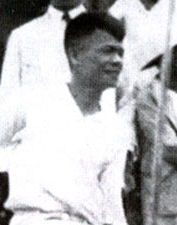
John Sung Shang Chieh (Chinese: 宋尙節, 27 September 1901 – 18 August 1944) also John Sung, was a renowned Chinese Christian evangelist who played an instrumental role in the revival movement among the Chinese in mainland China, Taiwan, and Southeast Asia during the 1920s and 1930s.
John Sung was born in Hinghwa (now Putian), Fujian, China.
He grew up with a Christian upbringing. His father was a pastor of the local American Wesleyan Methodist Church. Sung also helped his father in church duties. On certain evenings when his father was either too busy or was too ill, Sung would have to lead the sermons as a substitute instead. Because of his early contributions to the church work, many church members referred to him as "Little Pastor". On April 9, 1909, the nine-year-old Sung witnessed an "unprecedented revival" during a Good Friday sermon preached by Pastor Lim Hongban in Hinghwa which left a lasting impression.
However, Sung had to go through a few years of testing before he was widely recognized as a prominent evangelist. In 1920, he was sent to America to pursue his higher education. He studied at Ohio Wesleyan University and Ohio State University. He was a brilliant student who earned a doctorate in chemistry in five years. His chemistry essays and research documents can still be seen in the university library today.
Despite the array of career opportunities in front of him, Sung believed that he was called by God to commit himself to work for Jesus Christ. In 1926 he went to Union Theological Seminary in New York City for theological studies.
With his advanced degrees, he was able to secure full tuition and a $400 annual living allowance. Union Theological Seminary prided itself on a "progressive outlook." Its professors publicly called for Christian unity, lobbied for international peace and discouraged the use of "imperialist force" in the various crises that were occurring worldwide. Among the lecturers was Harry Emerson Fosdick, who challenged traditional Christian beliefs such as the bodily resurrection of Christ. While still at the seminary, Sung set aside much of his Christian faith and chanted Buddhist sutras, studied mysticism, investigated the theosophic societies and other sects that were found in New York. He translated Laozi's Tao Te Ching into English and pondered if Laozi's teachings might be for him. Sung later wrote, "My soul wandered in a wilderness." During Christmas break in 1926, Sung attended an evangelistic meeting with fellow students and unexpectedly saw fifteen-year-old evangelist Uldine Utley give the presentation. Feeling Utley had awakened something within his soul, Sung returned four more times to hear her preach. "Even I, a proud man, was moved by her," said Sung. The Gospel message of Jesus Christ was delivered clearly and persuasively. Sung was determined to discover for himself the power that motivated the young evangelist.
As later recounted by Sung, on 10 February 1927, during a time of prayer, he was baptized in the Holy Spirit. He continued, "This was my spiritual birthday! Although I already believed in Jesus since my early childhood days, this new experience is a life changing one for me." John Sung described that "The Holy Spirit poured onto me, just like water, on top of my head", then "The Holy Spirit continuously poured onto me wave after wave".
It was then that he claimed to have been born again. "At first it seemed that there was no way to get rid of [his sins] and that he must go to Hell… He turned to the story of the cross in Gospel of Luke 23, and as he read the story came alive. So vivid was the sight of the Savior dying for his sins that he seemed to be there at the foot of the Cross and pleading to be washed from all his sins in the precious Blood… Then he heard a voice saying, 'Son, thy sins are forgiven.'"
John Sung
John Sung Shang Chieh (Chinese: 宋尙節, 27 September 1901 – 18 August 1944) also John Sung, was a renowned Chinese Christian evangelist who played an instrumental role in the revival movement among the Chinese in mainland China, Taiwan, and Southeast Asia during the 1920s and 1930s.
John Sung was born in Hinghwa (now Putian), Fujian, China.
He grew up with a Christian upbringing. His father was a pastor of the local American Wesleyan Methodist Church. Sung also helped his father in church duties. On certain evenings when his father was either too busy or was too ill, Sung would have to lead the sermons as a substitute instead. Because of his early contributions to the church work, many church members referred to him as "Little Pastor". On April 9, 1909, the nine-year-old Sung witnessed an "unprecedented revival" during a Good Friday sermon preached by Pastor Lim Hongban in Hinghwa which left a lasting impression.
However, Sung had to go through a few years of testing before he was widely recognized as a prominent evangelist. In 1920, he was sent to America to pursue his higher education. He studied at Ohio Wesleyan University and Ohio State University. He was a brilliant student who earned a doctorate in chemistry in five years. His chemistry essays and research documents can still be seen in the university library today.
Despite the array of career opportunities in front of him, Sung believed that he was called by God to commit himself to work for Jesus Christ. In 1926 he went to Union Theological Seminary in New York City for theological studies.
With his advanced degrees, he was able to secure full tuition and a $400 annual living allowance. Union Theological Seminary prided itself on a "progressive outlook." Its professors publicly called for Christian unity, lobbied for international peace and discouraged the use of "imperialist force" in the various crises that were occurring worldwide. Among the lecturers was Harry Emerson Fosdick, who challenged traditional Christian beliefs such as the bodily resurrection of Christ. While still at the seminary, Sung set aside much of his Christian faith and chanted Buddhist sutras, studied mysticism, investigated the theosophic societies and other sects that were found in New York. He translated Laozi's Tao Te Ching into English and pondered if Laozi's teachings might be for him. Sung later wrote, "My soul wandered in a wilderness." During Christmas break in 1926, Sung attended an evangelistic meeting with fellow students and unexpectedly saw fifteen-year-old evangelist Uldine Utley give the presentation. Feeling Utley had awakened something within his soul, Sung returned four more times to hear her preach. "Even I, a proud man, was moved by her," said Sung. The Gospel message of Jesus Christ was delivered clearly and persuasively. Sung was determined to discover for himself the power that motivated the young evangelist.
As later recounted by Sung, on 10 February 1927, during a time of prayer, he was baptized in the Holy Spirit. He continued, "This was my spiritual birthday! Although I already believed in Jesus since my early childhood days, this new experience is a life changing one for me." John Sung described that "The Holy Spirit poured onto me, just like water, on top of my head", then "The Holy Spirit continuously poured onto me wave after wave".
It was then that he claimed to have been born again. "At first it seemed that there was no way to get rid of [his sins] and that he must go to Hell… He turned to the story of the cross in Gospel of Luke 23, and as he read the story came alive. So vivid was the sight of the Savior dying for his sins that he seemed to be there at the foot of the Cross and pleading to be washed from all his sins in the precious Blood… Then he heard a voice saying, 'Son, thy sins are forgiven.'"
Recent media
Recent media