Hubbry Logo
John of WorcesterJohn of WorcesterMain
Open search
John of Worcester
Community hub
John of Worcester
logo
8 pages, 0 posts
0 subscribers
Be the first to start a discussion here.
John of Worcester
John of Worcester
from Wikipedia

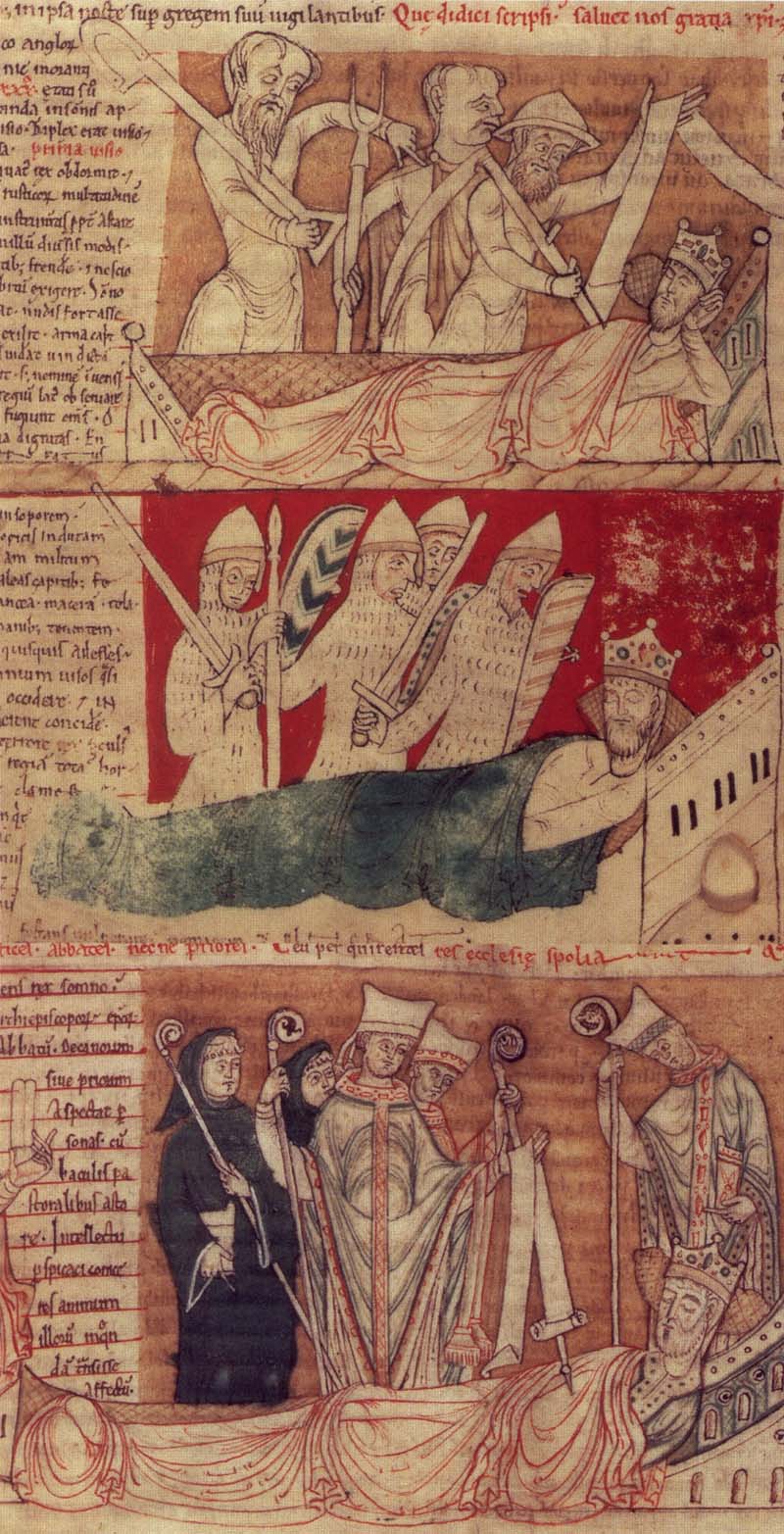
King Henry I's Dream in the Chronicle of John of Worcester. Corpus Christi College, Oxford.

John of Worcester (died c. 1140) was an English monk and chronicler who worked at Worcester Priory. He is now usually held to be the author of the Chronicon ex Chronicis.

Works

[edit]

John of Worcester's principal work was the Chronicon ex Chronicis (Latin for "Chronicle from Chronicles") or Chronicle of Chronicles (Chronica Chronicarum), also known as John of Worcester's Chronicle or Florence of Worcester's Chronicle. The Chronicon ex Chronicis is a world history which begins with the Creation and ends in 1140. The chronological framework of the Chronicon was presented by the chronicle of Marianus Scotus (d. 1082). A great deal of additional material, particularly relating to English history, was grafted onto it. These include a rendition of the Genealogia Lindisfarorum (Latin for "Genealogy of the people of Lindisfarne"), a putative genealogical list found in this and some other medieval manuscripts.

Authorship

[edit]

The greater part of the work, up to 1117 or 1118, was formerly attributed to Florence of Worcester on the basis of the entry for his death under the year 1118, which credits his skill and industry for making the chronicle such a prominent work.[1] In this view, the other Worcester monk, John, merely wrote the final part of the work. However, there are two main objections against the ascription to Florence. First, there is no change of style in the Chronicon after Florence's death, and second, certain sections before 1118 rely to some extent on the Historia Novorum ("History of New Things") of Eadmer of Canterbury, which was completed sometime in the period 1121–1124.[2]

The prevalent view today is that John of Worcester was the principal author and compiler. He is explicitly named as the author of two entries for 1128 and 1138, and two manuscripts (CCC MS 157 and the Chronicula) were written in his hand. He was seen working on it at the behest of Wulfstan, bishop of Worcester, when the Anglo-Norman chronicler Orderic Vitalis visited Worcester:

Ioannes Wigornensis a puero monachus, natione Anglicus, moribus et eruditione uenerandus, in his quæ Mariani Scotti cronicis adiecit, de rege Guillelmo et de rebus quæ sub eo uel sub filiis eius Guillelmo Rufo et Henrico usque hodie contigerunt honeste deprompsit. [...] Quem prosecutus Iohannes acta fere centum annorum contexuit, iussuque uenerabilis Wlfstani pontificis et monachi supradictis cronicis inseruit in quibus multa de Romanis et Francis et Alemannis aliisque gentibus quæ agnouit [...]. "John, an Englishman by birth who entered the monastery of Worcester as a boy and won great repute for his learning and piety, continued the chronicle of Marianus Scotus and carefully recorded the events of William's reign and of his sons William Rufus and Henry up to the present. [...] John, at the command of the venerable Wulfstan bishop and monk [d. 1095], added to these chronicles [i.e. of Marianus Scotus] events of about a hundred years, by inserting a brief and valuable summary of many deeds of the Romans and Franks, Germans and other peoples whom he knew [...]."[3]

Manuscripts

[edit]

The Chronicon survives in five manuscripts (and a fragment on a single leaf):

1128 sunspot drawing by John of Worcester. This is the earliest known drawing of a sunspot from anywhere in the world.[4]

In addition, there is the Chronicula, a minor chronicle based on the Chronicon proper: MS 503 (Dublin, Trinity College), written by John up to 1123.

Sources for English history

[edit]

For the body of material dealing with early English history, John is believed to have used a number of sources, some of which are now lost:

Editions and translations

[edit]
  • Darlington, Reginald R. and P. McGurk, eds. P. McGurk and Jennifer Bray (trs.). The Chronicle of John of Worcester: The Annals from 450–1066. Vol II. Oxford Medieval Texts. Oxford: 1995.
  • McGurk, P. ed. and tr., The Chronicle of John of Worcester: The Annals from 1067 to 1140 with the Gloucester Interpolations and the Continuation to 1141. Vol III. OMT. Oxford, 1998.
  • McGurk, P. and Woodman, D. A., ed. and trans., (2024), The Chronicle of John of Worcester: Volume IV, Chronicula, Oxford, UK: Oxford University Press, 978-0198916147
  • Thorpe, Benjamin, ed. (1848–1849), Florentii Wigorniensis Monachi Chronicon ex Chronicis... [Florence of Worcester's Chronicle from Chronicles] (in Latin), London.
  • Stevenson, J. (tr.). Church Historians of England. 8 vols: vol. 2.1. London, 1855. 171–372.
  • Forester, Thomas, ed. (1854), The Chronicle of Florence of Worcester with the Two Continuations Comprising Annals of English History from the Departure of the Romans to the Reign of Edward I., Bohn's Antiquarian Library, London: Henry G. Bohn{{citation}}: CS1 maint: ref duplicates default (link).
  • Weaver, J. R. H., ed. (1908) The Chronicle of John of Worcester, 1118–1140: being the continuation of the Chronicon ex Chronicis of Florence of Worcester. Oxford: Clarendon Press Edition on Archive.org

References

[edit]

Further reading

[edit]
Revisions and contributorsEdit on WikipediaRead on Wikipedia
from Grokipedia
John of Worcester (died c. 1140) was an English Benedictine monk and chronicler active at Worcester Cathedral Priory during the early twelfth century. He is now usually considered the primary author of the Chronica chronicarum, a comprehensive world chronicle extending from creation to 1140 that integrated universal history with detailed English annals. His work, preserved in the illuminated manuscript Oxford, Corpus Christi College, MS 157, built upon earlier efforts by predecessors like Florence of Worcester (d. 1118) and Marianus Scotus, incorporating revisions for chronological accuracy, astronomical data, and theological insights. Little is known of John's early life beyond his monastic vocation at Worcester, where he likely entered the priory around 1095 under the influence of Bishop Wulfstan (d. 1095), who initiated the chronicle project. As a scribe and scholar, John contributed his distinctive hand to the manuscript, evident in additions and corrections from the 1120s through the 1130s, reflecting his role in sustaining and expanding the priory's historiographical tradition amid the political upheavals of King Stephen's reign. His death around 1140 left the chronicle incomplete, but it influenced subsequent English histories at institutions like Coventry and Peterborough. Beyond the Chronica chronicarum, John is attributed authorship of the Chronicula, a concise version ending in 1123 (Trinity College Dublin, MS 503), and the Cronica de Anglia, an English-focused history from AD 162 to 1125 (, , Cotton MS Vitellius C.VIII). These works demonstrate his emphasis on episcopal lists, royal genealogies, and papal annals, advancing medieval English historiography by blending continental sources with local records and innovative scientific elements like computus calculations. The inclusion of unique illuminations, such as depictions of the and visions of Henry I, further highlights his multidisciplinary approach, merging history, , and astronomy.

Life

Monastic career at Worcester

John of Worcester entered monastic life as a at Priory, remaining active there until his death in 1140. As a member of the priory community in the decades following the of , he contributed to the monastic traditions of scholarship and preservation amid the integration of Norman governance and ecclesiastical reforms. His primary roles involved scribal work, including the copying, revising, and illustrating of manuscripts during the late eleventh and early twelfth centuries. John was recognized for his and learning, as noted by contemporary chronicler , who described him as "admirable for both and learning." These activities formed part of the daily monastic routine at Worcester, which emphasized liturgical observance, communal prayer, and intellectual labor in the , all under the Benedictine Rule adapted to post-Conquest realities such as increased Norman oversight of English religious houses. Evidence of John's scribal hand appears in several Worcester manuscripts, most notably , Corpus Christi College, MS 157, where his script is identifiable in sections such as lists of rulers and , revisions to papal annals up to Honorius II (1124–1130), and accompanying illustrations like tinted drawings of the and visions attributed to King Henry I. This , produced at the and terminating in 1140, exemplifies his meticulous approach to textual transmission and visual enhancement within the monastic workshop. During Wulfstan's tenure, John's historical writing was influenced by the , whose direction shaped aspects of his scholarly output.

Association with Bishop Wulfstan

Bishop Wulfstan II served as from 1062 until his death in 1095, becoming the last Anglo-Saxon prelate to retain his episcopal seat under the Norman regime following the of 1066. In an era of profound political and ecclesiastical upheaval, Wulfstan actively commissioned the compilation of historical records at Worcester Priory to safeguard Anglo-Saxon traditions, emphasizing the continuity of English royal and amid Norman efforts to reorganize and secularize monastic lands. This initiative reflected Wulfstan's commitment to preserving the priory's heritage, drawing on local archives to document events from the Anglo-Saxon period onward. John of Worcester, a and active at the during Wulfstan's tenure, collaborated closely with the on this historiographical project, assisting in the assembly of the Chronicon ex chronicis. Wulfstan personally instructed John to expand and continue earlier chronicles, such as those based on Marianus Scotus, with possible direct oversight on initial entries to incorporate Worcester-specific details like episcopal consecrations and benefactions. As a key figure in the , John benefited from Wulfstan's guidance, which integrated diverse sources into a cohesive narrative focused on institutions and royal successions. Wulfstan's influence profoundly shaped John's scholarly priorities, directing attention to the ecclesiastical and royal annals of as evidenced in priory cartularies and the chronicle's emphasis on Anglo-Saxon saints and bishops. A pivotal event underscoring this dynamic was Wulfstan's resistance to Norman secularization in 1075, when Archbishop attempted to deprive him of his see; Wulfstan's dramatic defense—laying his on the tomb of King Edward the , where it miraculously adhered—secured his position and reinforced the priory's autonomy. This stand against Norman encroachments invigorated Worcester's , promoting an intellectual milieu where historical writing served as a bulwark for traditional monastic values and local identity.

Chronicle

Overview and scope

The Chronica chronicarum, Latin for "Chronicle of Chronicles," represents the principal historical composition linked to John of Worcester, functioning as a comprehensive compilation that traces events from the biblical Creation of the world through to the year 1140. This universal history integrates diverse sources to form a continuous , reflecting the monastic of chronicling both global and local affairs to preserve knowledge and interpret in human events. The work exhibits a structure that balances broad chronological frameworks with focused regional detail: an initial segment covering world history up to 1082, drawing on earlier chronicles for a panoramic view of antiquity and medieval developments; a more elaborate treatment of English events from 1095 to 1140, highlighting political, social, and institutional changes. This organization allows for a seamless progression from universal origins to the immediate concerns of twelfth-century , with the later sections demonstrating increasing depth in eyewitness or near-contemporary reporting. As a Worcester-specific continuation of preceding annals, such as those maintained at the cathedral priory, the chronicle's purpose centered on documenting and analyzing and royal events to affirm the continuity of Anglo-Saxon traditions amid Norman rule, while underscoring the spiritual significance of historical patterns. It prioritizes the diocese's role in , weaving in details of bishopric activities, monastic life, and crown interactions to serve as both a record and a tool for moral reflection within the Worcester community. Among its distinctive elements, the Chronica chronicarum employs precise dating derived from Easter tables to synchronize disparate timelines, ensuring chronological accuracy across its vast scope, and incorporates astronomical observations—such as eclipses and —to illustrate the interplay between celestial signs and earthly occurrences, thereby elevating to a scientifically informed discipline. Handwriting analysis of the primary attributes primary authorship to John of Worcester.

Authorship attribution

In the early 19th century, the Chronica chronicarum was attributed to Florence of Worcester (d. 1118), a at Worcester Priory, primarily based on editions such as Benjamin Thorpe's 1848–1849 publication, which presented the work as Florence's composition up to 1118, with subsequent continuations by others. This attribution stemmed from an entry in the chronicle itself under the year 1118, which praised Florence's contributions to historical writing but did not explicitly claim authorship for the entire text. The attribution shifted in the 20th century toward John of Worcester (d. c. 1140), another Worcester monk, following paleographic analysis that identified his distinctive handwriting in key sections of surviving . Scholars such as R. R. Darlington and Patrick McGurk, in their editions of the chronicle, established John as the primary compiler and author of the core text, drawing on evidence from , MS 157—a semi-autograph where John's hand appears in revisions to papal lists up to Honorius II (1124–1130) and additions like the Frankish kings to Louis VI (d. 1137). Specific annals further support this: the 1128 entry, featuring the earliest known drawing of sunspots observed from Worcester, was added in John's script after erasing prior text, while the 1138 annal includes detailed references to astronomical tables, also in his hand. Although John collaborated with others at Worcester and acknowledged Florence's role, he is credited with the chronicle's overall structure and much of its content up to 1140, with anonymous continuators extending it afterward. Contemporary accounts, such as Orderic Vitalis's Ecclesiastical History, corroborate John's authorship by noting his additions of English royal reigns to earlier sources like Marianus Scotus's chronicle. This scholarly consensus, solidified by and McGurk's work in the , affirms John's primary responsibility for the Chronica chronicarum as a unified world history.

Manuscripts

Surviving copies

The Chronicon ex chronicis survives in five primary manuscripts, all dating to century and originating from the Worcester or closely associated centers between approximately 1122 and 1141. The principal manuscript, , Corpus Christi MS 157 (siglum C), is a working copy produced c. 1128–1140 by multiple scribes, including John of Worcester himself for the from 1128 onward, making it a semi-autograph exemplar that served as the archetype for the others. This manuscript covers the chronicle from creation to 1140, with later additions extending the to 1141 in a contemporary hand. The remaining four manuscripts are contemporary or near-contemporary copies derived from MS 157. , College MS 502 (siglum H), likely produced at in the mid-twelfth century, is a complete copy to 1140 with minor continuations. , Library MS 42 (siglum L), from Abingdon in the second quarter of the twelfth century, includes the full text to 1140 along with Abingdon-specific interpolations. , MS Bodley 297 (siglum B), copied at c. 1133–1143, preserves the chronicle to 1140 with additions to the early thirteenth century and local Bury . Cambridge, Corpus Christi College MS 92 (siglum P), produced at Abingdon in the third quarter of the twelfth century and later at , extends to 1131 with subsequent continuations to the mid-thirteenth century. These manuscripts vary in completeness and condition, with the core text uniformly ending in 1140, though post-1140 additions appear in several (e.g., up to 1152 in MS 42 and MS 92). Some suffered losses or damage over time, including marginal annotations and later folios, but none are fragmentary in their main body. John's distinctive scribal hand in MS 157, characterized by a clear Worcester style, provides key evidence for his direct involvement in authorship. Additionally, a shorter derivative known as the Chronicula, covering events to 1123 and in John's hand, survives in , College MS 503.

Illustrations and annotations

The manuscripts of John of Worcester's chronicle, particularly the semi-autograph Corpus Christi College MS 157, feature a rare set of illustrations that integrate visual elements with historical , marking an innovative approach in twelfth-century English . Among these, the most notable is the tinted of sunspots dated to 8 1128, depicting the sun as a golden orb with two prominent black spheres and surrounding penumbrae, accompanied by descriptive Latin text noting the phenomenon's visibility for over eight days. This illustration, executed in a precise scientific style, represents the earliest known graphical record of sunspots worldwide, predating similar depictions by centuries and highlighting Worcester's monastic interest in astronomy. Additional illustrations include simple astronomical sketches, such as diagrams of lunar and solar eclipses appended after the main text, which explain using geometric representations of the sun, , and positions. These sketches, rendered in a distinct linear style possibly by a second artist, are integrated directly into the , emphasizing natural phenomena as portents or historical markers without overt symbolic interpretation. Marginal annotations in John of Worcester's own hand further enrich the manuscripts, providing glosses that refine chronological alignments and insert details on local Worcester events, such as ecclesiastical appointments or monastic occurrences not covered in the main narrative. These notes, identifiable by their distinctive script, demonstrate John's role as both and reviser, ensuring the chronicle's accuracy against sources like Marianus Scotus. Collectively, these visual and marginal elements underscore the chronicle's significance as a pioneering medieval text for scientific recording, where astronomical observations were documented graphically to preserve for future scholars, predating comparable illustrated chronicles in .

Sources and composition

Primary influences

John of Worcester's Chronica chronicarum relied principally on the world chronicle composed by Marianus Scotus, an Irish monk who died around 1082–1083 while residing in . Marianus's work offered a comprehensive universal history from the Creation to his own time, structured around synchronized timelines using the Alexandrian era for precise dating of events across biblical, Roman, and contemporary narratives. John adopted this framework almost verbatim for the early portions of his chronicle, particularly Books 1 and 2, which cover events up to 1082, thereby establishing a global scope that distinguished his text from more insular English annals. Additional key influences included Bede's Ecclesiastical History of the , which supplied foundational material on early Anglo-Saxon church history and conversions, often mediated through intermediary texts. The , particularly the Peterborough (E) version available at Worcester, contributed chronological entries for English events, while Symeon of Durham's de exordio atque procurso istius, hoc est Dunhelmensis ecclesie provided details on northern English ecclesiastical developments. These sources were selectively integrated to enrich Marianus's outline without altering its core structure. John adapted Marianus's model by copying substantial sections directly but expanding the narrative from 1082 onward with contemporary annals, creating a layered text that evolved through multiple revisions. Scholars posit the existence of lost intermediaries, such as a hypothetical "Worcester Annals" precursor, which may have compiled local records before their incorporation into the chronicle. This approach allowed for the brief addition of English-specific material to the universal backdrop.

Integration of English history

John of Worcester's Chronica chronicarum systematically integrated English historical events into its universal framework by organizing content into annual entries that juxtaposed global occurrences with local developments, ensuring chronological precision through the use of regnal years and computations derived from computistical tables. This approach allowed for a seamless blend of world history—drawn from sources like Marianus Scotus—with detailed accounts of English affairs, particularly emphasizing post- transitions and maintaining a noticeable in the selection and depth of coverage. A key aspect of this integration was John's adaptation of Eadmer of Canterbury's Historia Novorum in Anglia (c. 1121–1124), which provided biographical narratives focused on ecclesiastical and political events during the reigns of William II (1087–1100) and Henry I (1100–1135); John transformed these into concise annalistic records, incorporating them primarily for the years 1102–1121 in the main text and using marginal annotations for events up to mid-1101. By excerpting and restructuring Eadmer's eyewitness-based accounts—such as disputes over Canterbury's primacy and royal ecclesiastical policies—John embedded them within the broader chronicle, enhancing the English sections with like letters while subordinating them to the universal timeline. This method not only preserved Eadmer's selective emphasis on post-Conquest Norman-English dynamics but also aligned it with Worcester's perspective, avoiding direct conflicts with local traditions. The chronicle's coverage of English events extended from the immediate aftermath of the (1066), including the consolidation of Norman rule and its impacts on Anglo-Saxon institutions, to the early years of Stephen's reign (1135–1140), with particular attention to Bishop Wulfstan's career as the last pre-Conquest , whose death in 1095 is detailed with hagiographic elements reflecting monastic pride. This Worcester bias is evident in the disproportionate space given to local ecclesiastical matters, such as Wulfstan's resistance to Norman secularization and his role in preserving Anglo-Saxon customs amid conquest-era upheavals. John's unique contributions include firsthand or near-contemporary eyewitness accounts of 1120s–1130s developments, notably the White Ship disaster of 1120, which drowned Henry I's heir and many nobles, precipitating succession crises; the chronicle describes the event's tragic circumstances and immediate political repercussions in vivid detail under that year's entry. Similarly, the onset of during Stephen's early reign is chronicled with annual updates on civil strife, castle seizures, and regional devastations up to 1140, blending these with English regnal dating to underscore their national significance within the universal narrative.

Editions and legacy

Modern editions

The first printed edition of the Chronicon ex chronicis appeared in 1848–1849, edited by Benjamin Thorpe as Florentii Wigorniensis monachi chronicon ex chronicis and published by the English Historical Society in two volumes; this edition incorrectly attributed the work primarily to Florence of Worcester rather than John. Thorpe's version drew from available manuscripts but lacked the of later scholarship, serving mainly as an initial transcription of the Latin text up to the mid-12th century. The definitive modern editions are those in the Oxford Medieval Texts series, which provide facing-page Latin texts and English translations based on rigorous manuscript collation, particularly prioritizing the early 12th-century Oxford, Corpus Christi College, MS 157. Volume II, edited by R. R. Darlington and P. McGurk with translation by Jennifer Bray, was published in 1995 and covers the annals from 450 to 1066, incorporating John's revisions to earlier sources like the Anglo-Saxon Chronicle. Volume III, edited and translated by Patrick McGurk, followed in 1998 and encompasses the annals from 1067 to 1140, including the Gloucester interpolations and a continuation to 1141 composed shortly after John's death. These volumes establish the chronicle's scope to 1140 while highlighting John's contributions to English historical narrative. Completing the series, Volume IV, edited by Patrick McGurk and D. A. Woodman, was published in 2024 and edits the Chronicula, a condensed version of the chronicle extending to 1141; this edition includes three previously unedited poems and addresses textual variants from later manuscripts. McGurk's work across these volumes underscores the chronicle's evolution from a world history to a detailed English annal, with annotations clarifying John's compilatory methods. In addition to printed editions, digital access to the original manuscripts has facilitated broader scholarly engagement; high-resolution scans of key copies, such as , Corpus Christi College, MS 92 (a 14th-century version to 1131), are available via the Parker Library's digital collections. Similarly, , Corpus Christi College, MS 157—the primary witness written partly by John himself—is digitized through the Bodleian Libraries' Early Manuscripts at project, allowing examination of its illustrations and annotations. The also provides online access to related fragments and continuations in its digitized medieval manuscripts portal.

Scholarly impact

The Chronicon ex chronicis exerted significant influence on subsequent medieval chroniclers, particularly in its detailed accounts of 12th-century English events. Henry of Huntingdon drew upon it for elements in his Historia Anglorum, incorporating shared materials on post-Conquest developments that aligned with his own annalistic style. Similarly, relied on the chronicle in composing his Historia rerum Anglicarum, integrating its narratives on ecclesiastical and political affairs to critique contemporary rulers like Henry II. This dissemination underscores the work's role as a foundational text within the network of Anglo-Norman , where Worcester's monastic facilitated the exchange of historical materials among institutions. In modern scholarship, the Chronicon ex chronicis serves as a for key episodes in English history, including (1135–1154), where its eyewitness-like entries on civil strife provide unique insights into royal legitimacy and baronial conflicts. It also illuminates Norman-Welsh relations, documenting interactions such as the mistreatment of Welsh prisoners and figures during campaigns in the late , which highlight the tensions of frontier governance. Furthermore, the chronicle's early scientific observations, notably the 1128 drawing—the earliest known depiction worldwide—have been analyzed in studies to reconstruct historical solar activity and its correlation with climatic events. These elements position the text as invaluable for understanding medieval environmental and diplomatic dynamics. The chronicle contributes to multiple scholarly fields by bridging Anglo-Saxon and Norman historiographical traditions, extending pre-1066 annals into a post-Conquest framework while preserving Latin translations of sources, thus facilitating continuity in English historical narrative. In astronomy, the 1128 illustration has informed reconstructions of solar cycles, aiding models of medieval . For , its detailed records of Worcester events, such as monastic disputes and regional eclipses, offer granular perspectives on West Midlands society under Norman rule. Recent 21st-century analyses, including Jennifer Paxton's examinations of monastic chronicles, emphasize the Chronicon's communal authorship and its selective coverage, noting gaps in pre-1066 material that reflect post-Conquest priorities in memory and among English Benedictine houses. Paxton's work highlights how such texts fostered lay audiences through shared monastic networks, underscoring the chronicle's enduring utility in studies of textual communities.

References

Add your contribution
Related Hubs
User Avatar
No comments yet.