
Recent from talks
Jonas Savimbi
Knowledge base stats:
Talk channels stats:
Members stats:
Jonas Savimbi
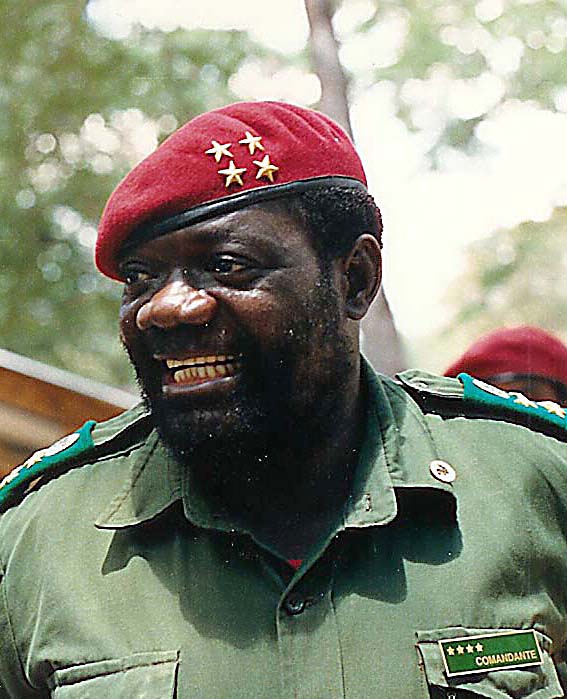
Jonas Malheiro Sidónio Sakaita Savimbi (Portuguese: [ˈʒɔnɐʃ ˈsavĩbi]; 3 August 1934 – 22 February 2002) was an Angolan revolutionary, politician, and rebel military leader who founded and led the National Union for the Total Independence of Angola, also known as UNITA. UNITA was one of several groups which waged a guerrilla war against Portuguese colonial rule from 1966 to 1974. Once independence was achieved, it then became an anti-communist group, which confronted the ruling People's Movement for the Liberation of Angola, also known as the MPLA, during the Angolan Civil War. Savimbi was killed in a clash with government troops in 2002.
Jonas Malheiro Sidónio Sakaita Savimbi was born on 3 August 1934 in Munhango, Bié Province, a small town on the Benguela railway, and raised in Chilesso, in the same province. Savimbi's father, Lote, was a stationmaster on Angola's Benguela railway line and a Protestant preacher at Igreja Evangélica Congregacional de Angola (Evangelical Congregational Church of Angola), which was founded and maintained by American missionaries. Both his parents were members of the Bieno, an Ovimbundu group. The Ovimbundu later served as Savimbi's largest political base of support in Angola.
In his early years, Savimbi was educated mainly in Protestant schools, but also attended Roman Catholic schools. At age 24, he was awarded a scholarship from the United Church of Christ to study medicine at the University of Lisbon. In Portugal, he became associated with students from Angola and other Portuguese colonies who were then preparing themselves for resistance to Portuguese colonialism in Angola. Some of these contacts, including Agostinho Neto, who Savimbi knew, had contacts with the Portuguese Communist Party, which was then outlawed. Neto, who was studying medicine with Savimbi in Portugal, later became president of the MPLA and Angola's first president after the end of colonial rule in Angola.
Facing growing pressure from the Portuguese secret police, known as PIDE, Portuguese and French communists aided Savimbi in escaping Portugal for Lausanne, Switzerland, where he secured a new scholarship awarded by American missionaries. Savimbi began studying social sciences and then enrolled in the University of Fribourg for further studies.
At the University of Fribourg, probably in August 1960, he met Holden Roberto, who was already a rising star in Angolan émigré circles. Roberto was a founding member of the National Liberation Front of Angola (FNLA), and supported Angolan independence at the United Nations. In the early 1960s, Roberto attempted to recruit Savimbi into the FNLA, but Savimbi was then undecided whether he wished to commit his life to the cause of Angolan independence.
In late September 1960, Savimbi was invited to give a speech in Kampala, Uganda on behalf of the União Democrática dos Estudantes da Africa Negra (UDEAN), a student organization affiliated with the MPLA. At this meeting, he met Tom Mboya, who took Savimbi to Kenya to meet with Jomo Kenyatta. Mboya and Kenyatta both urged Savimbi to join the UPA. Following the meeting, Savimbi told French media, "J'ai été convaincu par Kenyatta" ("I was convinced by Kenyatta"). Savimbi immediately wrote Roberto offering his service, and Mboya and Savimbi then both visited New York City.
In December 1960, following Savimbi's return to Switzerland, Roberto telephoned him and invited him to meet in Léopoldville in present-day Kinshasa. Savimbi then departed on his first of many visits to the United States. In 1961, Savimbi joined the UPA.
Savimbi remained in exile in Léopoldville until the end of March 1961, and then went to Switzerland to prepare for examinations. In December 1961, he transferred from the University of Fribourg to Lausanne University, where he studied law and international politics. In 1965, Savimbi was awarded a Ph.D. from Lausanne University.
Hub AI
Jonas Savimbi AI simulator
(@Jonas Savimbi_simulator)
Jonas Savimbi
Jonas Malheiro Sidónio Sakaita Savimbi (Portuguese: [ˈʒɔnɐʃ ˈsavĩbi]; 3 August 1934 – 22 February 2002) was an Angolan revolutionary, politician, and rebel military leader who founded and led the National Union for the Total Independence of Angola, also known as UNITA. UNITA was one of several groups which waged a guerrilla war against Portuguese colonial rule from 1966 to 1974. Once independence was achieved, it then became an anti-communist group, which confronted the ruling People's Movement for the Liberation of Angola, also known as the MPLA, during the Angolan Civil War. Savimbi was killed in a clash with government troops in 2002.
Jonas Malheiro Sidónio Sakaita Savimbi was born on 3 August 1934 in Munhango, Bié Province, a small town on the Benguela railway, and raised in Chilesso, in the same province. Savimbi's father, Lote, was a stationmaster on Angola's Benguela railway line and a Protestant preacher at Igreja Evangélica Congregacional de Angola (Evangelical Congregational Church of Angola), which was founded and maintained by American missionaries. Both his parents were members of the Bieno, an Ovimbundu group. The Ovimbundu later served as Savimbi's largest political base of support in Angola.
In his early years, Savimbi was educated mainly in Protestant schools, but also attended Roman Catholic schools. At age 24, he was awarded a scholarship from the United Church of Christ to study medicine at the University of Lisbon. In Portugal, he became associated with students from Angola and other Portuguese colonies who were then preparing themselves for resistance to Portuguese colonialism in Angola. Some of these contacts, including Agostinho Neto, who Savimbi knew, had contacts with the Portuguese Communist Party, which was then outlawed. Neto, who was studying medicine with Savimbi in Portugal, later became president of the MPLA and Angola's first president after the end of colonial rule in Angola.
Facing growing pressure from the Portuguese secret police, known as PIDE, Portuguese and French communists aided Savimbi in escaping Portugal for Lausanne, Switzerland, where he secured a new scholarship awarded by American missionaries. Savimbi began studying social sciences and then enrolled in the University of Fribourg for further studies.
At the University of Fribourg, probably in August 1960, he met Holden Roberto, who was already a rising star in Angolan émigré circles. Roberto was a founding member of the National Liberation Front of Angola (FNLA), and supported Angolan independence at the United Nations. In the early 1960s, Roberto attempted to recruit Savimbi into the FNLA, but Savimbi was then undecided whether he wished to commit his life to the cause of Angolan independence.
In late September 1960, Savimbi was invited to give a speech in Kampala, Uganda on behalf of the União Democrática dos Estudantes da Africa Negra (UDEAN), a student organization affiliated with the MPLA. At this meeting, he met Tom Mboya, who took Savimbi to Kenya to meet with Jomo Kenyatta. Mboya and Kenyatta both urged Savimbi to join the UPA. Following the meeting, Savimbi told French media, "J'ai été convaincu par Kenyatta" ("I was convinced by Kenyatta"). Savimbi immediately wrote Roberto offering his service, and Mboya and Savimbi then both visited New York City.
In December 1960, following Savimbi's return to Switzerland, Roberto telephoned him and invited him to meet in Léopoldville in present-day Kinshasa. Savimbi then departed on his first of many visits to the United States. In 1961, Savimbi joined the UPA.
Savimbi remained in exile in Léopoldville until the end of March 1961, and then went to Switzerland to prepare for examinations. In December 1961, he transferred from the University of Fribourg to Lausanne University, where he studied law and international politics. In 1965, Savimbi was awarded a Ph.D. from Lausanne University.
Recent media