


Community hub
Recent from talks
Contribute something
Nothing was collected or created yet.
The People's Movement for the Liberation of Angola (Portuguese: Movimento Popular de Libertação de Angola, abbr. MPLA), from 1977 to 1990 called the People's Movement for the Liberation of Angola – Labour Party (Portuguese: Movimento Popular de Libertação de Angola – Partido do Trabalho), is an Angolan social democratic political party. The MPLA fought against the Portuguese Army in the Angolan War of Independence from 1961 to 1974, and defeated the National Union for the Total Independence of Angola (UNITA) and the National Liberation Front of Angola (FNLA) in the Angolan Civil War. The party has ruled Angola since the country's independence from Portugal in 1975, being the de facto government throughout the civil war and continuing to rule afterwards.
Key Information


Formation
[edit]The articulation for the founding of the MPLA took place, mainly, within two political organizations: the Party of the United Struggle for Africans in Angola (PLUAA), founded in 1953 by Viriato da Cruz[16][17] and Matias Miguéis, which operated incipiently until 1954 due to a lack of mass mobilization, being overshadowed by other anti-colonial political and cultural nationalist groups that already operated in Angola and Portugal, and; the Angolan Communist Party (PCA), founded in December 1955 as a Luanda-based cell of the Portuguese Communist Party (PCP), initially grouping together prominent leaders of Angolan nationalism, such as Viriato da Cruz, Ilídio Machado, Mário António and António Jacinto, and, soon after, Lúcio Lara, Mário Pinto de Andrade and Joaquim Pinto de Andrade.
The PCA leadership realized that the growth of the nationalist struggle was hindered by the reluctance to accept the Marxist-Leninist class struggle that the party proposed, as well as by the persecution imposed by the Estado Novo regime on any organization of a communist or socialist nature. Viriato da Cruz, a member of both organizations, arranged for the merger and organization of the PCA with the PLUAA — the latter a non-communist party and, from mid-1955 onwards, already with a mass popular organization. Discussions advanced towards the formation of a broad-front nationalist movement that would encompass diluted organizations within it, without using symbols or explicitly disseminating Marxist-Leninist theories. Thus, on December 10, 1956, in a meeting at Ilídio Machado's house in Luanda, he, Viriato da Cruz and Mário Pinto de Andrade wrote the "Manifesto of 1956" for a "broad Popular Movement for the Liberation of Angola", as a program for regrouping nationalist struggles. In addition to the aforementioned names who led the PLUAA and the PCA, the following joined the manifesto creating the MPLA: Liceu Vieira Dias, Chico Machado, Germano Joy Gomes, Manuel dos Santos Capicua, Noé Saúde, Deolinda Rodrigues, Manuel Bento Ribeiro, Paulo Teixeira Jorge, Adriano Sebastião Kiwima and Amílcar Cabral. Ilídio Machado, a key member of the PCA and the African National League, was elected the first president of the MPLA, remaining in office until his arrest in 1959. Anticipating the siege by the Portuguese political police, Ilídio Machado ordered the withdrawal of part of the MPLA leadership from Luanda by September 1957, entrusting Mário de Andrade and Viriato da Cruz with the formation of a foreign relations nucleus and headquarters in exile in Paris and Frankfurt am Main. Ilídio Machado, Joaquim de Andrade, Sebastião Kiwima and Manuel Pedro Pacavira remained in Luanda leading the actions of the MPLA. When arrested, Ilídio Machado was replaced by the secretary-general Mário de Andrade, who held the position in exile between 1959 and 1960; of leadership, only António Jacinto, Pacavira and Joaquim de Andrade remained in Angola coordinating the activities of the movement that still had few militants. Other groups later merged into MPLA, such as the Movement for the National Independence of Angola (MINA) and the Democratic Front for the Liberation of Angola (FDLA).[18]
The MPLA's core base includes the Ambundu ethnic group and the educated intelligentsia of the capital city, Luanda. The party formerly had links to European and Soviet communist parties, but today is a full-member of the Socialist International grouping of social democratic parties. The armed wing of MPLA was the People's Armed Forces for the Liberation of Angola (FAPLA). The FAPLA later (1975–1991) became the national armed forces of the country when the MPLA took control of the government.
In 1961, the MPLA joined the African Party for the Independence of Guinea and Cape Verde (PAIGC), its fraternal party in Guinea-Bissau and Cabo Verde, in direct combat against the Portuguese empire in Africa. The following year, the expanded umbrella group Conference of Nationalist Organizations of the Portuguese Colonies (CONCP) replaced FRAIN, adding FRELIMO of Mozambique and the CLSTP, forerunner of the Movement for the Liberation of São Tomé and Príncipe (MLSTP).
In the early 1970s, the MPLA's guerrilla activities were reduced, due to the fierce counter-insurgency campaigns of the Portuguese military. At the same time, internal conflicts caused the movement to temporarily split into three factions (Ala Presidencialista or Presidentialist Wing, Revolta Activa or Active Revolt, and Revolta do Leste or Eastern Revolt). By 1974/75, this situation had been overcome with renewed cooperation, but it scarred the party.[19]
Independence and civil war
[edit]The Carnation Revolution in Lisbon, Portugal in 1974 established a military government. It promptly ceased anti-independence fighting in Angola and agreed to transfer power to a coalition of three pro-independence Angolan movements.
The coalition quickly broke down and the newly independent Angola broke into a state of civil war. Maintaining control over Luanda and the lucrative oil fields of the Atlantic coastline, Agostinho Neto, the leader of the MPLA, declared the independence of the Portuguese Overseas Province of Angola as the People's Republic of Angola on 11 November 1975, in accordance with the Alvor Accords.[20]
UNITA and FNLA together declared Angolan independence in Huambo. These differences reignited civil war between UNITA & FNLA and the MPLA, with the latter winning the upper hand. Agostinho Neto became the first president upon independence. He was succeeded after his death in 1979 by José Eduardo dos Santos.
.jpg)
In 1974–1976, South Africa and Zaire intervened militarily in favor of FNLA and UNITA. The United States strongly aided the two groups. Cuba in turn intervened in 1975 to aid the MPLA against South African intervention, and the Soviet Union aided both Cuba and the MPLA government during the war.
In November 1980, the MPLA had all but pushed UNITA into the bush, and the South African forces withdrew. [citation needed] The United States Congress barred further U.S. military involvement in the country, against the wishes of President Ronald Reagan, as the representatives feared getting into a situation similar to the Vietnam War. In 1976 the FNLA withdrew its troops to their bases in Zaire. Part of them joined the 32 Battalion, formed by South Africa in order to receive anti-MPLA Angolans.
At its first congress in 1977, the MPLA adopted Marxism–Leninism as the party ideology. It added Partido do Trabalho (Labour Party) to its name.[5]
After Nito Alves's attempted coup in 1977, Neto ordered the killing of suspected followers and sympathisers of "orthodox communism" inside and outside the party. During the coup, Cuban forces stationed in Angola sided with the MPLA leadership against the coup organizers.[21] Estimates for the number of Alves' followers killed by Cuban and MPLA troops in the aftermath range from 2,000 — 70,000 dead, with some placing the death toll at 18,000.[22][23][24]
After the violent internal conflict called Fractionism, the MPLA declared that it would follow the socialist, not the communist, model. But it did maintain close ties with the Soviet Union and the Communist bloc, establishing socialist economic policies and a one-party state[citation needed]. Several thousand Cuban troops remained in the country to combat UNITA fighters and bolster the regime's security.
When the Cold War ended and the Soviet Union fell, the MPLA abandoned its Marxist–Leninist ideology. On its third congress in December 1990, it declared social democracy to be its official ideology.[5]
The MPLA emerged victorious in Angola's 1992 general election, but eight opposition parties rejected the election as rigged. UNITA sent negotiators to Luanda, where they were killed. As a consequence, hostilities erupted in the city, and immediately spread to other parts of the country. Tens of thousands of UNITA and FNLA sympathizers were subsequently killed nationwide by MPLA forces, in what is known as the Halloween Massacre. The civil war resumed.[25][26][27][28]
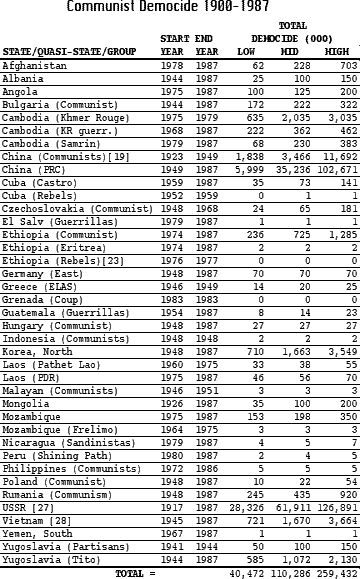
The war continued until 2002, when UNITA leader Jonas Savimbi was killed. The two parties agreed to a ceasefire, and a plan was laid out for UNITA to demobilize and become a political party. More than 500,000 civilians were killed during the civil war.[29] Human rights observers have accused the MPLA of "genocidal atrocities", "systematic extermination", "war crimes" and "crimes against humanity during the civil war."[30] Political scientist Rudolph Rummel estimated that the MPLA were responsible for between 100,000 and 200,000 deaths in democide from 1975 to 1987.[31]
Human rights record
[edit]The MPLA government of Angola has been accused of human rights violations such as arbitrary arrest and detention and torture[32] by international organisations, including Amnesty International[33] and Human Rights Watch.[34] The MPLA government hired Samuels International Associates Inc in 2008 to help improve Angola's global image and "'facilitate' its meetings with senior U.S. officials".[35]
Party organizations
[edit]At present, major mass organizations of the MPLA-PT include the Angolan Women's Organization (Organização da Mulher Angolana or O.M.A.), National Union of Angolan Workers (União Nacional dos Trabalhadores Angolanos or U.N.T.A.), Agostinho Neto Pioneer Organization (Organização de Pioneiros de Agostinho Neto or O.P.A.), and the Youth of MPLA (Juventude do MPLA or J.M.P.L.A.).
Foreign support
[edit]During both the Portuguese Colonial War and the Angolan Civil War, the MPLA received military and humanitarian support primarily from the governments of Algeria, Brazil,[36] the Bulgarian People's Republic, East Germany,[37] Cape Verde, Czechoslovak Socialist Republic,[38] the Congo, Cuba, Guinea-Bissau, Mexico, Morocco, the Mozambican People's Republic, Nigeria, North Korea, the Polish People's Republic, China, the Romanian Socialist Republic, São Tomé and Príncipe, Somalia,[39] the Soviet Union, Sudan,[38] Tanzania,[40] Libya[41] and SFR Yugoslavia. While China did briefly support the MPLA,[42] it also actively supported the MPLA's enemies, the FNLA and later UNITA, during the war for independence and the civil war. The switch was the result of tensions between China and the Soviet Union for dominance of the communist bloc, which almost led to war.[43][44]
Electoral history
[edit]In the 1992 election, MPLA-PT won 53.74% of the votes and 129 out of 227 seats in parliament; however, eight opposition parties rejected the 1992 elections as rigged.[45] In the next election, delayed until 2008 due to the civil war, the MPLA won 81.64% of the vote and 191 out of 220 parliamentary seats.[46] In the 2012 legislative election, the party won 71.84% of the vote and 175 of 220 parliamentary seats.[47]
In the 2022 general election, MPLA won 124 parliamentary seats and about 51% of the vote. The largest opposition party, UNITA, secured 44% of the vote and 90 parliamentary seats. The tight race was the MPLA's worst showing at the polls in 30 years. However, nearly all opposition parties considered the result to be a fake.[48]
Presidential elections
[edit]| Election | Party candidate | Votes | % | Result |
|---|---|---|---|---|
| 1992 | José Eduardo dos Santos | 1,953,335 | 49.57% | Elected 
|
| 2012 | 4,135,503 | 71.85% | Elected
| |
| 2017 | João Lourenço | 4,907,057 | 61.08% | Elected
|
| 2022 | 3,209,429 | 51.17% | Elected
|
National Assembly elections
[edit]| Election | Party leader | Votes | % | Seats | +/– | Position | Result |
|---|---|---|---|---|---|---|---|
| 1980 | José Eduardo dos Santos | Indirect election | 229 / 229
|
New |  1st 1st
|
Sole legal party | |
| 1986 | Indirect election | 173 / 290
|
 56 56
|
 1st 1st
|
Sole legal party | ||
| 1992 | 2,124,126 | 53.74% | 129 / 220
|
44
|
1st
|
Majority government | |
| 2008 | 5,266,216 | 81.64% | 191 / 220
|
62
|
1st
|
Supermajority government | |
| 2012 | 4,135,503 | 71.85% | 175 / 220
|
16
|
1st
|
Supermajority government | |
| 2017 | João Lourenço | 4,907,057 | 61.08% | 150 / 220
|
25
|
1st
|
Supermajority government |
| 2022 | 3,209,429 | 51.17% | 124 / 220
|
26
|
1st
|
Majority government | |
In popular culture
[edit]- In 1976, reggae singer Tapper Zukie dedicated the song and album titled "M.P.L.A" to the movement.[49]
- Pablo Moses dedicated the song "We Should be in Angola" (which appeared on his album Revolutionary Dream) to the MPLA.[50]
- The Sex Pistols singer John Lydon referred to the MPLA in the lyrics of "Anarchy in the U.K.".[51]
- The reggae band The Revolutionaries devoted an extended dub mix record to the movement entitled "MPLA", recorded at Channel One, engineered by King Tubby and released on the "Well Charge" label. The bass line and rhythm was based on "Freedom Blues" by Little Richard. The Revolutionaries also released an extended discomix entitled "Angola". Both tracks were later released on the Revolutionary Sounds album featuring Sly and Robbie.[52]
- The video game Call of Duty: Black Ops 2 features a level in which the player fought alongside the UNITA and Jonas Savimbi against the MPLA.[53]
- The video game Metal Gear Solid V: The Phantom Pain sets Missions 13–29 within the environs of the Angola-Zaire border region. Several references to the MPLA, CFA, and UNITA are made—with the in-universe mercenary group Diamond Dogs (led by player character Venom Snake) clashing with or aiding them in different missions.[54][better source needed]
See also
[edit]References
[edit]- ^ "MPLA: João Lourenço diz que teve a coragem de lutar contra a corrupção". Observador (in Portuguese). 18 August 2022. Archived from the original on 30 August 2022.
- ^ a b Andresen Guimarães, Fernando (2001). The Origins of the Angolan Civil War: Foreign Intervention and Domestic Political Conflict, 1961–76. Palgrave Macmillan. doi:10.1007/978-0-230-59826-3 (inactive 12 July 2025).
{{cite book}}: CS1 maint: DOI inactive as of July 2025 (link) - ^ Péclard, Didier (31 August 2021). "Nationalism, Liberation, and Decolonization in Angola". Oxford Academic – African History. Oxford University Press. doi:10.1093/acrefore/9780190277734.013.640. ISBN 978-0-19-027773-4.
- ^ a b c d Poddar, Prem; S. Patke, Rajeev; Jensen, Lars, eds. (2008). A Historical Companion to Postcolonial Literatures – Continental Europe and its Empires. Edinburgh University Press. pp. 480–481.
- ^ "Estatuto do MPLA". MPLA.ao. MPLA. Archived from the original on 8 June 2022. Retrieved 8 June 2022.
- ^ a b "Agostinho Neto'S Deeds Discussed at Round Table in Nigeria - Angola". www.africa-press.net. Retrieved 30 July 2025.
- ^ a b Szajkowski, Bogdan, ed. (1981). Marxist Governments: A World Survey. Macmillan Publishers. pp. 72–76. doi:10.1007/978-1-349-04329-3. ISBN 978-1-349-04331-6.
- ^ a b Hodges, Tony (2001). Angola: From Afro-Stalinism to Petro-Diamond Capitalism. Indiana University Press.
- ^ Ball, Jeremy (20 November 2017). "The History of Angola". Oxford Academic – African History. Oxford University Press: 20. doi:10.1093/acrefore/9780190277734.013.180. ISBN 978-0-19-027773-4.
The MPLA adopted Marxism in 1976, which strengthened its ties to Cuba and the Soviet Union.
- ^ Drew, Allison, ed. (1 May 2013). "16". The Oxford Handbook of the History of Communism. Oxford Academic. pp. 285–302. doi:10.1093/oxfordhb/9780199602056.013.003.
- ^ Country Reports on Human Rights Practices For 1989 (Report). US: Department of State. February 1990. Retrieved 20 May 2025.
- ^ Vanaik, Achin (13 December 2021). "Humanitarian Intervention Is a Cloak for Military Aggression". Jacobin. Archived from the original on 1 July 2022.
- ^ Lamb, Peter; Docherty, James C. (2006). Historical Dictionary of Socialism (Second ed.). The Scarecrow Press. p. 270. ISBN 978-0-8108-5560-1. Archived from the original on 23 February 2014. Retrieved 12 September 2017.
- ^ "Comité central do MPLA alargado para 497 membros" [MPLA central committee enlarged to 497 members]. Jornal de Angola (in Portuguese). 15 June 2019. Archived from the original on 16 June 2019.
O conclave, o primeiro convocado pelo presidente do partido e chefe de Estado, João Lourenço, decorreu sob o lema "MPLA e os Novos Desafios"
[The conclave, the first called by the party's president and head of state, João Lourenço, took place under the slogan "MPLA and the New Challenges".] - ^ Africa Year Book and Who's who. 1977. p. 238.
- ^ Tvedten, Inge (1997). Angola: Struggle for Peace and Reconstruction. pp. 29.
- ^ John Marcum, The Angolan Revolution, vol. I, The Anatomy of an Explosion (1950–1962), Cambridge/Mass. & London, MIT Press, 1969.
- ^ Benjamin Almeida (2011). Angola: O Conflito na Frente Leste. Lisbon: Âncora. ISBN 978 972 780 3156.
- ^ Rothchild, Donald S. (1997). Managing Ethnic Conflict in Africa: Pressures and Incentives for Cooperation. Brookings Institution Press. pp. 115–116. ISBN 0-8157-7593-8.
- ^ Georges A. Fauriol and Eva Loser. Cuba: The International Dimension, 1990, p. 164.
- ^ Sulc, Lawrence. "Communists coming clean about their past atrocities", Human Events (13 October 1990): 12.
- ^ Ramaer, J. C. Soviet Communism: The Essentials. Second Edition. Translated by G. E. Luton. Stichting Vrijheid, Vrede, Verdediging (Belgium), 1986.
- ^ Pawson, Lara (30 April 2014). In the Name of the People: Angola's Forgotten Massacre. I.B.Tauris. ISBN 9781780769059.
- ^ Historical Dictionary of Angola by W. Martin James, Susan Herlin Broadhead on Google Books
- ^ National Society for Human Rights, Ending the Angolan Conflict, Windhoek, Namibia, 3 July 2000.
- ^ John Matthew, Letters, The Times, UK, 6 November 1992 (election observer).
- ^ Angola: Resumption of the civil war Archived 2 September 2010 at the Wayback Machine EISA
- ^ Madsen, Wayne (17 May 2002). "Report Alleges US Role in Angola Arms-for-Oil Scandal". CorpWatch. Archived from the original on 5 January 2008. Retrieved 10 February 2008.
- ^ National Society for Human Rights, Press Releases, 12 September 2000, 16 May 2001.
- ^ "Power Kills", Hawaii.edu
- ^ "UN reports Angola 'torture' abuse". BBC News. 28 September 2007. Retrieved 28 September 2007.
- ^ Angola. Amnesty USA.
- ^ Angola. Human Rights Watch.
- ^ "How a U.S. agency cleaned up Rwanda's genocide-stained image", The Globe and Mail.
- ^ "KWACHA UNITA PRESS THE NATIONAL UNION FOR THE TOTAL INDEPENDENCE OF ANGOLA UNITA STANDING COMMITTEE OF THE POLITICAL COMMISSION 1999 – Year of Generalised Popular Resistance – COMMUNIQUE NO. 39/CPP/99". Federation of American Scientists. Archived from the original on 5 August 2022. Retrieved 3 December 2022.
- ^ Howe, Herbert M (2004). Ambiguous Order: Military Forces In African States. p. 81.
- ^ a b Wright, George (1997). The Destruction of a Nation: United States Policy Towards Angola Since 1945. pp. 9–10.
- ^ Nzongola-Ntalaja, Georges; Immanuel Maurice Wallerstein (1986). The Crisis in Zaire. pp. 193–194.
- ^ "Angola-Ascendancy of the MPLA". www.mongabay.com. Retrieved 6 July 2017.
- ^ Gebril, Mahmoud (1988), Imagery and Ideology in U.S. Policy Toward Libya 1969–1982, p. 70
- ^ China Study Centre (India) (1964). China Report. p. 25.
- ^ Walker, John Frederick (2004). A Certain Curve of Horn: The Hundred-Year Quest for the Giant Sable Antelope of Angola. p. 146.
- ^ Nzongola-Ntalaja, Georges; Immanuel Maurice Wallerstein (1986). The Crisis in Zaire. p. 194.
- ^ National Society for Human Rights, Ending the Angolan Conflict, Windhoek, Namibia, 3 July 2000
- ^ "Angolan ruling party gains about 82% of votes in legislative race". Xinhua. 17 September 2008.
- ^ "Eleicoes Gerais 2012: Resultados". Comissao Nacional Eleitoral Angola. Retrieved 29 November 2012.
- ^ "Angola after the election: No rest for the opposition – DW – 09/16/2022". dw.com.
- ^ "Man Ah Warrior: The Tappa Zukie Story". 4 May 2015. Retrieved 5 July 2021.
- ^ "Pablo Moses – Revolutionary Dream". Discogs. 1975. Retrieved 5 July 2021.
- ^ "Sex Pistols – Anarchy in the UK lyrics". Genius. Retrieved 5 July 2021.
- ^ "Revolutionaries – Revolutionary Sounds". Discogs. 1976. Retrieved 5 July 2021.
- ^ Stuart, Keith (14 January 2016). "Call of Duty publisher sued by family of Angolan rebel". The Guardian – via www.theguardian.com.
- ^ "Mission 13 Pitch Dark". Metal Gear Solid 5: The Phantom Pain Wiki Guide. IGN. September 2015. Retrieved 30 January 2023.
Further reading
[edit]- David Birmingham, A Short History of Modern Angola, London: Hurst, 2015
- Inge Brinkmann, "War, Witches and Traitors: Cases from the MPLA's Eastern Front in Angola (1966–1975)", Journal of African History, 44, 2003, pp. 303–325
- Mario Albano, Angola: una rivoluzione in marcia, Milano: Jaca Book, 1972
- Lúcio Lara, Um amplo movimento: Itinerário do MPLA através de documentos e anotações, vol. I, Até Fevereiro de 1961, 2ª ed., Luanda: Lúcio & Ruth Lara, 1998; vol. II, 1961–1962, Luanda: Lúcio Lara, 2006; vol. III, 1963–1964, Luanda: Lúcio Lara, 2008
External links
[edit]- Official website (in Portuguese)
- MPLA campaign site
| Central Committee |
| ||||||||
|---|---|---|---|---|---|---|---|---|---|
| Congress | |||||||||
| Leadership sittings |
| ||||||||
| Wider organization | |||||||||


| International | |
|---|---|
| National | |
| Academics | |
| Other | |
Origins and Early History
Founding and Ideological Foundations
The Popular Movement for the Liberation of Angola (MPLA) was founded clandestinely on December 10, 1956, in Luanda, emerging from the merger of nationalist groups such as the Party of the United Struggle of Africans in Angola (PLUA) and the Movement for the Liberation of Angola's Black Peoples (MLUAP), with roots tracing to the short-lived Angolan Communist Party established in October 1955.[9][10] Key founding figures included intellectuals and activists like Viriato da Cruz, Mário Pinto de Andrade, and Lúcio Lara, many of whom had ties to Portuguese anti-fascist and communist networks, reflecting the urban, Mbundu-dominated, and assimilationist character of early Angolan opposition to colonial rule.[11] The organization's formation occurred amid escalating Portuguese repression following the 1952 Statute of Indigenous Peoples, which failed to grant meaningful autonomy, prompting a shift toward radical anti-colonial organizing among educated elites in Luanda. Ideologically, the MPLA was grounded in a fusion of pan-African nationalism and Marxist principles, emphasizing national independence, agrarian reform, cultural unification across ethnic lines, and the abolition of tribal divisions to foster proletarian solidarity.[9] Its early manifesto called for eradicating illiteracy and building a unified Angolan identity, drawing on socialist critiques of imperialism while prioritizing urban workers and peasants over ethnic mobilization, which differentiated it from rivals like the FNLA.[12] Founders' associations with the Portuguese Communist Party infused the group with class-struggle rhetoric and internationalist outlooks, though the explicit adoption of Marxism-Leninism as the official doctrine occurred later, at the MPLA's 1977 congress, where it appended "Partido do Trabalho" (Workers' Party) to its name.[11][13] Agostinho Neto, an early member and physician who joined shortly after the founding, assumed leadership in December 1962 following his escape from Portuguese imprisonment and the ousting of interim head Mário de Andrade, steering the MPLA toward militarized resistance and deeper Soviet alignment.[14] This evolution underscored the ideological tension between broad anti-colonial appeal and vanguardist Leninist organization, with Neto's influence prioritizing centralized party control to achieve socialist transformation post-independence.[15] The MPLA's foundations thus reflected causal drivers of colonial exploitation and intellectual radicalization, though its Marxist commitments later invited critiques of subordinating national goals to ideological dogma.[13]Pre-Independence Activities
The MPLA, operating clandestinely after its formation, focused on political mobilization within Angola's urban centers, particularly Luanda, where it recruited among workers, intellectuals, and the assimilado class opposed to Portuguese colonial administration. Its early efforts emphasized propaganda, secret meetings, and agitation against discriminatory policies, marking it as the first Angolan nationalist group to conduct intensive mass political work inside the territory starting in 1956.[16] These activities laid the groundwork for broader resistance, though constrained by Portuguese surveillance and repression.[17] A pivotal incident occurred on June 8, 1960, when Portuguese police arrested MPLA leader Agostinho Neto at his medical clinic in Luanda for subversive activities, sparking protests in Icolo e Bengo that authorities suppressed with force, killing around 30 demonstrators.[14] Neto's repeated imprisonments, including prior detentions in 1959, highlighted the regime's targeting of MPLA figures and galvanized underground networks. Following his release and departure to the Republic of the Congo in 1962, the MPLA established external bases in the Congo and later Zambia, from which it coordinated recruitment, training, and limited infiltrations into Angola.[18][3] Throughout the 1960s, the MPLA sustained clandestine operations despite internal splits and competition from rival groups like the FNLA, emphasizing a Marxist-oriented program that appealed to urban Mbundu populations and sought international alliances, including early overtures to Soviet and Eastern Bloc support. By the early 1970s, amid Portugal's weakening grip post-Carnation Revolution, MPLA intensified preparations for power seizure in Luanda, allying temporarily with other factions under the Supreme Council for the Liberation of Angola in 1972 while positioning itself for dominance.[14] These pre-independence efforts, blending political subversion with logistical buildup, enabled MPLA's control of the capital as independence neared in 1975.[19]Independence Struggle and Power Consolidation
Armed Resistance Against Portugal
The MPLA's armed resistance against Portuguese colonial rule commenced with urban assaults in Luanda on February 4, 1961, when militants targeted the São Paulo prison, a police station, and government offices, killing seven Portuguese personnel and freeing hundreds of detainees.[14][20] These coordinated attacks, involving approximately 200 participants armed primarily with rudimentary weapons, aimed to incite widespread revolt but were suppressed within days by Portuguese security forces, resulting in over 1,000 Angolan deaths in reprisals.[14] The actions, linked to early MPLA organizers despite overlapping involvement from other nationalists, marked the formal onset of the Angolan War of Independence, shifting the movement toward protracted guerrilla operations.[12] Following the Luanda setback, MPLA leadership, under Agostinho Neto, relocated to exile bases in the Democratic Republic of Congo (then Congo-Léopoldville) and later Congo-Brazzaville, where cadres underwent military training in Algeria and received initial arms shipments from the Soviet Union starting in 1962.[17][12] By 1963–1964, internal ideological disputes had splintered the group, with figures like Daniel Chipenda challenging Neto's authority, yet the MPLA sustained low-level northern front incursions into Angola's Uíge and Zaire provinces, employing hit-and-run ambushes on patrols and supply lines.[17] Portuguese countermeasures, including aerial reconnaissance and rapid troop deployments, confined these efforts to border skirmishes, limiting MPLA penetration to a few hundred fighters at most during this phase.[21] A pivotal advance came on May 18, 1966, with the establishment of the Eastern Front (Frente Leste) from Zambian bases, led by commanders including Chipenda and targeting Moxico and Cuando Cubango districts.[22] MPLA detachments, numbering around 1,000–2,000 by the late 1960s, executed sabotage against railways, bridges, and convoys, inflicting hundreds of Portuguese casualties annually while avoiding large-scale engagements.[23] Tactics evolved from isolated raids to semi-conventional assaults by 1970, incorporating Soviet-supplied small arms and mortars, though terrain challenges and ethnic recruitment issues—favoring Mbundu over other groups—hindered broader mobilization.[21] Portugal responded with intensified pacification, relocating populations into over 100 aldeamentos (fortified hamlets) and deploying up to 60,000 troops by 1973, which eroded MPLA-held areas but failed to eradicate the insurgency amid rising domestic war fatigue in Lisbon.[23] The MPLA's persistence, bolstered by Cuban advisors from 1966 and escalating Soviet aid, pressured Portugal without achieving decisive territorial gains, as the group controlled no more than 5–10% of Angola's interior by 1974.[12] Rivalries with FNLA and UNITA fragmented the anti-colonial front, with occasional inter-factional clashes diverting resources from Portuguese targets.[24] The April 25, 1974, Carnation Revolution in Portugal, overthrowing the authoritarian regime, prompted unilateral withdrawal and the January 15, 1975, Alvor Agreement, which recognized MPLA, FNLA, and UNITA as co-belligerents and scheduled independence for November 11, 1975, thereby concluding direct armed resistance against colonial forces.[3]Transition to Independence in 1975
Following the Carnation Revolution in Portugal on April 25, 1974, which overthrew the authoritarian Estado Novo regime, Lisbon initiated rapid decolonization processes across its African territories, including Angola. Negotiations between Portuguese authorities and the three primary Angolan nationalist movements—the Marxist-oriented People's Movement for the Liberation of Angola (MPLA), the National Front for the Liberation of Angola (FNLA), and the National Union for the Total Independence of Angola (UNITA)—culminated in the Alvor Agreement, signed on January 15, 1975. This accord established a transitional government structure, with a Portuguese high commissioner retaining executive authority until independence on November 11, 1975; it allocated ministerial posts among the movements (seven to MPLA, six to FNLA, five to UNITA, and eight to Portugal); and it mandated the integration of the movements' armed forces into a unified national army of 24,000–30,000 troops, alongside provisions for elections by October 1975 to form a constituent assembly.[25][26] The transitional framework unraveled amid intensifying rivalries and ethnic tensions, exacerbated by external patrons. Skirmishes erupted in Luanda as early as March 1975, with FNLA forces, backed by Zaire, launching attacks on MPLA positions; these escalated into full-scale urban warfare by July, displacing over 100,000 residents and prompting Portuguese withdrawals from peripheral areas. Soviet military aid, including arms shipments via Tanzania and Congo-Brazzaville totaling thousands of tons by mid-1975, enabled the MPLA to fortify its urban strongholds, particularly Luanda, while FNLA and UNITA struggled with coordination despite initial U.S. covert funding via Zaire (approximately $14 million by August). On August 14, 1975, the coalition government dissolved after FNLA and UNITA ministers resigned amid accusations of MPLA dominance; Portugal assumed sole administrative control but proved unable to quell the violence, leading to a power vacuum as independence approached.[3][26] As Portuguese forces evacuated Luanda on November 10, 1975, MPLA troops, bolstered by the arrival of Cuban advisors and combat units (initially around 200, expanding rapidly), secured the capital against FNLA incursions. The MPLA unilaterally declared the People's Republic of Angola on November 11, 1975, with Agostinho Neto proclaimed president from the presidential palace in Luanda, establishing a Marxist-Leninist government that controlled roughly one-third of the territory, including key urban centers and oil facilities. In response, FNLA and UNITA proclaimed a rival Democratic Republic of Angola in Huambo on the same day, but their fragmented control outside Luanda marked the onset of the Angolan Civil War, with MPLA's hold on the capital providing strategic leverage for international recognition from the Soviet bloc and eventual Cuban reinforcement of over 10,000 troops by year's end.[3][27]Angolan Civil War Era
Outbreak and Factions Involved
The Angolan Civil War commenced in 1975 amid the transition to independence from Portugal, triggered by the collapse of power-sharing arrangements under the January 15, 1975, Alvor Agreement, which had intended to form a tripartite transitional government involving the three main nationalist groups but dissolved due to escalating hostilities and ethnic rivalries.[3][24] Clashes intensified from March onward, with the National Liberation Front of Angola (FNLA) launching attacks on Popular Movement for the Liberation of Angola (MPLA) positions near Luanda as early as February, exploiting the Portuguese military's phased withdrawal and leading to a full-scale conflict by mid-year.[12] Angola formally achieved independence on November 11, 1975, but the MPLA's unilateral declaration of a People's Republic in Luanda that day formalized the rift, as FNLA and National Union for the Total Independence of Angola (UNITA) leaders rejected it and vied for control, drawing in foreign proxies and prolonging the chaos.[3][24] The primary factions were the MPLA, FNLA, and UNITA, each rooted in distinct ethnic bases, regional strongholds, and ideological orientations that fueled mutual antagonism. The MPLA, founded in 1956 and led by physician Agostinho Neto from 1962, espoused Marxist-Leninist principles, emphasizing urban workers, intellectuals, and the Mbundu ethnic group while basing operations in Luanda and the northwest; it positioned itself as a vanguard for socialist transformation and received early covert aid from the Soviet Union.[28][24] The FNLA, established in the early 1960s under Holden Roberto and centered among the Bakongo in northern Angola, adopted a more conservative, anti-communist stance with tribal and exile ties to Zaire (now Democratic Republic of the Congo), which provided troops and logistics; it initially controlled parts of the north but struggled with internal divisions and limited rural appeal.[3][24] UNITA, formed in 1966 by Jonas Savimbi as a breakaway from the FNLA and drawing support from the Ovimbundu in the central and southern highlands, initially incorporated Maoist elements but evolved toward pragmatic nationalism opposing MPLA centralism; its rural, guerrilla-oriented structure allowed control over diamond-rich areas but isolated it from urban power centers.[3][18] In the war's opening phase, FNLA and UNITA loosely coordinated against the MPLA, with FNLA-Zairian forces advancing toward Luanda from the north while UNITA mobilized in the east, but the MPLA's hold on the capital—bolstered by approximately 1,000 Cuban advisors arriving in October 1975—thwarted these efforts and shifted momentum.[3][18] Ethnic cleavages exacerbated the divisions: MPLA's multi-ethnic but Luanda-centric composition clashed with FNLA's Bakongo dominance and UNITA's Ovimbundu focus, turning the conflict into a scramble for state control amid Cold War alignments that saw the MPLA backed by Soviet arms shipments starting in 1974.[24][12] By late 1975, the war had claimed thousands of lives and displaced populations, setting the stage for prolonged proxy engagements, though FNLA's influence waned after initial failures, leaving MPLA and UNITA as the enduring antagonists.[24][18]Soviet and Cuban Interventions
Following Angola's declaration of independence on November 11, 1975, the Marxist-oriented MPLA faced immediate military threats from rival factions FNLA and UNITA, backed by Zaire, the United States, and South Africa, prompting urgent appeals for external assistance to secure control of Luanda and key territories.[3] The Soviet Union, which had provided arms and training to the MPLA since the early 1970s, escalated deliveries of military equipment valued at approximately $160 million in 1975, including reimbursement to Cuba for initial shipments, alongside deploying around 400 military advisors to train MPLA forces.[29] [30] Cuba initiated Operation Carlota on November 5, 1975, dispatching the first contingent of 650 troops—disguised as civilians—via Cubana Airlines flights, followed rapidly by thousands more to counter South African incursions into southern Angola.[31] [32] By year's end, Cuba had committed about 7,500 military personnel, enabling the MPLA to repel advances by South African forces and FNLA units near Luanda, with Cuban engineering units repairing infrastructure and advisors embedding in FAPLA (MPLA's armed wing) battalions.[30] Soviet logistical support facilitated this buildup through airlifts of weapons such as T-55 tanks, artillery, and small arms, sustaining MPLA offensives that consolidated power in central and northern Angola by early 1976.[29] [30] Over the subsequent decade, Cuban troop rotations peaked at around 36,000-40,000 personnel by the mid-1980s, with an estimated 300,000-380,000 Cubans serving in total through 1991, suffering roughly 2,000 fatalities while providing combat leadership, medical support, and construction aid.[33] [34] The Soviet Union augmented this with over $4 billion in arms from 1982-1986, including MiG-21 fighters, SA-3 missiles, and armored vehicles, plus 1,500-1,700 advisors focused on air defense and mechanized tactics, though operational effectiveness was hampered by MPLA's limited training and guerrilla-style warfare.[27] [35] These interventions proved decisive in key engagements, such as the 1975-1976 defense of Luanda and the 1987-1988 Battle of Cuito Cuanavale, where combined Cuban-Soviet-MPLA forces stalemated South African incursions, pressuring Pretoria to withdraw and influencing UNITA's reliance on external backing.[36] [3] Withdrawals commenced in phases after the 1988 New York Accords, with most Cuban forces departing by 1991 amid Soviet economic strains and shifting Cold War dynamics, leaving the MPLA dominant but the civil war protracted against UNITA until 2002.[37] Soviet aid tapered post-1989 as Moscow prioritized domestic reforms, though residual equipment stockpiles bolstered FAPLA's conventional capabilities.[35] This external backing, while enabling MPLA survival, entrenched Angola's dependence on foreign military expertise and fueled proxy dynamics, with declassified assessments noting Soviet-Cuban coordination as opportunistic rather than strategically cohesive.[38] [36]Military Strategies and Outcomes
The MPLA's military arm, the Forças Armadas Populares de Libertação de Angola (FAPLA), primarily employed conventional warfare tactics during the Angolan Civil War, leveraging Soviet-supplied heavy weaponry, artillery, and air support to conduct offensives aimed at securing urban centers and key infrastructure. From 1975 onward, FAPLA focused on defending Luanda and coastal regions while launching operations to dismantle rival factions like the FNLA and UNITA, often coordinating with Cuban expeditionary forces that provided specialized infantry and engineering units. This approach contrasted with UNITA's guerrilla tactics, which emphasized rural ambushes and territorial denial; FAPLA's strategy prioritized mechanized assaults and fortified positions to exploit numerical and technological advantages, as seen in the rapid consolidation of power in Luanda by November 1975 following the defeat of FNLA incursions.[3][6] Cuban military intervention, initiated in late 1975 with approximately 18,000 troops by early 1976, was pivotal to FAPLA's early successes, enabling the repulsion of South African Defense Force (SADF) advances during Operation Savannah, where Cuban-FAPLA forces halted a column of over 2,000 South African troops and their Angolan allies near the Cuanza River in January 1976. Subsequent FAPLA offensives, such as the 1987 push toward Mavinga in southeastern Angola, sought to overrun UNITA's base areas but encountered stiff resistance from UNITA guerrillas supported by SADF air strikes and artillery, resulting in heavy FAPLA casualties—estimated at over 5,000 in that campaign alone—and logistical strains from stretched supply lines. The protracted Battle of Cuito Cuanavale (October 1987–March 1988) exemplified this dynamic, with FAPLA and Cuban units under Soviet advisors holding the town against repeated UNITA-SADF assaults, inflicting significant losses (around 1,000 SADF casualties per South African estimates) but failing to achieve a decisive breakthrough due to UNITA's effective hit-and-run interdictions.[39][3][24] Overall outcomes favored the MPLA despite the war's 27-year duration and mutual attrition, with FAPLA maintaining control over approximately 70% of Angola's territory by the 1990s, including diamond-rich regions that funded operations through state enterprises. UNITA's reliance on external aid from the U.S. and South Africa waned after apartheid-era withdrawals and congressional cutoffs like the Clark Amendment repeal's reversal in 1985, while Soviet and Cuban commitments—totaling over 300,000 Cuban rotations by 1991—sustained MPLA logistics until their phased exit under the 1988 New York Accords. The conflict concluded in 2002 following UNITA leader Jonas Savimbi's death on February 22, 2002, in a FAPLA ambush, prompting UNITA's demobilization and integration into the political system, thereby securing MPLA dominance without a formal military surrender but through exhaustion of UNITA's operational capacity.[6][24][39]One-Party Rule (1975–2017)
Governance Under Neto and Dos Santos
Following independence on November 11, 1975, Agostinho Neto, as leader of the MPLA, established the People's Republic of Angola as a Marxist-Leninist one-party state, with the MPLA designated as the vanguard party representing the proletariat and embodying national sovereignty.[40] The 1975 constitution formalized this structure, vesting supreme power in the MPLA's Central Committee and Politburo, while the president—Neto himself—served concurrently as MPLA chairman, commander-in-chief, and head of government, enabling centralized control over legislative, executive, and judicial functions amid the escalating civil war.[41] This framework prioritized ideological conformity, nationalization of key industries, and alignment with Soviet and Cuban allies, but it also facilitated internal purges to eliminate factionalism within the MPLA.[40] Governance under Neto was marked by efforts to consolidate MPLA authority against rival liberation movements and domestic dissent, culminating in the violent suppression of the May 1977 coup attempt led by Nito Alves and his "Nitista" faction, which sought to oust Neto and install a more radical, anti-Soviet leadership.[42] State forces, backed by Cuban troops, crushed the uprising after days of street fighting in Luanda, resulting in hundreds of immediate deaths and a subsequent purge that killed thousands—estimates range from 3,000 to 30,000—through executions, mass arrests, and forced labor camps targeting perceived Nitistas, intellectuals, and urban youth.[43] [44] This repression, often described as a "massacre," eliminated potential rivals and reinforced Neto's dominance but entrenched a culture of surveillance and fear, with the regime's security apparatus expanding to monitor MPLA cadres and suppress dissent under the guise of anti-factionalism.[43] José Eduardo dos Santos assumed the presidency in September 1979 following Neto's death from cancer in Moscow, inheriting and perpetuating the one-party system while gradually centralizing executive authority within the presidency and MPLA hierarchy.[45] Dos Santos purged remnants of Neto's inner circle in the early 1980s, abolished the death penalty, and released some political prisoners to signal moderation, but these measures coexisted with intensified authoritarian controls, including expanded intelligence networks and military loyalty oaths to the MPLA, ensuring the party's monopoly on power even as the civil war raged until 2002.[46] By the late 1980s, amid Soviet decline, Dos Santos oversaw the MPLA's ideological shift from Marxism-Leninism to "social democracy" in 1990, allowing nominal multiparty reforms and a 1992 constitution, yet the system retained hegemonic features: no direct presidential elections until 1992 (which Dos Santos won amid fraud allegations), state media dominance, and judicial subordination to executive fiat.[40] [47] Under Dos Santos, governance evolved into a patronage-driven autocracy, with power centralized in the presidency's "parallel structures" bypassing formal institutions, enabling control over oil revenues—Angola's primary export, accounting for over 90% of state income by the 2000s—to fund MPLA loyalists, security forces, and family-linked enterprises.[48] Repression intensified during wartime (1975–2002), including arbitrary detentions, media censorship, and crackdowns on opposition protests, such as the 1992 post-election violence that killed thousands and justified renewed war, while post-2002 reconstruction masked ongoing abuses like the 2015 dispersal of peaceful demonstrations with live ammunition.[49] [47] Dos Santos maintained rule through 2017 by balancing factional elites via appointments and co-optation, fostering a system where MPLA congresses rubber-stamped decisions and electoral commissions favored the incumbent party, resulting in contested victories in 2008, 2012, and beyond despite international observer concerns over irregularities.[50] This structure prioritized regime survival over accountability, with Dos Santos's family amassing billions from state contracts, underscoring the fusion of party, state, and personal power.[51]Economic Policies and Oil Dependency
Following independence in 1975, the MPLA government under President Agostinho Neto adopted Marxist-Leninist economic policies, including nationalization of key industries, land reform, and central planning to redistribute colonial-era assets and prioritize state-led development amid civil war disruptions.[52] These measures aimed to dismantle Portuguese economic dominance but resulted in inefficiencies, production declines in agriculture and manufacturing, and reliance on Soviet aid, as war and ideological commitments limited private enterprise and foreign investment.[52] Under José Eduardo dos Santos, who succeeded Neto in 1979 and ruled until 2017, economic policy shifted post-civil war toward selective liberalization after abandoning strict Marxism-Leninism in the early 1990s, including privatization of some state assets and encouragement of foreign oil investment via production-sharing agreements.[53] Oil production surged from about 300,000 barrels per day in the 1980s to over 1.8 million by 2008, fueling GDP growth averaging 11% annually from 2001 to 2010, but policies entrenched patronage networks where state-owned Sonangol controlled oil rents, often diverted through opaque deals benefiting MPLA elites rather than broad investment.[54][52] Corruption scandals, including billions allegedly siphoned by Dos Santos's family via entities like the sovereign wealth fund, exemplified kleptocratic tendencies that prioritized elite accumulation over diversification.[55][56] Angola's economy became profoundly oil-dependent under MPLA rule, with petroleum accounting for over 90% of exports, more than 70% of government revenues, and roughly 50% of GDP by the 2010s, rendering fiscal stability vulnerable to price volatility—evident in contractions during the 2014-2016 oil slump when GDP fell over 10% cumulatively from 2016-2020.[57][58] This dependency induced "Dutch disease" effects, where oil-driven currency appreciation eroded non-oil sector competitiveness, decimating agriculture (which shrank from 20% of GDP pre-independence to under 10% by 2010) and manufacturing, while failing to build human capital or infrastructure despite repeated diversification pledges.[59][60] The resource curse dynamic, amplified by weak institutions and rent-seeking, sustained MPLA's one-party control through oil-funded patronage but perpetuated poverty, with over 40% of the population below the poverty line in 2015 despite peak oil wealth.[61][58]Internal Repression and Authoritarian Measures
Upon assuming power in 1975, the MPLA enshrined a one-party state in Angola's constitution, declaring itself the vanguard of the proletariat and prohibiting opposition parties or independent political activity.[62] This framework enabled systematic suppression of dissent, with the regime's security apparatus—bolstered by Cuban military advisors—targeting perceived internal threats through arbitrary arrests, torture, and executions.[63] A pivotal episode occurred on May 27, 1977, when Nito Alves, the former interior minister, and his supporters (known as Nitistas) staged an uprising in Luanda, seizing the state radio station and organizing demonstrations to demand reforms and purge Soviet-influenced elements from the MPLA leadership under President Agostinho Neto.[63] The government labeled the action a coup attempt, prompting a brutal counteroffensive by loyalist forces and Cuban troops, which included mass roundups, public executions, and purges extending beyond Luanda to provincial areas.[63] Estimates of the death toll vary widely: official figures claimed around 300 fatalities, while Amnesty International documented approximately 30,000 killings, and some accounts suggest up to 90,000 victims in the ensuing repression.[63] [64] The purge dismantled radical factions within the MPLA, consolidated Neto's control, and instilled a climate of fear that stifled intra-party debate and civil society.[65] Under José Eduardo dos Santos, who succeeded Neto in 1979 and ruled until 2017, authoritarian measures persisted through centralized control of state institutions, including the judiciary and security services, which routinely employed extrajudicial means against critics.[66] No independent press operated until 1991, after which state dominance continued via censorship laws prohibiting content deemed subversive, such as quotations from UNITA leader Jonas Savimbi, and through MPLA oversight of newsrooms that restricted non-party members' access to official sources.[67] Journalists faced assaults, threats, and unexplained murders, exemplified by the 1995 killing of Imparcial Fax editor Ricardo de Mello, which remained uninvestigated.[67] Opposition groups like the Party for Democratic Support and Progress of Angola (PADEPA) endured violent crackdowns on protests, including beatings and mass arrests, particularly from 1999 onward.[67] The regime's one-party monopoly until the early 1990s precluded multi-party competition, fostering a pattern of impunity for abuses against intellectuals, activists, and suspected dissidents, often justified as countermeasures to civil war threats but extending to non-combatants.[68] Even after nominal multiparty reforms, MPLA control over electoral processes and media reinforced authoritarianism, with security forces implicated in suppressing rallies and monitoring opposition through expanded surveillance, including post-2000 laws criminalizing information deemed harmful to state security.[69] These measures sustained the MPLA's dominance while eroding public trust and perpetuating cycles of coercion.[70]Transition to Multi-Party System
1992 Elections and Constitutional Reforms
In response to the Bicesse Accords signed on 31 May 1991 between the MPLA-led government and UNITA, Angola undertook constitutional reforms to facilitate a transition from one-party rule to a multi-party system.[71] These accords, mediated by Portugal with U.S. and Soviet involvement, mandated a ceasefire, demobilization of forces, and national elections within one year under United Nations supervision.[71] In May 1991, the MPLA-controlled People's Assembly approved amendments to the 1975 Constitution, legalizing opposition parties, including UNITA, and enshrining freedoms of expression, assembly, and association to enable political pluralism.[40] Additional revisions in September 1992 renamed the state the Republic of Angola and instituted a presidential system granting the executive broad powers, including unilateral appointments of key officials like provincial governors and Supreme Court judges, while adopting a winner-takes-all electoral framework with limited parliamentary checks on the president.[40] The inaugural multi-party elections occurred on 29–30 September 1992, encompassing both presidential and parliamentary contests for the 220-seat National Assembly, marking Angola's first free vote since independence.[72] Supervised by the UN Angola Verification Mission II (UNAVEM II) with around 800 international observers, the process involved voter registration from 20 May to 31 July and achieved a reported turnout of 91.2%.[72][73] United Nations and other monitors, including those from the U.S. and European Community, assessed the elections as generally free and fair despite logistical challenges and isolated incidents of intimidation.[74] In the parliamentary election, the MPLA received 2,124,126 votes (53.74%), securing 129 seats, while UNITA obtained 1,347,636 votes (34.10%) for 70 seats; smaller parties like the FNLA and PRS took the remainder.[72][73] For the presidency, MPLA incumbent José Eduardo dos Santos polled 1,953,335 votes (49.57%), short of the absolute majority needed to avoid a runoff, as UNITA's Jonas Savimbi garnered 1,579,298 votes (40.07%); other candidates, such as the FNLA's Holden Roberto, received under 3% each.[73] UNITA immediately disputed the outcomes, citing alleged fraud and irregularities, and declined to join a scheduled second round, prompting the resumption of civil war hostilities in October 1992.[72] The new multiparty National Assembly convened on 26 October 1992 without UNITA participation, with Dos Santos retaining de facto executive authority amid the escalating conflict.[72] These events underscored the fragility of the democratic transition, as the reforms and elections failed to consolidate peace without broader verification of electoral integrity.[74]Peace Negotiations and End of Civil War in 2002
The death of UNITA leader Jonas Savimbi on February 22, 2002, during a clash with Angolan government forces in Moxico Province marked a pivotal turning point, as it decapitated the rebel movement's command structure and prompted a shift toward capitulation rather than continued guerrilla warfare.[75] Savimbi's elimination, after decades of his personalist leadership and rejection of prior peace deals like the 1994 Lusaka Protocol, removed the primary obstacle to resolution, given UNITA's heavy reliance on his ideological commitment to armed struggle against the MPLA government.[76] The MPLA-led government, bolstered by oil revenues funding a professionalized army (Forças Armadas Angolanas, or FAA), had achieved military dominance by the early 2000s, encircling UNITA strongholds and disrupting their diamond smuggling networks that sustained operations.[77] In the immediate aftermath, UNITA's interim leadership, including António Dembo (who briefly succeeded Savimbi before his own death) and later Paulo Lukamba, initiated unilateral ceasefires and contacted government representatives to explore demobilization, reflecting the faction's exhaustion after 27 years of conflict that had displaced over four million people and killed an estimated 500,000 to 800,000.[78] Negotiations accelerated in late March 2002, culminating in the Luena Memorandum of Understanding signed on March 30, 2002, in the eastern town of Luena by FAA Chief of Staff General Geraldo Sachipengo Nunda and UNITA military commander General Kamorteiro. This accord outlined immediate cessation of hostilities, the quartering of approximately 5,000 UNITA fighters, their integration into the national military or civilian life with amnesty provisions, and UNITA's transformation into a political party without further recourse to arms.[76] The formal ceasefire ceremony occurred on April 4, 2002, in Luanda, where UNITA representatives, led by Isaías Samakuva as party president, affixed signatures alongside MPLA officials and international observers from the United Nations and the African Union, officially terminating the Angolan Civil War.[79] Unlike earlier accords marred by UNITA's electoral grievances post-1992 and Savimbi's intransigence—which had reignited fighting despite UN-monitored processes—the 2002 agreement succeeded due to UNITA's battlefield defeat and the MPLA's refusal to concede power-sharing beyond political participation.[80] Demobilization proceeded rapidly, with over 85,000 former combatants (including UNITA ranks) registering for reintegration by mid-2002 under a joint commission, though challenges persisted in verifying fighters and distributing aid amid widespread minefields and famine.[77] This resolution solidified MPLA dominance, enabling resource allocation toward reconstruction while UNITA gained parliamentary seats in subsequent elections, though critics noted the government's continued authoritarian grip precluded deeper reforms.[81]Post-Dos Santos Era Under Lourenço
Leadership Succession in 2017
In February 2017, following preliminary signals in 2016, long-serving MPLA leader and Angolan President José Eduardo dos Santos formally announced his intention to retire from the presidency after the upcoming general elections, designating João Lourenço—then the party's vice president and minister of defense—as his successor.[82] This move concluded Dos Santos' 38-year tenure, during which he had consolidated power within the MPLA and the state apparatus. The succession was orchestrated to maintain stability, with Dos Santos retaining his position as MPLA chairman initially to oversee the transition and avert internal factionalism.[83] The MPLA had nominated Lourenço as its head of list for the legislative elections in December 2016, positioning him to assume the presidency under Angola's 2010 constitution, which awards the role to the top candidate of the winning party.[84] General elections occurred on August 23, 2017, with the MPLA securing 61.07% of the vote and 149 of 220 National Assembly seats, outperforming the opposition UNITA's 26.67%.[85] Official results, certified by the National Electoral Commission, confirmed the party's victory despite allegations of irregularities from challengers.[86] Lourenço was sworn in as president on September 26, 2017, marking the formal handover of executive power and the onset of the post-Dos Santos era.[87] In his inaugural address, he pledged continuity in MPLA governance while hinting at reforms to address economic stagnation tied to oil dependency. Dos Santos, who had groomed Lourenço as a loyalist during his vice-presidential role from 2012, expected influence through family and allies embedded in state institutions, though this arrangement soon faced tensions as Lourenço asserted independence.[88]Anti-Corruption Drives and Political Reforms
Upon assuming the presidency in September 2017 as MPLA candidate, João Lourenço initiated an aggressive anti-corruption campaign targeting entrenched networks from the prior Dos Santos era, including family members and allies, which recovered over $5 billion in allegedly looted assets by 2020.[50] This effort involved prosecuting high-profile figures, such as Isabel dos Santos, daughter of former president José Eduardo dos Santos, who faced charges for 12 crimes including embezzlement and fraud related to her tenure as chair of state oil firm Sonangol, culminating in a 2024 indictment by Angolan authorities.[89] Similarly, her brother José Filomeno dos Santos was convicted in 2020 on corruption charges tied to a $500 million sovereign wealth fund scheme before the conviction was overturned on appeal in April 2024.[90] By 2022, Angola reported 715 active prosecutions for corruption, fraud, and embezzlement, signaling a shift from impunity under the previous regime.[91] Lourenço's administration bolstered institutional frameworks by amending anti-corruption and anti-money laundering laws between 2017 and 2021, enhancing transparency in public procurement and asset declarations for officials.[92] International partners, including the UK, froze Isabel dos Santos's assets worth £580 million in December 2023 over money laundering allegations linked to Angolan state contracts, while the US imposed sanctions on her in 2021 under anti-corruption statutes.[93] [94] These measures extended to MPLA insiders, with arrests of party members, though critics argue the drive selectively targets Dos Santos loyalists to consolidate Lourenço's power rather than eradicate systemic graft.[95] Parallel political reforms aimed to dilute authoritarian legacies, including easing media restrictions and permitting broader political discourse since 2017, which allowed opposition voices greater visibility despite ongoing MPLA dominance.[84] The 2019 Private Investment Law streamlined business regulations to attract foreign capital and reduce oligopolistic control by politically connected elites.[96] Local governance reforms doubled the number of administrative units by 2025, fragmenting Luanda into 16 entities to decentralize power, though implementation of local elections has been delayed, prompting accusations of stalling to preserve MPLA hegemony.[97] Economic diversification efforts under Lourenço sought to lessen oil dependency through incentives for agriculture and manufacturing, yet persistent fuel price hikes in 2025 sparked deadly protests, highlighting limits to reform amid public discontent.[98] [99]Recent Electoral Challenges (2022 Onward)
In the August 24, 2022, general elections, the MPLA secured 51.17% of the vote, retaining a slim majority with 124 seats in the 220-member National Assembly and enabling President João Lourenço's re-election as party leader under Angola's constitutional framework where the top vote-getting party's head assumes the presidency.[100][101] This represented a decline from the party's 61.06% share in 2017, reflecting growing urban and youth discontent amid persistent economic hardships including high unemployment and inequality.[102][103] The opposition National Union for the Total Independence of Angola (UNITA), which obtained 43.95% of the vote, immediately rejected the results, alleging widespread irregularities such as ballot stuffing, inflated turnout figures in MPLA strongholds, and discrepancies in vote tabulation at provincial levels.[104][105] UNITA leader Adalberto Costa Júnior claimed his party had actually won a majority based on independent tallies from polling stations, prompting legal challenges filed with the National Electoral Commission and Constitutional Court.[106] On September 9, 2022, the Constitutional Court dismissed the complaints, validating the electoral commission's certification despite acknowledging some procedural flaws but deeming them insufficient to alter the outcome.[101] Post-election protests erupted, with thousands marching in Luanda on September 24, 2022, decrying electoral fraud and demanding transparency; security forces dispersed demonstrators using tear gas and batons, resulting in arrests and injuries.[107][108] UNITA and allied groups sustained pressure through street actions and parliamentary boycotts, highlighting MPLA's historical dominance since 1975 and accusing the ruling party of leveraging state resources for campaigning.[109] These events underscored a narrowing of MPLA's electoral base, particularly in Luanda where UNITA outperformed expectations, signaling potential vulnerabilities in future contests absent reforms.[103] Beyond 2022, MPLA has faced criticism for delaying local elections, originally pledged under Lourenço's 2017 platform to devolve power and enhance multi-party competition; as of September 2025, parliament adjourned without advancing enabling legislation, fueling opposition accusations of entrenching centralized control.[97] Internal MPLA frictions, including Lourenço's public rebukes of party veterans in 2024, have compounded these challenges by exposing succession uncertainties that could erode unity ahead of the 2027 general elections.[110] Persistent youth mobilization and economic grievances continue to bolster UNITA's appeal, pressuring MPLA to address governance deficits to mitigate further vote erosion.[106]Ideology and Organizational Structure
Evolution from Marxism-Leninism
The MPLA formally adopted Marxism-Leninism as its guiding ideology during a Central Committee plenum in October 1976, a decision solidified at its First Congress in December 1977, where it rebranded as the MPLA-Workers' Party and emphasized vanguard party principles, centralized planning, and class struggle against colonial remnants and internal opponents.[111][112] This alignment facilitated alliances with the Soviet Union and Cuba, enabling military support that sustained the MPLA regime amid the Angolan Civil War, including nationalizations of key industries like oil and diamonds under state control to fund protracted conflict.[113] Policies reflected orthodox Marxist-Leninist tenets, such as collectivization attempts in agriculture and suppression of private enterprise, though practical implementation was hampered by war devastation and reliance on foreign aid, leading to economic stagnation by the late 1980s.[114] By the late 1980s, geopolitical shifts—including Mikhail Gorbachev's perestroika reforms in the USSR and waning Soviet subsidies—exposed the unsustainability of rigid ideological adherence, prompting initial economic adjustments like partial market openings even before formal renunciation.[114] The decisive evolution occurred at the MPLA's Third Congress in December 1990, where the party explicitly abandoned Marxism-Leninism, rejected the one-party monopoly, and proclaimed social democracy as its new orientation, enabling constitutional amendments for multiparty competition and private sector involvement.[115][71] This pivot, driven by the need to negotiate the Bicesse Accords with UNITA rebels and attract Western investment amid civil war fatigue, marked a pragmatic retreat from doctrinal purity rather than grassroots ideological conviction, as evidenced by retained state dominance over strategic resources.[18][40] In practice, the post-1990 shift facilitated hybrid policies blending social democratic rhetoric—such as expanded social spending from oil revenues—with state capitalism, where Sonangol (the state oil company) centralized resource extraction, limiting diversification and fostering elite capture rather than egalitarian redistribution.[113] Critics, including opposition figures, argue this evolution preserved authoritarian structures under a liberal facade, with ideological flexibility serving power consolidation over substantive pluralism, as multiparty elections post-1992 reinforced MPLA hegemony despite irregularities.[40] Subsequent congresses, like the 2017 Fifth Ordinary Congress under João Lourenço, reaffirmed "democratic socialism" while prioritizing anti-corruption and economic pragmatism, reflecting adaptation to global norms without fully dismantling patronage networks rooted in the Leninist era.[114] This trajectory underscores causal pressures from external aid collapse and internal warfare, prioritizing regime survival over unwavering adherence to original tenets.[115]Party Apparatus and Youth/Women's Wings
The MPLA operates through a centralized hierarchical structure, with the party congress serving as the highest decision-making body, convened periodically to elect leaders and approve policies; the central committee implementing congress directives between sessions; and the political bureau functioning as the executive organ of the central committee, overseeing daily operations and strategy.[116][117] This framework, inherited from its Marxist-Leninist phase, places authority under the party president, who heads all bodies and directs political orientation.[1] The structure includes specialized departments for areas such as propaganda, organization, and international relations, ensuring disciplined cadre mobilization across provinces.[117] The youth wing, Juventude do Movimento Popular de Libertação de Angola (JMPLA), founded on December 10, 1962, functions as the MPLA's mass youth organization, tasked with political indoctrination, recruitment of young militants, and fostering participation in national reconstruction efforts.[118] Its objectives emphasize building ideological commitment among youth aged 14 to 35, through education, cultural activities, and advocacy for MPLA-aligned development goals, with membership campaigns historically aiming to expand to hundreds of thousands of adherents.[119][120] The women's wing, Organização da Mulher Angolana (OMA), established in 1962 during the MPLA's early liberation conferences, serves to mobilize, organize, and educate Angolan women over age 16 for adherence to party ideals, functioning as the primary vehicle for female incorporation into MPLA structures.[121][122] OMA promotes gender-specific initiatives like literacy drives and economic empowerment while subordinating them to broader party loyalty, with leadership roles often held by prominent female militants to advance MPLA's political hegemony.[123] Both wings operate as autonomous yet tightly integrated mass organizations, channeling grassroots support to reinforce the party's dominance in Angola's one-party dominant system.[124]Electoral History
Presidential Contests
In Angola's electoral framework, the president is selected as the leading candidate on the national party list receiving the plurality of votes in general elections for the National Assembly, rather than through a direct popular vote for the presidency except in the inaugural 1992 contest.[125] This system, formalized after the 1992 polls and reinforced by the 2010 constitution, ties executive leadership to legislative dominance, ensuring the winning party's nominee assumes the presidency for a five-year term.[126] The 1992 elections marked Angola's first multiparty contest post-independence, featuring a direct presidential ballot alongside National Assembly voting on September 29–30. MPLA incumbent José Eduardo dos Santos secured 49.57% of the presidential vote (1,853,543 ballots), falling short of a majority against UNITA's Jonas Savimbi's 40.07% (1,497,927 votes), with a planned runoff aborted amid fraud allegations and renewed civil war.[72] Despite the inconclusive presidential result, MPLA's 53.74% in assembly voting yielded 129 of 220 seats, allowing dos Santos to retain power as the Bicesse Accords' framework prioritized stability over strict electoral mandates. International observers, including the UN, deemed the process largely free but noted logistical flaws and post-election violence that undermined UNITA's acceptance.[74] Subsequent contests from 2008 onward operated under the indirect system, with MPLA candidates routinely prevailing amid opposition claims of irregularities, uneven campaigning, and state media dominance, though courts upheld results and turnout exceeded 50% in most cases. In 2008, dos Santos headed the MPLA list to 81.64% of the vote (over 4 million ballots), capturing 191 assembly seats and extending his tenure uninterrupted since 1979.[127] The 2012 election saw dos Santos again leading MPLA to 71.08% (4.1 million votes) and 175 seats, despite UNITA protests over ballot stuffing in Luanda, where results were delayed and revised downward for the opposition.[128] The 2017 transition elevated João Lourenço, handpicked by dos Santos as MPLA nominee, to 61.09% party-list support (over 3 million votes) and 149 seats, marking the first leadership change in 38 years and prompting anti-corruption rhetoric that later targeted dos Santos allies.[85] Voter turnout reached 68%, with UNITA alleging manipulation but international monitors like the EU noting acceptable conduct despite transparency gaps in counting.[126] Lourenço's 2022 reelection, the narrowest to date at 51.17% (3.2 million votes) for MPLA's 124 seats, faced heightened scrutiny and street protests from UNITA over alleged fraud in key provinces, though the constitutional court validated the outcome amid 44% turnout and economic discontent.[100][129]| Year | MPLA Candidate | Party-List Vote % | Assembly Seats Won | Turnout % | Key Notes |
|---|---|---|---|---|---|
| 1992 | José Eduardo dos Santos | 49.57 (presidential direct) | 129/220 | ~81 | Disputed; no runoff due to war resumption; assembly plurality retained power.[72] |
| 2008 | José Eduardo dos Santos | 81.64 | 191/220 | 68 | Landslide post-peace; opposition conceded despite urban flaws.[127] |
| 2012 | José Eduardo dos Santos | 71.08 | 175/220 | 57 | Claims of ballot irregularities in capital; dos Santos's final term.[128] |
| 2017 | João Lourenço | 61.09 | 149/220 | 68 | Succession from dos Santos; focus on reforms promised.[85] |
| 2022 | João Lourenço | 51.17 | 124/220 | 44 | Closest margin; protests over results; lost supermajority.[100] |
National Assembly Results
The National Assembly of Angola consists of 220 seats elected through closed party-list proportional representation in a single nationwide constituency, using the d'Hondt method. The MPLA has maintained an absolute majority in every legislative election held since the advent of multi-party competition following the 1991 Bicesse Accords, enabling it to form governments unilaterally despite opposition challenges and periodic allegations of irregularities.[130][72] The 1992 elections, the first multi-party polls, saw the MPLA secure 129 seats with 53.7% of the vote amid claims of fraud by UNITA, which contributed to the resumption of civil war.[74][73] In 2008, post-war polls yielded the MPLA 169 seats on 81.7% of votes, reflecting strong incumbency advantages after peace in 2002.[131][132] The party won 175 seats in 2012 with 71.1% support, consolidating dominance under José Eduardo dos Santos.[133][134] Subsequent elections under João Lourenço showed erosion: in 2017, the MPLA took 149 seats with 61.1% of votes, losing its two-thirds supermajority amid the leadership transition.[86][135] The 2022 results marked the narrowest margin, with the MPLA gaining 124 seats on 51.17% (3,209,429 votes), just above the majority threshold, while UNITA obtained 90 seats; opposition disputes over tabulation led to protests, though courts upheld the outcome.[136][101]| Year | Date | MPLA Vote % | MPLA Seats | Opposition Gains/Notes |
|---|---|---|---|---|
| 1992 | Sep 29–30 | 53.7 | 129/220 | UNITA 70 seats; fraud claims sparked war resumption.[73] |
| 2008 | Sep 5–6 | 81.7 | 169/220 | UNITA 16 seats; first post-peace polls, high turnout.[131] |
| 2012 | Aug 31 | 71.1 | 175/220 | UNITA 32 seats; supermajority retained.[133] |
| 2017 | Aug 23 | 61.1 | 149/220 | UNITA 51 seats; end of dos Santos era.[86] |
| 2022 | Aug 24 | 51.2 | 124/220 | UNITA 90 seats; turnout 44.8%, disputed results.[136] |