Hubbry Logo
Jostedal GlacierJostedal GlacierMain
Open search
Jostedal Glacier
Community hub
Jostedal Glacier
logo
8 pages, 0 posts
0 subscribers
Be the first to start a discussion here.
Jostedal Glacier
Jostedal Glacier
from Wikipedia

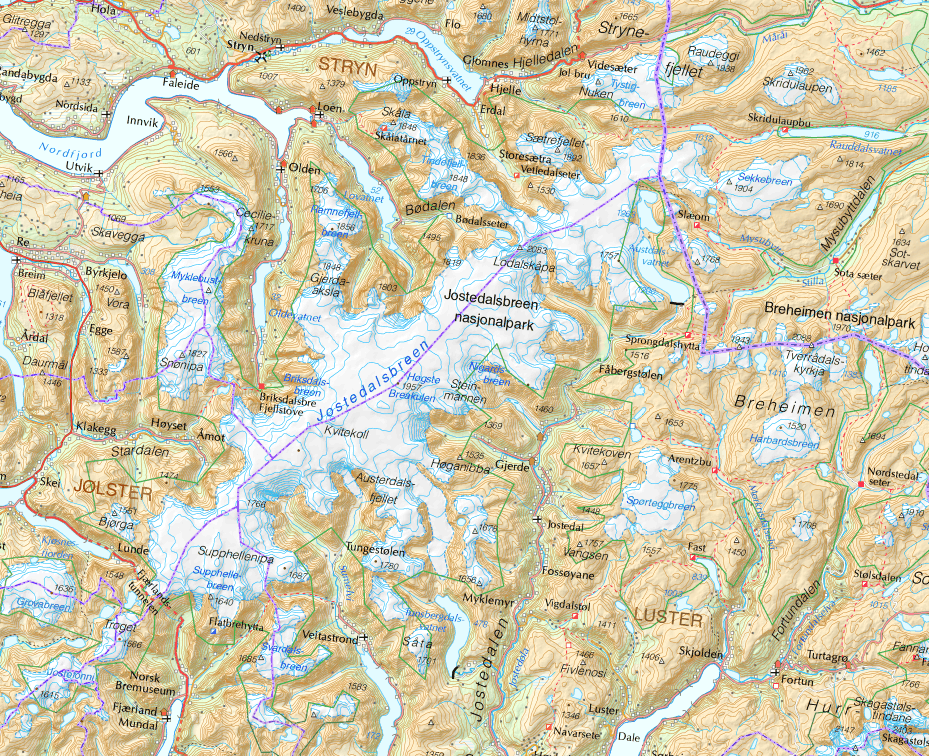
Jostedal Glacier or Jostedalsbreen (Norwegian)[1] is the largest glacier in continental Europe. It is in Vestland county in Western Norway.[2] Jostedalsbreen is located in the municipalities of Luster, Sogndal, Sunnfjord, and Stryn (all in Vestland county), plus the northeastern tip of the glacier extends into Skjåk Municipality (in Innlandet county). The highest peak in the area is Lodalskåpa at a height of 2,083 metres (6,834 ft).

Key Information

History

[edit]

In 1906, work was being done on footpaths that could accommodate tourists.[3]

The glacial water is also used in distilling Vikingfjord.

Geography

[edit]

The Jostedal Glacier has a total area of 487 square kilometres (188 sq mi). The highest point is Høgste Breakulen at 1,957 metres (6,421 ft) above mean sea level. Branches of the glacier reach down into the valleys, for instance Bøyabreen in Fjærland and Nigardsbreen, both at 300 metres (980 ft) above sea level. The thickest part of the glacier is 600 metres (2,000 ft). Jostedalsbreen has a length of a little more than 60 kilometres (37 mi) and it is a part of the 1,310-square-kilometre (510 sq mi) Jostedalsbreen National Park, which was established in 1991. The glacier covers over half of the national park.[2]

The glacier is maintained by the high snowfall rates in the region, not the cold temperatures. This means the glacier has high melting rates in its snouts. The Jostedalsbreen has around 50 glacier arms such as the Nigardsbreen and Tunsbergdalsbreen in Jostedalen, the Briksdalsbreen near Olden, the Bøyabreen by Fjærland, the Kjenndalsbreen, Tindefjellbreen near Loen, and Austerdalsbreen.[2]

In 2012, the glacier arm Briksdalsbreen lost 50 metres (160 ft) of ice in a few months. More recent measurements now show that Briksdalsbreen retreated 146 metres (479 ft) in 2006, and could be in danger of breaking away from the upper icefield. Ice climbing has now been terminated because of this event.

See also

[edit]

References

[edit]

Further reading

[edit]
[edit]
Revisions and contributorsEdit on WikipediaRead on Wikipedia
from Grokipedia
Jostedal Glacier, known in Norwegian as Jostedalsbreen, is the largest glacier in mainland , situated in county in . Covering an area of 458 square kilometers as of 2022, it stretches approximately 60 kilometers in length with a maximum thickness of around 630 meters and a total volume of about 70.6 cubic kilometers, making it a significant freshwater equivalent to roughly 70.6 trillion liters. The glacier's highest point reaches 1,957 meters above at Høgste Breakulen, while its lowest is 60 meters at Supphellebreen, and it receives up to 12 meters of annual snowfall, eroding approximately 400,000 tons of rock each year. Jostedal Glacier serves as the defining feature of Jostedalsbreen National Park, established in 1991 and encompassing 1,315 square kilometers, of which nearly half is glacier-covered and 90% lies above 800 meters elevation. Positioned between the and Nordfjord, it separates dramatic fjord landscapes from rugged mountain plateaus, creating a diverse that supports unique , , and geological formations shaped by ongoing glacial activity. The park protects not only the glacier's ice masses but also associated wetlands, rivers, and sites, including historical routes used for herding livestock across . The glacier re-formed around 5,300 years ago following the thermal maximum, a post-glacial warming period that melted earlier ice formations between approximately 8,000 and 6,000 years ago, and it expanded to its modern maximum extent during the from 1300 to 1920. Today, it features prominent outlet glaciers such as and Nigardsbreen, which attract hikers and researchers, though the overall has been retreating due to , with notable advances in some arms like by approximately 440 meters between 1987 and 1997 followed by subsequent losses. As of 2024, outlet glaciers continue to show negative mass balance and retreat, with annual losses of 0.5–2 meters water equivalent in key arms. As a key site for glaciological studies, Jostedal Glacier contributes to understanding broader environmental changes in , while offering low-impact tourism opportunities like guided hikes and educational visits to nearby museums.

Physical Description

Location and Dimensions

Jostedal Glacier, known as Jostedalsbreen in Norwegian, is situated in county in , spanning the municipalities of Luster, Sogndal, , and Stryn, with a small northeastern extension into Skjåk municipality in county. The glacier occupies a central position between the to the south and the Nordfjord to the north, forming a prominent feature in the region's mountainous terrain. Its approximate central coordinates are 61°42′38″N 06°55′27″E. As the largest glacier in , Jostedal Glacier covers an area of approximately 458 km² based on measurements from 2019, with minor adjustments noted in subsequent surveys up to 2022. The glacier extends over a length of about 60 km from its highest accumulation zones to its outlet tongues. Its ice surface elevation ranges from 60 m above at the terminus of Supphellebreen to a maximum of 1,957 m at Høgste Breakulen, while the highest peak is Lodalskåpa at 2,083 m. The glacier's maximum ice thickness reaches approximately 630 m, concentrated in the central accumulation areas, contributing to its substantial ice volume of around 70.6 km³. These dimensions underscore Jostedal Glacier's role as a key component of Norway's cryospheric , encompassing roughly 20% of the country's total glaciated area in mainland .

Structure and Arms

The Jostedal Glacier, or Jostedalsbreen, forms a broad that blankets the Jostedal plateau and surrounding mountain peaks in , creating a central accumulation zone from which radiates outward. This plateau structure, situated at elevations up to 1,957 meters above at its highest point, Høgste Breakulen, supports a network of outlet glaciers that extend across the . The 's surface undulates over the underlying topography, with the uppermost regions characterized by gentle slopes and fields where snowfall accumulates annually. From this central ice cap, more than 50 arms or outlet glaciers descend into the surrounding valleys, forming a complex branching system that drains the glacier's mass into multiple fjords and rivers. Prominent among these are Nigardsbreen on the eastern side, Briksdalsbreen to the west, Bøyabreen in the southern reaches, and Haugabreen in the northwestern sector, each channeling ice flow through distinct valleys carved by past glacial activity. These outlet glaciers vary in length and width, with the larger ones like Nigardsbreen extending several kilometers from the plateau to their terminal snouts. Ice thickness across the glacier exhibits significant variations, averaging around 154 meters but reaching maxima of approximately 630 meters in the upper basins of major outlets such as Tunsbergdalsbreen, while thinning to less than 50 meters near the valley margins. This distribution influences the glacier's flow dynamics, where moves slowly from the high-elevation plateau—through deformation and basal sliding—accelerating as it funnels into narrower valleys toward the snouts. In the central cap, flow rates are minimal due to the flat terrain, but they increase in the steeper outlet arms, shaping the glacier's overall morphology and contributing to its characteristic dendritic pattern.

Geological and Climatic Context

Formation and Historical Fluctuations

The Jostedal Glacier, forming part of the larger Jostedalsbreen in , originated during the epoch amid post-glacial climatic shifts. Following after the stadial, the ice cap likely vanished completely during the early thermal maximum (ca. 8000–6000 years , or BP), as evidenced by lithostratigraphic sequences and paleobotanical remains indicating ice-free conditions with rising temperatures and vegetation expansion. Reformation began around 5300 BP with the onset of Neoglacial cooling, marking the re-establishment of glacier ice in the high-elevation plateau. Subsequent Neoglacial advances occurred in discrete phases, driven by periodic drops in the equilibrium-line altitude, including intervals from 2595–2360 , 2250–2150 , 1740–1730 , 1430–1270 , and after 890 (ca. AD 1060–1220). These expansions, interspersed with pre-Little Ice Age () retreat phases recorded in glaciolacustrine sediments and dated organic material, allowed the glacier to further erode and shape the surrounding landscape, deepening U-shaped valleys and contributing to the extension of local systems through abrasive processes and . An initial expansion specifically affected the northwestern outlets after ca. AD 1030–1220, as dated from radiocarbon analysis of overridden . The glacier underwent its most extensive growth during the (ca. AD 1300–1850), peaking around AD 1750 when the ice cap's area reached approximately 572 km²—about 25% larger than its 458 km² extent as of 2022—and its volume approximated 76 km³, or about 8% greater than the modern estimate of 70.6 km³. For the prominent outlet Nigardsbreen, this maximum occurred specifically around AD 1748–1750, with the front advancing aggressively to overrun farmland and approach within 50–100 m of historical settlements by the 1730s, prompting farm evacuations as documented in contemporary records. Evidence for these Holocene and LIA fluctuations derives from multiple proxies, including terminal and recessional moraines that preserve records of advance limits and high-frequency variations, particularly over the past 250 years. From the 18th century, written accounts—such as tax registers noting farmland destruction in 1723 and 1743, and descriptions from 1742 and 1750 detailing the glacier's proximity to farms—complement early pictorial evidence like 1822 sketches of the ice front. These sources collectively trace the glacier's dynamic response to climatic forcing prior to the 20th century.

Current Climate and Retreat

The Jostedal Glacier experiences high winter snowfall accumulation, reaching up to 12 meters annually in its higher elevations, which historically balanced summer melt rates under cooler conditions. However, since the early 2000s, rising regional temperatures—approximately 1–1.5°C warmer in western Norway compared to the late 20th century—have intensified summer ablation, leading to a net mass loss despite increased winter precipitation. This imbalance is evidenced by geodetic mass balance measurements showing an average annual loss of about 0.8 meters water equivalent from 2001 to 2018, accelerating the glacier's overall retreat. The glacier's area has diminished from approximately 520 km² in 1966 to 458 km² by 2019, reflecting a roughly 12% reduction driven by climatic warming. Specific outlet glaciers, such as , have retreated dramatically, losing 145 meters in the 2005–2006 season and an additional 50 meters by 2012, contributing to broader length reductions across the ice cap's arms. Annual mass losses have averaged 0.5–1 meter water equivalent since 2000, with surface elevation decreases of up to 40 meters observed at major outlets like Tunsbergdalsbreen between 1964 and 2013. These changes represent a departure from the glacier's maximum extent around 1750, when its area reached 572 km². Retreat has facilitated the formation of proglacial lakes, with about 10 km² of previously glaciated terrain exposed since 1999, now partially occupied by new water bodies that cover roughly 2% of areas deglaciated since the mid-20th century. This exposure has increased calving rates, particularly at outlets like Austdalsbreen, where calving accounted for 0.19 meters water equivalent of the 2024 mass loss. Such dynamics underscore the glacier's vulnerability to ongoing warming, with 2024 measurements indicating continued negative balances, including -0.58 meters water equivalent at Nigardsbreen. Preliminary measurements indicate continued retreat in 2025 as well. In 2024, Norwegian glaciers, including those of Jostedalsbreen, experienced accelerated due to record European warmth. Projections based on regional models indicate 12–74% loss by 2100, depending on emission scenarios from RCP2.6 (low emissions, ~12–21% loss) to RCP8.5 (high emissions, up to 74% loss), with cumulative surface deficits reaching 110 meters water equivalent under the latter. In high-emission pathways, the could fragment into smaller masses and potentially disappear entirely by 2300, though low-emission scenarios suggest partial preservation. These forecasts align with observed trends, emphasizing the dominant role of summer rises in driving future retreat.

Environmental and Ecological Aspects

National Park and Conservation

Jostedalsbreen was established by royal decree on October 25, 1991, encompassing 1,315 km² of diverse terrain including the glacier itself, high plateaus, valleys, and lakes, with the primary aim of safeguarding this extensive wilderness area in southern . The park's creation emphasized the protection of the largest on mainland and its surrounding ecosystems from human encroachment, ensuring the preservation of natural processes amid increasing environmental pressures. Management of the park falls under the Norwegian Environment Agency (Miljødirektoratet), which oversees protected areas nationwide in coordination with local municipalities and stakeholders, implementing regulations under the Nature Diversity Act and Outdoor Recreation Act to balance conservation with public access. Three authorized visitor centers—Jostedalsbreen Centre in Oppstryn, the Norwegian Glacier Museum in Fjærland, and Breheimsenteret in Jostedalen—serve as key hubs for , guided interpretation, and scientific monitoring, fostering public understanding of glacial dynamics and climate influences. Conservation efforts include stringent restrictions on development, such as prohibitions on new , , and motorized vehicle traffic within park boundaries to maintain its pristine character, alongside regulated activities like controlled burns and . Research initiatives feature monitoring stations operated by the Norwegian Water Resources and Energy Directorate (NVE) on major outlet glaciers, such as Nigardsbreen, providing long-term data on ice volume changes essential for strategies. The park integrates with the World Heritage-listed West Norwegian Fjords sites through shared regional landscapes, supporting broader efforts to protect fjord-glacier interconnections. Climate change presents ongoing challenges, with accelerating retreat threatening the 's core features and hydrological balance, prompting policies for restoration in newly exposed forelands through natural revegetation guidelines and measures. In 2025, a proposed development near the boundary sparked controversy, with environmental groups launching campaigns to oppose it due to potential impacts on protected . Sustainable visitation is managed via capacity limits on guided tours, trail monitoring to prevent overuse, and educational campaigns promoting the "right to roam" under allemannsretten principles, ensuring minimal while accommodating over 250,000 annual visitors, primarily to sites like .

Biodiversity and Ecosystems

The deglaciated forelands of Jostedal Glacier provide dynamic sites for primary vegetation succession, where pioneer communities establish on nutrient-poor substrates exposed by retreating ice. Initial colonization is dominated by cryptogams, including lichens and mosses, which form protective mats on terrain approximately 25-30 years old, stabilizing the soil and facilitating further development. Vascular soon follow, with a characteristic Poa alpina-Oxyria digyna community prevailing across forelands in the Jostedalsbreen area; dominant include Poa alpina, Oxyria digyna, Deschampsia alpina, and , occurring on over 80% of sites and dispersed primarily by wind and water. Over subsequent decades, alpine herbs such as purple saxifrage () and mountain chickweed ( cerastioides) integrate, progressing toward stages with like dwarf birch () emerging after roughly 50-100 years in suitable microhabitats, though full establishment can extend beyond 200 years in harsher conditions. Fauna in the glacier's vicinity reflects the harsh alpine environment, with sparse populations adapted to high elevations and seasonal variability. Mammals such as wild reindeer (Rangifer tarandus), wolverines (Gulo gulo), and lemmings inhabit the surrounding plateaus and valleys, while ptarmigan (Lagopus muta) and thrive in . Proglacial lakes and rivers support aquatic species, including (Salmo salar), (Salmo trutta), and (Salvelinus alpinus), which utilize these cold, nutrient-enriched waters for migration and rearing. Microbial communities are integral to these ecosystems, particularly in glacial , where and other microbes drive nutrient cycles by processing and nitrates in turbid, polymictic lakes like Brevatnet and Nigardsbrevatnet. Distinct microecosystems enhance the region's , including cryoconite holes on glacier surfaces like Austerdalsbreen, which host cold-tolerant , , and within organic-rich granules that accelerate local . Glacial rivers sustain salmonid populations, contributing to trophic dynamics, while adjacent montane forests harbor diverse , such as oribatid mites (e.g., Tectocepheus velatus) and spiders, which colonize forelands early and persist into wooded stages. Glacier retreat fosters emerging habitats, such as new proglacial lakes that promote microbial and aquatic through influx, but it also threatens ice-dependent species in cryoconite and supraglacial environments. Overall, the varied altitudinal gradients and microclimates—from lowland floodplains to high-alpine zones—position the area as a , with succession patterns amplifying amid ongoing environmental shifts.

Human Engagement

Tourism and Recreation

Tourism at Jostedal Glacier centers on guided excursions that allow visitors to experience its dramatic ice formations and surrounding landscapes safely. Popular activities include guided glacier hikes on arms like Nigardsbreen, where participants traverse blue ice crevasses and towers in tours lasting 3 to 6 hours, often incorporating elements like exploration. on proglacial lakes such as Nigardsbrevatnet provides a serene approach to the glacier front, typically combined with short hikes and lasting about 30 minutes to 2 hours, offering views of calving ice. on glacial rivers, classified as Class III , involves 2.5-hour descents through turbulent waters fed by , suitable for ages 12 and older in groups of at least four. Ziplining adventures, often paired with other activities, allow thrilling aerial views over the glacier and , emphasizing the region's rugged terrain. Access to the glacier begins via established trails in the Jostedalen valley, with the first constructed in 1906 to facilitate tourist visits, now supplemented by well-marked paths from gateways like Jostedalen and Olden. These routes, including the scenic Glacier Road (Sognefjellet), lead to key outlets like Nigardsbreen, with operations peaking in summer from June to September, though some hikes extend from May to October depending on conditions. Infrastructure supports these pursuits through facilities like the Breheimsenteret visitor center in Jostedalen, which serves as a hub for bookings, , and educational exhibits on dynamics, directly overlooking Nigardsbreen. tours, involving top-rope ascents on vertical ice walls, remain available on Nigardsbreen for experienced participants, though guides adapt routes due to ongoing ice changes. In winter, on surfaces draws adventurers for multi-day tours, including cross-country traverses and powder descents across the ice cap's high plateaus. Safety protocols are paramount, with all glacier activities requiring certified guides from organizations like Jostedalen Breførarlag, who provide essential equipment such as crampons, harnesses, ice axes, and ropes to mitigate risks from hidden crevasses and potential . Participants must follow weather monitoring guidelines, as sudden changes can heighten hazards, and regulations mandate guided access to ensure environmental protection alongside personal security.

Cultural and Economic Significance

The Jostedal Glacier holds a prominent place in Norwegian cultural heritage, particularly through folklore recounting its destructive advances during the around 1750, when it buried farms such as Tungøyane and Nigard under ice, symbolizing nature's formidable power in local oral traditions. This glacier's dramatic landscape has also inspired artists of the Norwegian national-romantic era, who captured its majestic forms in major paintings that contributed to the nation's artistic identity in the late 19th and early 20th centuries. Historically, the glacier and its surrounding valleys facilitated human activities like livestock herding and , with cattle and horses driven across its passes for trade at eastern markets, a practice dating back centuries before the . By the 19th century, it became a site of scientific and exploratory interest, drawing early tourists and researchers who traversed its routes by horse and carriage to study its extent and dynamics. Economically, the glacier's meltwater powers the Jostedal Hydropower Plant, operated by , which generates 956.3 GWh annually using reservoirs at the glacier's foot, contributing to Norway's sector and supporting regional stability. Its pristine also sustains industries like beverage production; for instance, Vikingfjord is distilled using glacial sourced from the Jostedalsbreen, highlighting the resource's purity in commercial applications. Similarly, Olden is bottled from meltwater near the arm, bolstering local export economies. from Jostedal Glacier contributes to Norway's production via the Jostedal Hydropower Plant and other facilities in the region. Glacier meltwater from Norwegian glaciers overall provides about 15% of the exploited flow for the country's . In modern times, the glacier's retreat poses challenges in balancing economic exploitation—such as and limited —with conservation efforts in Jostedalsbreen , where restrictions on like roads and power expansions aim to preserve areas amid pressures. As of , ongoing glacier retreat has led to increased summer meltwater for but reduced long-term reserves, prompting adaptations in reservoir management. Research initiatives, funded by the Norwegian Research Council, support monitoring and management plans, fostering jobs in education at centers like the Norwegian Glacier Museum and in guiding roles that promote sustainable engagement. These efforts create seasonal employment in park inspection and operations, indirectly aiding regional development while addressing environmental vulnerabilities.

References

Add your contribution
Related Hubs
User Avatar
No comments yet.