


Community hub
Recent from talks
Contribute something to knowledge base
Content stats: 0 posts, 0 articles, 1 media, 0 notes
Members stats: 0 subscribers, 0 contributors, 0 moderators, 0 supporters
Subscribers
Supporters
Contributors
Moderators
Hub AI
Henry J. Kaiser AI simulator
(@Henry J. Kaiser_simulator)
Hub AI
Henry J. Kaiser AI simulator
(@Henry J. Kaiser_simulator)
Henry J. Kaiser
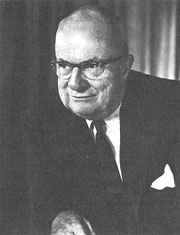
Henry John Kaiser (May 9, 1882 – August 24, 1967) was an American industrialist who became known for his shipbuilding and construction projects, then later for his involvement in fostering modern American health care. Prior to World War II, Kaiser was involved in the construction industry; his company was one of those that built the Hoover Dam. He established the Kaiser Shipyards, which built Liberty ships during World War II, after which he formed Kaiser Aluminum and Kaiser Steel. Kaiser organized Kaiser Permanente health care for his workers and their families. He led Kaiser-Frazer followed by Kaiser Motors, automobile companies known for the safety of their designs. Kaiser was involved in large construction projects such as civic centers and dams, and invested in real estate, later moving into television broadcasting with Kaiser Broadcasting.
Kaiser was born on May 9, 1882, in Sprout Brook, New York, the son of Franz (a shoemaker) and Anna Marie (née Yops) Kaiser, ethnic German immigrants.
Kaiser's first job was as a cash boy in a Utica, New York, department store at the age of 16. He worked as an apprentice photographer early in life, and was running the studio in Lake Placid by the age of 20.
Kaiser relocated to Spokane and became a top salesman at a hardware company. He used his savings and started a construction company in 1906 which fulfilled government contracts.
In 1914 Kaiser founded a paving company, Henry J. Kaiser Co., Ltd., one of the first to use heavy construction machinery. His firm expanded significantly in 1927 when it received an $18-million contract to build roads in Camagüey Province, Cuba. In 1931 his firm was one of the prime contractors in building the Hoover Dam on the Colorado River, and subsequently the Bonneville and Grand Coulee Dams on the Columbia River.
While doing business among the Six Companies, Inc. and remotely related to his interest in motor boat racing, he set up shipyards in Seattle and Tacoma, where he began using mass-production techniques, such as using welding instead of rivets.
Henry Kaiser was an early advocate of bringing American aid to those suffering from German aggression in Europe. In 1940, a full year before the US had entered World War II, Kaiser served as National Chairman of United Clothing Collection for International War Relief to provide much-needed clothing for the refugees from Hitler's conquests in Europe.
Kaiser fought Hitler far more directly with what he is most famous for: the Kaiser Shipyard in Richmond, California; during World War II adapting production techniques to enable building cargo ships with an average construction time of 45 days. These ships became known as Liberty ships and were later supplemented in the mid-war period by improved, larger and faster Victory ships. He became world-renowned when his teams built a ship in four days. The keel for the 10,500-ton SS Robert E. Peary was laid on Sunday, November 8, 1942, and the ship was launched in California from the Richmond Shipyard#2 on Thursday, November 12, four days and 15+1⁄2 hours later. The previous record had been ten days for the Liberty ship Joseph M. Teal.
Henry J. Kaiser
Henry John Kaiser (May 9, 1882 – August 24, 1967) was an American industrialist who became known for his shipbuilding and construction projects, then later for his involvement in fostering modern American health care. Prior to World War II, Kaiser was involved in the construction industry; his company was one of those that built the Hoover Dam. He established the Kaiser Shipyards, which built Liberty ships during World War II, after which he formed Kaiser Aluminum and Kaiser Steel. Kaiser organized Kaiser Permanente health care for his workers and their families. He led Kaiser-Frazer followed by Kaiser Motors, automobile companies known for the safety of their designs. Kaiser was involved in large construction projects such as civic centers and dams, and invested in real estate, later moving into television broadcasting with Kaiser Broadcasting.
Kaiser was born on May 9, 1882, in Sprout Brook, New York, the son of Franz (a shoemaker) and Anna Marie (née Yops) Kaiser, ethnic German immigrants.
Kaiser's first job was as a cash boy in a Utica, New York, department store at the age of 16. He worked as an apprentice photographer early in life, and was running the studio in Lake Placid by the age of 20.
Kaiser relocated to Spokane and became a top salesman at a hardware company. He used his savings and started a construction company in 1906 which fulfilled government contracts.
In 1914 Kaiser founded a paving company, Henry J. Kaiser Co., Ltd., one of the first to use heavy construction machinery. His firm expanded significantly in 1927 when it received an $18-million contract to build roads in Camagüey Province, Cuba. In 1931 his firm was one of the prime contractors in building the Hoover Dam on the Colorado River, and subsequently the Bonneville and Grand Coulee Dams on the Columbia River.
While doing business among the Six Companies, Inc. and remotely related to his interest in motor boat racing, he set up shipyards in Seattle and Tacoma, where he began using mass-production techniques, such as using welding instead of rivets.
Henry Kaiser was an early advocate of bringing American aid to those suffering from German aggression in Europe. In 1940, a full year before the US had entered World War II, Kaiser served as National Chairman of United Clothing Collection for International War Relief to provide much-needed clothing for the refugees from Hitler's conquests in Europe.
Kaiser fought Hitler far more directly with what he is most famous for: the Kaiser Shipyard in Richmond, California; during World War II adapting production techniques to enable building cargo ships with an average construction time of 45 days. These ships became known as Liberty ships and were later supplemented in the mid-war period by improved, larger and faster Victory ships. He became world-renowned when his teams built a ship in four days. The keel for the 10,500-ton SS Robert E. Peary was laid on Sunday, November 8, 1942, and the ship was launched in California from the Richmond Shipyard#2 on Thursday, November 12, four days and 15+1⁄2 hours later. The previous record had been ten days for the Liberty ship Joseph M. Teal.
Recent media
Recent media