
Recent from talks
Kananaskis Country
Knowledge base stats:
Talk channels stats:
Members stats:
Kananaskis Country
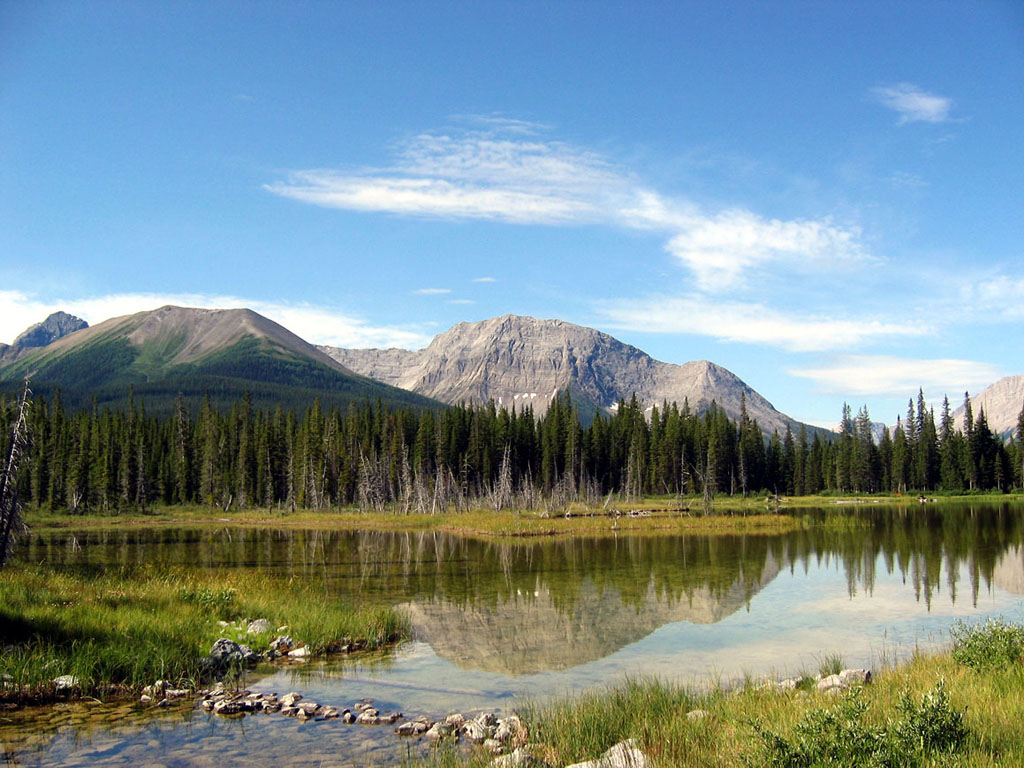
Kananaskis Country (also known as K-Country) is a multi-use area located west of Calgary in the foothills and front ranges of the Canadian Rockies, Alberta, Canada. Its western edge borders Banff National Park and the Alberta-British Columbia border. The region owes its name to the Kananaskis River, which was named by John Palliser in 1858 after a legendary Cree Native. Covering an area of approximately 4,000 km2 (1,500 sq mi), Kananaskis Country was established by the Alberta Government in 1978 to provide a variety of land uses and designations. Land uses include resource extraction activities (such as forestry, cattle grazing, water, oil and gas), recreation, power generation, and residential communities. Land designations include public land and protected areas.
The late 19th century and early 20th century saw the development of commercial use such as lumbering, hydroelectric developments, and coal mining in the eastern slopes of the Rockies, which included what is now the Kananaskis region. When control over natural resources and Crown land was transferred from federal responsibility to Alberta in 1930, the province’s natural resources were considered to be a source of considerable wealth that would stay within the province. This led to more commercial use and the establishing of a provincial park system. Tourism and recreational demand also increased after the Second World War.
Increased recreational use, especially after the completion of industrial access roads, led to serious environmental problems in the eastern slopes area. The environmental effects of the petroleum industry and coal mining were also causing problems that needed to be minimized. Environmental protection, including the importance of protecting and regulating stream flow, became a concern. These issues led to the establishment of Kananaskis Country, whose main intent was to provide recreational opportunities that were balanced with resource protection and commercial interests.
Kananaskis Country was officially dedicated by Alberta Premier Peter Lougheed in September 1978. Although Kananaskis Country is often mistaken to be a single park, it comprises several provincial parks, wildland provincial parks, provincial recreation areas, an ecological reserve and Crown Land, and provides for various uses that include recreation, tourism, industry and preservation. The primary reason for Kananaskis Country's establishment, however, was to accommodate recreational pursuits. The Kananaskis Country subregional Integrated Resource Plan ensures that all activities are planned and facilities are developed to prioritize conservation and environmental protection. Not all areas of Kananaskis Country are covered by the same measure of protection and each area has its own permitted activities. The main (regional) Kananaskis parks office is located in Canmore.
Improvement District No. 5 (Kananaskis), which shares most of its boundaries with Kananaskis Country, is the municipal region that provides local government and municipal services including fire protection, ambulance service, garbage handling, water, sewer, collecting taxes, and business licensing. Kananaskis Improvement District's municipal office is located in Kananaskis Village.
Although Kananaskis Country is a multi-use area, it is noted for recreation and tourism. One of the reasons the area was established was to "alleviate congestion in national parks, and to provide greater recreation opportunities for Albertans"
Recreation facilities in Kananaskis include several campgrounds, a golf course, a hotel, a holiday ranch, two alpine ski areas (Nakiska, which hosted alpine skiing and freestyle moguls skiing during the 1988 Winter Olympics and Fortress Mountain Resort and a competitive cross-country ski area, the Canmore Nordic Centre) that the public can use. The Canmore Nordic Centre was the venue for cross-country skiing events during the 1988 Winter Olympics. Most of the development is within Peter Lougheed Provincial Park and along the highway 40 corridor that parallels the Kananaskis River and the Highwood River. Kananaskis has many kilometres of hiking, cross-country ski, and horse trails. Other activities popular in Kananaskis include mountain biking, scrambling, climbing, backpacking, hunting, and fishing.
Kananaskis Country contains five provincial parks, four wildland provincial parks, one ecological reserve, several provincial recreation areas, four public land use zones and two public land recreation trails. Each of these land use designations have a different purpose, different levels of protection, different permitted activities and different management priorities. These areas or designations include:
Hub AI
Kananaskis Country AI simulator
(@Kananaskis Country_simulator)
Kananaskis Country
Kananaskis Country (also known as K-Country) is a multi-use area located west of Calgary in the foothills and front ranges of the Canadian Rockies, Alberta, Canada. Its western edge borders Banff National Park and the Alberta-British Columbia border. The region owes its name to the Kananaskis River, which was named by John Palliser in 1858 after a legendary Cree Native. Covering an area of approximately 4,000 km2 (1,500 sq mi), Kananaskis Country was established by the Alberta Government in 1978 to provide a variety of land uses and designations. Land uses include resource extraction activities (such as forestry, cattle grazing, water, oil and gas), recreation, power generation, and residential communities. Land designations include public land and protected areas.
The late 19th century and early 20th century saw the development of commercial use such as lumbering, hydroelectric developments, and coal mining in the eastern slopes of the Rockies, which included what is now the Kananaskis region. When control over natural resources and Crown land was transferred from federal responsibility to Alberta in 1930, the province’s natural resources were considered to be a source of considerable wealth that would stay within the province. This led to more commercial use and the establishing of a provincial park system. Tourism and recreational demand also increased after the Second World War.
Increased recreational use, especially after the completion of industrial access roads, led to serious environmental problems in the eastern slopes area. The environmental effects of the petroleum industry and coal mining were also causing problems that needed to be minimized. Environmental protection, including the importance of protecting and regulating stream flow, became a concern. These issues led to the establishment of Kananaskis Country, whose main intent was to provide recreational opportunities that were balanced with resource protection and commercial interests.
Kananaskis Country was officially dedicated by Alberta Premier Peter Lougheed in September 1978. Although Kananaskis Country is often mistaken to be a single park, it comprises several provincial parks, wildland provincial parks, provincial recreation areas, an ecological reserve and Crown Land, and provides for various uses that include recreation, tourism, industry and preservation. The primary reason for Kananaskis Country's establishment, however, was to accommodate recreational pursuits. The Kananaskis Country subregional Integrated Resource Plan ensures that all activities are planned and facilities are developed to prioritize conservation and environmental protection. Not all areas of Kananaskis Country are covered by the same measure of protection and each area has its own permitted activities. The main (regional) Kananaskis parks office is located in Canmore.
Improvement District No. 5 (Kananaskis), which shares most of its boundaries with Kananaskis Country, is the municipal region that provides local government and municipal services including fire protection, ambulance service, garbage handling, water, sewer, collecting taxes, and business licensing. Kananaskis Improvement District's municipal office is located in Kananaskis Village.
Although Kananaskis Country is a multi-use area, it is noted for recreation and tourism. One of the reasons the area was established was to "alleviate congestion in national parks, and to provide greater recreation opportunities for Albertans"
Recreation facilities in Kananaskis include several campgrounds, a golf course, a hotel, a holiday ranch, two alpine ski areas (Nakiska, which hosted alpine skiing and freestyle moguls skiing during the 1988 Winter Olympics and Fortress Mountain Resort and a competitive cross-country ski area, the Canmore Nordic Centre) that the public can use. The Canmore Nordic Centre was the venue for cross-country skiing events during the 1988 Winter Olympics. Most of the development is within Peter Lougheed Provincial Park and along the highway 40 corridor that parallels the Kananaskis River and the Highwood River. Kananaskis has many kilometres of hiking, cross-country ski, and horse trails. Other activities popular in Kananaskis include mountain biking, scrambling, climbing, backpacking, hunting, and fishing.
Kananaskis Country contains five provincial parks, four wildland provincial parks, one ecological reserve, several provincial recreation areas, four public land use zones and two public land recreation trails. Each of these land use designations have a different purpose, different levels of protection, different permitted activities and different management priorities. These areas or designations include:
Recent media