


Community hub
Recent from talks
Contribute something
Nothing was collected or created yet.
Kappa Reticuli
View on Wikipedia  | |
| Observation data Epoch J2000.0 Equinox J2000.0 (ICRS) | |
|---|---|
| Constellation | Reticulum |
| Right ascension | 03h 29m 22.67742s[1] |
| Declination | −62° 56′ 15.1042″[1] |
| Apparent magnitude (V) | +4.71[2] + 10.7[3] |
| Characteristics | |
| Spectral type | F3 V[4] or F3 IV/V[5] + M1[6] |
| U−B color index | −0.04[2] |
| B−V color index | +0.39[2] |
| Astrometry | |
| Radial velocity (Rv) | +12.96±0.13[1] km/s |
| Proper motion (μ) | RA: +382.538 mas/yr[1] Dec.: +373.589 mas/yr[1] |
| Parallax (π) | 45.9103±0.0934 mas[1] |
| Distance | 71.0 ± 0.1 ly (21.78 ± 0.04 pc) |
| Absolute magnitude (MV) | +2.98[7] |
| Details | |
| κ Ret A | |
| Mass | 1.34+0.05 −0.04[8] M☉ |
| Radius | 1.65±0.03[8] R☉ |
| Luminosity | 4.95+0.25 −0.23[8] L☉ |
| Surface gravity (log g) | 4.10±0.10[9] cgs |
| Temperature | 6,700+56 −52[9] K |
| Metallicity [Fe/H] | −0.17±0.07[9] dex |
| Rotational velocity (v sin i) | 14.3±0.6[9] km/s |
| Age | 2.29+0.43 −0.39[8] Gyr |
| κ Ret B | |
| Mass | 0.54[6] M☉ |
| Radius | 0.50[6] R☉ |
| Luminosity | 0.043[6] L☉ |
| Temperature | 3,733[6] K |
| Other designations | |
| κ Ret, 4 Ret, CD−63°112, FK5 126, HD 22001, HIP 16245, HR 1083, SAO 248819, WDS J03294-6256A[10] | |
| Database references | |
| SIMBAD | data |
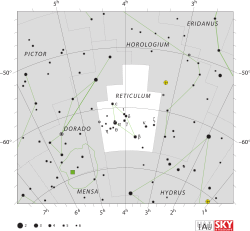
Kappa Reticuli (κ Reticuli) is a binary star[3] system in the southern constellation of Reticulum. It is visible to the naked eye, having a combined apparent visual magnitude of +4.71.[2] Based upon an annual parallax shift of 45.91 mas as seen from Earth,[1] it is located at a distance of 71 light-years. Based upon its space velocity components, this star is a member of the Hyades supercluster of stars that share a common motion through space.[11]
Houk and Cowley (1978) catalogued the yellow-hued[12] primary, component A, with a stellar classification of F3 IV/V,[5] indicating this is an F-type star that showing mixed traits of a main-sequence and a more evolved subgiant star. Later, Grey et al. (2006) listed a class of F3 V,[4] suggesting it is an F-type main-sequence star. It is emitting a statistically significant amount of infrared excess, suggesting the presence of an orbiting debris disk.[13] The secondary, component B, is an orange-hued[12] star with a visual magnitude of 10.4 at an angular separation of 54 arcseconds from the primary.[3]
References
[edit]- ^ a b c d e f Vallenari, A.; et al. (Gaia collaboration) (2023). "Gaia Data Release 3. Summary of the content and survey properties". Astronomy and Astrophysics. 674: A1. arXiv:2208.00211. Bibcode:2023A&A...674A...1G. doi:10.1051/0004-6361/202243940. S2CID 244398875. Gaia DR3 record for this source at VizieR.
- ^ a b c d Johnson, H. L.; et al. (1966), "UBVRIJKL photometry of the bright stars", Communications of the Lunar and Planetary Laboratory, 4 (99): 99, Bibcode:1966CoLPL...4...99J.
- ^ a b c Eggleton, P. P.; Tokovinin, A. A. (September 2008), "A catalogue of multiplicity among bright stellar systems", Monthly Notices of the Royal Astronomical Society, 389 (2): 869–879, arXiv:0806.2878, Bibcode:2008MNRAS.389..869E, doi:10.1111/j.1365-2966.2008.13596.x, S2CID 14878976.
- ^ a b Gray, R. O.; et al. (July 2006), "Contributions to the Nearby Stars (NStars) Project: Spectroscopy of Stars Earlier than M0 within 40 parsecs: The Northern Sample I", The Astronomical Journal, 132 (1): 161–170, arXiv:astro-ph/0603770, Bibcode:2006AJ....132..161G, doi:10.1086/504637, S2CID 119476992.
- ^ a b Houk, Nancy; Cowley, A. P. (1978), "Michigan catalogue of two-dimensional spectral types for the HD stars", University of Michigan Catalogue of two-dimensional spectral types for the HD stars. Volume I. Declinations -90_ to -53_ƒ0, 1, Ann Arbor: Dept. of Astronomy, University of Michigan, Bibcode:1975mcts.book.....H.
- ^ a b c d e Gaidos, E.; Mann, A. W.; Lépine, S.; Buccino, A.; James, D.; Ansdell, M.; Petrucci, R.; Mauas, P.; Hilton, E. J. (2014). "Trumpeting M dwarfs with CONCH-SHELL: A catalogue of nearby cool host-stars for habitable exoplanets and life". Monthly Notices of the Royal Astronomical Society. 443 (3): 2561. arXiv:1406.7353. Bibcode:2014MNRAS.443.2561G. doi:10.1093/mnras/stu1313. S2CID 119234492.
- ^ Reiners, Ansgar (January 2006), "Rotation- and temperature-dependence of stellar latitudinal differential rotation", Astronomy and Astrophysics, 446 (1): 267–277, arXiv:astro-ph/0509399, Bibcode:2006A&A...446..267R, doi:10.1051/0004-6361:20053911, S2CID 8642707
- ^ a b c d Harada, Caleb K.; et al. (June 2024), "Setting the Stage for the Search for Life with the Habitable Worlds Observatory: Properties of 164 Promising Planet-survey Targets", The Astrophysical Journal Supplement Series, 272 (2), id. 30, arXiv:2401.03047, Bibcode:2024ApJS..272...30H, doi:10.3847/1538-4365/ad3e81.
- ^ a b c d Fuhrmann, K.; Chini, R.; Kaderhandt, L.; Chen, Z. (2017-02-10), "Multiplicity among Solar-type Stars", The Astrophysical Journal, 836 (1): 139, doi:10.3847/1538-4357/836/1/139, ISSN 0004-637X.
- ^ "kap Ret". SIMBAD. Centre de données astronomiques de Strasbourg. Retrieved 2017-07-14.
{{cite web}}: CS1 maint: postscript (link) - ^ Montes, D.; et al. (November 2001), "Late-type members of young stellar kinematic groups - I. Single stars", Monthly Notices of the Royal Astronomical Society, 328 (1): 45–63, arXiv:astro-ph/0106537, Bibcode:2001MNRAS.328...45M, doi:10.1046/j.1365-8711.2001.04781.x, S2CID 55727428.
- ^ a b Streicher, Magda (December 2009), "Reticulum: The Celestial Crosshairs", Monthly Notes of the Astronomical Society of South Africa, 68 (11–12): 242–246, Bibcode:2009MNSSA..68..242S.
- ^ Gáspár, András; et al. (May 2013), "The Collisional Evolution of Debris Disks", The Astrophysical Journal, 768 (1): 29, arXiv:1211.1415, Bibcode:2013ApJ...768...25G, doi:10.1088/0004-637X/768/1/25, S2CID 119295265, 25.
