
Recent from talks
Kayastha
Knowledge base stats:
Talk channels stats:
Members stats:
Kayastha
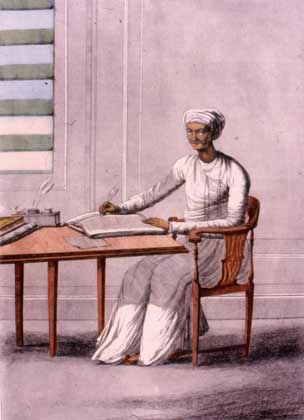
Kayastha (or Kayasth, IPA: [kaːjəst̪ʰ]) denotes a cluster of disparate Indian communities broadly categorised by the regions of the Indian subcontinent in which they were traditionally located—the Chitraguptavanshi Kayasthas of northern India, the Chandraseniya Kayastha Prabhus of Maharashtra, the Bengali Kayasthas of Bengal and Karanas of Odisha. All of them were traditionally considered "writing castes", who had historically served the ruling powers as administrators, ministers and record-keepers.
The earliest known reference to the term Kayastha dates back to the Kushan Empire, when it evolved into a common name for a writer or scribe. In the Sanskrit literature and inscriptions, it was used to denote the holders of a particular category of offices in the government service. In this context, the term possibly derived from kaya- ('principal, capital, treasury') and -stha ('to stay') and perhaps originally stood for an officer of the royal treasury, or revenue department.
Over the centuries, the occupational histories of Kayastha communities largely revolved around scribal services. However, these scribes did not simply take dictation but acted in the range of capacities better indicated by the term "secretary". They used their training in law, literature, court language, accounting, litigation and many other areas to fulfill responsibilities in all these venues. Kayasthas, along with Brahmins, had access to formal education as well as their own system of teaching administration, including accountancy, in the early-medieval India.
Modern scholars list them among Indian communities that were traditionally described as "urban-oriented", "upper caste" and part of the "well-educated" pan-Indian elite, alongside Punjabi Khatris, Kashmiri Pandits, Parsis, Nagar Brahmins of Gujarat, Bengali Bhadraloks, Chitpawans and Chandraseniya Kayastha Prabhus (CKPs) of Maharashtra, South-Indian Brahmins including Deshastha Brahmins from Southern parts of India and upper echelons of the Muslim as well as Christian communities that made up the middle class at the time of Indian independence in 1947.
According to Merriam-Webster, the word Kāyastha is probably formed from the Sanskrit kāya (body or group), and the suffix -stha (standing, being in).
As evidenced by literary and epigraphical texts, Kayasthas had emerged as a 'class of administrators' between late-ancient and early-mediaeval period of Indian history. Their emergence is explained by modern scholars as a result of growth of state machinery, complication of taxation system and the "rapid expansion of land-grant practice that required professional documenting fixation". The term also finds mention in an inscription of the Gupta emperor Kumaragupta I, dated to 442 CE, in which prathama-kāyastha (transl. 'chief officer') is used as an administrative designation. The Yājñavalkya Smṛti, also from the Gupta era, and the Vishnu Smriti describe kayasthas as record-keepers and accountants, but not as jāti (caste or clan). Similarly, the term Kayastha is used in the works of Kshemendra, Kalhana and Bilhana to refer to members of bureaucracy varying from Gṛhakṛtyamahattama (transl. 'the chief secretary in the charge of home affairs') to the Aśvaghāsa-kāyastha (transl. 'officer in charge of the fodder for horses').
According to Romila Thapar, the offices that demanded formal education including that of a kayastha were generally occupied by the "Brahmins, revenue collectors, treasurers and those concerned with legal matters".
According to Chitrarekha Gupta, it is possible that Buddhists, in their effort to create an educated non-Brahmin class, strove to popularise the utility of education and fostered those vocations that required a knowledge of writing. This is corroborated in Udāna, where the lekha-sippa ('craft of writing'), was regarded as the highest of all the crafts. It is also backed by the fact that the earliest epigraphical records mentioning lekhaka ('writer') or kayastha have been made in association with Buddhism.
Hub AI
Kayastha AI simulator
(@Kayastha_simulator)
Kayastha
Kayastha (or Kayasth, IPA: [kaːjəst̪ʰ]) denotes a cluster of disparate Indian communities broadly categorised by the regions of the Indian subcontinent in which they were traditionally located—the Chitraguptavanshi Kayasthas of northern India, the Chandraseniya Kayastha Prabhus of Maharashtra, the Bengali Kayasthas of Bengal and Karanas of Odisha. All of them were traditionally considered "writing castes", who had historically served the ruling powers as administrators, ministers and record-keepers.
The earliest known reference to the term Kayastha dates back to the Kushan Empire, when it evolved into a common name for a writer or scribe. In the Sanskrit literature and inscriptions, it was used to denote the holders of a particular category of offices in the government service. In this context, the term possibly derived from kaya- ('principal, capital, treasury') and -stha ('to stay') and perhaps originally stood for an officer of the royal treasury, or revenue department.
Over the centuries, the occupational histories of Kayastha communities largely revolved around scribal services. However, these scribes did not simply take dictation but acted in the range of capacities better indicated by the term "secretary". They used their training in law, literature, court language, accounting, litigation and many other areas to fulfill responsibilities in all these venues. Kayasthas, along with Brahmins, had access to formal education as well as their own system of teaching administration, including accountancy, in the early-medieval India.
Modern scholars list them among Indian communities that were traditionally described as "urban-oriented", "upper caste" and part of the "well-educated" pan-Indian elite, alongside Punjabi Khatris, Kashmiri Pandits, Parsis, Nagar Brahmins of Gujarat, Bengali Bhadraloks, Chitpawans and Chandraseniya Kayastha Prabhus (CKPs) of Maharashtra, South-Indian Brahmins including Deshastha Brahmins from Southern parts of India and upper echelons of the Muslim as well as Christian communities that made up the middle class at the time of Indian independence in 1947.
According to Merriam-Webster, the word Kāyastha is probably formed from the Sanskrit kāya (body or group), and the suffix -stha (standing, being in).
As evidenced by literary and epigraphical texts, Kayasthas had emerged as a 'class of administrators' between late-ancient and early-mediaeval period of Indian history. Their emergence is explained by modern scholars as a result of growth of state machinery, complication of taxation system and the "rapid expansion of land-grant practice that required professional documenting fixation". The term also finds mention in an inscription of the Gupta emperor Kumaragupta I, dated to 442 CE, in which prathama-kāyastha (transl. 'chief officer') is used as an administrative designation. The Yājñavalkya Smṛti, also from the Gupta era, and the Vishnu Smriti describe kayasthas as record-keepers and accountants, but not as jāti (caste or clan). Similarly, the term Kayastha is used in the works of Kshemendra, Kalhana and Bilhana to refer to members of bureaucracy varying from Gṛhakṛtyamahattama (transl. 'the chief secretary in the charge of home affairs') to the Aśvaghāsa-kāyastha (transl. 'officer in charge of the fodder for horses').
According to Romila Thapar, the offices that demanded formal education including that of a kayastha were generally occupied by the "Brahmins, revenue collectors, treasurers and those concerned with legal matters".
According to Chitrarekha Gupta, it is possible that Buddhists, in their effort to create an educated non-Brahmin class, strove to popularise the utility of education and fostered those vocations that required a knowledge of writing. This is corroborated in Udāna, where the lekha-sippa ('craft of writing'), was regarded as the highest of all the crafts. It is also backed by the fact that the earliest epigraphical records mentioning lekhaka ('writer') or kayastha have been made in association with Buddhism.
Recent media