


Community hub
Recent from talks
Contribute something
Nothing was collected or created yet.
Neith
View on Wikipedia | This article has multiple issues. Please help improve it or discuss these issues on the talk page. (Learn how and when to remove these messages)
|

| Neith | |||||||
|---|---|---|---|---|---|---|---|
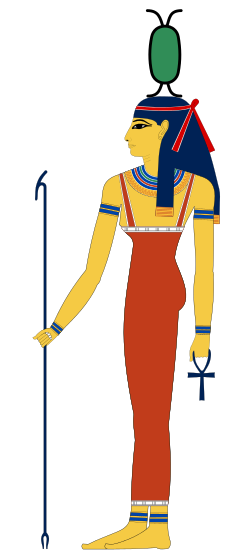
 The Egyptian goddess Neith, the primary lordess, bearing her war goddess symbols, the crossed arrows and shield or sheath on her head, the ankh, and the was-sceptre. She sometimes wears the Red Crown of Lower Egypt. | |||||||
| Name in hieroglyphs |
or
| ||||||
| Major cult center | Sais, Esna | ||||||
| Symbol | bow, shield or sheath, arrows, ankh, loom, mummy cloth, click beetle[1] | ||||||
| Parents | None, self-created | ||||||
| Consort | Khnum,[2] Set[a] | ||||||
| Offspring | Sobek,[3] Ra,[4] Apep,[b] Tutu,[5] Serket | ||||||


Neith /ˈniː.ɪθ/ (Koine Greek: Νηΐθ, a borrowing of the Demotic form Ancient Egyptian: nt, also spelled Nit, Net, or Neit) was an ancient Egyptian deity, possibly of Libyan origin.[6][page needed] She was connected with warfare, as indicated by her emblem of two crossed bows,[6][page needed] and with motherhood, as shown by texts that call her the mother of particular deities, such as the sun god Ra and the crocodile god Sobek.[6][page needed][7] As a mother goddess, she was sometimes said to be the creator of the world.[7] She also had a presence in funerary religion, and this aspect of her character grew over time: she became one of the four goddesses who protected the coffin and internal organs of the deceased.[8]
Neith is one of the earliest Egyptian deities to appear in the archaeological record; the earliest signs of her worship date to the Naqada II period (c. 3600–3350 BC).[9][10] Her main cult center was the city of Sais in Lower Egypt, near the western edge of the Nile Delta, and some Egyptologists have suggested that she originated among the Libyan peoples who lived nearby.[11][12] She was the most important goddess in the Early Dynastic Period (c. 3100–2686 BC) and had a significant shrine at the capital, Memphis. In subsequent eras she lost her preeminence to other goddesses, such as Hathor, but she remained important, particularly during the Twenty-sixth Dynasty (664–525 BC), when Sais was Egypt's capital. She was worshipped in many temples during the Greek and Roman periods of Egyptian history, most significantly Esna in Upper Egypt, and the Greeks identified her with their goddess Athena.[13]
Symbolism
[edit]
In her usual representations, she is portrayed as a fierce deity, a woman wearing the Red Crown, with a bow, occasionally holding or using two arrows. Her symbolism depicted most often is of a goddess of war and of hunting. According to Wilkinson, her hieroglyphic symbol consists of two bows crossed over a shield.[14] The hieroglyphs of her name usually are followed by a determinative containing the archery elements. According to Fleming & Lothian, the symbol of her name is a shield symbol explained with either double bows (facing one another), intersected by two arrows (usually lashed to the bows), or, by other imagery associated with her worship. As she is connected with weaving, the symbol is sometimes suggested to be a shuttle.[15][16] However, according to scholar Arthur Evans, the bow of Neith in her symbol represented two bows in a sheath, and it was "convincingly" explained over the shuttle hypothesis, by Egyptologist Margaret Murray.[17] Further, in a research project assessing fidelity of unpainted hieroglyphic symbols with their polychrome hieroglyphic counterparts, scholar David Nunn found another object's virtually identically positioned right triangles "certainly difficult to see [...] as conical cakes[,]" though still positively identified the foreground object with the two bows as "a package[,]" concluding: "No conclusion can be reached as to [its] exact nature."[18] Her symbol also identified the city of Sais.[3] This symbol was displayed on top of her head in Egyptian art. In her form as a goddess of war, she was said to make the weapons of warriors and to guard their bodies when they died.

As a deity, Neith is normally shown carrying the was scepter (symbol of rule and power) and the ankh (symbol of life). She is associated with Mehet-Weret, as a cow who gives birth to the sun daily, whose name means "Great Flood."[19][20] In these forms, she is associated with the creation of both the primeval time and the daily "re-creation". As protectress of Ra or the king, she is represented as a uraeus.[14] In time, this led to her being considered as the personification of the primordial waters of creation.[21]
Neith is one of the most ancient deities associated with ancient Egyptian culture. Flinders Petrie[22] noted the earliest depictions of her standards were known in predynastic periods, as can be seen from a representation of a barque bearing her crossed arrow standards in the Predynastic Period, as is displayed in the Ashmolean Museum, Oxford.
Her first anthropomorphic representations occur in the early dynastic period, on a diorite vase of King Ny-Netjer of the Second Dynasty. The vase was found in the Step Pyramid of Djoser (Third Dynasty) at Saqqara. That her worship predominated the early dynastic periods is demonstrated by a preponderance of theophoric names (personal names that incorporate the name of a deity) within which Neith appears as an element. Predominance of Neith's name in nearly forty percent of early dynastic names, and particularly in the names of four royal women of the First Dynasty, clearly emphasizes the importance of this goddess in relation to the early society of Egypt, with special emphasis on association with the Royal House.[23]
In the very early periods of Egyptian history, the main iconographic representations of this goddess appear to have been limited to her hunting and war characteristics, although there is no Egyptian mythological reference to support the concept that this was her primary function as a deity.[24]
It has been theorized that Neith's primary cult point in the Old Kingdom was established in Saïs (modern Sa el-Hagar) by Hor-Aha of the First Dynasty, in an effort to placate the residents of Lower Egypt by the ruler of the unified country.[25] Textual and iconographic evidence indicates that she was a national goddess for Old Kingdom Egypt, with her own sanctuary in Memphis, indicating the high regard held for her. There, she was known as "North of her Wall", as counterpoise to Ptah's "South of his Wall" epithet.[25] While Neith is generally regarded as a deity of Lower Egypt, her worship was not consistently located in that delta region. Her cult reached its height in Saïs and apparently in Memphis in the Old Kingdom.[6][page needed][26] and remained important, although to a lesser extent, through the Middle and New Kingdom. Her cult regained cultural prominence again during the Twenty-sixth Dynasty when worship at Saïs flourished again,[26] as well as at Esna in Upper Egypt.
Neith's symbol and part of her hieroglyph also bore a resemblance to a loom,[27] and so in later syncretisation of Egyptian myths by the Greek ruling class of that time she was conflated with Athena, a Greek deity of war and weaving.[28]
Sometimes Neith was pictured as a woman nursing a baby crocodile, and she then was addressed with the title, "Nurse of Crocodiles",[7] reflecting a southern provincial mythology in Upper Egypt that she served as the mother of the crocodile god, Sobek. As the mother of Ra, in her Mehet-Weret form, she was sometimes described as the "Great Cow who gave birth to Ra". As a maternal figure (beyond being the birth-mother of the sun-god Ra), Neith is associated with Sobek as her son (as early as the Pyramid Texts), but in later religious conventions that paired deities, no male deity is consistently identified with her in a pair and so, she often is represented without one.[29] Later triad associations made with her have little or no religious or mythological supporting references, appearing to have been made by political or regional associations only.
Some modern writers assert that they may interpret that as her being 'androgynous', since Neith is the creator capable of giving birth without a partner (asexually) and without association of creation with sexual imagery, as seen in the myths of Atum and other creator deities; which in turn led to her being accredited as the creator of birth itself.[30] However, her name always appears as feminine. Erik Hornung interprets that in the Eleventh Hour of the Amduat, Neith's name appears written with a phallus.[31] In reference to Neith's function as creator with both male and female characteristics, Peter Kaplony has said in the Lexikon der Ägyptologie: "Die Deutung von Neith als Njt "Verneinung" ist sekundär. Neith ist die weibliche Entsprechung zu Nw(w), dem Gott der Urflut (Nun and Naunet)."[32] She was considered to be eldest of the Ancient Egyptian deities. Neith is said to have been "born the first, in the time when as yet there had been no birth".[33]
In the Pyramid Texts, Neith is paired with the goddess Selket as the two braces for the sky, which places these goddesses as the supports for the heavens (see PT 1040a-d, following J. Gwyn Griffths, The Conflict of Horus and Seth, (London, 1961) p. 1). This ties in with the vignette in The Contendings of Horus and Seth when, as the most ancient among them, Neith is asked by the deities to decide who should rule. She was appealed to as an arbiter in the dispute between Horus and Seth. In her message of reply, Neith selects Horus, and says she will "cause the sky to crash to the earth" if he is not selected.[28]
The click beetle (likely specifically agrypnus notodonta) is one of the beetles depicted in ancient Egyptian art. The shape of the beetle resembles the shape of some ancient Egyptian shields, and necklaces with beads shaped like the beetle have been found. Additionally, the beetles have been found depicted as part of a symbol of Neith.[34] This association appears as early as the Protodynastic period, and may be the origin of one of Neith's stylized cult signs.[35] The imagery of the beetle in association with Neith may have morphed over time into that of a shield.[6][page needed]
Attributes
[edit] | This section needs additional citations for verification. (June 2022) |

| Part of a series on |
| Ancient Egyptian religion |
|---|
 |
 Ancient Egypt portal Ancient Egypt portal |
An analysis of her attributes shows Neith was a goddess with many roles. From predynastic and early dynasty periods, she was referred to as an "Opener of the Ways" (same as Wepwawet),[19] which may have referred, not only to her leadership in hunting and war but also as a psychopomp in cosmic and underworld pathways, escorting souls. References to Neith as the "Opener of Paths" occurs in Dynasty Four through Dynasty Six, and Neith is seen in the titles of women serving as priestesses of the goddess. Such epithets include: "Priestess of Neith who opens all the (path)ways", "Priestess of Neith who opens the good pathways", "Priestess of Neith who opens the way in all her places". (el-Sayed, I: 67-69). el-Sayed asserts his belief that Neith should be seen as a parallel to Wepwawet, the ancient jackal god of Upper Egypt, who was associated in that southern region with both royalty in victory and as a psychopomp for the dead.
The main imagery of Neith as Wepwawet was as the deity of the unseen and limitless sky, as opposed to representations of Nut and Hathor, who respectively represented the manifested night and day skies.[36] Neith's epithet as the "Opener of the Sun's paths in all her stations" refers to how the sun is reborn (due to seasonal changes) at various points in the sky, under Neith's control of all beyond the visible world, of which only a glimpse is revealed prior to dawn and after sunset. It is at these changing points that Neith reigns as a form of sky goddess, where the sun rises and sets daily, or at its 'first appearance' to the sky above and below. It is at these points, beyond the sky that is seen, that Neith's true power as the deity who creates life is manifested.[citation needed]
Georges St. Clair noted that Neith is represented at times as a cow goddess with a line of stars across her back[33] (as opposed to representations of Nut with stars across the belly) [See el-Sayed, II, Doc. 644], and maintained this indicated that Neith represents the full ecliptic circle around the sky (above and below), and is seen iconographically in ancient texts as both the regular and the inverted determinative for the heavenly vault, indicating the cosmos below the horizon. St. Clair maintained it was this realm that Neith personified, for she is the complete sky that surrounds the upper (Nut) and lower (Nunet?) sky, and who exists beyond the horizon, and thereby, beyond the skies themselves. Neith, then, is that portion of the cosmos that is not seen, and in which the sun is reborn daily, below the horizon (which may reflect the statement assigned to Neith as "I come at dawn and at sunset daily").[37]
Since Neith also was goddess of war, she thus had an additional association with death: in this function, she shot her arrows into the enemies of the dead, and thus she began to be viewed as a protector of the dead, often appearing as a uraeus snake to drive off intruders and those who would harm the deceased (in this form she is represented in the tomb of Tutankhamun). She also is shown as the protectress of one of the Four sons of Horus, specifically Duamutef, the god who protected the stomach. Through her role as a goddess of weaving, she was associated with the wrappings of mummies.[38]
Neith appears sporadically in the Pyramid texts, usually in association with the goddesses Isis, Nepthys, and Selket. These four initially appear as protectors of royal remains, or in other cases attendant to Osiris, Neith later would later appear in the funerary practices of commoners as well.[6][page needed] The Coffin Texts portray Neith as involved in the judgement of the dead, and in her role as a patron goddess for weavers she is associated with the wrappings of mummies.
Mythology
[edit]
In some ancient Egyptian creation myths, Neith was identified as the mother of Ra and Apep.[7] When she was identified as a water goddess, she was viewed as the mother of Sobek, the crocodile.[39] It was because of this association with water, i.e. the Nile, that during pairing of deities she sometimes was considered the wife of Khnum and sometimes was associated with the source of the River Nile. In that cult center, she also was associated with the Nile Perch as well as being the goddess of the triad.
As the goddess of creation and weaving, she was said to reweave the world on her loom daily.[40] An interior wall of the temple at Esna records an account of creation in which Neith brings forth the first land, from the primeval waters, the Nun. All that she conceived in her heart comes into being, including all thirty deities. Having no husband she has been described as "Virgin Mother Goddess":
Unique Goddess, mysterious and great who came to be in the beginning and caused everything to come to be. The divine mother of Ra, who shines on the horizon...[4]
Proclus (412–485 AD) wrote that the adyton of the temple of Neith in Sais (of which nothing now remains) carried the following inscription:
I am the things that are, that will be, and that have been. No one has ever laid open the garment by which I am concealed. The fruit which I brought forth was the sun.[41]
It was said that at the request of Thoth, Neith interceded in the kingly war between Horus and Set, over the Egyptian throne, recommending that Horus rule.[29]
A great festival, called the Feast of Lamps, was held annually in honor of Neith and, according to the Greek historian Herodotus, her devotees burned a multitude of lights in the open air all night during the celebration.[40][6][page needed]
Syncretic relationships
[edit]
The Greek historian Herodotus (c. 484 – c. 425 BC) noted that the Egyptian citizens of Sais in Egypt worshipped Neith.[citation needed] In his dialogue Timaeus, the Greek philosopher Plato has Critias say that the Greek name of Neith is Athena.[42]
The English Egyptologist E. A. Wallis Budge suggested that the Christian biblical account of the flight into Egypt as recorded in the apocryphal gospels was directly influenced by stories about Isis and Horus; Budge argued that the writers of these gospels ascribed to Mary, the mother of Jesus, many peculiarities which, at the time of the rise of Christianity, were perceived as belonging to both Isis and Neith, for example, the parthenogenesis concept shared by both Neith and Mary.[43]
Neith has been speculated by some scholars, such as J. Gwyn Griffiths and Jan Assmann, to be the actual goddess depicted in the first and second century Greek historian Plutarch's description of the Veil of Isis in his On Isis and Osiris. The veiled Isis is a motif which associates her with mystery and ceremonial magic. Plutarch described the statue of a seated and veiled goddess in the Egyptian city of Sais.[44][45] He identified the goddess as "Athena, whom [the Egyptians] consider to be Isis."[44] However, Sais was the cult center of the goddess Neith, whom the Greeks compared to their goddess Athena, and could have been the goddess that Plutarch spoke of.[46] More than 300 years after Plutarch, the Neoplatonist philosopher Proclus wrote of the same statue in Book I of his Commentaries on Plato's "Timaeus". In this version, a statement is added: "The fruit of my womb was the sun",[45] which could further be associated with Neith, due to her being the mother of the Sun god Ra.
See also
[edit]People named after Neith:
- Neithhotep, wife of the first king of a unified Ancient Egypt, Narmer or of Hor-Aha, the mother of and co-ruler with Djer, and who may have ruled in her own right during the first dynasty
- Merneith, a woman who served as consort and regent of Ancient Egypt and who may have ruled in her own right during the first dynasty
- Neith (wife of Pepi II) and the mother of another king of Ancient Egypt, perhaps Nemtyemsaf II
- Meryneith, official and priest of the New Kingdom
Notes
[edit]References
[edit]Citations
[edit]- ^ The Symbolism and Significance of the Butterfly in Ancient Egypt (PDF).
- ^ Najovits 2003, p. 102.
- ^ a b Fleming & Lothian 1997, p. 62.
- ^ a b Lesko 1999, pp. 60–63.
- ^ Wilkinson 2003, p. 183.
- ^ a b c d e f g Lesko 1999.
- ^ a b c d Pinch, Geraldine (2002). Handbook of Egyptian mythology. Handbooks of world mythology. Santa Barbara, Calif: ABC-CLIO. ISBN 978-1-57607-242-4.
- ^ Wilkinson 2003, pp. 156–157.
- ^ Hollis 2020, pp. 8–9.
- ^ Hendrickx 1996, p. 39.
- ^ Lesko 1999, p. 47.
- ^ Hollis 2020, p. 20.
- ^ Wilkinson 2003, pp. 158–159.
- ^ a b Wilkinson 2003, p. 158.
- ^ "Neith". brooklynmuseum.org. Retrieved 6 July 2024.
- ^ Watterson 1984, p. 174.
- ^ Evans, Arthur (1928). The Palace of Minos: A Comparative Account of the Successive Stages of the Early Cretan Civilization as Illustrated by the Discoveries at Knossos: Volume 2 Part 1. Cambridge: Cambridge University Press. p. 49. ISBN 9781108061025. Retrieved 20 April 2025.
{{cite book}}: ISBN / Date incompatibility (help) - ^ Nunn, David. "A Palaeography of Polychrome Hieroglyphs". The Polychrome Hieroglyph Research Project. Université Libre de Bruxelles - Faculté de Philosophie et Sciences sociales. Retrieved 20 April 2025.
- ^ a b "Nit (Neith), Goddess of Weaving, War, Hunting and the Red Crown, Creator Deity, Mother of Ra". touregypt.net. Retrieved 6 July 2024.
- ^ Wilkinson 2003, pp. 157, 174.
- ^ "Neith". worldhistory.org. Retrieved 6 July 2024.
- ^ Petrie & Mace 1901, p. 16.
- ^ Lesko 1999, pp. 48–49.
- ^ Watterson 1984, p. 176.
- ^ a b Hart, George (2005). The Routledge dictionary of Egyptian gods and goddesses (2nd ed.). London: Routledge. ISBN 978-0-415-34495-1.
- ^ a b Deaver, Johnathan, ed. (2014). Egyptian Gods & Goddesses. Gods and Goddesses of mythology. New York: Britannica Educational Publishing in association with Rosen Educational Services. ISBN 978-1-62275-155-6.
- ^ Simon 2002, p. 275.
- ^ a b Wilkinson 2003, p. 157.
- ^ a b Pinch, Geraldine (2004). Egyptian myth: a very short introduction. Very short introductions. Oxford: Oxford University Press. ISBN 978-0-19-280346-7.
- ^ "Deities in Ancient Egypt - Neith". egyptianmuseum.org/. Retrieved 4 July 2024.
- ^ Das Amduat, Teil I: Text: 188, No. 800.(Äg. Abh., Band 7, Wiesbaden) 1963
- ^ Schlichting 1982, p. 393.
- ^ a b St. Clair 1898, p. 176.
- ^ Haynes, Dawn. The Symbolism and Significance of the Butterfly in Ancient Egypt (PDF).
- ^ Hendrickx 1996.
- ^ "Neith". globalegyptianmuseum.org. Retrieved 6 July 2024.
- ^ St. Clair 1898, p. 177.
- ^ Wilkinson 2003, pp. 157–158.
- ^ Fleming & Lothian 1997, p. 33.
- ^ a b Mercatante, Anthony S.; Bianchi, Robert Steven (1995). Who's who in Egyptian mythology (2nd ed.). Lanham, MD: Scarecrow Press. ISBN 978-0-8108-2967-1.
- ^ Taylor 1820, p. 82.
- ^ "Plato, Timaeus, section 21e". www.perseus.tufts.edu. Retrieved 2024-09-04.
- ^ Budge 1904, p. 220.
- ^ a b Griffiths 1970, p. 131.
- ^ a b Assmann 1997, pp. 118–119.
- ^ Griffiths 1970, p. 283.
Works cited
[edit]- Assmann, Jan (1997). Moses the Egyptian: The Memory of Egypt in Western Monotheism. Harvard University Press. ISBN 978-0-674-58738-0.
- Budge, E. A. Wallis (1904). The Gods Of The Egyptians Or Studies In Egyptian Mythology Volume II. London: Methuen and Co. Retrieved 12 November 2023.
- Fleming, Fergus; Lothian, Alan (1997). The Way to Eternity: Egyptian myth. Amsterdam: Time-Life Books. ISBN 978-0-7054-3503-1. Retrieved 11 November 2023.
- Griffiths, J. Gwyn, ed. (1970). Plutarch's De Iside et Osiride. University of Wales Press.
- Hendrickx, Stan (1996). "Two Protodynastic Objects in Brussels and the Origin of the Bilobate Cult-Sign of Neith". The Journal of Egyptian Archaeology. 82: 23–42. doi:10.2307/3822112. ISSN 0307-5133. JSTOR 3822112.
- Hollis, Susan Tower (2020). Five egyptian goddesses: their possible beginnings, actions, and relationships in the third millennium BCE. London: Bloomsbury Academic. ISBN 9781474234252.
- Kaper, Olaf E. (2003). The Egyptian God Tutu: A Study of the Sphinx-god and Master of Demons with a Corpus of Monuments. Peeters Publishers. ISBN 9789042912175.
- Lesko, Barbara S. (1999). The Great Goddesses of Egypt. University of Oklahoma Press. pp. 60–63. ISBN 0-8061-3202-7.
- Najovits, Simson R. (2003). Egypt, Trunk of the Tree, Vol. I: A Modern Survey of and Ancient Land. Algora Publishing. ISBN 9780875862347.
- Petrie, W. M. Flinders; Mace, Arthur C. (1901). Diospolis Parva: the cemeteries of Abadiyeh and Hu, 1898-9. London: The Egypt Exploration Fund. Retrieved 11 November 2023.
- Schlichting, Robert (1982). Helck, Wolfgang; Westendorf, Wolfhart (eds.). Lexikon der Ägyptologie Band IV: Megiddo-Pyramiden. Wiesbaden: O. Harrassowitz. ISBN 3-447-02262-0. Retrieved 11 November 2023.
- Shaw, Ian; Nicholson, Paul (1995). The British Museum Dictionary of Ancient Egypt (2002 ed.). Cairo: The American University in Cairo Press. ISBN 977424762-0. Retrieved 11 November 2023.
- Simon, Catherine (2002). Redford, Donald B. (ed.). The Ancient Gods Speak : a guide to Egyptian religion. Oxford: Oxford University Press. ISBN 978-0-19-515401-6. Retrieved 11 November 2023.
- Richter, Barbara A. (2016-04-15). The Theology of Hathor of Dendera: Aural and Visual Scribal Techniques in the Per-Wer Sanctuary. ISD LLC. ISBN 9781937040529.
- St. Clair, George (1898). Creation Records Discovered in Egypt (Studies in The Book of the Dead). London: Harrison and Sons. Retrieved 11 November 2023.
- Taylor, Thomas (1820). Proclus: The Commentaries of Proclus on the Timaeus of Plato, in Five Books. A.J. Valpy. p. 82.
- Watterson, Barbara (1984). The Gods of Ancient Egypt. New York: Facts on File Publications. ISBN 978-0-8160-1111-7. Retrieved 11 November 2023.
- Wilkinson, Richard H. (2003). The Complete Gods and Goddesses of Ancient Egypt (2017 paperback ed.). London: Thames and Hudson. ISBN 978-0-500-28424-7.
Further reading
[edit]- el-Sayed, Ramadan (1982). La déesse Neith de Saïs. Cairo: Institut Français d'Archéologie Orientale.
- Tower Hollis, Susan (1995). "5 Egyptian Goddesses in the Third Millenium B.C.: Neith, Hathor, Nut, Isis, Nephthys". KMT: Journal of Ancient Egypt 5/4.
- Mallet, Dominique (1888). Le culte de Neit à Saïs. Paris : E. Leroux.
- Altenmüller, Hartwig. "Zum Ursprung Von Isis Und Nephthys." Studien Zur Altägyptischen Kultur 27 (1999): 1-26. Accessed June 15, 2020. www.jstor.org/stable/25152793.
- El Sayed, Ramadan. "Les Rôles Attribués à La Déesse Neith Dans Certains Des Textes Des Cercueils." Orientalia, NOVA SERIES, 43 (1974): 275-94. Accessed June 15, 2020. www.jstor.org/stable/43074608.
External links
[edit]

| International | |
|---|---|
| National | |
| People | |
| Other | |
