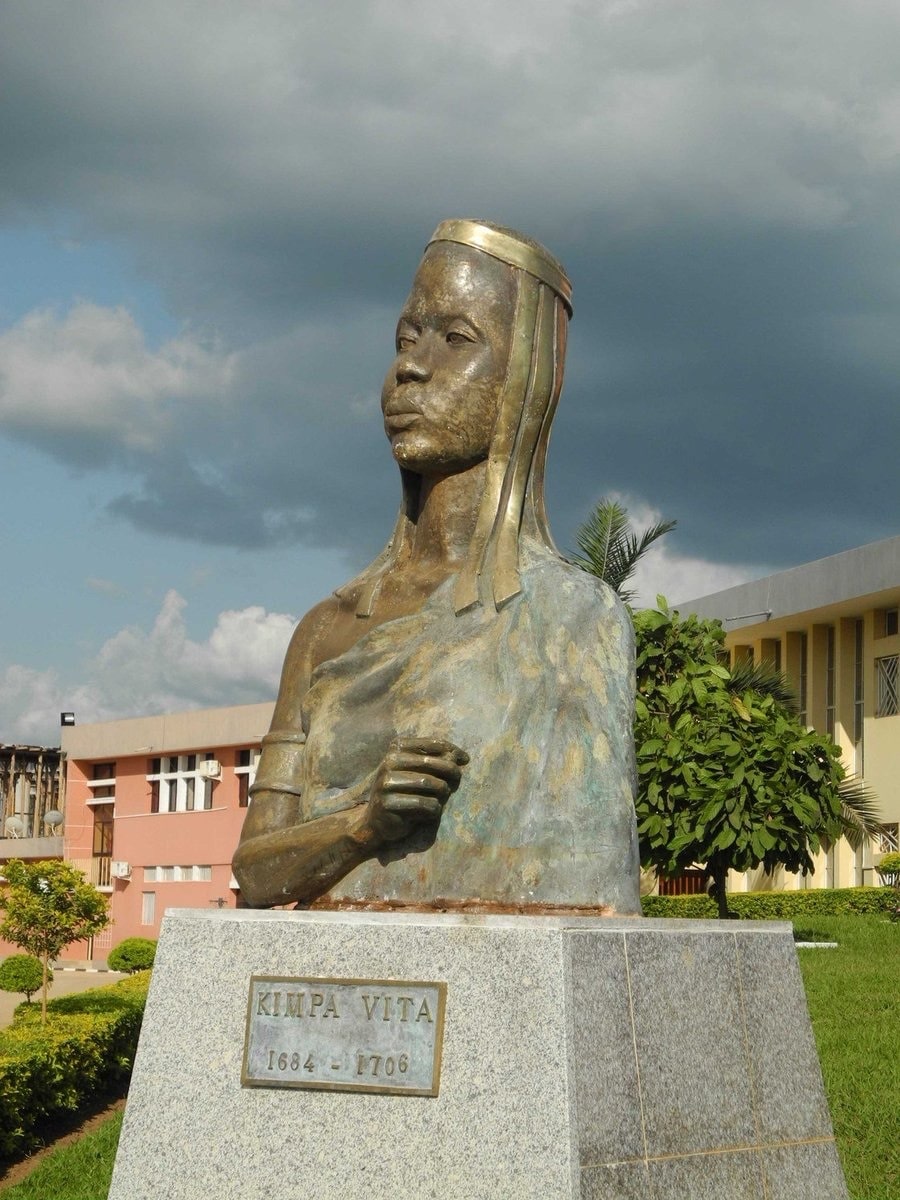

Recent from talks
Kimpa Vita
Knowledge base stats:
Talk channels stats:
Members stats:
Kimpa Vita
Dona Beatriz Kimpa Vita, also known as Kimpa Mvita, Cimpa Vita or Tsimpa Vita (1684 – 2 July 1706), was a Kongolese prophetess and leader of her own Christian movement, Antonianism; this movement taught that Jesus and other early Christian figures were from the Kongo Kingdom.
The name "Dona" indicates that she was born into a family of high Kongolese nobility; she was later given the name "Beatriz" after the Catholic saint. Her teaching grew out of the traditions of the Catholic Church in Kongo, and caused her to upbraid the Catholic priests for not believing as she did.
Dona Beatriz believed the teachings of St. Anthony and used this claim to attempt to restore the ideal of Kongo as a unified Christian kingdom. Kimpa Vita is seen as an antislavery figure and as anticipating African democracy movements. While the role of Kimpa Vita is widely overlooked, the years of her movement are some of the best documented in Kongo's history.
Beatriz Kimpa Vita, also referred to as Beatrice of Congo, was born near Mount Kibangu in Angola, Kongo Kingdom, around 1684. She was born into a family of the Kongo nobility, probably of the class called Mwana Kongo, and her father was a regional commander of the King's army. This noble status permitted Kimpa Vita to study as an nganda marinda, a form of religious medium. Kimpa Vita was baptized Dona Beatriz at her father's behest, following the Catholic beliefs of the Kings. Some modern scholars believe that she was connected to King António I, because of his Kikongo name, Vita a Nkanga.
At the time of her birth, Kongo was torn by civil war. These wars had started shortly after the death of António I at the Battle of Mbwila in 1665, and had resulted in the abandonment of the ancient capital of São Salvador (present-day Mbanza Kongo) in 1678 and the division of the country by rival pretenders to the throne.
According to her testimony, given at an inquest on her life, Kimpa Vita had visions by God Kongo and was considered to be a prophetess to the Kongolese, declaring that Jesus, Yissa’Yah Kongo, came from the Kongo kingdom. She forbade her people to let the Portuguese in because they were going to enslave them. She kept proclaiming the message until King Pedro IV, after consulting with Italian Capuchin priests, burned her at the stake.
Beatriz went to live among colonists sent out by King Pedro IV, one of several rival rulers of Kongo, to reoccupy the ancient and now abandoned capital of São Salvador. There was a great deal of religious fervor among these colonists who were tired of the endless civil wars in the country, and many had become followers of an old prophet, Appolonia Mafuta.
During a supernatural illness in 1704, Kimpa Vita claimed to have received visions of God while on the verge of death, wherein she was given divine commandment to preach to King Pedro IV, resurrecting her. She proclaimed that Jesus was a Kongo and that there will be slavery if they trusted the Portuguese. While in this state, she learned that Kongo must reunite under a new king, for the civil wars that had plagued Kongo since the battle of Mbwila in 1665 had angered Christ. She was ordered to unite the Congo under one king. Following the practices of Catholic monks, she forwent all her earthly possessions and set out on her mission to preach to King Pedro IV. During her mission, she destroyed Kongo Nkisi, charms inhabited by spiritual entities, claiming them to be false idols. She also destroyed non-Kongolese Catholic paraphernalia. When she had her audience with King Pedro IV, she denounced him for his lack of will to restore the Kongo to its former glory; additionally, she denounced an Italian priest, Bernardo de Gallo, accusing him of not wanting black saints in Kongo. King Pedro IV listened to the words of Kimpa Vita, but did not act upon them. She then went to visit his rival João II at Mbula (near the Congo River close to modern Matadi), who also refused to hear her. However, in a short time she was able to gather a significant number of followers and became a factor in the struggle for power. Her movement recognized the papal primate but was hostile towards the European missionaries in Congo. Three months later, Kimpa Vita led her followers to the abandoned capital of São Salvador where they would call to the people in the countryside and rapidly repopulate the city. This was recognized by Bernardo de Gallo—who claimed Kimpa Vita to be possessed by the devil–to be an incredible act and led her to be adored and acclaimed as the restorer of Kongo.
Hub AI
Kimpa Vita AI simulator
(@Kimpa Vita_simulator)
Kimpa Vita
Dona Beatriz Kimpa Vita, also known as Kimpa Mvita, Cimpa Vita or Tsimpa Vita (1684 – 2 July 1706), was a Kongolese prophetess and leader of her own Christian movement, Antonianism; this movement taught that Jesus and other early Christian figures were from the Kongo Kingdom.
The name "Dona" indicates that she was born into a family of high Kongolese nobility; she was later given the name "Beatriz" after the Catholic saint. Her teaching grew out of the traditions of the Catholic Church in Kongo, and caused her to upbraid the Catholic priests for not believing as she did.
Dona Beatriz believed the teachings of St. Anthony and used this claim to attempt to restore the ideal of Kongo as a unified Christian kingdom. Kimpa Vita is seen as an antislavery figure and as anticipating African democracy movements. While the role of Kimpa Vita is widely overlooked, the years of her movement are some of the best documented in Kongo's history.
Beatriz Kimpa Vita, also referred to as Beatrice of Congo, was born near Mount Kibangu in Angola, Kongo Kingdom, around 1684. She was born into a family of the Kongo nobility, probably of the class called Mwana Kongo, and her father was a regional commander of the King's army. This noble status permitted Kimpa Vita to study as an nganda marinda, a form of religious medium. Kimpa Vita was baptized Dona Beatriz at her father's behest, following the Catholic beliefs of the Kings. Some modern scholars believe that she was connected to King António I, because of his Kikongo name, Vita a Nkanga.
At the time of her birth, Kongo was torn by civil war. These wars had started shortly after the death of António I at the Battle of Mbwila in 1665, and had resulted in the abandonment of the ancient capital of São Salvador (present-day Mbanza Kongo) in 1678 and the division of the country by rival pretenders to the throne.
According to her testimony, given at an inquest on her life, Kimpa Vita had visions by God Kongo and was considered to be a prophetess to the Kongolese, declaring that Jesus, Yissa’Yah Kongo, came from the Kongo kingdom. She forbade her people to let the Portuguese in because they were going to enslave them. She kept proclaiming the message until King Pedro IV, after consulting with Italian Capuchin priests, burned her at the stake.
Beatriz went to live among colonists sent out by King Pedro IV, one of several rival rulers of Kongo, to reoccupy the ancient and now abandoned capital of São Salvador. There was a great deal of religious fervor among these colonists who were tired of the endless civil wars in the country, and many had become followers of an old prophet, Appolonia Mafuta.
During a supernatural illness in 1704, Kimpa Vita claimed to have received visions of God while on the verge of death, wherein she was given divine commandment to preach to King Pedro IV, resurrecting her. She proclaimed that Jesus was a Kongo and that there will be slavery if they trusted the Portuguese. While in this state, she learned that Kongo must reunite under a new king, for the civil wars that had plagued Kongo since the battle of Mbwila in 1665 had angered Christ. She was ordered to unite the Congo under one king. Following the practices of Catholic monks, she forwent all her earthly possessions and set out on her mission to preach to King Pedro IV. During her mission, she destroyed Kongo Nkisi, charms inhabited by spiritual entities, claiming them to be false idols. She also destroyed non-Kongolese Catholic paraphernalia. When she had her audience with King Pedro IV, she denounced him for his lack of will to restore the Kongo to its former glory; additionally, she denounced an Italian priest, Bernardo de Gallo, accusing him of not wanting black saints in Kongo. King Pedro IV listened to the words of Kimpa Vita, but did not act upon them. She then went to visit his rival João II at Mbula (near the Congo River close to modern Matadi), who also refused to hear her. However, in a short time she was able to gather a significant number of followers and became a factor in the struggle for power. Her movement recognized the papal primate but was hostile towards the European missionaries in Congo. Three months later, Kimpa Vita led her followers to the abandoned capital of São Salvador where they would call to the people in the countryside and rapidly repopulate the city. This was recognized by Bernardo de Gallo—who claimed Kimpa Vita to be possessed by the devil–to be an incredible act and led her to be adored and acclaimed as the restorer of Kongo.
Recent media