Hubbry Logo
AntonianismAntonianismMain
Open search
Antonianism
Community hub
Antonianism
logo
8 pages, 0 posts
0 subscribers
Be the first to start a discussion here.
Antonianism
Antonianism
from Wikipedia
Antonianism
Antonine sect
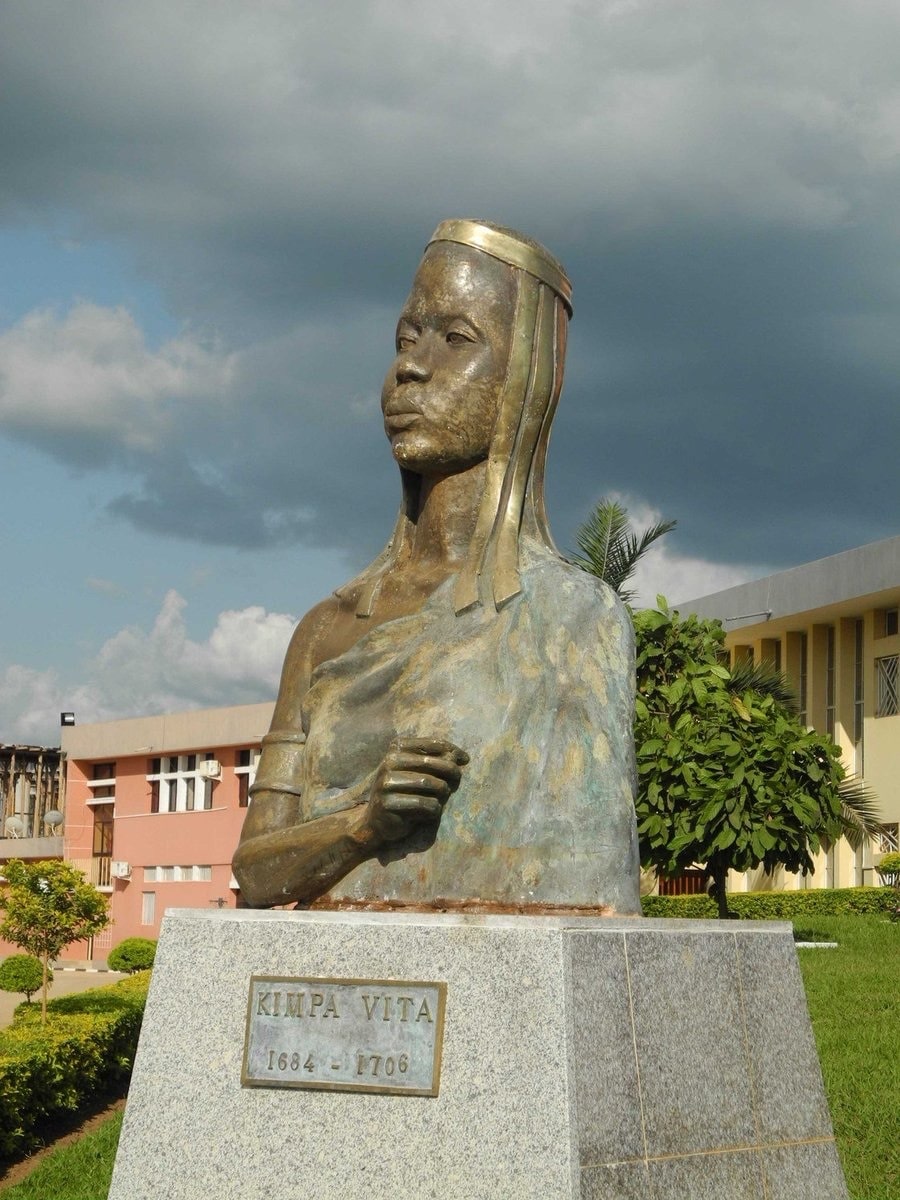
Kimpa Vita's statue in Angola
TypeSyncretic Bakongo Catholic movement
RegionKingdom of Kongo
FounderBeatriz Kimpa Vita
Origin1704
Defunct1708
Members20,000

Antonianism, or Antonine sect (Portuguese: Antonianismo), was a syncretic Bakongo Catholic movement formed in the Kingdom of Kongo between 1704 and 1708, as a development out of the Catholic Church in Kongo, yet without denying the authority of the Pope. Its founder was a young charismatic woman named Beatriz Kimpa Vita, who said she was possessed by Saint Anthony of Padua.[1][2] Beatriz became known for healing and other miracles. It was eventually suppressed by King Pedro IV of Kongo, and Dona Beatriz was burned at the stake as a heretic.[3]

Origins

[edit]

Dona Beatriz (the Baptismal name of Kimpa Vita) was a young indigenous noblewoman born around 1684 in the Kongo.[3] The Kingdom of Kongo was the largest and most powerful kingdom in Central Africa, but its influence was waning; during the 17th century, Portugal became the region's dominant military and economic force. The Portuguese had begun converting the people of the Kongo to Catholicism as early as the 15th century. The nobility of the Kongo and the commoners both practised Catholicism.[4]

Roman Catholicism had been introduced to Sub-Saharan Africa in the 15th century and had attracted a wide following in Kongo. Beatriz claimed Anthony had told her through a vision to create a new Kongolese Catholicism, and she incorporated various native practices and traditions into her movement. The major differences between Roman Catholicism and Antonianism were the rejection of the cross, as it was seen as being responsible for Christ's death, as well as the rejection of baptism, confession and prayer. Among her beliefs were that Jesus was a black man and that the Kongo was the real home of Christianity.[5] She also held that heaven was for Africans.[citation needed]

After an illness in 1704, Dona Beatriz began to preach that she had been possessed by St. Anthony of Padua, who was a major Portuguese saint.

Teachings

[edit]

Dona Beatriz "was trained as an nganga marinda, an individual who consults the supernatural world to solve problems within the community",[4] and acted as a medium, speaking the pronouncements of St. Anthony. The teachings were a mixture of Kongo religious rituals, nativism, and Catholicism:

According to this vision, Jesus was born in Mbanza Kongo and baptized not at Nazareth but in the northern province of Nsundi, while Mary's mother was a slave of the Kongo nobleman Nzimba Mpangi. Dona Beatriz also disclosed new versions of the Ave Maria and Salve Regina that were more relevant to Kongolese modes of thought.[4]

Dona Beatriz prophesied a new golden age to her followers, one that would follow the end of European presence in the Kongo. European treasures would be found around the Kongo capital city of Mbanza Kongo by her followers, and trees would turn to silver and gold.[3] Dona Beatriz acknowledged papal authority, yet her cult was hostile to European missionaries, teaching that they were "corrupt and unsympathetic to the spiritual needs of Kongolese Catholics".[4]

Political activities and suppression

[edit]

The Antonians, led by Dona Beatriz, occupied the territory of Mbanza Kongo. It served as a base for Antonian missionaries, who were sent by Dona Beatriz to convert followers to her movement, and "to urge rulers of the divided Kongo territories to unite under one king".[4] She aimed to end the civil wars that had plagued the kingdom since the arrival of the Portuguese. Dona Beatriz' political influence was a threat to Pedro IV and the Portuguese administration that supported him. In 1706, Pedro IV had Dona Beatriz arrested and burned at the stake for heresy, under the urging of Portuguese Capuchin monks.[4] The movement of Antonianism did not immediately die when she did and in 1708 twenty thousand Antonians marched on King Pedro IV, who eventually defeated them and restored his kingdom.[6]

Although the movement had a short life under the leadership of Dona Beatriz, artifacts have survived, including St. Anthony figurines made of "ivory, brass, and wood ... affixed to crosses, used as staff finials, and worn as pendants.... these images, called Toni Malau or "Anthony of good fortune" in KiKongo, served to guard their bearers against illness and other misfortunes".[4]

References

[edit]
Revisions and contributorsEdit on WikipediaRead on Wikipedia
from Grokipedia
Antonianism was a syncretic religious movement that emerged in the Kingdom of Kongo between 1704 and 1706, blending elements of Catholicism with Kongolese spiritual traditions to promote national unity and restoration amid civil strife. Led by , a young Kongolese woman born around 1684, the movement centered on her claims of being possessed by Saint Anthony of Padua, whom she positioned as the patron and savior of Kongo. preached that key Christian figures, including Jesus Christ and the Virgin Mary, originated from Kongo, thereby indigenizing to counter Portuguese colonial influences and the kingdom's fragmentation following invasions and slave trade disruptions in the late . The movement gained significant popular support among commoners and some elites, advocating for the cessation of between rival claimants to the throne by rallying followers to back Pedro IV, a restorationist king, and emphasizing rituals that integrated Kongo cosmology with Catholic practices. However, Antonianism was condemned as heretical by Kongo's Catholic clergy and authorities, leading to Kimpa Vita's , for sorcery and false prophecy, and execution by burning at the stake on July 2, 1706, alongside her husband. Despite its brief duration, Antonianism represented an early example of African-initiated , highlighting resistance to external religious impositions and efforts to reconcile indigenous beliefs with imported faith amid socio-political crisis, though its doctrines were later suppressed and its legacy debated in historical accounts favoring orthodox Catholicism.

Historical Context

Kingdom of Kongo's Decline and Christianity

The on October 29, 1665, resulted in the death of King António I at the hands of forces, precipitating the Kingdom of Kongo's central authority collapse and initiating prolonged succession disputes among rival noble factions. These conflicts evolved into civil wars that ravaged the kingdom from 1665 onward, fragmenting it into competing principalities such as , Mbamba, and Nsundi, while destroying agricultural infrastructure and depopulating rural areas through warfare and enslavement. traders capitalized on this instability by intensifying the slave trade, sourcing captives from war victims and judicial sales to supply Angola's plantations and Atlantic markets, thereby undermining Kongo's sovereignty and economy. Catholicism had been officially adopted in Kongo since 1491, when King Nzinga a Nkuwu received as I alongside Portuguese envoys, leading to the establishment of churches and royal patronage of the faith. However, by the late , chronic shortages of ordained —exacerbated by Portugal's monopoly on appointments and the limited influx of Capuchin missionaries after their arrival in 1645—forced reliance on untrained local catechists who propagated doctrine through oral traditions and indigenous frameworks. This institutional weakness fostered syncretic practices, blending Catholic rituals with Bakongo cosmology, such as associating saints with ancestral spirits, which diluted orthodox teachings and created a heterogeneous religious landscape vulnerable to prophetic reinterpretations. The compounding crises of civil strife, encroachments, and environmental stressors like recurrent droughts in the late triggered famines and , heightening social desperation and millenarian sentiments among Kongolese . Prophetic movements emerged sporadically during this , invoking biblical restoration themes to promise Kongo's revival under divine intervention, reflecting a where the kingdom's intertwined with hopes for reunification amid fragmentation. These expectations, rooted in the interplay of and a faltering apparatus, primed the populace for charismatic figures promising eschatological renewal tied to Kongo's sacred and royal lineage.

Influence of Portuguese Catholicism and Local Syncretism

Portuguese missionaries introduced Catholicism to the Kingdom of Kongo following initial contact in 1483, with King Nzinga a Nkuwu's as João I in 1491 marking formal of sacraments, of European saints, and liturgical rituals. This imposition encountered Bakongo cosmology, which centered on Nzambi Mpungu as the distant creator and prioritized ancestor as a means to access spiritual power, often mediated through minkisi objects and diviners employing geomantic practices to interpret earthly signs for guidance. Early interactions produced syncretic adaptations, as Kongolese elites equated local ancestral figures and spiritual entities with biblical patriarchs and saints, facilitating acceptance of Christian doctrine within indigenous frameworks; for instance, 16th-century rulers under Afonso I (r. 1509–1543) integrated Catholic iconography into royal rituals while mapping simbi water spirits onto . Practices like sangamento processions blended European clerical processions with Kongo dances and ancestor invocations, demonstrating how Catholic rituals were reinterpreted through local geomantic lenses to affirm communal harmony and royal authority. The in 1665, which killed António I and fragmented central authority, exacerbated the scarcity of ordained , as Portuguese dominance reduced consistent presence and Capuchin efforts from the 1680s proved intermittent amid civil strife. This institutional vacuum empowered lay prophets and visionaries to innovate independently, drawing on pre-existing hybridity to challenge orthodox constraints and elevate local cosmological elements, thereby laying groundwork for movements that fused Catholic symbolism with unmediated Bakongo spiritual agency.

Origins

Early Life and Visions of Dona Beatriz Kimpa Vita

Dona Beatriz was born around 1684 near the mountain of Kibangu in the eastern region of the Kingdom of Kongo, to a family of Bakongo nobility; her father held the title of mwana Kongo, denoting elite status within local chiefly lineages. Baptized by Capuchin missionaries, she received the Christian name Dona Beatriz and participated in the kingdom's syncretic religious environment, which blended Catholic elements with indigenous Bakongo spiritual traditions. Prior to her prophetic career, she trained as a nganga mbongi, a local healer and diviner involved in ritual practices addressing community ailments and spiritual imbalances. In 1704, Kimpa Vita suffered a prolonged and near-fatal illness, during which she reported dying and being revived through divine intervention, emerging with claims of possession by the spirit of Saint Anthony of . This episode elevated her status to that of a nganga marinda, a potent spirit medium capable of channeling otherworldly entities, a role Capuchin observers later interpreted as demonic influence rather than authentic inspiration. Through Anthony's voice speaking via her, she began issuing prophecies centered on the Kingdom of Kongo's restoration to unity and prosperity, declaring herself an envoy dispatched by to heal the realm's divisions. These initial revelations, emphasizing Kongo's divinely ordained revival under spiritual guidance, drew early adherents from local communities who witnessed her trance-induced utterances and attributed powers to her mediated persona. Her visions positioned Saint Anthony not as a distant intercessor but as an active force addressing the kingdom's crises, marking the personal catalyst for her emerging authority without yet forming organized structures.

Establishment of the Movement (1704–1705)

In 1704, Dona Beatriz Kimpa Vita, having fallen ill and claimed possession by Saint Anthony of , began publicly preaching a message of religious and political restoration in the Kingdom of Kongo, marking the emergence of Antonianism as a distinct movement. Centered initially in the vicinity of the ruined capital Mbanza Kongo (São Salvador), her prophecies called for repopulating the abandoned city and reviving Kongolese unity through a reinterpreted that positioned Kongo as the biblical . Her appeals drew thousands of adherents, encompassing nobles, commoners, and displaced persons amid the kingdom's , with followers adopting the designation "Antonians" to signify their allegiance. The movement expanded swiftly from local gatherings to broader regional influence, as Beatriz traveled to proclaim her visions, fostering communal rituals that bypassed traditional Catholic . Antonians implemented simplified baptismal rites performed by lay members without priestly involvement, enabling rapid and emphasizing direct spiritual access over institutional . Adherents also destroyed or discarded religious artifacts viewed as foreign or incompatible, such as certain European Catholic icons not reconcilable with the movement's Kongolese-centric , to purify practices. Throughout 1704–1705, Beatriz's sermons linked spiritual renewal to Kongo's political cohesion, advocating unity against fragmentation without initial endorsement of any ducal faction, thereby framing Antonianism as a catalyst for national revival prior to deeper entanglements.

Key Beliefs and Practices

Theological Innovations and Saint Anthony's Role

Dona Beatriz Kimpa Vita asserted that she was possessed by the spirit of Saint Anthony of Padua, whom she reimagined as a black Kongolese figure central to divine restoration efforts in the Kingdom of Kongo. Following a claimed illness, death, and resurrection on August 14, 1704, Beatriz declared that Saint Anthony spoke through her, positioning him as the harbinger of apocalyptic renewal and the restorer of Kongo's unity and sovereignty. This possession narrative elevated Anthony above traditional Catholic intermediaries, with Beatriz conveying his prophecies of an imminent end times where Antonians would triumph over civil strife and foreign influences, culminating in Kongo's exaltation as the new spiritual center. A core theological innovation involved relocating biblical origins to Kongo soil, asserting that Jesus Christ, the Virgin Mary, , and the apostles were born and lived there, equating with Mbanza Kongo (São Salvador do Congo). This reinterpretation rejected European iconography depicting Christ and saints as white, insisting instead on their Kongolese to affirm Christianity's indigenous roots and critique Portuguese-imposed imagery as distortions. Such claims, documented in Capuchin reports like those from Bernardo da Gallo, were condemned as heretical by Catholic authorities for undermining scriptural geography and , though they reflected Beatriz's effort to decolonize doctrine through localized . Antonian teachings further dispensed with formal sacraments and clerical authority, arguing that Saint Anthony's direct possession and prophesied interventions rendered priests obsolete and rituals superfluous in the face of impending . Followers were instructed to prioritize Anthony's revelations over obedience to Capuchin missionaries or adherence to , , or as traditionally required, viewing these as barriers to the movement's restorative mission. Accounts from King Pedro IV, who initially documented these doctrines before aligning against , highlight how this antinomian stance fueled accusations of , prioritizing prophetic immediacy over ecclesiastical hierarchy.

Syncretism with Bakongo Traditions and Rejection of Orthodox Elements

Antonianism integrated Bakongo cosmological elements, such as ancestor veneration (nkita), into Christian saint worship, equating deceased Kongo figures with holy personages to emphasize their role as benevolent intermediaries between the living and the divine. Traditional minkisi—power objects embodying spiritual forces—were combined with Christian crosses, creating hybrid ritual items that channeled kindoki (religious power) alongside Catholic , reflecting a causal of local beliefs to . water spirits from Kongo tradition were aligned with the , merging indigenous elemental forces with Trinitarian doctrine to localize eschatological fulfillment within Bakongo worldview. The movement rejected European depictions of Christ and saints as white, deeming such images idolatrous and disconnected from Kongo heritage, instead promoting Africanized representations where Jesus was portrayed as a black Kongo native born in São Salvador (recast as ) and baptized in Nzundi (as ). This localization extended to figures like the Virgin Mary and Saint Francis, asserted to be , prioritizing cultural realism over imported iconography to assert Christianity's indigenous roots. Practices drew on traditional nganga (healer-diviner) roles through and , where leaders channeled entities in ways akin to Kongo ritual ecstasy, but reinterpreted as divine inspiration fulfilling Catholic without requiring European sacraments like , which were dismissed as unnecessary since God discerned intentions directly. Capuchin missionaries, representing Portuguese ecclesiastical authority, condemned these adaptations as heretical deviations that diluted orthodox faith and revived pre-Christian fetishism, accusing Antonian leaders of demonic possession and pagan subversion under a Christian veneer. Such critiques, rooted in missionary imperatives to enforce Roman doctrinal purity, overlooked the movement's empirical success in mobilizing Kongo adherents by aligning with verifiable local causal mechanisms of spiritual power and ancestry.

Leadership and Organization

Role of Dona Beatriz and João Granjero

Dona Beatriz Kimpa Vita functioned as the paramount prophetess and spiritual medium in Antonianism, claiming possession by Saint Anthony to deliver revelations that shaped the movement's doctrines and practices from 1704 onward. Trained as an nganga marinda—a traditional diviner consulting supernatural forces—she issued prophetic guidance emphasizing Kongo-centric Christianity, positioning herself at the hierarchy's apex where followers deferred to her visions as divine authority. In 1705, Dona entered a relationship with Barro, one of her close assistants and a follower, who became her consort and assumed enforcement duties within the movement; despite her teachings on , this union produced a , highlighting tensions between her spiritual claims and personal actions as reported in contemporary accounts. Barro, often identified with Saint John in the movement's possession practices, enforced doctrinal compliance, including coercive measures and violence against internal dissenters who challenged revelations or refused adherence. The couple asserted divine invulnerability, proclaiming protection from harm under Saint Anthony's influence, which bolstered follower loyalty amid enforcement efforts; this internal structure featured Beatriz's unchallenged spiritual supremacy supported by Barro's militant role and subordinate disciples claiming possession by other saints, fostering a hierarchical order reliant on prophetic authority and physical rather than orthodox models.

Alliance with Pedro IV and Follower Structure

King IV initially supported the Antonian movement in 1705 by intervening to prevent Dona Beatriz's execution at the camp of rival leader João da Cruz Barbosa, recognizing its potential to rally Kongolese against competing claimants amid ongoing civil strife. This endorsement positioned Antonian followers as aligned bands loyal to IV's unification efforts, leveraging the movement's prophetic appeal to consolidate influence in São Salvador do Kongo and surrounding provinces. The internal organization functioned as a decentralized prophetic network, eschewing formal in favor of fluid groups of adherents who propagated the message through itinerant preaching, communal rituals, and targeted campaigns against perceived orthodox corruptions, such as destroying imported religious icons deemed foreign. These bands, often numbering in the hundreds per locale, emphasized direct spiritual authority derived from Saint Anthony's possession of Dona Beatriz, enabling rapid mobilization without centralized administration. By mid-1705, the movement had expanded to encompass thousands of followers from diverse ethnic and factional backgrounds, including nobles and commoners, drawn by promises of restoration and cross-cutting loyalty that transcended immediate allegiances. This scale reflected Antonianism's role as a social adhesive in a fragmented by succession disputes, though its loose structure facilitated both growth and vulnerability to shifting political winds.

Political Engagement

Aims for Kongo Restoration

The Antonian movement, led by Dona Beatriz Kimpa Vita from 1704 to 1706, pursued the restoration of the Kingdom of Kongo as a centralized monarchy under Pedro IV, whom Beatriz identified through prophecy as the divinely ordained ruler to end the ongoing civil wars that had fragmented the realm since the 1660s. This vision emphasized reestablishing Mbanza Kongo (formerly São Salvador) as the undivided political and spiritual capital, drawing on Kongo's pre-colonial traditions of unified kingship while integrating Christian legitimacy to rally disparate factions. Beatriz's pronouncements, delivered as the voice of Saint Anthony, demanded the submission of rival claimants—such as those from competing ducal houses—who had proliferated amid the power vacuum, framing their resistance as defiance of God's will and a barrier to national renewal. Beatriz critiqued Portuguese interference in Kongo's internal affairs and the escalating as contributing factors to divine punishments manifested in the kingdom's devastation, including the enslavement of up to 10,000 Kongo subjects annually in the early 1700s through raids and judicial sales tied to civil strife. She advocated an indigenized form of , rooted in Kongo origins for biblical figures and rituals, to reclaim spiritual authority from European clergy and legitimize the restored against foreign dependencies that had undermined since the 1665 . This positioned restoration as a causal remedy to avert further collapse, with the slave trade's disruptions—exacerbated by Portuguese alliances with factions—serving as empirical evidence of the need for internal unification over external alliances. Antonian followers, numbering in the thousands by mid-1705, mobilized for practical reconstruction in war-ravaged areas, particularly reoccupying Mbanza Kongo's ruins after its abandonment in 1678 and using it as a base for propagating the restoration agenda. This included efforts to resettle populations displaced by conflicts that had depopulated the , fostering economic revival through communal labor aligned with prophetic calls for to Pedro IV's court at nearby Mbuji. Such actions underscored the movement's blend of ideological goals with tangible steps toward reinstating centralized governance, distinct from mere theological reform.

Involvement in Civil Conflicts and Violence

The Antonian movement engaged directly in the Kingdom of Kongo's civil wars, mobilizing followers to support unification efforts amid the protracted conflict between the Kinlaza and Kimpanzu dynastic houses, which had fragmented the realm since the late 17th century. In November 1704, Antonians aided in the reoccupation of the capital Mbanza Kongo (São Salvador), previously abandoned due to warfare, by attracting commoner migrants and repopulating the city to reestablish it as the political and spiritual center under Saint Anthony's auspices. This action provided short-term territorial gains, bolstering control over key areas and demonstrating the movement's capacity to harness popular support for restoring centralized authority. Alliances proved fluid and opportunistic, with Antonians initially aligning with claimants like IV of Kongo to legitimize his rule through their prophetic endorsement, but shifting toward figures such as Kibenga, who rebelled against Pedro in 1705. These partnerships involved military mobilization, including the deployment of "little Anthonys"—emissaries who rallied armed adherents to battle rival factions, including mercenaries employed by opposing sides. Such engagements yielded tactical successes, such as temporary dominance in , but sowed discord by prioritizing religious conformity over stable coalitions. To enforce doctrinal , Antonian militants targeted religious sites affiliated with rival political groups or adhering to unmodified Catholic rites, destroying chapels, icons, and artifacts deemed impure between 1705 and 1706, while reports from Capuchin missionaries documented killings of priests who resisted the movement's syncretic impositions. Portuguese colonial records and clerical accounts portrayed these acts as fomenting , arguing that the violence disrupted established order and intensified factional strife rather than resolving it. Although intended to purify and unify Kongo's as a basis for political cohesion, the excesses alienated noble houses and foreign clergy, undermining long-term stability and contributing to the movement's isolation amid escalating reprisals.

Suppression and Aftermath

Ecclesiastical and Political Condemnation

Capuchin missionaries in the Kingdom of Kongo, including Bernardo da Gallo and Lorenzo da Lucca, documented Antonian doctrines in reports from 1705, condemning them as heretical deviations from Catholic orthodoxy. These critiques highlighted Antonian claims that Saint Anthony was born in Kongo, that and the Virgin Mary originated from Mbanza Kongo rather than and , and rejections of certain sacraments such as , viewing the as symbolic rather than literal transformation. The friars argued these innovations undermined core Christian tenets, promoting instead a localized that subordinated universal Church authority to Kongolese spiritual claims, prompting calls for suppression to preserve doctrinal purity. King Pedro IV, who had initially allied with Antonian leaders in 1704 to bolster his claim against rival factions in the ongoing , reversed course by 1706 amid growing threats to his sovereignty. Influenced by Capuchin counsel and royal advisors who warned that Dona Beatriz's prophecies—declaring Pedro's dynasty illegitimate and favoring restoration under ancient Mbanza Kongo lines—eroded his authority by drawing thousands of followers into a parallel power structure, Pedro convened a framing her as a and witch under traditional Kongo civil law rather than proceedings. This approach allowed circumvention of Church while addressing the movement's challenge to monarchical control, as Beatriz's visions positioned her as an intermediary bypassing both royal and clerical hierarchies. Portuguese colonial authorities, reliant on Kongo stability for slave trade routes and missionary outposts, viewed Antonianism's emphasis on indigenous restoration and implicit critiques of European incursions—such as blaming wars for Kongo's decline—as fostering anti-European unrest that could disrupt alliances and . Capuchin reports to amplified these concerns, portraying the movement as a potential catalyst for broader against foreign influence, though direct intervention remained limited to advisory pressure on Pedro IV to act decisively.

Executions and Dissolution (1706–1708)

Dona Beatriz Kimpa Vita and her associate João Granjero were captured in late June 1706 by forces loyal to King Pedro IV of Kongo and brought to trial in Mbanza Kongo. The proceedings, held under Kongo civil law rather than authority, charged them with and , citing Beatriz's claims of possession by Saint Anthony, failed prophecies such as the imminent restoration of Kongo's unity, and allegations of . Eyewitness accounts from Capuchin missionaries, the primary sources for the trial, describe the condemnation as rooted in local legal traditions punishing spiritual deception and sorcery, with Pedro IV intervening to spare Beatriz's infant child from the flames. On July 2, 1706, both were burned at the stake in Evululu, near Mbanza Kongo, effectively decapitating the movement's leadership. The executions prompted immediate dispersal among followers, as the absence of centralized institutions—reliant instead on Beatriz's personal —led to rapid fragmentation without sustained organization. Remnants of Antonian resistance persisted briefly, culminating in 1708 when an estimated 20,000 adherents marched on IV's position but were decisively defeated by his allied forces, marking the movement's complete suppression. This terminal phase underscores the Antonian movement's empirical brevity: its peak influence endured less than four years from 1704, collapsing without legacy structures due to dependence on prophetic authority over institutional foundations.

Legacy and Interpretations

Influence on African Independent Churches

Antonianism served as an early precursor to the prophetic traditions underpinning many 20th-century African Independent Churches (AICs), particularly in the Congo region, by modeling indigenous reinterpretation of Catholic doctrine through local prophets who claimed divine possession and adapted Christian figures to African contexts. The movement's emphasis on a young female prophet, , possessing the spirit of Saint Anthony to preach Kongo-centric Christianity—such as portraying and the Virgin Mary as Kongolese—foreshadowed AIC patterns of spiritual authority vested in unordained Africans amid European missionary shortages. This approach addressed the scarcity of Catholic clergy in post-civil war Kongo, where local leaders filled ritual voids, a dynamic that persisted into later indigenized movements. Scholars trace conceptual continuities to movements like , founded by in 1921 in the , which echoed Antonianism's prophetic healing and anti-colonial , with some Kongolese oral traditions invoking Dona Beatriz alongside Kimbangu in prayers for deliverance. Kimbangu's church, which grew to millions of adherents by emphasizing African prophets over foreign oversight, reflected Antonianism's push for autonomous and ritual sovereignty, though direct institutional transmission was severed by the 1706–1708 suppression that executed key leaders and scattered followers. Despite this rupture, Antonianism's legacy in fostering vernacular theology contributed to broader AIC proliferation in and the Democratic Republic of Congo, where over 10,000 independent congregations emerged by the mid-20th century, often led by self-proclaimed visionaries blending biblical prophecy with ethnic restoration narratives. The movement's influence manifested symbolically in Congolese , inspiring later AIC resistance to missionary paternalism during colonial rule, as seen in the 1920s–1950s kingunza prophetic waves in Lower Congo that revived possession cults akin to Kimpa Vita's. However, for unbroken lineages remains sparse, limited to cultural motifs rather than documented apostolic successions, underscoring Antonianism's role as a foundational rather than a direct progenitor.

Scholarly Debates and Controversies

Catholic clergy and Portuguese authorities at the time condemned Antonianism as a heretical millenarian sect that distorted Christian doctrine through excessive syncretism, such as asserting that Jesus, Mary, and the apostles were born in Kongo locales like Nkamba and that St. Anthony superseded the Virgin Mary in devotion, thereby rejecting orthodox sacraments and papal authority. This viewpoint, echoed in later ecclesiastical histories, posits that the movement's prophetic claims fueled violent factionalism amid Kongo's civil wars, paralleling European heresies like the Taborites or Anabaptists where eschatological fervor incited social disorder, with any devotional innovations deemed subordinate to the resulting doctrinal errors and bloodshed. In contrast, many Africanist scholars frame Antonianism as a proto-nationalist uprising against colonial erosion of Kongo sovereignty, portraying Dona Beatriz as a feminist who leveraged spiritual authority to rally for centralized restoration under Pedro IV, blending Catholic elements with indigenous cosmology to assert African primacy in and resist European . Such interpretations often celebrate it as an embryonic independent church model, emphasizing non-violent resistance origins despite alliances with warring factions; however, detractors argue this romanticizes a syncretic that empirically amplified chaos by sanctifying opportunistic violence and alienating potential stabilizers like Portuguese traders, whose absence prolonged enslavement cycles. Historians like John K. Thornton offer a more nuanced synthesis, viewing Antonianism as evidence of Kongo's proactive Christian agency—deeply internalizing while adapting it via local prophetic traditions—rather than passive mimicry, though its eschatological urgency intertwined with civil war ambitions, providing ideological cover for leaders like João Granjero to pursue power rather than pure revival. Debates continue over violence causation, with empirical records linking Antonian to targeted killings of non-adherents and , yet attributing escalation more to pre-existing dynastic rivalries than inherent ; on , Beatriz's female leadership is seen by some as radically subversive in a patrilineal society, challenging male clerical monopoly, while others contextualize it within Kongo's established traditions allowing women prophetic roles without broader . These analyses underscore systemic biases in source interpretation, where post-colonial scholarship may prioritize anti-imperial heroism over archival evidence of internal divisions, while orthodox accounts risk understating Kongo's theological sophistication.

References

Add your contribution
Related Hubs
User Avatar
No comments yet.