Hubbry Logo
NkisiNkisiMain
Open search
Nkisi
Community hub
Nkisi
logo
8 pages, 0 posts
0 subscribers
Be the first to start a discussion here.
Nkisi
Nkisi
from Wikipedia
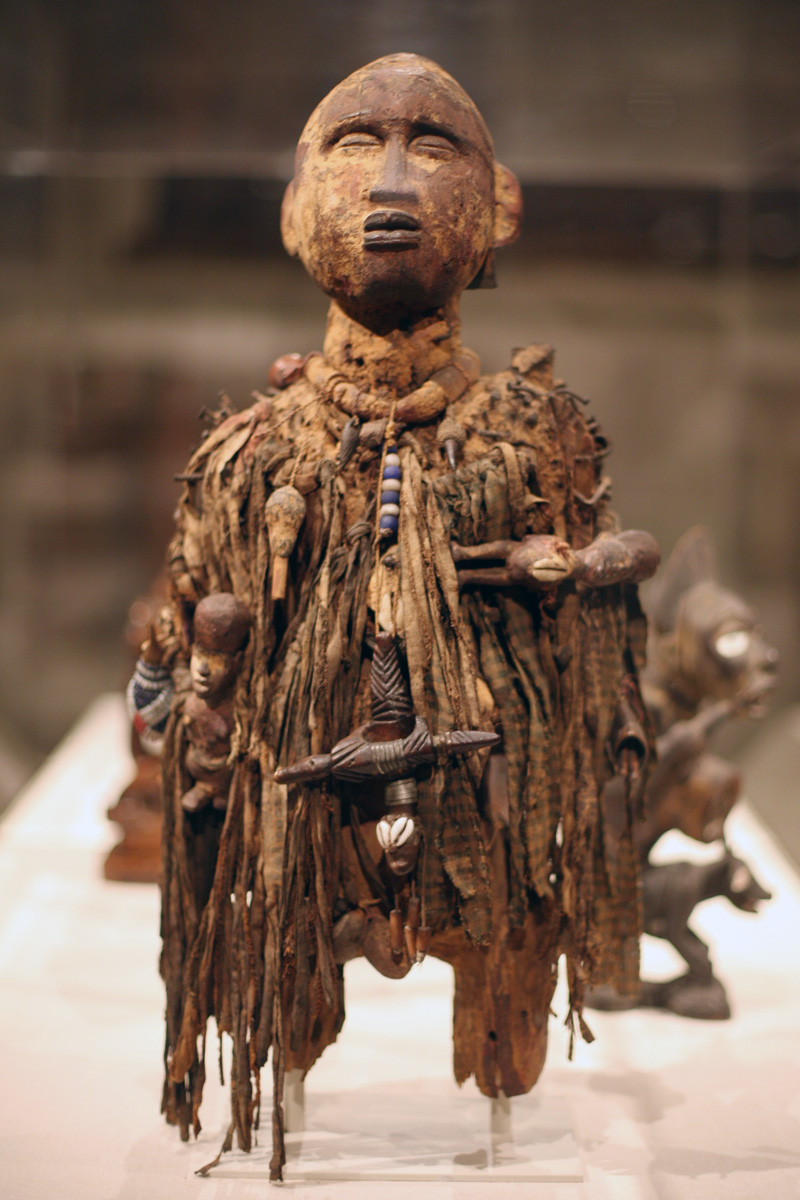
Power Figure: Male (Nkisi). Created circa 1800-1950, DRC, The Metropolitan Museum of Art, New York, The Michael C. Rockefeller Memorial Collection, Bequest of Nelson A. Rockefeller, 1979

Nkisi or Nkishi (plural varies: minkisi, mikisi, zinkisi, or nkisi) are spirits or an object that a spirit inhabits. It is frequently applied to a variety of objects used throughout the Congo Basin in Central Africa, especially in the Territory of Cabinda that are believed to contain spiritual powers or spirits. The term and its concept have passed with the Atlantic slave trade to the Americas.[1]

Meaning

[edit]

The current meaning of the term derives from the root *-kitį, referring to a spiritual entity or material objects in which it is manifested or inhabits in Proto-Njila, an ancient subdivision of the Bantu language family.[2]

In its earliest attestations in Kikongo dialects in the early seventeenth century, it was transliterated as mokissie in Dutch, as the mu- prefix in this noun class was still pronounced. It was reported by Dutch visitors to Loango, the current territory of Cabinda, in the 1668 book Description of Africa as referring both to a material item and the spiritual entity that inhabits it.[3] In the sixteenth century, when the Kingdom of Kongo was converted to Christianity, ukisi (a substance having characteristics of nkisi) was used to translate holy in the Kikongo Catechism of 1624.[4]

Use

[edit]

Close communication with ancestors and belief in the efficacy of their powers are closely associated with minkisi in Kongo tradition. Among the peoples of the Congo Basin, especially the Bakongo and the Songye people of Kasai, exceptional human powers are frequently believed to result from some sort of communication with the dead. People known as banganga[5] (singular: nganga) work as healers, diviners, and mediators who defend the living against black magic (witchcraft) and provide them with remedies against diseases resulting either from witchcraft or the demands of bakisi (spirits), emissaries from the land of the dead.

Banganga harness the powers of bakisi and the dead by making minkisi. Minkisi are primarily containers – ceramic vessels, gourds, animal horns, shells, bundles, or any other object that can contain spiritually charged substances. Even graves themselves, as the home of the dead and hence the home of bakisi, can be considered as minkisi. In fact, minkisi have even been described as portable graves, and many include earth or relics from the grave of a powerful individual as a prime ingredient. The powers of the dead thus infuse the object and allow the nganga to control it.[6] The metal objects commonly pounded into the surface of the power figures represent the minkisi's active roles during rituals or ceremonies. Each nail or metal piece represents a vow, a signed treaty, and an effort to abolish evil. Ultimately, these figures most commonly represent reflections upon socially unacceptable behaviors and efforts to correct them.[7]

Often, people would seek aid through minkisi. In order to do so, an individual would have to seek the guidance of a nganga. The nganga would proceed using their ability to intervene with minkisi on behalf of the person seeking aid.[8]

The substances chosen for inclusion in minkisi are frequently called bilongo or milongo (singular nlongo), a word often translated as 'medicine'. However, their operation is not primarily pharmaceutical, as they are not applied to or ingested by those who are sick, and perhaps bilongo is more accurately translated as 'therapeutic substances'. Rather they are frequently chosen for metaphoric reasons, for example, bird claws in order to catch wrongdoers or because their names resemble characteristics of spirits in question.

Among the many common materials used in the minkisi were fruit (luyala in Kikongo), charcoal (kalazima), and mushrooms (tondo).[9] Minerals were collected from various places associated with the dead, such as earth collected from graves and riverbeds. White clay was also very important in the composition of minkisi due to the symbolic relationship of the color white and the physical aspects of dead skin as well as their moral rightness and spiritual positivity. White contrasted with black, the color of negativity. Some minkisi use red ochre as a coloring agent. The use of red is symbolic of the mediation of the powers of the dead.

Minkisi serve many purposes. Some are used in divination practices, rituals to eradicate evil or punish wrong-doers, and ceremonies for protective installments. Many are also used for healing, while others provide success in hunting or trade, among other things. Important minkisi are often credited with powers in multiple domains. Most famously, minkisi may also take the form of anthropomorphic or zoomorphic wooden carvings.

Types

[edit]
Nkisi Mangaaka power figure in Manchester Museum

Minkisi and the afflictions associated with them are generally classified into two types; the "of the above" and the "of the below". The above minkisi are associated with the sky, rain, and thunderstorms. The below minkisi are associated with the earth and waters on land. The above minkisi were considered masculine and were closely tied to violence and violent forces.[10] The minkisi of the above were largely used to maintain order, serve justice, and seal treaties.

Birds of prey, lightning, weapons, and fire are all common themes among the minkisi of the above. They also affected the upper body. Head, neck, and chest pains were said to be caused by these nkisi figures. Some figures were in the form of animals. Most often these were dogs (kozo). Dogs are closely tied to the spiritual world in Kongo mythology. They live in two separate worlds; the village of the living, and the forest of the dead. Kozo figures were often portrayed as having two heads – this was symbolic of their ability to see both worlds.

Na monanga are associated with a powerful person, with great reasoning, bringing happiness and fortune. They often were created carefully, have a tranquil expression, and are covered in decorations consisting of different substances.[11]

Npezo figures are crafted to look menacing and are believed to have their powers weakened by laughter. [11]

There is also a difference between personal, and community nkisi. Personal nkisi figures were much more anonymous. They often were kept within a private domicile. While community mankishi on the other hand were much less anonymous, often times overlooking the village in a way to intentionally be visible to many in the village. They were meant to be visible, but often times were kept inside their own personal enclosure during the daytime.[12]

Nkondi

[edit]

Nkondi (plural forms minkondi, zinkondi) are a subclass of minkisi that are considered aggressive. Because many of the nkondi collected in the nineteenth century were activated by having nails driven into them, they were often called "nail fetishes" in travel writing, museum catalogs, and art history literature. Many nkondi also feature reflective surfaces, such as mirrors, on their stomach areas or the eyes, which are held to be the means of vision in the spirit world. They are often decorated with tubes of various substances. The most common of which being gunpowder. The idea behind this is for it to be used for killing ndoki, who is associated with the powers of a witch. [11]Although they can be made in many forms, the ones featuring a human statue with nails are the best described in anthropological and scholarly literature.

Nkondi are invoked to search out wrongdoing, enforce oaths, and cause or cure sicknesses. Perhaps the most common use was the locating and punishing of criminals, by hunting down wrongdoers and to avenging their crimes. An oath taker may declare him or herself vulnerable to the disease caused by an nkondi should he or she violate the oath. People who fall sick with diseases known to be associated with a particular nkondi may need to consult the nganga responsible for mediating with that spirit to determine how to be cured.

Although nkisi nkondi have probably been made since at least the sixteenth century, the specifically nailed figures, which have been the object of collection in Western museums, nailed nkondi were probably made primarily in the northern part of the Kongo cultural zone in the nineteenth and early twentieth centuries.

Modern impact

[edit]

The nkisi figures acquired by the Europeans in the nineteenth century caused great interest in stimulating emerging trends in modern art and Bantu themes previously considered primitive or gruesome were now viewed as aesthetically interesting. The pieces became influential in art circles and many were acquired by art museums. The intentions of the banganga who created minkisi were practical; that is, their characteristics were dictated by the need of the object to do the work it was required to do. Hence the nails that caused a sensation were never seen as decorative items but as a requirement of awakening the spirit or the gestures were part of a substantial metaphor of gestures found in Kongo culture.[13]

Recently some modern artists have also been interested in creating nkisi of their own, most notably Renee Stout, whose exhibition "Astonishment and Power" at the Smithsonian Institution coupled her own versions of nkisi with a commentary by noted anthropologist Wyatt MacGaffey.[14]

The Republic of the Congo artist Trigo Piula painted several items in a "New Fetish" series, due to the rebuffing of traditional fetishes by people. It "is a way of engaging with my community and a way of denouncing things that I believe are impacting us, like television for example",[15] he said.

[edit]

See also

[edit]

References

[edit]

Bibliography

[edit]
Revisions and contributorsEdit on WikipediaRead on Wikipedia
from Grokipedia
An nkisi (plural: minkisi) is a sacred object in the cosmology of the of , serving as a container for spiritual forces or medicinal substances (known as bilongo) that are activated through rituals to provide protection, healing, or enforcement of social order. Originating in the Kingdom of Kongo, established in the in what is now the , , and , nkisi represent a core element of Kongo spiritual beliefs, where they embody the mediation between the living world and supernatural powers derived from the creator god Nzambi Mpungu. These objects trace their conceptual roots to ancient traditions, with the god Ne Kongo mythically bringing sacred medicine from heaven to empower humanity against misfortune. Crafted collaboratively by sculptors and ritual specialists called nganga, nkisi are typically wooden figures—often human or animal in form—infused with organic and inorganic materials such as resins, pigments, cloth, shells, and metals to house and activate their spiritual potency. Among the most prominent variants are , meaning "hunter" in Kikongo, which function as aggressive guardians or avengers, designed to detect and pursue wrongdoers, witches, or violators of oaths. These power figures are ritually empowered by the through incantations, prayers, and the insertion of elements like nails, blades, or pegs into the wood, each marking a , , or of ; for instance, parties to an agreement might lick a nail before hammering it in to bind their commitment. Other types include protective nkisi for healing illnesses or resolving disputes (mambu), and they could range from simple bundles of herbs to elaborate sculptures with abdominal cavities or head compartments for storing bilongo. In Kongo society, nkisi played a vital role in maintaining community harmony, enforcing laws, and combating evil, often serving as witnesses to contracts or tools for communal problem-solving under the guidance of the . Historically, nkisi proliferated in the 19th and early 20th centuries amid colonial disruptions, with European missionaries denouncing them as "fetishes" and destroying many, though surviving examples were collected for museums and scholarly study. Their influence extended beyond , shaping elements of Afro-Atlantic religions such as Vodou and Palo in the through the transatlantic slave trade. Today, nkisi are recognized as profound artistic and cultural artifacts, exemplifying the Kongo worldview where spiritual agency is materially embodied to navigate human challenges.

Origins and Historical Context

Kongo Cultural Background

The Kongo peoples, a Bantu-speaking ethnic group, have historically inhabited the lower basin, a region spanning parts of present-day , , and northern . The Kingdom of Kongo, established around the late (c. 1390) under King , emerged as a powerful centralized state at the river's mouth, fostering cultural and political cohesion among diverse clans. By the late , the capital Mbanza Kongo supported a population of 60,000 to 100,000, reflecting the society's agricultural prosperity and trade networks in , , and salt. Nkisi originated within this pre-colonial context, deeply embedded in the Kongo's animistic worldview that predated European contact, where natural elements and ancestral essences were believed to hold inherent spiritual potency. Central to Kongo cosmology is the division between the visible world of the living (ku nseke) and the invisible realm of the dead and spirits (ku mpemba), separated by the primordial waters of Kalunga, envisioned as a reflective mirror. function as vital mediators in this dualistic framework, embodying sacred medicines (bilongo)—herbs, minerals, and relics—that channel spiritual energies to influence human affairs, such as or . Traditional narratives attribute the origin of nkisi to the culture Funza (or Mpulu Bunse), an intermediary who descended from the supreme creator Nzambi Mpungu to teach humanity how to harness these forces, as recounted in oral traditions documented by early 20th-century ethnographers drawing on pre-colonial lore. This integration underscores nkisi's role in maintaining harmony between the material and spiritual domains. Nkisi are interwoven with key cosmological elements, including the bisimbi—nature and water spirits that inhabit rivers, forests, and crossroads, serving as guardians of fertility and environmental balance within Kongo . These spirits, often invoked through nkisi, reflect the belief in a vibrant, animated landscape where the living world (kimpasi, denoting communal life cycles and initiation societies) intersects with supernatural agencies. Early Portuguese explorers, arriving in 1483 under , provided some of the first written accounts of these practices, describing nkisi as communal power objects activated for collective benefit, such as oaths or communal defense against misfortune. Missionaries like those accompanying King Afonso I in the early noted their use in village rituals, though often misconstruing them as idolatrous fetishes to be destroyed.

Evolution Through Colonial Encounters

During the , Christian missionaries in the Kingdom of Kongo increasingly viewed nkisi objects as "fetishes" emblematic of and sorcery, initiating campaigns to suppress and destroy them as part of broader efforts to enforce conversion and eradicate indigenous spiritual practices. These missionaries, often aligned with European colonial interests, confiscated nkisi figures during expeditions and public rituals, burning or dismantling them to symbolize the triumph of over what they deemed heathen . For instance, missionaries as early as the late had requested the burning of such objects, but the intensity escalated in the under intensified missionary activity, leading to widespread suppression within Kongo communities where nkisi served as central mediators of spiritual power and . Under Belgian and Portuguese colonial rule from the late 19th to early 20th centuries, nkisi traditions faced further disruption as colonial authorities targeted them as symbols of resistance against European domination. In regions like Kakongo, agents confiscated prominent nkisi, such as the Mavungu figure around 1892, while Belgian officials in the systematically removed the medicinal contents—considered the core of nkisi potency—from these objects to neutralize their perceived threat to colonial authority. Many nkisi were hidden by practitioners in remote areas or repurposed into less conspicuous forms to evade detection, allowing some to function covertly in private rituals amid forced labor systems and administrative controls that dismantled traditional Kongo political structures. Missionaries and agents often collected disempowered nkisi for export as curiosities, further commodifying and decontextualizing them from their sacred roles. Despite these pressures and widespread forced conversions, nkisi traditions endured in Kongo through clandestine transmission via oral histories and secret societies led by nganga specialists. Oral narratives, preserved by community elders and ritual experts, recounted the activation and symbolism of nkisi, ensuring conceptual continuity even as physical objects were scarce; Wyatt MacGaffey documented these accounts in the late , revealing how they maintained knowledge of nkisi as agents of and . Secret societies, operating underground to avoid colonial , adapted nkisi practices into coded rituals that blended with emerging Christian elements, fostering resilience against total erasure and sustaining spiritual agency within suppressed communities.

Definition and Symbolism

Etymology and Core Concepts

The term nkisi (plural minkisi) originates from the Kikongo language of the in , where it denotes a sacred or substance that embodies spiritual potency and serves as a vessel for supernatural forces. Scholars such as Wyatt MacGaffey describe nkisi as lacking a precise English equivalent, often rendered inadequately as "fetish" or "power figure," but fundamentally referring to an object or entity that channels otherworldly agency for practical ends like or enforcement. This linguistic root underscores its role in Kongo ritual practice as a dynamic mediator rather than a static idol. At its philosophical core, nkisi functions as a power object that bridges the visible physical realm (Ku Nseke) and the invisible spiritual domain (Ku Mpemba), drawing on the Kongo understanding of existence as interconnected layers separated yet linked by the watery boundary of kalunga. It harnesses spiritual forces derived from Nzambi Mpungu, the creator god, including ancestral or elemental spirits with ambivalent potential for benevolence or retribution, enabling humans—through ritual experts—to direct these energies for communal benefit. This concept reflects the broader Kongo worldview, where spiritual vitality permeates everyday life, allowing nkisi to enforce moral order and restore balance without direct divine intervention. In distinction from analogous traditions, such as the Yoruba objects that venerate deities through dedicated shrines and offerings, nkisi emphasize medicinal activation via bilongo—consecrated substances that bind and empower the indwelling spirit—positioning them as operable tools for human agency rather than passive representations of gods. This focus on pharmacological and empowerment highlights nkisi's unique integration of material and metaphysical elements in Kongo thought.

Spiritual Power and Symbolism

In Kongo cosmology, nkisi serve as embodiments of spiritual forces, often manifesting bisimbi—water spirits associated with rivers, , and moral oversight—or ancestral entities known as bakulu, which are invoked to protect lineage members and enforce communal harmony. These spirits are activated through ritual substances, transforming the nkisi into a living conduit that channels agency, capable of both benevolent aid and punitive action depending on human adherence to taboos. The power of nkisi lies in their ability to mediate between the human realm and the divine, bridging the gap to resolve afflictions or affirm oaths by drawing on the inherent vitality of these embedded spirits. Symbolic elements on nkisi figures, such as mirrors affixed to the or eyes carved with prominent pupils, represent the entity's vigilance and , enabling it to observe breaches in social or contracts from the spiritual domain. The mirror, in particular, acts as a portal to the invisible world, allowing ancestral or bisimbi forces to scrutinize and intervene in human affairs, thereby ensuring accountability and protection. These features underscore the nkisi's role as an ever-watchful guardian, embodying the hunter-like essence of variants that "hunt" wrongdoers through supernatural means. At the core of nkisi symbolism is the Kongo philosophical dualism, which divides existence into a visible world of the living above the and an invisible realm of ancestors and spirits below, with nkisi facilitating reciprocity and balance between these planes. This mediation promotes equilibrium, as the nkisi demands mutual respect—offering healing or prosperity when humans honor spiritual obligations, but unleashing misfortune when reciprocity is violated. Through this framework, nkisi encapsulate the Kongo worldview's emphasis on interconnectedness, where spiritual power is not abstract but materially harnessed to sustain social and cosmic order.

Construction and Activation

Materials and Physical Components

Nkisi are primarily constructed from wood carvings that serve as the foundational figure, typically anthropomorphic or zoomorphic in design, providing a vessel for spiritual containment. These figures incorporate cavities, often referred to as mooyo, strategically placed in areas such as the belly, back, base, or forehead, which are filled with herbal medicines known as bilongo—including substances like roots, leaves, , ashes, and calabar beans—as well as relics such as feathers, bones, hair, nails, or cloth fragments to harness and direct spiritual power. The choice of these organic fillings draws from local natural and personal sources, emphasizing the nkisi's connection to the environment and human experience. Variations in size and form allow nkisi to adapt to different needs, spanning from compact portable amulets small enough for personal use to expansive communal statues reaching up to human height, with non-figurative variants like bundled sacks or pots also common for certain applications. This diversity in scale and shape—ranging from abstract bundles to detailed animal forms like dogs or crocodiles—facilitates both individual and collective engagement with the object's power. To amplify spiritual resonance, non-organic elements such as shells, beads, mirrors, or iron pieces, often sourced from nearby rivers, forests, or trade networks, are integrated into the structure or affixed to the surface, serving both aesthetic and functional roles in channeling energy. These additions, typically sealed over cavities with or clay, underscore the nkisi's role as a multifaceted container of forces drawn from the material world.

Role of the Nganga in Activation

The , a specialist and diviner-healer in Kongo society, serves as the central figure in activating nkisi objects, transforming inert sculptures into potent spiritual agents. Trained through extended apprenticeships under elder , the specialist acquires knowledge of spiritual forces and medicinal substances known as bilongo, which are essential for empowering the nkisi. The commissions an artist to carve the basic form but personally selects and inserts these bilongo—such as grave dirt containing ancestral spirits, herbs, and minerals—into cavities within the figure's head and abdomen, thereby binding the nkisi to specific spiritual entities. Activation occurs through elaborate rituals led by the , who recites invocations, often in the form of insults and jeers directed at the nkisi to awaken its dormant power and compel it to act. These ceremonies may involve the nganga licking nails or blades with before driving them into the figure, sealing oaths or vows that link the nkisi to its intended purpose, such as or . In some cases, or additional is incorporated during the rite to bless and vitalize the object, making it a "living" intermediary capable of influencing events on behalf of the community. The nganga's expertise ensures the nkisi responds only to legitimate calls, preventing misuse. Within Kongo communities, hold esteemed social status as mediators between the living and the spiritual realm, often undergoing years of rigorous that includes physical trials and mastery of techniques to diagnose communal ills. This training emphasizes ethical responsibilities, such as maintaining social harmony by using the activated nkisi judiciously and avoiding revelations that could incite conflict. Apprentices, selected for their aptitude, learn to handle the nganga's tools and secrets, perpetuating the role across generations while upholding taboos against personal gain or harm.

Classification and Types

Broad Categories of Nkisi

Nkisi in Kongo culture are broadly categorized by their intended function, serving as spiritual mediators to address specific communal and individual needs such as , , , , and . These categories reflect the versatile role of minkisi (plural) as activated objects that harness spiritual forces for practical purposes, often customized by the (ritual specialist) to suit particular circumstances. For instance, benevolent nkisi focus on restorative powers, while others emphasize enforcement or foresight. One primary distinction lies between "minkisi of the above" and "minkisi of the below," a cosmological classification that aligns functions with domains of power. Minkisi of the above, associated with public order, , and defense against threats like sorcery, often incorporate symbols of aggression such as weapons, nails, or red pigments to invoke forceful intervention; examples include for hunting wrongdoers and nkisi nduda equipped with mirrors to reflect harm back to aggressors. In contrast, minkisi of the below emphasize , , and communal harmony, using cooler elements like white kaolin or seashells to promote growth and resolution; representative types are minkisi phemba, which aid in and concerns. These functional categories overlap in practice, allowing nkisi to adapt to layered spiritual demands. Regional variations in the lower Congo region further diversify nkisi classifications, with objects often tailored to , village, or lineage-specific needs, such as local threats from or disputes. In coastal and inland areas, nkisi might incorporate regionally available materials or address environmental concerns like river spirits (bisimbi), resulting in customized forms for or economic . This adaptability underscores the nkisi's role as a dynamic tool rather than a fixed . Nkisi also overlap with other Kongo spiritual objects, particularly non-figural minkisi bundles—simple containers of medicines (bilongo) like herbs, bones, or cloth—used for portable or concealed rituals. In distinction, figural nkisi, such as carved wooden statues, serve as more visible mediators of power, publicly embodying the spirit (nitu) to affirm communal authority and deterrence. This contrast highlights how form reinforces function, with bundles suiting private and figures enabling overt protection or judgment.

Specific Features of Nkondi Figures

Nkondi figures represent a prominent subtype of nkisi, embodying the concept of a spiritual hunter empowered to pursue and confront malevolent forces within Kongo cosmology. Derived from the Kikongo term meaning "hunter," these figures are typically anthropomorphic wooden sculptures activated through the insertion of nails, blades, or pegs into their surfaces, which serve to bind oaths or summon the 's retributive power. The , or ritual specialist, drives these protrusions into the figure during activation rituals, with nails often signifying grave transgressions and pegs denoting resolved matters, thereby transforming the sculpture into a dynamic vessel for the nkisi spirit. Historical examples from 19th-century Kongo collections highlight the 's intimidating physical attributes, designed to evoke fear and vigilance. Many such figures feature exaggerated facial elements, including oversized eyes crafted from glass, mirrors, or shells to symbolize piercing insight into hidden wrongs, alongside prominent weaponry such as upraised arms grasping spears or knives for an aggressive, confrontational stance. For instance, a late 19th-century from the Democratic Republic of Congo or , measuring approximately 115.6 x 47 x 38.1 cm and composed of wood and metal, exemplifies this with its robust, dynamic posture and surface embedded with iron nails and blades, now housed in the . Similarly, a mid-to-late 19th-century example at the , standing 118 x 49.5 x 39.4 cm in wood, paint, metal, , and ceramic, displays a hollow abdominal cavity sealed with a mirror-backed pack containing bilongo (medicinal substances), enhancing its role as a watchful guardian. These features underscore the 's purpose in amplifying communal deterrence against wrongdoing. Among nkondi sub-variations, the mangaaka stands out as a larger, communal form often deployed in organized anti-witchcraft efforts across Kongo villages. These oversized figures, sometimes exceeding human height, incorporate extensive arrays of nails and blades to represent collective invocations, with their exaggerated proportions—such as elongated limbs and amplified sensory elements like protruding ears or fangs—intended to project overwhelming authority over sorcery. A notable 19th-century mangaaka nkondi, featuring a mirrored belly cavity for bilongo and dense metal insertions, illustrates this subtype's role in broader protective campaigns, as preserved in major collections like the . This variation's scale and communal activation distinguished it from smaller, personal , emphasizing group solidarity in spiritual defense.

Ritual Uses and Functions

Healing and Protective Applications

In Kongo culture, the nganga, a trained ritual specialist, plays a central role in using nkisi for diagnosing and treating illnesses, which are often attributed to spiritual imbalances such as witchcraft (kindoki) or ancestral unrest. The nganga consults the nkisi—typically a power figure or bundle containing medicinal substances (bilongo)—through rituals involving chants, prayers, and manipulation of its components to reveal the spiritual cause of the ailment. Once identified, the cure proceeds with the extraction of herbal elements from the nkisi's abdominal cavity (mooyo), such as mixed plant concoctions administered as drinks or poultices to restore harmony between the physical and spiritual realms. These bilongo, comprising roots, leaves, and other natural materials, are selected for their potency in countering malevolent forces and promoting recovery. Nkisi also fulfill communal protective roles, particularly against threats like evil spirits, sorcery, and epidemics, with figures strategically positioned at village entrances to act as sentinels. In 18th-century Kongo practices, amid the disruptions of the Atlantic slave trade and inter-clan conflicts, such placements invoked the nkisi's power to repel invaders, neutralize witchcraft, and prevent disease outbreaks by mediating between the human world and simbi spirits. For example, the nkisi Mayimbi was ritually activated with offerings and sacrifices during epidemics to appease associated spirits and contain the spread of illness, ensuring village-wide safeguarding. For individual defense, nkisi manifest as compact amulets tailored for travelers and warriors, providing portable spiritual armor against perils encountered en route or in conflict. These small-scale objects, often non-figurative bundles or seed-pod enclosures filled with protective bilongo like herbs or chalk, are prepared and activated by the to shield the user from harm, such as accidents or enemy attacks. A notable variant, associated with the spirit Nsakula, was worn directly on the chest to offer continuous personal during voyages or warfare. The 's activation process briefly underscores this utility, imbuing the amulet with targeted spiritual energy for the bearer's safety.

Judicial and Social Enforcement

In traditional Kongo society, nkisi nkondi figures were integral to judicial processes, particularly in oath-taking ceremonies called mambu, which facilitated the settlement of disputes and lawsuits. During these rituals, opposing parties would lick the blades or before hammering them into the figure, symbolically binding their agreement and invoking the nkisi's spiritual power to enforce compliance; any breach was believed to activate the as a hunter, inflicting punishment on the violator. The , as the ritual specialist, mediated these ceremonies, overseeing the insertion of materials like or knots to record and sacralize the pact, drawing on the figure's embedded bilongo (medicinal substances) to ensure moral accountability. This practice, as detailed by anthropologists such as Robert Farris Thompson, underscored the nkondi's role in maintaining social harmony through supernatural oversight. Nkisi nkondi also featured prominently in addressing witchcraft accusations, where the nganga employed the figure in mediated trials to identify and pursue alleged offenders. Victims of suspected sorcery would consult the , who activated the by driving nails into it, directing its aggressive spirit—embodied in the term "," meaning "hunter"—to afflict the guilty with illness or misfortune until or restitution occurred. These trials, often involving elements like the nkasa ordeal, reinforced communal by targeting those believed to disrupt through malevolent forces, as explored in Wyatt MacGaffey's ethnographic studies of . Beyond formal disputes, enforced broader social taboos, serving as communal deterrents against offenses like and . In village settings, the figures were publicly activated to guard against such transgressions, with the invoking their power to impose spiritual penalties on violators, thereby upholding moral codes and preventing antisocial behavior. This regulatory function highlighted the nkondi's dual role as both protector and enforcer, embedding ethical norms within the spiritual fabric of Kongo life.

Contemporary Significance

Preservation in Museums and Collections

Nkisi artifacts, revered as power figures in Kongo cosmology, entered major Western museum collections primarily during the 19th and early 20th centuries through colonial acquisitions, often involving missionary activities. The Brooklyn Museum holds several notable examples, including a Nkisi Nkondi power figure acquired in the early 20th century, which archival records indicate was deactivated—its magico-religious materials removed—likely by Kongo priests or Christian missionaries to prevent iconoclasm before transfer to European hands. Similarly, the British Museum's collection features a Bakongo Nkisi figure (Af1905,0525.3), purchased in 1905 from collector H. L. Sparrow for £25 as part of a larger Congo assemblage, reflecting the era's widespread procurement of such objects from southeast Democratic Republic of the Congo via traders and missionaries who confiscated or purchased deactivated pieces amid anti-idolatry campaigns. These acquisitions frequently stemmed from missionary confiscations in the late 19th century, when Christian evangelists targeted minkisi as symbols of "paganism," leading to their deactivation and export. Conservation efforts for nkisi in museums face significant challenges due to their , which includes perishable organic elements like carvings, resins, textiles, , and embedded medicines. components often suffer from decay such as surface flaking, cracking, and damage, exacerbated by fluctuating environmental conditions during colonial transport and storage. Organic medicines, integral to the figures' spiritual activation, are particularly vulnerable to degradation from and oxidation, complicating preservation as these materials can include parts, herbs, and clays that attract biological agents. Modern techniques address these issues through controlled environments, such as climate-regulated display cases maintaining low relative (around 40-50%) to prevent mold and , alongside non-invasive methods like analysis for internal assessment and surface consolidation with reversible adhesives. For instance, the voor Volkenkunde in examined 59 minkisi figures in a comprehensive project, identifying 19 distinct materials and applying solvent-based cleaning (e.g., acetone for restoration) to stabilize about one-third of the collection, while integrating the ' Delta Plan for long-term preventive care. Since the , the preservation of nkisi has sparked ethical debates centered on post-colonial legacies, including demands and culturally sensitive display practices. Advocacy for has intensified, with calls to return looted Congolese artifacts—including Kongo power figures—from Belgian institutions like the Royal Museum for Central Africa, where items such as a Nkisi Nkonde seized during an punitive expedition highlight colonial violence. These debates emphasize rectifying historical injustices, as Belgium's 2022 restitution facilitates returns, though remains contested amid concerns over and shared heritage. Parallel discussions on display sensitivity have prompted museums to abandon derogatory terms like "fetish" in favor of "power figure" or "nkisi," providing contextual labels that explain spiritual roles without exoticization, a shift influenced by initiatives in that prioritize source community input to avoid misrepresentation. This evolution reflects broader ethical frameworks urging collaborative stewardship to honor nkisi's living cultural significance.

Influence on Modern Art and Diaspora Cultures

In the realm of , nkisi figures have profoundly influenced African American artists seeking to reclaim and reinterpret African spiritual traditions amid experiences. Renée Stout, who first encountered a nkisi at the Carnegie Museum as a child, draws directly from these power objects in her multidisciplinary works to explore themes of personal and communal identity, protection, and empowerment. For instance, in Fetish #2 (1988), Stout presents a self-portrait adorned with charm pouches, beads, and a hidden compartment containing symbolic items like flowers and a photograph, evoking the nkisi's role as a vessel for spiritual agency and ancestral connection. Similarly, integrates nkisi nkondi motifs—such as nails and hollow compartments—into her sculptures to address racial identity, confinement, and resistance. In Briar Patch (1988) and Chaos in the Kitchen (1998), Saar employs these elements to symbolize the entrapment and liberation of Black women, transforming historical Kongo symbols into critiques of power dynamics in American society. This artistic legacy extends to broader cultures, where nkisi concepts persist and evolve in syncretic rituals among contemporary Kongo-descended communities. In modern BaKongo societies in the , traditional nkisi practices blend with , as ritual specialists () incorporate Christian symbols like crosses into power figures for and social enforcement, reflecting ongoing adaptations of ancestral . These syncretic forms maintain nkisi's core function as mediators of spiritual power, often coexisting with and prayers to maintain cultural continuity amid colonial and postcolonial influences. Since the 2000s, nkisi have featured prominently in academic and through exhibitions emphasizing African spirituality and themes. The 2000 Metropolitan Museum of Art exhibition Art and Oracle: Spirit Voices of showcased a monumental nkisi nkondi figure alongside Kongo diviner's , illustrating how such objects embody , , and communal in spiritual practices. More recently, the 2022 Kimbell Art Museum show Beauty, Ugliness, and Power in African Art highlighted nkisi's aesthetic and ritual efficacy, underscoring their role in and societal value within contemporary curatorial discourses. These displays have fostered greater appreciation for nkisi's enduring influence on identity and resilience in global African diasporas.

References

Add your contribution
Related Hubs
User Avatar
No comments yet.