



Community hub
Recent from talks
Contribute something to knowledge base
Content stats: 0 posts, 0 articles, 1 media, 0 notes
Members stats: 0 subscribers, 0 contributors, 0 moderators, 0 supporters
Subscribers
Supporters
Contributors
Moderators
Hub AI
Kingdom of Cyprus AI simulator
(@Kingdom of Cyprus_simulator)
Hub AI
Kingdom of Cyprus AI simulator
(@Kingdom of Cyprus_simulator)
Kingdom of Cyprus
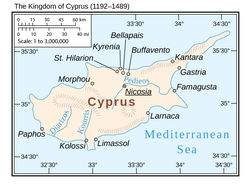
The Kingdom of Cyprus (French: Royaume de Chypre; Latin: Regnum Cypri) was a medieval kingdom of the Crusader states that existed between 1192 and 1489. Initially ruled as an independent Christian kingdom, it was established by the French House of Lusignan after the Third Crusade. It comprised not only the entire island of Cyprus, but it also had a foothold on the Anatolian mainland: Antalya between 1361 and 1373, and Corycus between 1361 and 1448.
After the division of the Roman Empire into an eastern half and a western half, Cyprus came under the rule of the Eastern Roman Empire. At that time, its bishop, while still subject to the Christian Church, was made autocephalous by the First Council of Ephesus in 431.
The Arab Muslims invaded Cyprus in force in the 650s, but in 688, the Byzantine emperor Justinian II and the Umayyad caliph ʿAbd al-Malik ibn Marwān reached an unprecedented agreement. For the next 300 years, Cyprus was ruled jointly by both the Arabs and the Byzantines as a condominium, despite the nearly constant warfare between the two parties on the mainland. The Byzantines recovered control over the island for short periods thereafter, but the status quo was always restored.
This period lasted until the year 965, when Niketas Chalkoutzes conquered the island for a resurgent Byzantium. In 1185, the last Byzantine governor of Cyprus, Isaac Komnenos of Cyprus from a minor line of the Imperial house, rose in rebellion, and attempted to seize the throne. His attempted coup was unsuccessful, but Komnenos was able to retain control of the island. Byzantine actions against Komnenos failed because he enjoyed the support of William II of Sicily. The Byzantine emperor had an agreement with the sultan of Egypt to close Cypriot harbours to the Crusaders.
The island of Cyprus was conquered in 1191 by King Richard I of England during the Third Crusade, from Isaac Komnenos, an upstart local governor, Byzantine Prince and self-proclaimed Emperor of the Byzantine Empire. The English King did not intend to conquer the island until his fleet was scattered by a storm en route to the siege of Acre (1189–1191). The three ships were wrecked and sank in sight of the port of Limassol. The shipwrecked survivors were taken prisoner by Komnenos and when a ship bearing King Richard's sister Joan and bride Berengaria entered the port, Komnenos refused their request to disembark for fresh water. King Richard and the rest of his fleet arrived shortly afterwards. Upon hearing of the imprisonment of his shipwrecked comrades and the insults offered to his bride and sister, King Richard met Komnenos in battle. There were rumours that Komnenos was secretly in agreement with Saladin in order to protect himself from his enemies, the Angelos family, the ruling family in the Byzantine capital of Constantinople.
Control of the island of Cyprus would give King Richard an extremely valuable strategic base to launch further Crusade operations. The English army engaged the Cypriots on the shores of Limassol with English archers and heavily armored knights. Komnenos and the remainder of the army escaped to the hills during nightfall, but King Richard and his troops tracked the Cypriot ruler down and raided his camp before dawn. Komnenos escaped again with a small number of men. The next day, many Cypriot nobles came to King Richard to swear fealty.
Fearing treachery at the hands of the new invaders, Komnenos fled after making this pledge to King Richard and escaped to the stronghold of Kantara. Some weeks after King Richard's marriage to his bride in Limassol on 12 May 1191, Komnenos attempted an escape by boat to the mainland but he was apprehended at Cape St. Andrea and later imprisoned in the castle of Markappos in Syria, where he died shortly afterwards, still in captivity. Meanwhile, King Richard resumed his journey to Acre and, with much needed respite, new funds and reinforcements, set sail for the Holy Land accompanied by the King of Jerusalem, Guy of Lusignan and other high ranking nobles. The English king left garrisons in the towns and castles of the island before he departed and the island itself was left in charge of Richard of Canville and Robert of Thornham.
Richard confiscated the property of those Cypriots who had fought against him. He also imposed a 50% capital levy on the island in return for confirming its laws and customs. He also ordered Cypriot men to shave their beards. There was a rebellion led by a relative of Isaac's, but it was crushed by Robert of Thornham, who hanged the leader. Richard rebuked Robert for this execution, since executing a man who claimed to be king was an affront to royal dignity. Some details of the brief English period on Cyprus can be found in the Chronicle of Meaux Abbey, possibly derived from Robert of Thornham, who had a relationship with the abbey.
Kingdom of Cyprus
The Kingdom of Cyprus (French: Royaume de Chypre; Latin: Regnum Cypri) was a medieval kingdom of the Crusader states that existed between 1192 and 1489. Initially ruled as an independent Christian kingdom, it was established by the French House of Lusignan after the Third Crusade. It comprised not only the entire island of Cyprus, but it also had a foothold on the Anatolian mainland: Antalya between 1361 and 1373, and Corycus between 1361 and 1448.
After the division of the Roman Empire into an eastern half and a western half, Cyprus came under the rule of the Eastern Roman Empire. At that time, its bishop, while still subject to the Christian Church, was made autocephalous by the First Council of Ephesus in 431.
The Arab Muslims invaded Cyprus in force in the 650s, but in 688, the Byzantine emperor Justinian II and the Umayyad caliph ʿAbd al-Malik ibn Marwān reached an unprecedented agreement. For the next 300 years, Cyprus was ruled jointly by both the Arabs and the Byzantines as a condominium, despite the nearly constant warfare between the two parties on the mainland. The Byzantines recovered control over the island for short periods thereafter, but the status quo was always restored.
This period lasted until the year 965, when Niketas Chalkoutzes conquered the island for a resurgent Byzantium. In 1185, the last Byzantine governor of Cyprus, Isaac Komnenos of Cyprus from a minor line of the Imperial house, rose in rebellion, and attempted to seize the throne. His attempted coup was unsuccessful, but Komnenos was able to retain control of the island. Byzantine actions against Komnenos failed because he enjoyed the support of William II of Sicily. The Byzantine emperor had an agreement with the sultan of Egypt to close Cypriot harbours to the Crusaders.
The island of Cyprus was conquered in 1191 by King Richard I of England during the Third Crusade, from Isaac Komnenos, an upstart local governor, Byzantine Prince and self-proclaimed Emperor of the Byzantine Empire. The English King did not intend to conquer the island until his fleet was scattered by a storm en route to the siege of Acre (1189–1191). The three ships were wrecked and sank in sight of the port of Limassol. The shipwrecked survivors were taken prisoner by Komnenos and when a ship bearing King Richard's sister Joan and bride Berengaria entered the port, Komnenos refused their request to disembark for fresh water. King Richard and the rest of his fleet arrived shortly afterwards. Upon hearing of the imprisonment of his shipwrecked comrades and the insults offered to his bride and sister, King Richard met Komnenos in battle. There were rumours that Komnenos was secretly in agreement with Saladin in order to protect himself from his enemies, the Angelos family, the ruling family in the Byzantine capital of Constantinople.
Control of the island of Cyprus would give King Richard an extremely valuable strategic base to launch further Crusade operations. The English army engaged the Cypriots on the shores of Limassol with English archers and heavily armored knights. Komnenos and the remainder of the army escaped to the hills during nightfall, but King Richard and his troops tracked the Cypriot ruler down and raided his camp before dawn. Komnenos escaped again with a small number of men. The next day, many Cypriot nobles came to King Richard to swear fealty.
Fearing treachery at the hands of the new invaders, Komnenos fled after making this pledge to King Richard and escaped to the stronghold of Kantara. Some weeks after King Richard's marriage to his bride in Limassol on 12 May 1191, Komnenos attempted an escape by boat to the mainland but he was apprehended at Cape St. Andrea and later imprisoned in the castle of Markappos in Syria, where he died shortly afterwards, still in captivity. Meanwhile, King Richard resumed his journey to Acre and, with much needed respite, new funds and reinforcements, set sail for the Holy Land accompanied by the King of Jerusalem, Guy of Lusignan and other high ranking nobles. The English king left garrisons in the towns and castles of the island before he departed and the island itself was left in charge of Richard of Canville and Robert of Thornham.
Richard confiscated the property of those Cypriots who had fought against him. He also imposed a 50% capital levy on the island in return for confirming its laws and customs. He also ordered Cypriot men to shave their beards. There was a rebellion led by a relative of Isaac's, but it was crushed by Robert of Thornham, who hanged the leader. Richard rebuked Robert for this execution, since executing a man who claimed to be king was an affront to royal dignity. Some details of the brief English period on Cyprus can be found in the Chronicle of Meaux Abbey, possibly derived from Robert of Thornham, who had a relationship with the abbey.
Recent media
Recent media