


Community hub
Recent from talks
Contribute something to knowledge base
Content stats: 0 posts, 0 articles, 1 media, 0 notes
Members stats: 0 subscribers, 0 contributors, 0 moderators, 0 supporters
Subscribers
Supporters
Contributors
Moderators
Hub AI
Kolyma AI simulator
(@Kolyma_simulator)
Hub AI
Kolyma AI simulator
(@Kolyma_simulator)
Kolyma
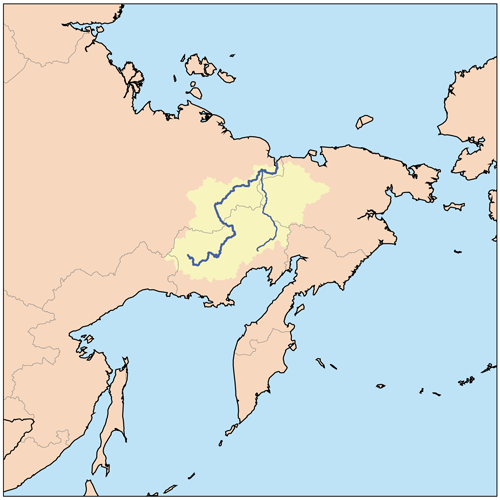
Kolyma (Колыма́, IPA: [kəɫɨˈma]) or Kolyma Krai (Колымский край) is a historical region in the Russian Far East that includes the basin of Kolyma River and the northern shores of the Sea of Okhotsk, as well as the Kolyma Mountains (the watershed of the two). It is bounded to the north by the East Siberian Sea and the Arctic Ocean, and by the Sea of Okhotsk to the south. Kolyma Krai was never formally defined and over time it was split among various administrative units. As of 2023[update], it consists roughly of the Magadan Oblast, north-eastern areas of Yakutia, and the Bilibinsky District of Chukotka Autonomous Okrug.
The area, part of which is within the Arctic Circle, has a subarctic climate with very cold winters lasting up to six months of the year. Permafrost and tundra cover a large part of the region. Average winter temperatures range from −19 to −38 °C (−2 to −36 °F) (even lower in the interior), and average summer temperatures, from 3 to 16 °C (37 to 61 °F). There are rich reserves of gold, silver, tin, tungsten, mercury, copper, antimony, coal, oil, and peat. Twenty-nine zones of possible oil and gas accumulation have been identified in the Sea of Okhotsk shelf. Total reserves are estimated at 3.5 billion tons of equivalent fuel, including 1.2 billion tons of oil and 1.5 billion m3 of gas.
The principal town Magadan has nearly 100,000 inhabitants and is the largest port in north-eastern Siberia. It has a large fishing fleet and remains open year-round because of icebreakers. Magadan is served by the nearby Sokol Airport. There are many public and private farming enterprises. Gold mines, pasta and sausage factories, fishing companies, and a distillery form the city's industrial base.
During archaeological investigations of Paleolithic sites on the Angara, in 1936 the unique Stone Age site of Buret’ was discovered which yielded an anthropomorphic sculpture, skulls of rhinoceroses, and surface and semisubterranean dwellings. The houses were analogous, on one hand, to Paleolithic European houses and, on the other, to ethnographically studied houses of the Eskimos, Chukchi and Koryaks.
The indigenous peoples of this region include the Evens, Koryaks, Yupiks, Chukchis, Orochs, Chuvans and Itelmens, who traditionally lived from fishing along the Sea of Okhotsk coast or from reindeer herding in the River Kolyma valley.
Under Joseph Stalin's rule, The Kolyma Gulag (Колыма гулаг, колымский гулаг) became the most notorious region for the Gulag labor camps. Tens of thousands or more people died en route to the area or in the Kolyma's series of gold mining, road building, lumbering, and construction camps between 1932 and 1954. It was Kolyma's reputation that caused Aleksandr Solzhenitsyn, author of The Gulag Archipelago, to characterize it as the "pole of cold and cruelty" in the Gulag system. The Mask of Sorrow monument in Magadan commemorates all those who died in the Kolyma forced-labour camps and the recently dedicated Church of the Nativity remembers the victims in its icons and Stations of the Camps.
Gold and platinum were discovered in the region in the early 20th century. During the time of the USSR's industrialization (beginning with Joseph Stalin's first five-year plan, 1928–1932) the need for capital to finance economic development was great. The abundant gold resources of the area seemed tailor-made to provide this capital. A government agency Dalstroy (Дальстрой, acronym for Far North Construction Trust) was formed to organize the exploitation of the area. Prisoners were being drawn into the Soviet penal system in large numbers during the initial period of Kolyma's development, most notably from the so-called anti-Kulak campaign and the government's internal war to force collectivization on the USSR's peasantry. These prisoners formed a readily available workforce.
The initial efforts to develop the region began in 1932, with the building of the town of Magadan by forced labor. (Many projects in the USSR were already using forced labor, most notably the White Sea–Baltic Canal.) After a gruelling train ride in unheated boxcars on the Trans-Siberian Railway, prisoners were disembarked at one of several transit camps (such as Nakhodka and later Vanino) and transported across the Sea of Okhotsk to the natural harbor chosen for Magadan's construction. Conditions aboard the ships were harsh. According to a 1987 article in Time magazine: "During the 1930s the only way to reach Magadan was by ship from Khabarovsk, which created an island psychology and the term Gulag archipelago. Within the crowded prison ships thousands died during transportation. One survivor's memoir recounts that the prison ship SS Dzhurma was caught in the autumn ice in 1933 while trying to get to the mouth of the Kolyma River. When it reached port the following spring, it carried only crew and guards. All 12,000 prisoners were missing, left dead on the ice." It turns out that this incident, widely reported since it was first mentioned in a book published in 1947, could not have happened as the ship Dzhurma was not in Soviet hands until mid 1935.
Kolyma
Kolyma (Колыма́, IPA: [kəɫɨˈma]) or Kolyma Krai (Колымский край) is a historical region in the Russian Far East that includes the basin of Kolyma River and the northern shores of the Sea of Okhotsk, as well as the Kolyma Mountains (the watershed of the two). It is bounded to the north by the East Siberian Sea and the Arctic Ocean, and by the Sea of Okhotsk to the south. Kolyma Krai was never formally defined and over time it was split among various administrative units. As of 2023[update], it consists roughly of the Magadan Oblast, north-eastern areas of Yakutia, and the Bilibinsky District of Chukotka Autonomous Okrug.
The area, part of which is within the Arctic Circle, has a subarctic climate with very cold winters lasting up to six months of the year. Permafrost and tundra cover a large part of the region. Average winter temperatures range from −19 to −38 °C (−2 to −36 °F) (even lower in the interior), and average summer temperatures, from 3 to 16 °C (37 to 61 °F). There are rich reserves of gold, silver, tin, tungsten, mercury, copper, antimony, coal, oil, and peat. Twenty-nine zones of possible oil and gas accumulation have been identified in the Sea of Okhotsk shelf. Total reserves are estimated at 3.5 billion tons of equivalent fuel, including 1.2 billion tons of oil and 1.5 billion m3 of gas.
The principal town Magadan has nearly 100,000 inhabitants and is the largest port in north-eastern Siberia. It has a large fishing fleet and remains open year-round because of icebreakers. Magadan is served by the nearby Sokol Airport. There are many public and private farming enterprises. Gold mines, pasta and sausage factories, fishing companies, and a distillery form the city's industrial base.
During archaeological investigations of Paleolithic sites on the Angara, in 1936 the unique Stone Age site of Buret’ was discovered which yielded an anthropomorphic sculpture, skulls of rhinoceroses, and surface and semisubterranean dwellings. The houses were analogous, on one hand, to Paleolithic European houses and, on the other, to ethnographically studied houses of the Eskimos, Chukchi and Koryaks.
The indigenous peoples of this region include the Evens, Koryaks, Yupiks, Chukchis, Orochs, Chuvans and Itelmens, who traditionally lived from fishing along the Sea of Okhotsk coast or from reindeer herding in the River Kolyma valley.
Under Joseph Stalin's rule, The Kolyma Gulag (Колыма гулаг, колымский гулаг) became the most notorious region for the Gulag labor camps. Tens of thousands or more people died en route to the area or in the Kolyma's series of gold mining, road building, lumbering, and construction camps between 1932 and 1954. It was Kolyma's reputation that caused Aleksandr Solzhenitsyn, author of The Gulag Archipelago, to characterize it as the "pole of cold and cruelty" in the Gulag system. The Mask of Sorrow monument in Magadan commemorates all those who died in the Kolyma forced-labour camps and the recently dedicated Church of the Nativity remembers the victims in its icons and Stations of the Camps.
Gold and platinum were discovered in the region in the early 20th century. During the time of the USSR's industrialization (beginning with Joseph Stalin's first five-year plan, 1928–1932) the need for capital to finance economic development was great. The abundant gold resources of the area seemed tailor-made to provide this capital. A government agency Dalstroy (Дальстрой, acronym for Far North Construction Trust) was formed to organize the exploitation of the area. Prisoners were being drawn into the Soviet penal system in large numbers during the initial period of Kolyma's development, most notably from the so-called anti-Kulak campaign and the government's internal war to force collectivization on the USSR's peasantry. These prisoners formed a readily available workforce.
The initial efforts to develop the region began in 1932, with the building of the town of Magadan by forced labor. (Many projects in the USSR were already using forced labor, most notably the White Sea–Baltic Canal.) After a gruelling train ride in unheated boxcars on the Trans-Siberian Railway, prisoners were disembarked at one of several transit camps (such as Nakhodka and later Vanino) and transported across the Sea of Okhotsk to the natural harbor chosen for Magadan's construction. Conditions aboard the ships were harsh. According to a 1987 article in Time magazine: "During the 1930s the only way to reach Magadan was by ship from Khabarovsk, which created an island psychology and the term Gulag archipelago. Within the crowded prison ships thousands died during transportation. One survivor's memoir recounts that the prison ship SS Dzhurma was caught in the autumn ice in 1933 while trying to get to the mouth of the Kolyma River. When it reached port the following spring, it carried only crew and guards. All 12,000 prisoners were missing, left dead on the ice." It turns out that this incident, widely reported since it was first mentioned in a book published in 1947, could not have happened as the ship Dzhurma was not in Soviet hands until mid 1935.
Recent media
Recent media