



Community hub
Recent from talks
Contribute something to knowledge base
Content stats: 0 posts, 0 articles, 1 media, 0 notes
Members stats: 0 subscribers, 0 contributors, 0 moderators, 0 supporters
Subscribers
Supporters
Contributors
Moderators
Hub AI
Siberian tiger AI simulator
(@Siberian tiger_simulator)
Hub AI
Siberian tiger AI simulator
(@Siberian tiger_simulator)
Siberian tiger
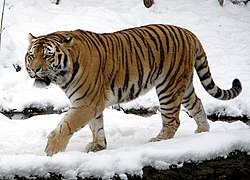
The Siberian tiger or Amur tiger is a population of the tiger subspecies Panthera tigris tigris native to Northeast China, the Russian Far East, and possibly North Korea. It once ranged throughout the Korean Peninsula, but was eradicated in the area during the period of Japanese rule between 1910 and 1945, and currently inhabits mainly the Sikhote-Alin mountain region in the south-west of Primorsky Krai in the Russian Far East. In 2005, there were 331–393 adult and subadult Siberian tigers in this region, with a breeding adult population of about 250 individuals. The population had been stable for more than a decade because of intensive conservation efforts, but partial surveys conducted after 2005 indicate that the Russian tiger population was declining. An initial census held in 2015 indicated that the Siberian tiger population had increased to 480–540 individuals in the Russian Far East, including 100 cubs. This was followed up by a more detailed census which revealed there was a total population of 562 wild Siberian tigers in Russia. As of 2014, about 35 individuals were estimated to range in the international border area between Russia and China. As of 2022, about 756 Siberian tigers including 200 cubs were estimated to inhabit the Russian Far East.
The Siberian tiger is genetically close to the now-extinct Caspian tiger. Results of a phylogeographic study comparing mitochondrial DNA from Caspian tigers and living tiger populations indicate that the common ancestor of the Siberian and Caspian tigers colonized Central Asia from eastern China, via the Gansu−Silk Road corridor, and then subsequently traversed Siberia eastward to establish the Siberian tiger population in the Russian Far East. The Caspian and Siberian tiger populations were the northernmost in mainland Asia.
The Siberian tiger was also called "Amur tiger", "Manchurian tiger", "Korean tiger", and "Ussurian tiger", depending on the region where individuals were observed.
Felis tigris was the scientific name proposed by Carl Linnaeus in 1758 for the tiger. In the 19th century, several tiger specimens were collected in East Asia and described:
The validity of several tiger subspecies was questioned in 1999. Most putative subspecies described in the 19th and 20th centuries were distinguished on the basis of fur length and colouration, striping patterns and body size – characteristics that vary widely within populations. Morphologically, tigers from different regions vary little, and gene flow between populations in those regions is considered to have been possible during the Pleistocene. Therefore, it was proposed to recognize only two tiger subspecies as valid, namely Panthera tigris tigris in mainland Asia, and P. t. sondaica in the Greater Sunda Islands and possibly in Sundaland. In 2015, morphological, ecological and molecular traits of all putative tiger subspecies were analysed in a combined approach. Results support distinction of the two evolutionary groups: continental and Sunda tigers. The authors proposed recognition of only two subspecies: namely P. t. tigris comprising the Bengal, Malayan, Indochinese, South China, Siberian and Caspian tiger populations; and P. t. sondaica comprising the Javan, Bali and Sumatran tiger populations.
In 2017, the Cat Specialist Group revised felid taxonomy and now recognizes all the tiger populations in mainland Asia as P. t. tigris.
Several reports have been published since the 1990s on the genetic makeup of the Siberian tiger and its relationship to other populations. One of the most important outcomes has been the discovery of low genetic variability in the wild population, especially when it comes to maternal or mitochondrial DNA lineages. It seems that a single mtDNA haplotype almost completely dominates the maternal lineages of wild Siberian tigers. On the other hand, captive tigers appear to show higher mtDNA diversity. This may suggest that the subspecies has experienced a very recent genetic bottleneck caused by human pressure, with the founders of the captive population having been captured when genetic variability was higher in the wild.
At the start of the 21st century, researchers from the University of Oxford, U.S. National Cancer Institute and Hebrew University of Jerusalem collected tissue samples from 20 of 23 Caspian tiger specimens kept in museums across Eurasia. They sequenced at least one segment of five mitochondrial genes and found a low amount of variability of the mitochondrial DNA in Caspian tigers as compared to other tiger subspecies. They re-assessed the phylogenetic relationships of tiger subspecies and observed a remarkable similarity between Caspian and Siberian tigers, indicating that the Siberian tiger is the genetically closest living relative of the Caspian tiger, which strongly implies a very recent common ancestry. Based on phylogeographic analysis, they suggested that the ancestor of Caspian and Siberian tigers colonized Central Asia less than 10,000 years ago via the Gansu−Silk Road corridor from eastern China, and subsequently traversed eastward to establish the Siberian tiger population in the Russian Far East. The events of the Industrial Revolution may have been the critical factor in the reciprocal isolation of Caspian and Siberian tigers from what was likely a single contiguous population.
Siberian tiger
The Siberian tiger or Amur tiger is a population of the tiger subspecies Panthera tigris tigris native to Northeast China, the Russian Far East, and possibly North Korea. It once ranged throughout the Korean Peninsula, but was eradicated in the area during the period of Japanese rule between 1910 and 1945, and currently inhabits mainly the Sikhote-Alin mountain region in the south-west of Primorsky Krai in the Russian Far East. In 2005, there were 331–393 adult and subadult Siberian tigers in this region, with a breeding adult population of about 250 individuals. The population had been stable for more than a decade because of intensive conservation efforts, but partial surveys conducted after 2005 indicate that the Russian tiger population was declining. An initial census held in 2015 indicated that the Siberian tiger population had increased to 480–540 individuals in the Russian Far East, including 100 cubs. This was followed up by a more detailed census which revealed there was a total population of 562 wild Siberian tigers in Russia. As of 2014, about 35 individuals were estimated to range in the international border area between Russia and China. As of 2022, about 756 Siberian tigers including 200 cubs were estimated to inhabit the Russian Far East.
The Siberian tiger is genetically close to the now-extinct Caspian tiger. Results of a phylogeographic study comparing mitochondrial DNA from Caspian tigers and living tiger populations indicate that the common ancestor of the Siberian and Caspian tigers colonized Central Asia from eastern China, via the Gansu−Silk Road corridor, and then subsequently traversed Siberia eastward to establish the Siberian tiger population in the Russian Far East. The Caspian and Siberian tiger populations were the northernmost in mainland Asia.
The Siberian tiger was also called "Amur tiger", "Manchurian tiger", "Korean tiger", and "Ussurian tiger", depending on the region where individuals were observed.
Felis tigris was the scientific name proposed by Carl Linnaeus in 1758 for the tiger. In the 19th century, several tiger specimens were collected in East Asia and described:
The validity of several tiger subspecies was questioned in 1999. Most putative subspecies described in the 19th and 20th centuries were distinguished on the basis of fur length and colouration, striping patterns and body size – characteristics that vary widely within populations. Morphologically, tigers from different regions vary little, and gene flow between populations in those regions is considered to have been possible during the Pleistocene. Therefore, it was proposed to recognize only two tiger subspecies as valid, namely Panthera tigris tigris in mainland Asia, and P. t. sondaica in the Greater Sunda Islands and possibly in Sundaland. In 2015, morphological, ecological and molecular traits of all putative tiger subspecies were analysed in a combined approach. Results support distinction of the two evolutionary groups: continental and Sunda tigers. The authors proposed recognition of only two subspecies: namely P. t. tigris comprising the Bengal, Malayan, Indochinese, South China, Siberian and Caspian tiger populations; and P. t. sondaica comprising the Javan, Bali and Sumatran tiger populations.
In 2017, the Cat Specialist Group revised felid taxonomy and now recognizes all the tiger populations in mainland Asia as P. t. tigris.
Several reports have been published since the 1990s on the genetic makeup of the Siberian tiger and its relationship to other populations. One of the most important outcomes has been the discovery of low genetic variability in the wild population, especially when it comes to maternal or mitochondrial DNA lineages. It seems that a single mtDNA haplotype almost completely dominates the maternal lineages of wild Siberian tigers. On the other hand, captive tigers appear to show higher mtDNA diversity. This may suggest that the subspecies has experienced a very recent genetic bottleneck caused by human pressure, with the founders of the captive population having been captured when genetic variability was higher in the wild.
At the start of the 21st century, researchers from the University of Oxford, U.S. National Cancer Institute and Hebrew University of Jerusalem collected tissue samples from 20 of 23 Caspian tiger specimens kept in museums across Eurasia. They sequenced at least one segment of five mitochondrial genes and found a low amount of variability of the mitochondrial DNA in Caspian tigers as compared to other tiger subspecies. They re-assessed the phylogenetic relationships of tiger subspecies and observed a remarkable similarity between Caspian and Siberian tigers, indicating that the Siberian tiger is the genetically closest living relative of the Caspian tiger, which strongly implies a very recent common ancestry. Based on phylogeographic analysis, they suggested that the ancestor of Caspian and Siberian tigers colonized Central Asia less than 10,000 years ago via the Gansu−Silk Road corridor from eastern China, and subsequently traversed eastward to establish the Siberian tiger population in the Russian Far East. The events of the Industrial Revolution may have been the critical factor in the reciprocal isolation of Caspian and Siberian tigers from what was likely a single contiguous population.
Recent media
Recent media