Hubbry Logo
KorsakoviaKorsakoviaMain
Open search
Korsakovia
Community hub
Korsakovia
logo
8 pages, 0 posts
0 subscribers
Be the first to start a discussion here.
Korsakovia
Korsakovia
from Wikipedia

Korsakovia
DeveloperThe Chinese Room
PublisherThe Chinese Room
ComposerJessica Curry
EngineSource
PlatformMicrosoft Windows
Release20 September 2009
GenrePsychological horror
ModeSingle-player

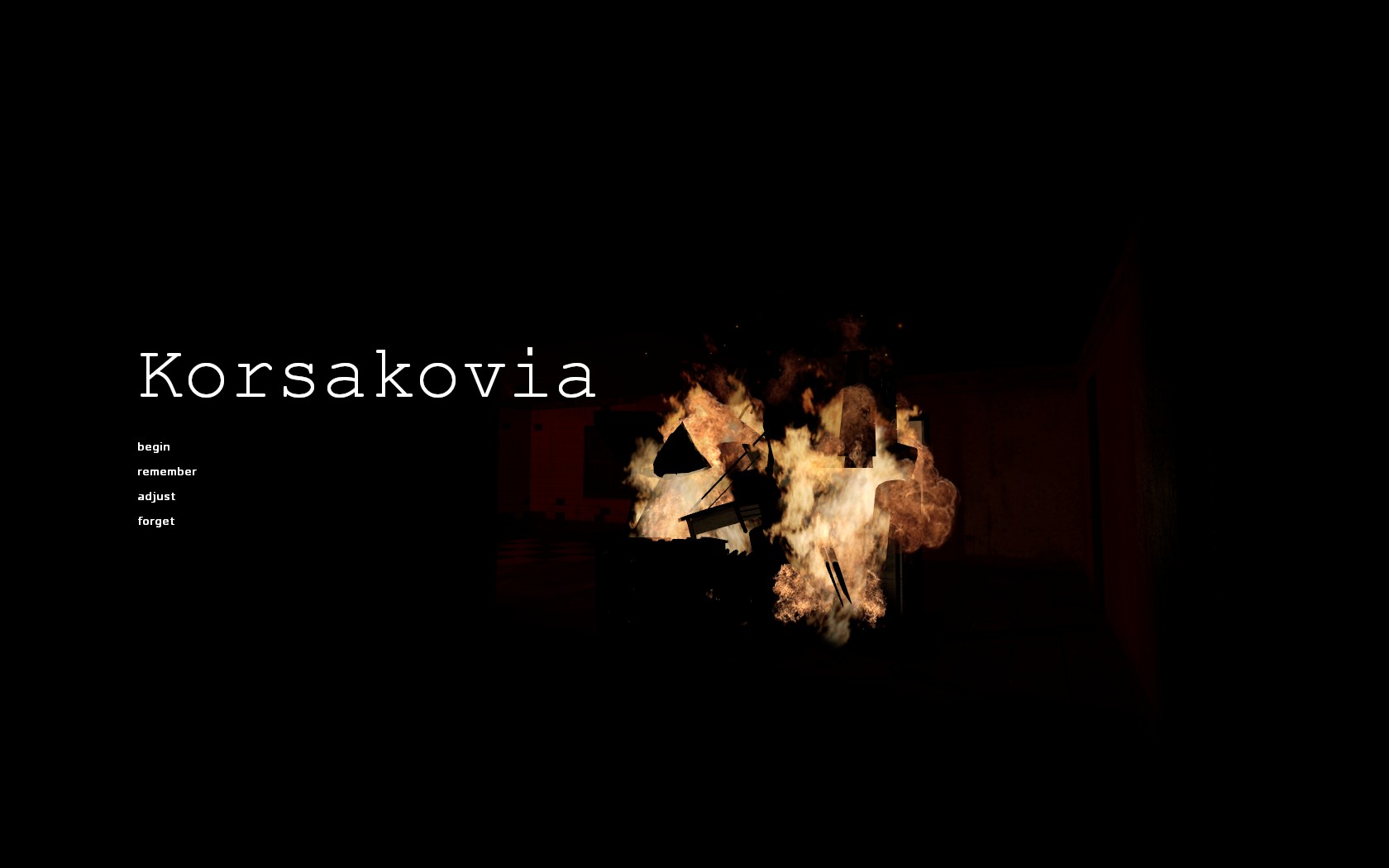
Korsakovia is a single-player mod for Valve's video game Half-Life 2. It was developed by The Chinese Room. Korsakovia was released as freeware download on 20 September 2009.

Plot

[edit]

In Korsakovia, the player travels through the delusions of Christopher, a man suffering from Korsakoff's syndrome. The player hears the voices of Christopher and a doctor as they try to help Christopher.

Location

[edit]

The game takes place in numerous presumably illusory locations, ranging from an asylum to a factory. Objects sometimes float or otherwise defy the ordinary laws of physics. The player has the standard Half-Life 2 flashlight, but it often runs out of electricity and must be turned off to recharge. The overall ambiance is nightmarishly grim, grimy, and depressing, an effect that is amplified considerably by atmospheric music and sound effects.

The narrator's words imply that the player is under treatment in a hospital while he is having the delusions that constitute the game. Before the beginning of the game, Christopher was found in his living room with copper wire around his hands. He had punched the television and the wires caught fire, which is the cause of the damage to his hands. He also seems to have ripped his own eyeballs out and eaten them as reported by the paramedics. These injuries and their rationale are referenced repeatedly in the narration and by objects the player finds in his illusory landscape.

Gameplay

[edit]

Like The Chinese Room's previous mod, Dear Esther, the player explores the environment while listening to narration. However, this time the player can move far more freely and is sometimes armed with a crowbar, which he uses to smash through obstacles or ward off monsters composed of black smoke. The player can also pick up health packs to repair damage, the existence and extent of which is indicated by cracks spreading inward from the edges of his screen. If the player "dies" as a result of too much damage, they are returned to the last previous save point.

References

[edit]
Revisions and contributorsEdit on WikipediaRead on Wikipedia
from Grokipedia
Korsakovia is a single-player experimental survival horror mod for Half-Life 2: Episode Two, developed by thechineseroom (formerly known as Rhubarb & Rhubarb) and released as freeware on September 20, 2009. The mod centers on a protagonist named Christopher, who suffers from Korsakoff's syndrome—a neurological disorder causing severe memory loss and confabulation—while navigating the disorienting confines of St. Clements Neurological Clinic, a psychiatric hospital. Blending abstract storytelling with traditional first-person shooter elements, it explores themes of delusion, paranoia, and the blurring of reality and fantasy through fragmented audio logs of doctor-patient conversations and a haunting sound design by composer Jessica Curry. Gameplay in Korsakovia emphasizes psychological tension over combat, with players evading fast-moving, abstract enemies resembling streams of black fog using only a for limited defense, alongside challenging platforming sections and environmental puzzles. The mod's unfolds non-linearly, reflecting the protagonist's unreliable , and was created with a £10,500 grant from the to push the boundaries of and player immersion in the Source engine. Funded as an experimental project, it received praise for its atmospheric storytelling and innovative horror mechanics but faced criticism for technical issues and uneven level design upon release. A community-patched version compatible with the Source SDK 2013 update was later made available in 2015, ensuring ongoing accessibility via ports.

Development

Concept and influences

Korsakovia emerged as The Chinese Room's inaugural major public mod for , building on prior smaller-scale projects within the same engine to pioneer narrative-driven horror centered on and . Developed by a team of researchers from the , the mod sought to push the boundaries of storytelling by integrating psychological depth with experimental gameplay mechanics. At its core, the concept draws directly from Korsakoff's syndrome, a chronic neuropsychiatric disorder resulting from that impairs memory formation and prompts —fabricated memories to fill gaps in recollection. Lead developer Dan Pinchbeck first encountered the condition in William Gibson's novel , which inspired the mod's portrayal of unreliable narration and a protagonist's descent into fragmented, delusional reality. This foundation allowed the team to craft an experience where players question the coherence of the world, mirroring the syndrome's effects on perception. The mod's influences extend to psychological horror exemplars like the series, prioritizing atmospheric dread, disorientation, and existential unease over jump scares or conventional combat. Pinchbeck emphasized creating "a world that is genuinely frightening and aggressively beyond comprehension," deliberately subverting player expectations through distorted environments, abstract audio cues, and non-traditional antagonists to evoke panic and mental unraveling. Central to its design philosophy is the fusion of open exploration with intrusive voice-over narration, simulating cognitive deterioration. By breaking established game design norms—such as predictable physics and clear objectives—the mod aimed to foster unpredictability and emotional immersion, treating the player's mind as the primary battleground for horror.

Production and team

Korsakovia was developed by , a studio founded by Dan Pinchbeck as a mod team for at the . The core team for the project consisted of approximately five key members, including Pinchbeck as writer and producer, Adam Griffiths handling environment design and build, Maksim Mitrofanov on coding, and responsible for audio and music composition. was provided by Ben Crystal (Christopher) and Genevieve Adam (Dr. Christine Grayson, the doctor). The mod was built on Valve's Source engine, derived from : Episode Two, utilizing its built-in physics simulation and lighting systems to create surreal, disorienting environments. Custom modifications included experiments with agent visualization and extensive to enhance the atmosphere, alongside dynamic audio triggers integrated into the environment for immersive delivery. Level design relied on community tools such as the Hammer Editor, standard for Source engine mods, to construct the game's confined, memory-altered spaces. Production began conceptualization in late 2008 and spanned roughly six person-months in 2009, involving iterative testing to refine pacing and player disorientation effects. The audio production featured Curry's ambient tracks, designed to evoke unease and fragmentation, complementing the voice performances to deepen immersion without relying on traditional jump scares. As a mod, Korsakovia faced significant challenges from its limited £10,500 budget, sourced from a internal grant, which restricted hiring and extended development timelines. The small team operated under tight constraints, leading to a streamlined process focused on core experiential elements rather than expansive features, with no funds available for additional staff or polish iterations.

Release

Initial release

Korsakovia was released on September 20, 2009, as a download mod for on Microsoft Windows. Developed as a single-player experience built on the Source engine, it required players to own a copy of , with Episode Two recommended for optimal compatibility due to its use of assets and features from that expansion. The mod's initial file size was approximately 115 MB, distributed as a ZIP archive that users extracted into the SourceMods folder for installation. Self-published by , the mod was made available directly through the developer's website and prominent modding platforms such as ModDB, allowing easy access within indie gaming communities. It was promoted as an experimental title, emphasizing psychological themes over traditional action, which generated early interest in the modding scene. Previews from outlets like highlighted its innovative approach shortly after launch, contributing to buzz among enthusiasts and horror fans. The release eschewed digital rights management (DRM), relying on community trust and the Source engine's open modding ecosystem to facilitate widespread sharing and play without restrictions. This approach aligned with the era's indie mod culture, enabling quick dissemination through forums and download sites.

Ports and availability

In 2015, Korsakovia was re-uploaded to ModDB with a patch addressing compatibility issues for modern versions of Half-Life 2, specifically adapting to the Source SDK 2013 update to fix bugs related to engine changes post-original release. A community-driven port of Korsakovia to the Steam Workshop was released in 2023 by modder activefall, allowing seamless integration into users' libraries via subscription for simplified installation and including patches for compatibility with and 11. The mod remains available for free download on ModDB and Steam Workshop; there are no official ports to consoles due to the inherent limitations of the Source engine, which is primarily designed for PC platforms. Korsakovia retains its status, with assets preserved for archival purposes but the source code never publicly released. Accessing the mod requires ownership of a valid copy of , and some users encounter challenges stemming from Source SDK updates after 2013, which can cause loading errors or instability on newer systems without additional tweaks.

Gameplay

Mechanics and controls

Korsakovia employs a first-person perspective, inheriting the control scheme from , where players use the WASD keys for forward, backward, left, and right movement, the mouse for looking around, the spacebar for jumping, and the for sprinting. This setup facilitates fluid navigation through the game's environments, emphasizing player agency in a context. The primary interactive tool available to the player is the , which serves dual purposes: breaking through environmental obstacles like doors or barriers and providing limited defense against enemies, such as the smoke entities that pursue the protagonist. Notably, the game eschews firearms entirely, heightening vulnerability and tension by restricting combat to close-range, improvised actions rather than ranged engagements. Damage to the player arises from environmental hazards or direct contact, with restoration possible through collectible packs scattered in the levels; death results in respawning at the nearest checkpoint. Interactions are streamlined for linear exploration, eschewing intricate puzzles in favor of environmental cues and environmental storytelling; the save system operates automatically at designated points to preserve flow. Pacing is designed for deliberate, tension-building movement, occasionally disrupted by physics anomalies like floating debris or erratic object behavior that underscore the protagonist's distorted reality.

Horror elements

Korsakovia employs ethereal smoke monsters as primary antagonists, manifesting as black fog streams or screaming plumes of vapor that emerge unpredictably within the game's environments, often tied to the protagonist's delusional perceptions. These entities charge aggressively upon detection, lacking discernible facing directions to heighten unpredictability, and require defensive responses using the for close-quarters combat, though encounters emphasize evasion due to their speed and overwhelming nature. The game's atmospheric horror leverages the Source engine's dynamic lighting and shadow systems to foster disorientation, with shifting light sources and elongated shadows amplifying a sense of instability in the setting. Audio design further intensifies tension through echoing screams from the smoke monsters and fragmented, alien soundscapes, complemented by Jessica Curry's dissonant score that blends orchestral elements with unsettling dissonance to evoke psychological unease. Psychological horror permeates the experience via an unreliable environment that simulates memory loss associated with Korsakoff's syndrome, featuring traversable walls, non-standard physics, and impossible such as tilted warehouses or randomly repositioned structures that defy spatial logic. The absence of a heads-up display (HUD) enhances immersion, leaving players without health indicators or objectives, which forces reliance on environmental cues and heightens vulnerability to sudden threats. Survival mechanics prioritize resource scarcity, with the as the sole weapon and sparse pickups that vanish without feedback, compelling evasion over prolonged combat against the relentless smoke entities. occurs abruptly without warning, reinforcing the protagonist's fractured psyche. The game's tagline integrates through visual distortions alluding to self-inflicted eye removal, including probing of empty sockets and cues of autocannibalism, manifesting as screen flashes and repulsive, mutilated imagery during encounters.

Plot and setting

Plot summary

Korsakovia follows Christopher, a patient afflicted with Korsakoff's syndrome, as he navigates a disorienting reality within St. Clements Neurological Clinic. The story unfolds through Christopher's fragmented perceptions, where the boundaries between his delusions and actual surroundings blur, creating a nightmarish interpretation of the hospital environment. The narrative is conveyed primarily via voice-acted internal monologues and interactions with his neurologist, Dr. Grayson, whose conversations interrupt the action with bursts of static, gradually revealing pieces of Christopher's involving trauma and his path to institutionalization. These audio elements are semi-randomized, reflecting the confabulatory nature of Christopher's condition, where fabricated memories fill gaps in his recollection. As the player progresses, actions in the environment trigger flashes of these memories, propelling the story forward in a non-linear fashion through various wings. Key events center on Christopher's journey of exploration and evasion, where he uncovers suppressed memories tied to a violent incident from his past. This progression builds toward a climactic revelation concerning self-inflicted injuries, all while Dr. Grayson attempts to guide him toward confronting the truth. The experience emphasizes a concise yet immersive descent into psychological turmoil. The plot concludes with an ambiguous resolution that intertwines Christopher's physical condition with his mental state, underscoring the profound loss of grip on without providing definitive answers. This open-ended finale invites reflection on the events witnessed, leaving the distinction between and fact unresolved.

Locations and themes

Korsakovia is primarily set in the St. Clements Neurological , a that serves as the foundation for the game's distorted environments, manifesting as illusory asylum corridors, abandoned factories, and surreal void spaces that defy conventional physics. These locations blend realistic institutional architecture with nightmarish alterations, such as claustrophobic, dimly lit hallways and floating debris platforms suspended in an apocalyptic void, evoking a fractured perception of . The environments transition from confined apartment-like rooms within the to expansive, disorienting warehouses and twisted industrial structures, emphasizing isolation and unpredictability. The game's themes center on the exploration of memory, identity, and madness, deeply rooted in Korsakoff's syndrome, a neuropsychiatric disorder typically caused by from chronic alcohol misuse, leading to severe and the fabrication of false memories known as . In the narrative, the protagonist's condition manifests as — the inability to form new memories— and , which justifies the surreal locations as fabricated realities blending real events with delusions of and an impending end of the world. This medical basis grounds the , portraying identity as fluid and unreliable, where the boundaries between self and environment erode into confusion. Recurring motifs include industrial decay, symbolizing the protagonist's mental breakdown through rusted machinery, crumbling concrete, and overgrown voids that represent cognitive deterioration. emerges through subtle references to self-mutilation, such as implications of gouged eyes and damaged hands from electrical burns, underscoring themes of bodily and mental fragmentation. Environmental storytelling enhances these elements via a grim ambiance of flickering fluorescent lights, scattered bloodstains, and personal artifacts like medical records and fragmented photographs, which gradually reveal fragments of the protagonist's history without explicit resolution. These details collectively immerse players in a world where physical spaces mirror the syndrome's symptoms, prioritizing atmospheric dread over linear progression.

Reception

Critical response

Upon its release in September 2009, Korsakovia received generally positive reviews from indie gaming outlets, with critics praising its innovative approach to narrative-driven horror and atmospheric immersion, though some noted frustrations with its gameplay mechanics. The mod's experimental blend of psychological themes and environmental storytelling was highlighted as a strength, positioning it as an early example of what would later be termed walking simulators. Rock Paper Shotgun commended the game's creative direction for delivering eerie, unsettling moments through its delusional world-building, describing it as a "terrific premise for a horror game" that effectively toys with player perception. The audio design, particularly Jessica Curry's score, was lauded as an "absolute aural feast" that amplified the sense of dread and immersion. Similarly, Destructoid drew comparisons to early Silent Hill titles for its mind-bending environments and creepy atmosphere, appreciating the compelling story of a patient suffering from Korsakoff's syndrome who has gouged out his own eyes. However, reviews were mixed regarding the gameplay, with several critics pointing to its simplistic mechanics—primarily running, platforming, and jumping puzzles—as a weakness that occasionally undermined the narrative depth. found the navigation frustratingly disorienting, likening it to overly difficult sections that broke the tension, while Electron Dance criticized the deliberate obtuseness and slow pacing as "disastrous " that led many players to abandon the experience. Despite these issues, the elements were consistently praised for their ambiguity and emotional impact. As a free mod requiring Half-Life 2: Episode Two, Korsakovia garnered limited mainstream attention but was later recognized in retrospective indie compilations, such as GamesRadar's 2013 list of "amazing indie games you've never played," where it was spotlighted for its role in The Chinese Room's evolution toward narrative-focused titles. User ratings on ModDB averaged 8.4 out of 10 based on over 270 reviews, reflecting strong appreciation within the community.

Legacy and influence

Korsakovia played a pivotal role in pioneering narrative-focused horror mods within indie gaming, emphasizing psychological disorientation and environmental over traditional action mechanics in the Source engine. Developed by , the mod's experimental approach to player alienation—drawing on the protagonist's Korsakoff's syndrome-induced memory loss—challenged conventional schemas, influencing subsequent titles in the genre. This work contributed significantly to 's reputation for psychological titles, bridging their mod-era experiments like (2008 mod) toward commercial successes such as the 2012 remake and Amnesia: A Machine for Pigs (2013). The mod's legacy extends to a dedicated community engagement, with an active scene producing fan patches and ports to sustain its playability. A notable Workshop port in recent years has made Korsakovia more accessible on modern platforms, reviving interest among players and facilitating new explorations of its horror elements. Preserved as since its release, the mod ensures ongoing accessibility for studies in interactive horror, allowing researchers and enthusiasts to analyze its innovative use of unreliable and spatial . Culturally, Korsakovia highlighted Korsakoff's syndrome in gaming by immersing players in its debilitating effects, such as and , to evoke alongside terror—a rare depiction that served as a for narrative-driven . It has been cited in academic discussions on disruptive design methodologies, underscoring its impact on cognitive engagement and player perception in digital narratives. For , Korsakovia marked a crucial transition from free mods to professional development, solidifying their focus on experiential storytelling and paving the way for high-profile collaborations. As of 2025, Korsakovia continues to feature in indie retrospectives, celebrated for its experimental Source engine applications and contributions to the subgenre's evolution into horror-infused experiences.

References

Add your contribution
Related Hubs
User Avatar
No comments yet.