


Community hub
Recent from talks
Contribute something
Nothing was collected or created yet.
Kreuzer
View on Wikipedia

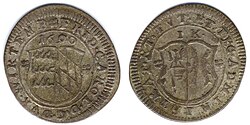
The Kreuzer (German: [ˈkʁɔʏtsɐ] ⓘ), in English also spelled kreutzer[1] (/ˈkrɔɪtsər/ KROYT-sər), was a coin and unit of currency in the southern German states prior to the introduction of the German gold mark in 1871–1873, and in Austria and Switzerland. After 1760 it was made of copper.[2] In south Germany the kreuzer was typically worth 4 Pfennige and there were 60 Kreuzer to a gulden. Kreuzer was abbreviated as Kr, kr, K or Xr.
Early history
[edit]The Kreuzer goes back to a Groschen coin minted in Merano in South Tyrol in 1271 (the so-called etscher Kreuzer[3]). Because of the double cross (German: Kreuz) on the face of the coin, it was soon given the name Kreuzer. It spread in the 15th and 16th centuries throughout the south of the German-speaking area. The Imperial Coinage Act of 1551 made them the unit for small silver coins.
In 1559 a value of 60 Kreuzer to 1 Gulden had been adopted throughout the southern states of the Holy Roman Empire, but the northern German states declined to join, and used the Groschen instead of the Kreuzer. The Kreuzer in turn was worth about 4.2 Pfennige (pennies). Thus one (golden) gulden was worth 60 Kreuzer or 252 Pfennige. Later currencies adopted a standard relationship of 240 Pfennige = 60 Kreuzer = 1 Gulden.
Conventionsmünze
[edit]
Following the adoption of the Conventionsthaler in 1754, two distinct Kreuzer came into being. The first, sometimes referred to as the Conventionskreuzer, was worth 1⁄120 of a Conventionsthaler, valuing the Gulden at half a Conventionsthaler. This was used in Austria-Hungary. However, the states of southern Germany adopted a smaller Kreuzer Landmünze worth 1⁄144 of a Conventionsthaler, thus valuing the Gulden at 5⁄12 of a Conventionsthaler. In fact, the southern German states issued coins denominated in Kreuzer Landmünze up to 6 Kreuzer Landmünze (equal to 5 Conventionskreuzer), but in Conventionskreuzer for higher denominations.
South Germany 1837–1873
[edit]The South German Currency Union of 1837 used a system of 60 Kreuzer = 1 Gulden and 1+3⁄4 Gulden = 1 Thaler, with the Kreuzer equal to the old Kreuzer Landmünze. These Kreuzer continued in circulation until decimalization following the unification of Germany in 1871.
Austria-Hungary 1857–1892
[edit]Austria-Hungary decimalized in 1857, adopting a system of 100 Kreuzer = 1 gulden/forint. 1+1⁄2 florins = 1 Vereinsthaler. The kreuzer was known as krajczár in Hungarian (krajcár in modern orthography), krejcar in Czech, grajciar in Slovak, krajcar in Slovene and Serbocroatian, creițar or crăițar in Romanian, grajcar in Polish.
See also
[edit]References
[edit]- ^ New Shorter Oxford English Dictionary, 1997
- ^ "Coin Denominations". www.austriancoins.com. Archived from the original on 23 September 2015. Retrieved 12 January 2022.
- ^ D. Johann Georg Krünitz (1780), Oekononomisch-technologische Encyklopädie oder allgemeines System der Stats- Stadt- Haus- und Landwirtschaft und der Kunstgeschichte in alphabetischer Ordnung (in German), Berlin: Joachim Pauli, pp. 374–378
External links
[edit] The dictionary definition of Kreuzer at Wiktionary


| International | |
|---|---|
| Other | |

| Late Modern period (1750–2000) |  | |
|---|---|---|
| Late Middle Ages (1250–1500) | ||
| High Middle Ages (1000–1250) | ||
| Early Middle Ages (600–1000) | ||
| Other pfennig related denominations | ||
| See also | ||
Kreuzer
View on GrokipediaOrigins and Etymology
Name and Design Origin
The name Kreuzer originates from the Middle High German term kriuzer or kriuzœre, denoting a small coin marked with a cross, derived from kriuze meaning "cross." This etymology directly references the prominent double cross motif—often described as a crux gemina or the superposition of an ordinary cross and a St. Andrew's cross—stamped on the obverse of early specimens, symbolizing both Christian iconography and the issuing authority's heraldic elements. The design emphasized the coin's silver content and regional prestige, distinguishing it from simpler pfennig types prevalent in the 13th century.[5][4] The cross motif first appeared on a groschen-type silver coin minted in Merano, South Tyrol, in 1271 under Mainardo II (also known as Meinhard II), Count of Tyrol. This coin, weighing approximately 1.5 grams and valued at 20 pfennigs, featured the double cross within concentric circles on one side, paired with an eagle on the reverse, establishing the Kreuzer's initial identity as a high-quality, locally inspired denomination. The motif not only served as a visual identifier but also evoked the counts of Tyrol's ties to imperial and ecclesiastical traditions, where crosses symbolized sovereignty and faith.[6][4] As the coin circulated beyond German-speaking regions, the name evolved into linguistic adaptations reflecting local phonetic and orthographic conventions: krejcar in Czech, krajcar in Slovak and Slovene, and krajcár in Hungarian.Initial Introduction
The Kreuzer originated as a distinct silver coin denomination with its inaugural minting in 1271 in Merano (modern-day Meran, South Tyrol), under Count Meinhard II of Tyrol. This coin served as a variant of the emerging groschen type, featuring a double cross on the obverse that inspired its name, derived from the German word for "cross." Weighing approximately 1.5 grams and containing high-purity silver, it was valued at 20 pfennigs (1/12 of a mark), positioning it as a medium-value piece suitable for regional commerce.[7] Initially circulated within the County of Tyrol and adjacent Alpine regions, such as parts of modern-day Austria and northern Italy, the Kreuzer functioned primarily as a small-value coin for local trade, including payments for goods, labor, and tolls in mountainous areas where smaller denominations like pfennigs often proved insufficient. Its introduction marked an early adaptation of groschen-inspired designs to the needs of Tyrolean minting, facilitating transactions in mining communities and agricultural markets.[7][8] By the early 14th century, the Kreuzer had spread to nearby principalities, including Bavaria and Swabia, where it began replacing or supplementing traditional pfennigs in everyday transactions. This diffusion reflected the coin's acceptance due to its consistent silver content and familiar cross motif, aiding cross-border trade along Alpine routes.[7]Early Modern Period
Standardization in the Holy Roman Empire
The efforts to standardize the Kreuzer within the Holy Roman Empire gained momentum in the mid-16th century amid widespread monetary fragmentation caused by autonomous minting by princes and cities. The Imperial Coinage Act of 1551, promulgated at the Diet of Augsburg (known as the Augsburg Reichstagsabschied), marked a pivotal step by designating the Kreuzer as the principal unit for small-denomination silver coinage across participating territories. This legislation established a fixed equivalence of 72 Kreuzer to one gulden (Reichsguldiner), thereby anchoring the Kreuzer to a consistent silver standard and facilitating trade by reducing valuation discrepancies.[9][10][11] This standardization played a crucial role in addressing the severe debasement crises of the Kipper- und Wipperzeit, a period of rampant coin clipping and over-minting from 1619 to 1623 that eroded trust in imperial currency. During this turmoil, numerous mints produced debased Kreuzer coins, leading to hyperinflation and economic disruption as the unit's silver content plummeted. In response, imperial authorities reaffirmed the 1551 ordinance through edicts in the mid-1620s, restoring the Kreuzer to its predefined silver fineness and value relative to the gulden, which helped stabilize southern and central German economies by reimposing a reliable small silver unit for everyday transactions.[12][13] However, the standardization's reach was geographically limited, excluding northern German states that favored the groschen-based system tied to the emerging thaler, reflecting deep regional divides in monetary preferences and minting traditions. These northern territories, including key Hanseatic cities and principalities, resisted adoption of the Kreuzer-centric framework, prioritizing their established groschen subdivisions for compatibility with Baltic trade networks. As a result, the 1551 act's uniformity primarily took hold in southern and central regions, such as Bavaria, Swabia, and the Habsburg lands, where the Kreuzer became integral to local economies without fully unifying the Empire's coinage.[14][15]Widespread Adoption in Southern Europe
By the mid-15th century, the Kreuzer had gained significant traction within Habsburg territories, beginning with its introduction under Friedrich V (also known as Frederick III, Holy Roman Emperor from 1452) in Austria, where it was minted as a small silver coin weighing approximately 0.57 grams in locations such as Graz.[7] This adoption extended to Bohemia and Hungary, integral parts of the Habsburg domains, where the coin supported local economies and was produced alongside gold ducats to balance silver-based small transactions with higher-value gold currency for international trade.[16] In Bohemia, early records from the late 15th century indicate Kreuzer circulation tied to Austrian minting influences, while in Hungary, it integrated into the monetary framework under Habsburg rule, facilitating administrative and commercial exchanges across these regions.[17] The Kreuzer's utility propelled its expansion into adjacent areas beyond the core Habsburg lands, notably the Swiss cantons and Italian border states such as Vorarlberg, which served as a conduit for cross-Alpine commerce during the 15th to 17th centuries.[7] In Swiss territories like Bern and Fribourg, local mints produced Kreuzer variants, such as the 4 Kreuzer (or Batzen) in Bern, adapting the design for regional use while maintaining compatibility with southern German standards to ease trade in goods like textiles and metals over the Alps.[18] Vorarlberg, under Habsburg control, functioned as a key nexus, where the coin's prevalence supported mercantile networks linking Tyrolean mines to Italian markets, including border areas near Milan, without disrupting established silver flows.[16] Within these expanding networks, the Kreuzer integrated seamlessly into local monetary systems, typically valued at approximately 4 pfennige, which underpinned everyday mercantile activities in pivotal southern European trade hubs like Augsburg and Nuremberg from the 16th century onward.[19] In Nuremberg, for instance, billon Kreuzer struck at 4 pfennige equivalents circulated widely, enabling precise accounting in textile and metal trades that connected the Holy Roman Empire to Mediterranean routes.[20] This valuation, reinforced by the 1551 Imperial Coinage Act as a stabilizing measure for small silver denominations, enhanced the coin's role in fostering economic cohesion across southern European borders.[16]18th Century Developments
Conventionsmünze System
The Conventionsmünze system emerged in the mid-18th century as a key multilateral effort to standardize coinage across parts of the Holy Roman Empire, primarily to counteract rampant coin clipping and debasement that undermined economic stability and trade. The foundational agreement, known as the Austro-Bavarian Münzkonvention (Österreichisch-bayrische Münzkonvention), was signed in 1753 between Austria under Empress Maria Theresa and Bavarian states, setting uniform minting standards to ensure coins retained their intrinsic value regardless of regional variations.[21] This pact built on earlier 16th-century relations to the gulden as a baseline for silver-based currencies but focused on practical enforcement through shared specifications.[21] Complementing this, the Austrian Convention of 1754 extended the framework specifically within Austrian domains, reinforcing the system's adoption by aligning local mints with the broader standards and promoting interoperability with neighboring economies.[21] Under these agreements, the Conventionskreuzer was precisely defined as one 120th of a Conventionsthaler, establishing a clear subunit structure where 60 Kreuzer equated to half a Conventionsthaler in Austrian usage, thereby facilitating calculations in everyday transactions.[21] The initial minting conventions emphasized small-denomination silver coins to meet common needs, specifying production of 1- to 6-Kreuzer pieces with a uniform silver fineness of 0.833 to prevent adulteration and build public confidence in the currency's reliability.[21] These standards marked a significant step toward a more integrated monetary environment in Central Europe, prioritizing verifiable purity over variable local practices.[21]Differences Between Austrian and South German Variants
The Austrian Conventionskreuzer, established under the framework of the 1753 Austro-Bavarian monetary convention, was valued at 1/120 of a Conventionsthaler, with 60 such Kreuzer equaling one gulden equivalent to half a thaler.[22][23] This valuation aligned with the higher silver content standards adopted in Austrian territories, facilitating uniform reckoning in imperial trade networks.[23] In South German states, the Landmünze Kreuzer diverged by being worth 1/144 of a Conventionsthaler, despite also comprising 60 Kreuzer per gulden; this rendered the gulden equivalent to 5/12 thaler, reflecting local preferences for lighter small-denomination coins to ease everyday transactions.[23][24] The resulting 20% lower intrinsic value of the South German variant compared to its Austrian counterpart created a persistent discrepancy within the shared Conventionsmünze system.[23] These valuation differences fostered practical challenges, particularly in regions with cross-border commerce, where dual circulation of the coins prompted variable exchange rates and opportunities for arbitrage by merchants exploiting the gap.[25] Such issues complicated pricing and settlements in border trade until the 19th century, underscoring the limits of the convention's harmonizing intent amid regional economic priorities.[25]19th Century Usage
South German Currency Union (1837–1873)
The South German Currency Union was established in 1837 via the Munich Coinage Treaty, uniting the states of Baden, Bavaria, Hesse, and Württemberg in a shared monetary framework to promote economic cohesion amid the fragmented systems of the German Confederation.[26] This agreement standardized the gulden as the primary unit of account, subdivided into 60 Kreuzer, which served as the key smaller denomination for everyday transactions and aligned the southern states' currencies for smoother cross-border commerce.[26] The treaty's provisions emphasized uniformity in silver content and valuation, reducing discrepancies that had previously hindered trade.[27] The union maintained compatibility with broader German monetary practices by linking the gulden to the thaler at a fixed rate of 1 thaler equaling 1¾ gulden, allowing southern currencies to circulate alongside northern ones based on the Prussian thaler standard.[26] It also perpetuated the Landmünze conventions inherited from 18th-century practices, ensuring the Kreuzer retained its established value and weight relative to the gulden without introducing disruptive changes.[28] This relational structure supported the union's goal of regional stability while accommodating the thaler-dominated north, fostering gradual alignment within the Zollverein customs union.[29] With the proclamation of the German Empire in 1871, the South German Currency Union entered a phase of dissolution as national unification demanded a single currency to consolidate economic policy across all states. The gulden and Kreuzer were progressively demonetized, with the transition culminating in their full replacement by the gold-backed German mark in 1873, which subdivided into 100 pfennigs and equaled 7/12 of a gulden for exchange purposes. This shift ended the era of regional unions like the South German one, paving the way for centralized monetary authority under the Reichsbank.[30]Austrian Decimalization and Use (1857–1892)
In 1857, the Austrian Empire enacted a comprehensive currency reform through an imperial decree that decimalized the monetary system, establishing the gulden (also known as the florin) as the primary unit divided into 100 kreuzer, a significant shift from the previous non-decimal structure of 60 kreuzer per gulden.[31][32] This reform unified the currency across the empire, including territories like the Lombardo-Venetian Kingdom, and built upon the earlier Conventionskreuzer as a foundational silver subunit while introducing the Vereinsthaler as a trade coin equivalent to 1½ gulden to facilitate international exchange.[31][32] The kreuzer, now revalued as the centesimal subunit, circulated widely in everyday transactions, with copper coins minted for denominations like 1, 2, 5, and 10 kreuzer, reflecting its role in the multi-ethnic empire's economy.[32] Regional linguistic variations highlighted the kreuzer's integration into diverse cultural contexts within Austria-Hungary. In Hungarian-speaking areas, it was commonly referred to as the krajcár, aligning with local monetary traditions and appearing on bilingual coinage issued from Hungarian mints like Kremnitz (Kremnica).[31] Among Yiddish-speaking Jewish communities, particularly in Galicia and Bohemia, the term kreytsar was used in daily commerce and memoirs, underscoring its prevalence in small-scale trade and labor payments, such as agrarian wages ranging from 12 to 60 kreuzer per day.[33] These adaptations ensured the kreuzer's accessibility across the empire's ethnic groups, from German-speaking regions where the standard Kreuzer prevailed to Slavic and Romance-language areas with phonetic equivalents like krajcar in Croatian or creițar in Romanian dialects.[31] The kreuzer remained in official circulation until the 1892 currency reform, which introduced the krone (crown) at a fixed rate of 1 gulden equaling 2 krone, as part of Austria-Hungary's adoption of the gold standard to stabilize the economy amid industrialization and trade expansion.[34] Demonetization of the gulden and its kreuzer subunits occurred progressively from 1892, with low-denomination kreuzer coins withdrawn as krone heller equivalents (1 kreuzer ≈ 2 heller) entered circulation, though some gulden notes and subsidiary coins lingered as legal tender until 1900 to ease the transition.[34] This marked the end of the kreuzer's 35-year decimal era, transitioning the empire to a modern gold-based system that persisted until the monarchy's dissolution in 1918.[34]Physical Characteristics
Coin Specifications
The Kreuzer coinage featured a range of denominations that evolved over time, typically including 1, 2, 3, 6, 10, 15, 20, 30, and 60 Kreuzer, with the 60 Kreuzer equating to 1 gulden in standard valuation across Austrian and South German systems.[35] Higher denominations such as 10 Kreuzer and above were generally struck in silver, while lower values like 1 to 6 Kreuzer used billon (low-grade silver alloy) or copper to facilitate everyday transactions.[36] Early variants from the Holy Roman Empire period were small silver coins, with representative pieces weighing approximately 1 gram total at around 0.850 fineness, deriving from groschen standards. By the 18th century, specifications varied by region and material; for instance, South German 1 Kreuzer coins, such as those from Baden under Frederick I, were copper with a weight of 4 grams and a diameter of 21.7 millimeters. In Austrian territories, post-1760 copper issues for the 1 Kreuzer denomination shifted to lighter formats, exemplified by Maria Theresa-era pieces at 10.04 grams and 25 millimeters in diameter, later reducing to around 3.3 grams and 19 millimeters by the late 19th century under the decimalized gulden.[37] Austrian higher-denomination examples illustrate silver usage, such as the 20 Kreuzer from 1754–1765, composed of silver at 0.583 fineness, weighing 6.68 grams.[38] For the 30 Kreuzer, an 1807 Austrian issue under Francis I was struck in copper at 17.5 grams and 37.5 millimeters diameter, reflecting wartime material adaptations, though earlier silver variants used standards around 0.583 fineness in the mid-18th century.[39]| Denomination | Material | Representative Weight (g) | Diameter (mm) | Example Period/Issuer |
|---|---|---|---|---|
| 1 Kreuzer | Copper | 3.3–10.04 | 19–25 | Austrian Empire, 1760–1891[37] |
| 3 Kreuzer | Silver | ~1.8 | ~20 | Holy Roman Empire, 16th century[40] |
| 20 Kreuzer | Silver | 6.68 | N/A | Austrian Empire, 1754–1765 (0.583 fineness)[38] |
| 30 Kreuzer | Copper | 17.5 | 37.5 | Austrian Empire, 1807[39] |
| 60 Kreuzer | Silver | Varies (~28–30) | ~35–40 | South German/Austrian, 18th century[35] |
Materials and Minting
The Kreuzer coin was primarily composed of silver in its early iterations before 1760, reflecting the standard for small-denomination currency in the Holy Roman Empire and associated territories. This silver content allowed for consistent valuation and widespread acceptance in southern German states and Austria, where the coin served as a fundamental unit in local economies.[2] In the 16th and 17th centuries, lower denominations like 1-3 Kreuzer were often struck in billon (debased silver alloy) before transitioning to copper in the 18th century. Transitioning to base metals became necessary as economic pressures mounted, particularly for low-value pieces; by 1760, under Maria Theresa, the 1 Kreuzer shifted to copper composition to mitigate production costs while maintaining utility for everyday transactions. Later variants in the 19th century continued to use copper for small denominations to maintain low production costs.[41] Minting of Kreuzer coins occurred at several prominent facilities across central Europe, with Vienna serving as the primary hub for Austrian issues, producing high volumes under imperial oversight. Munich handled Bavarian variants, leveraging local silver supplies for regional output, while Augsburg, as a free imperial city, minted independent Kreuzer that circulated widely in Swabia. Hall in Tyrol emerged as a crucial center, especially for Tyrolean specialties, where advanced machinery enabled efficient production from the late 15th century onward.[42] Initially, production relied on hammered techniques, involving hand-struck blanks between engraved dies, a labor-intensive method prevalent until the 16th century when mechanical presses began to supplant them for greater uniformity.[43] By the late 16th century, milled processes—using screw presses or roller mills—gained adoption at sites like Hall, yielding more precise and round coins that resisted deformation during handling.[44] To combat counterfeiting, which plagued small silver coins like the Kreuzer, 18th-century minting conventions introduced sophisticated edge designs. Edge lettering, often inscribed with mottos or denominations, and reeding—parallel grooves along the rim—were implemented to prevent clipping and filing, ensuring the coin's integrity from production through circulation. These measures, standardized in Austrian and South German outputs, significantly raised the barrier for illicit replication while preserving aesthetic consistency.[45]Decline and Legacy
Replacement by National Currencies
The establishment of the German Empire in 1871 prompted a comprehensive currency unification, culminating in the Reichsmünzgesetz of December 4, 1871, which introduced the gold-based mark divided into 100 pfennige as the standard currency across all states. In the southern German states—Bavaria, Baden, Württemberg, and others—where the Kreuzer had been a key subunit of the South German gulden (60 Kreuzer per gulden), the new law mandated the withdrawal of regional currencies, including the Kreuzer, in favor of the mark. The exchange rate was fixed at 1 gulden equaling 1 5/7 marks (or precisely 12/7 marks), which translated to 1 mark equaling 35 Kreuzer, ensuring a smooth transition for existing silver-based denominations without immediate loss in intrinsic value.[46] This reform, fully implemented by 1873 with the issuance of mark coins, eliminated the Kreuzer from official circulation by 1875 as southern mints shifted production to imperial standards.[47] In Austria-Hungary, the Kreuzer's obsolescence followed the Currency Standard Act of 1892, which adopted the gold standard and replaced the silver-based Austro-Hungarian gulden (divided into 100 new Kreuzer since the 1857 decimalization) with the krone, subdivided into 100 heller. The conversion rate was set at 1 gulden equaling 2 kronen, meaning 1 Kreuzer corresponded to 2 heller, preserving nominal value continuity while aligning the monetary system with international gold standards. Silver coins continued to be minted under the new regime, with their fine silver content calibrated to the krone's gold parity (approximately 0.305 g fine gold per krone). The reform centralized monetary authority under the Austro-Hungarian Bank, phasing out Kreuzer coins by the mid-1890s as krone issues dominated circulation.[48] The Kreuzer's formal replacement did not end its presence everywhere immediately. In annexed or peripheral territories like Liechtenstein, which aligned with Austrian currency until adopting the Swiss franc, Kreuzer coins from the Austro-Hungarian era lingered in use alongside the krone until 1921, when economic instability prompted a full shift.[49] These instances marked the Kreuzer's final vestiges before complete obsolescence by the mid-1920s.Numismatic and Cultural Significance
The Kreuzer holds significant appeal among numismatists due to the rarity of early Tyrolean specimens, which date back to the 15th century and feature distinctive designs such as the cross emblem after which the coin is named. These early pieces from the County of Tyrol, often struck in silver or billon, are prized for their historical ties to the Habsburg domains and limited surviving examples, with rarity indices on platforms like Numista rating them as uncommon to rare among collectors.[50] Modern numismatic catalogs value well-preserved 18th-century Kreuzer specimens—typically in billon or copper—at $50–500 USD, depending on condition, mint mark, and provenance, reflecting their role as everyday fractional currency in the Holy Roman Empire. In literature and folklore, the Kreuzer appears as a symbol of modest wealth and everyday transactions. Johann Wolfgang von Goethe references the coin in his autobiography Poetry and Truth, describing how, as a youth, he would cross the Main River in Frankfurt for a mere kreuzer, underscoring its status as inexpensive small change in 18th-century German-speaking regions.[51] Similarly, Austrian folk tales, such as those collected in In the Land of Marvels: Folk-tales from Austria and Bohemia, feature the Kreuzer in narratives like "For One Kreuzer a Hundred," where it represents humble bargaining or minor fortunes, embedding it in cultural motifs of thrift and simplicity.[52] This legacy persists in regional dialects across Austria and southern Germany, where "Kreuzer" evolved colloquially to denote any trivial sum or pocket money, evoking the coin's historical ubiquity as a low-denomination unit. Beyond its core Habsburg origins, the Kreuzer circulated in Swiss cantons from the 15th century until the adoption of the Swiss franc in 1850, with local mints like those in Freiburg and St. Gallen producing billon examples for regional trade.[53] In the Principality of Liechtenstein, it served as part of the Austrian-influenced currency system until the early 20th century, when the Swiss franc was adopted in 1924. Today, these peripheral issues are primarily collectible, valued for their ties to decentralized European monetary history rather than circulation, with physical characteristics like lightweight billon composition (often 0.5–2 grams) enhancing their appeal to specialists in minor denominations.[49]References
- https://en.wikisource.org/wiki/An_Etymological_Dictionary_of_the_German_Language/Annotated/Kreuzer
- https://de.wikisource.org/wiki/M%C3%BCnzgesetz
- https://en.wikisource.org/wiki/The_Works_of_J._W._von_Goethe/Volume_4/First_Book