


Community hub
Kripke semantics
View on Wikipedia | This article includes a list of general references, but it lacks sufficient corresponding inline citations. (April 2013) |
Kripke semantics (also known as relational semantics or frame semantics, and often confused with possible world semantics)[1] is a formal semantics for non-classical logic systems created in the late 1950s and early 1960s by Saul Kripke and André Joyal. It was first conceived for modal logics, and later adapted to intuitionistic logic and other non-classical systems. The development of Kripke semantics was a breakthrough in the theory of non-classical logics, because the model theory of such logics was almost non-existent before Kripke (algebraic semantics existed, but were considered 'syntax in disguise').[citation needed]
Semantics of modal logic
[edit]The language of propositional modal logic consists of a countably infinite set of propositional variables, a set of truth-functional connectives (in this article and ), and the modal operator ("necessarily"). The modal operator ("possibly") is (classically) the dual of and may be defined in terms of necessity like so: ("possibly A" is defined as equivalent to "not necessarily not A").[2]



Basic definitions
[edit]A Kripke frame or modal frame is a pair , where W is a (possibly empty) set, and R is a binary relation on W. Elements of W are called nodes or worlds, and R is known as the accessibility relation.[3]

A Kripke model is a triplet ,[4] where is a Kripke frame, and is a relation between nodes of W and modal formulas, such that for all w ∈ W and modal formulas A and B:


- if and only if ,
- if and only if or ,
- if and only if for all such that .


We read as “w satisfies A”, “A is satisfied in w”, or “w forces A”. The relation is called the satisfaction relation, evaluation, or forcing relation. The satisfaction relation is uniquely determined by its value on propositional variables.

A formula A is valid in:
- a model , if for all ,
- a frame , if it is valid in for all possible choices of ,
- a class C of frames or models, if it is valid in every member of C.

We define Thm(C) to be the set of all formulas that are valid in C. Conversely, if X is a set of formulas, let Mod(X) be the class of all frames which validate every formula from X.
A modal logic (i.e., a set of formulas) L is sound with respect to a class of frames C, if L ⊆ Thm(C). L is complete wrt C if L ⊇ Thm(C).
Correspondence and completeness
[edit]Semantics is useful for investigating a logic (i.e. a derivation system) only if the semantic consequence relation reflects its syntactical counterpart, the syntactic consequence relation (derivability).[5] It is vital to know which modal logics are sound and complete with respect to a class of Kripke frames, and to determine also which class that is.
For any class C of Kripke frames, Thm(C) is a normal modal logic (in particular, theorems of the minimal normal modal logic, K, are valid in every Kripke model). However, the converse does not hold in general: while most of the modal systems studied are complete of classes of frames described by simple conditions, Kripke incomplete normal modal logics do exist. A natural example of such a system is Japaridze's polymodal logic.
A normal modal logic L corresponds to a class of frames C, if C = Mod(L). In other words, C is the largest class of frames such that L is sound wrt C. It follows that L is Kripke complete if and only if it is complete of its corresponding class.
Consider the schema T : . T is valid in any reflexive frame : if , then since w R w. On the other hand, a frame which validates T has to be reflexive: fix w ∈ W, and define satisfaction of a propositional variable p as follows: if and only if w R u. Then , thus by T, which means w R w using the definition of . T corresponds to the class of reflexive Kripke frames.


It is often much easier to characterize the corresponding class of L than to prove its completeness, thus correspondence serves as a guide to completeness proofs. Correspondence is also used to show incompleteness of modal logics: suppose L1 ⊆ L2 are normal modal logics that correspond to the same class of frames, but L1 does not prove all theorems of L2. Then L1 is Kripke incomplete. For example, the schema generates an incomplete logic, as it corresponds to the same class of frames as GL (viz. transitive and converse well-founded frames), but does not prove the GL-tautology .


Common modal axiom schemata
[edit]The following table lists common modal axioms together with their corresponding classes. The naming of the axioms often varies; Here, axiom K is named after Saul Kripke; axiom T is named after the truth axiom in epistemic logic; axiom D is named after deontic logic; axiom B is named after L. E. J. Brouwer; and axioms 4 and 5 are named based on C. I. Lewis's numbering of symbolic logic systems.
| Name | Axiom | Frame condition |
|---|---|---|
| K | holds true for any frames | |
| T | reflexive: | |
| Q | dense: | |
| 4 | transitive: | |
| D | or or | serial: |
| B | or | symmetric : |
| 5 | Euclidean: | |
| GL | R transitive, R−1 well-founded | |
| Grz[6] | R reflexive and transitive, R−1−Id well-founded | |
| H | [7] | |
| M | (a complicated second-order property) | |
| G | convergent: | |
| - | discrete: | |
| - | partial function: | |
| - | function: ( is the uniqueness quantification) | |
| - | or | empty: |







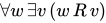





















Axiom K can also be rewritten as , which logically establishes modus ponens as a rule of inference in every possible world.
![{\displaystyle \Box [(A\to B)\land A]\to \Box B}](https://wikimedia.org/api/rest_v1/media/math/render/svg/0bb5446fefa7edfe8c494e8beae2661c2c2b956f)
Note that for axiom D, implicitly implies , which means that for every possible world in the model, there is always at least one possible world accessible from it (which could be itself). This implicit implication is similar to the implicit implication by existential quantifier on the range of quantification.


Common modal systems
[edit]The following table lists several common normal modal systems. Frame conditions for some of the systems were simplified: the logics are sound and complete with respect to the frame classes given in the table, but they may correspond to a larger class of frames.
| Name | Axioms | Frame condition |
|---|---|---|
| K | — | all frames |
| T | T | reflexive |
| K4 | 4 | transitive |
| S4 | T, 4 | preorder |
| S5 | T, 5 or D, B, 4 | equivalence relation |
| S4.3 | T, 4, H | total preorder |
| S4.1 | T, 4, M | preorder, |
| S4.2 | T, 4, G | directed preorder |
| GL, K4W | GL or 4, GL | finite strict partial order |
| Grz, S4Grz | Grz or T, 4, Grz | finite partial order |
| D | D | serial |
| D45 | D, 4, 5 | transitive, serial, and Euclidean |

Canonical models
[edit]For any normal modal logic, L, a Kripke model (called the canonical model) can be constructed that refutes precisely the non-theorems of L, by an adaptation of the standard technique of using maximal consistent sets as models. Canonical Kripke models play a role similar to the Lindenbaum–Tarski algebra construction in algebraic semantics.
A set of formulas is L-consistent if no contradiction can be derived from it using the theorems of L, and Modus Ponens. A maximal L-consistent set (an L-MCS for short) is an L-consistent set that has no proper L-consistent superset.
The canonical model of L is a Kripke model , where W is the set of all L-MCS, and the relations R and are as follows:
- if and only if for every formula , if then ,
- if and only if .


The canonical model is a model of L, as every L-MCS contains all theorems of L. By Zorn's lemma, each L-consistent set is contained in an L-MCS, in particular every formula unprovable in L has a counterexample in the canonical model.
The main application of canonical models are completeness proofs. Properties of the canonical model of K immediately imply completeness of K with respect to the class of all Kripke frames. This argument does not work for arbitrary L, because there is no guarantee that the underlying frame of the canonical model satisfies the frame conditions of L.
We say that a formula or a set X of formulas is canonical with respect to a property P of Kripke frames, if
- X is valid in every frame that satisfies P,
- for any normal modal logic L that contains X, the underlying frame of the canonical model of L satisfies P.
A union of canonical sets of formulas is itself canonical. It follows from the preceding discussion that any logic axiomatized by a canonical set of formulas is Kripke complete, and compact.
The axioms T, 4, D, B, 5, H, G (and thus any combination of them) are canonical. GL and Grz are not canonical, because they are not compact. The axiom M by itself is not canonical (Goldblatt, 1991), but the combined logic S4.1 (in fact, even K4.1) is canonical.
In general, it is undecidable whether a given axiom is canonical. We know a nice sufficient condition: Henrik Sahlqvist identified a broad class of formulas (now called Sahlqvist formulas) such that
- a Sahlqvist formula is canonical,
- the class of frames corresponding to a Sahlqvist formula is first-order definable,
- there is an algorithm that computes the corresponding frame condition to a given Sahlqvist formula.
This is a powerful criterion: for example, all axioms listed above as canonical are (equivalent to) Sahlqvist formulas.
Finite model property
[edit]A logic has the finite model property (FMP) if it is complete with respect to a class of finite frames. An application of this notion is the decidability question: it follows from Post's theorem that a recursively axiomatized modal logic L which has FMP is decidable, provided it is decidable whether a given finite frame is a model of L. In particular, every finitely axiomatizable logic with FMP is decidable.
There are various methods for establishing FMP for a given logic. Refinements and extensions of the canonical model construction often work, using tools such as filtration or unravelling. As another possibility, completeness proofs based on cut-free sequent calculi usually produce finite models directly.
Most of the modal systems used in practice (including all listed above) have FMP.
In some cases, we can use FMP to prove Kripke completeness of a logic: every normal modal logic is complete with respect to a class of modal algebras, and a finite modal algebra can be transformed into a Kripke frame. As an example, Robert Bull proved using this method that every normal extension of S4.3 has FMP, and is Kripke complete.
Multimodal logics
[edit]Kripke semantics has a straightforward generalization to logics with more than one modality. A Kripke frame for a language with as the set of its necessity operators consists of a non-empty set W equipped with binary relations Ri for each i ∈ I. The definition of a satisfaction relation is modified as follows:

- if and only if


A simplified semantics, discovered by Tim Carlson, is often used for polymodal provability logics. A Carlson model is a structure with a single accessibility relation R, and subsets Di ⊆ W for each modality. Satisfaction is defined as

- if and only if

Carlson models are easier to visualize and to work with than usual polymodal Kripke models; there are, however, Kripke complete polymodal logics which are Carlson incomplete.
Semantics of intuitionistic logic
[edit]Kripke semantics for intuitionistic logic follows the same principles as the semantics of modal logic, but it uses a different definition of satisfaction.[8]
An intuitionistic Kripke model is a triple , where is a preordered Kripke frame, and satisfies the following conditions:[9]


- if p is a propositional variable, , and , then (persistency condition (cf. monotonicity)),
- if and only if and ,
- if and only if or ,
- if and only if for all , implies ,
- not .


The negation of A, ¬A, could be defined as an abbreviation for A → ⊥. If for all u such that w ≤ u, not u ⊩ A, then w ⊩ A → ⊥ is vacuously true, so w ⊩ ¬A.
Intuitionistic logic is sound and complete with respect to its Kripke semantics, and it has the finite model property.
Intuitionistic first-order logic
[edit]Let L be a first-order language. A Kripke model of L is a triple , where is an intuitionistic Kripke frame, Mw is a (classical) L-structure for each node w ∈ W, and the following compatibility conditions hold whenever u ≤ v:

- the domain of Mu is included in the domain of Mv,
- realizations of function symbols in Mu and Mv agree on elements of Mu,
- for each n-ary predicate P and elements a1,...,an ∈ Mu: if P(a1,...,an) holds in Mu, then it holds in Mv.
Given an evaluation e of variables by elements of Mw, we define the satisfaction relation :
![{\displaystyle w\Vdash A[e]}](https://wikimedia.org/api/rest_v1/media/math/render/svg/5904096a35806f2c02953bb68ba19d017bcaf1e9)
- if and only if holds in Mw,
- if and only if and ,
- if and only if or ,
- if and only if for all , implies ,
- not ,
- if and only if there exists an such that ,
- if and only if for every and every , .
![{\displaystyle w\Vdash P(t_{1},\dots ,t_{n})[e]}](https://wikimedia.org/api/rest_v1/media/math/render/svg/8bed6a4398de6219b9869cde647174b79751084c)
![{\displaystyle P(t_{1}[e],\dots ,t_{n}[e])}](https://wikimedia.org/api/rest_v1/media/math/render/svg/f044e919c1699f3912aa10e901576f7edf998dc0)
![{\displaystyle w\Vdash (A\land B)[e]}](https://wikimedia.org/api/rest_v1/media/math/render/svg/59c38161da49f139a1f966606cb046c16d837180)
![{\displaystyle w\Vdash B[e]}](https://wikimedia.org/api/rest_v1/media/math/render/svg/2ec4262aadbaddbbbd29208e26a2887915fb5ef0)
![{\displaystyle w\Vdash (A\lor B)[e]}](https://wikimedia.org/api/rest_v1/media/math/render/svg/a84898302d45c20f4f6db6c50d572916d3942341)
![{\displaystyle w\Vdash (A\to B)[e]}](https://wikimedia.org/api/rest_v1/media/math/render/svg/78199ffd20d1c1697171cc8732fba8055f6a218b)
![{\displaystyle u\Vdash A[e]}](https://wikimedia.org/api/rest_v1/media/math/render/svg/8f26512eec2a9afbb76fb5bf0c851aae40852d3b)
![{\displaystyle u\Vdash B[e]}](https://wikimedia.org/api/rest_v1/media/math/render/svg/f3f80feb5d37d28d4f3f8fa9f48e714912720dea)
![{\displaystyle w\Vdash \bot [e]}](https://wikimedia.org/api/rest_v1/media/math/render/svg/681489a81096035bc73737762cffddc0248b86e9)
![{\displaystyle w\Vdash (\exists x\,A)[e]}](https://wikimedia.org/api/rest_v1/media/math/render/svg/c9e280fc19d6459dd2f63e61ff5f3bfe780a0c8e)

![{\displaystyle w\Vdash A[e(x\to a)]}](https://wikimedia.org/api/rest_v1/media/math/render/svg/35cfa78009e8ef4f2e7fd55829fe5068f492b2ba)
![{\displaystyle w\Vdash (\forall x\,A)[e]}](https://wikimedia.org/api/rest_v1/media/math/render/svg/58f4621d5c02e76efb59d112699bbe7ce8aaae5c)

![{\displaystyle u\Vdash A[e(x\to a)]}](https://wikimedia.org/api/rest_v1/media/math/render/svg/741627df2ff936ce2f77b245fc160a7bca31678d)
Here e(x→a) is the evaluation which gives x the value a, and otherwise agrees with e.[10]
Kripke–Joyal semantics
[edit]As part of the independent development of sheaf theory, it was realised around 1965 that Kripke semantics was intimately related to the treatment of existential quantification in topos theory.[11] That is, the 'local' aspect of existence for sections of a sheaf was a kind of logic of the 'possible'. Though this development was the work of a number of people, the name Kripke–Joyal semantics is often used in this connection.
Model constructions
[edit]As in classical model theory, there are methods for constructing a new Kripke model from other models.
The natural homomorphisms in Kripke semantics are called p-morphisms (which is short for pseudo-epimorphism, but the latter term is rarely used). A p-morphism of Kripke frames and is a mapping such that


- f preserves the accessibility relation, i.e., u R v implies f(u) R’ f(v),
- whenever f(u) R’ v’, there is a v ∈ W such that u R v and f(v) = v’.
A p-morphism of Kripke models and is a p-morphism of their underlying frames , which satisfies

- if and only if , for any propositional variable p.

P-morphisms are a special kind of bisimulations. In general, a bisimulation between frames and is a relation B ⊆ W × W’, which satisfies the following “zig-zag” property:
- if u B u’ and u R v, there exists v’ ∈ W’ such that v B v’ and u’ R’ v’,
- if u B u’ and u’ R’ v’, there exists v ∈ W such that v B v’ and u R v.
A bisimulation of models is additionally required to preserve forcing of atomic formulas:
- if w B w’, then if and only if , for any propositional variable p.

The key property which follows from this definition is that bisimulations (hence also p-morphisms) of models preserve the satisfaction of all formulas, not only propositional variables.
We can transform a Kripke model into a tree using unravelling. Given a model and a fixed node w0 ∈ W, we define a model , where W’ is the set of all finite sequences such that wi R wi+1 for all i < n, and if and only if for a propositional variable p. The definition of the accessibility relation R’ varies; in the simplest case we put



- ,

but many applications need the reflexive and/or transitive closure of this relation, or similar modifications.
Filtration is a useful construction which one can use to prove FMP for many logics. Let X be a set of formulas closed under taking subformulas. An X-filtration of a model is a mapping f from W to a model such that
- f is a surjection,
- f preserves the accessibility relation, and (in both directions) satisfaction of variables p ∈ X,
- if f(u) R’ f(v) and , where , then .


It follows that f preserves satisfaction of all formulas from X. In typical applications, we take f as the projection onto the quotient of W over the relation
- u ≡X v if and only if for all A ∈ X, if and only if .
As in the case of unravelling, the definition of the accessibility relation on the quotient varies.
General frame semantics
[edit]The main defect of Kripke semantics is the existence of Kripke incomplete logics, and logics which are complete but not compact. It can be remedied by equipping Kripke frames with extra structure which restricts the set of possible valuations, using ideas from algebraic semantics. This gives rise to the general frame semantics.
Computer science applications
[edit]Blackburn et al. (2001) argue that, because a relational structure is simply a set together with a collection of relations on that set, it is unsurprising that relational structures can often be found.[clarification needed] As an example from theoretical computer science, they give labeled transition systems, which model program execution. Blackburn et al. thus claim because of this connection that modal languages are ideally suited in providing "internal, local perspective on relational structures." (p. xii)
History and terminology
[edit] |
Similar work that predated Kripke's revolutionary semantic breakthroughs:[12]
- Rudolf Carnap seems to have been the first to have the idea that one can give a possible world semantics for the modalities of necessity and possibility by means of giving the valuation function a parameter that ranges over Leibnizian possible worlds. Bayart develops this idea further, but neither gave recursive definitions of satisfaction in the style introduced by Tarski;
- J.C.C. McKinsey and Alfred Tarski developed an approach to modeling modal logics that is still influential in modern research, namely the algebraic approach, in which Boolean algebras with operators are used as models. Bjarni Jónsson and Tarski established the representability of Boolean algebras with operators in terms of frames. If the two ideas had been put together, the result would have been precisely frame models, which is to say Kripke models, years before Kripke. But no one (not even Tarski) saw the connection at the time.
- Arthur Prior, building on unpublished work of C. A. Meredith, developed a translation of sentential modal logic into classical predicate logic that, if he had combined it with the usual model theory for the latter, would have produced a model theory equivalent to Kripke models for the former. But his approach was resolutely syntactic and anti-model-theoretic.
- Stig Kanger gave a rather more complex approach to the interpretation of modal logic, but one that contains many of the key ideas of Kripke's approach. He first noted the relationship between conditions on accessibility relations and Lewis-style axioms for modal logic. Kanger failed, however, to give a completeness proof for his system;
- Jaakko Hintikka gave a semantics in his papers introducing epistemic logic that is a simple variation of Kripke's semantics, equivalent to the characterisation of valuations by means of maximal consistent sets. He doesn't give inference rules for epistemic logic, and so cannot give a completeness proof;
- Richard Montague had many of the key ideas contained in Kripke's work, but he did not regard them as significant, because he had no completeness proof, and so did not publish until after Kripke's papers had created a sensation in the logic community;
- Evert Willem Beth presented a semantics of intuitionistic logic based on trees, which closely resembles Kripke semantics, except for using a more cumbersome definition of satisfaction.
See also
[edit]Notes
[edit]- ^ Possible world semantics is a broader term encompassing various approaches, including Kripke semantics. It generally refers to the idea of analyzing modal statements by considering alternative possible worlds where different propositions are true or false. While Kripke semantics is a specific type of possible world semantics, there are other ways to model possible worlds and their relationships. Kripke semantics is a specific form of possible world semantics that employs relational structures to represent the relationships between possible worlds and propositions in modal logic.[citation needed]
- ^ Shoham & Leyton-Brown 2008.
- ^ Gasquet et al. 2013, pp. 14–16.
- ^ Note that the notion of 'model' in the Kripke semantics of modal logic differs from the notion of 'model' in classical non-modal logics: In classical logics we say that some formula F has a 'model' if there exists some 'interpretation' of the variables of F which makes the formula F true; this specific interpretation is then a model of the formula F. In the Kripke semantics of modal logic, by contrast, a 'model' is not a specific 'something' that makes a specific modal formula true; in Kripke semantics a 'model' must rather be understood as a larger universe of discourse within which any modal formulae can be meaningfully 'understood'. Thus: whereas the notion of 'has a model' in classical non-modal logic refers to some individual formula within that logic, the notion of 'has a model' in modal logic refers to the logic itself as a whole (i.e.: the entire system of its axioms and deduction rules).
- ^ Giaquinto 2002.
- ^ After Andrzej Grzegorczyk.
- ^ Boolos, George (1993). The Logic of Provability. Cambridge University Press. pp. 148, 149. ISBN 0-521-43342-8.
- ^ Troelstra & van Dalen 1988, pp. 75–87, 5. Kripke semantics.
- ^ Simpson 1994, p. 20, 2.2 The semantics of intuitionistic logic.
- ^ See a slightly different formalization in Moschovakis (2022)
- ^ Goldblatt 2006b.
- ^ Stokhof 2008, See the last two paragraphs in Section 3 Quasi-historical Interlude: the Road from Vienna to Los Angeles..
References
[edit]- Blackburn, P.; de Rijke, M.; Venema, Yde (2002). Modal Logic. Cambridge University Press. ISBN 978-1-316-10195-7.
- Bull, Robert A.; Segerberg, K. (2012) [1984]. "Basic Modal Logic". In Gabbay, D.M.; Guenthner, F. (eds.). Extensions of Classical Logic. Handbook of Philosophical Logic. Vol. 2. Springer. pp. 1–88. ISBN 978-94-009-6259-0.
- Chagrov, A.; Zakharyaschev, M. (1997). Modal Logic. Clarendon Press. ISBN 978-0-19-853779-3.
- Cresswell, M.J.; Hughes, G.E. (2012) [1996]. A New Introduction to Modal Logic. Routledge. ISBN 978-1-134-80028-5.
- Van Dalen, Dirk (2013) [1986]. "Intuitionistic Logic". In Gabbay, Dov M.; Guenthner, Franz (eds.). Alternatives to Classical Logic. Handbook of Philosophical Logic. Vol. 3. Springer. pp. 225–339. ISBN 978-94-009-5203-4.
- Dummett, Michael A. E. (2000). Elements of Intuitionism (2nd ed.). Clarendon Press. ISBN 978-0-19-850524-2.
- Fitting, Melvin (1969). Intuitionistic Logic, Model Theory and Forcing. North-Holland. ISBN 978-0-444-53418-7.
- Gasquet, Olivier; Herzig, Andreas; Said, Bilal; Schwarzentruber, François (2013). Kripke's Worlds: An Introduction to Modal Logics via Tableaux. Springer. pp. XV, 198. ISBN 978-3764385033. Retrieved 24 December 2014.
- Giaquinto, Marcus (2002). The Search for Certainty : A Philosophical Account of Foundations of Mathematics: A Philosophical Account of Foundations of Mathematics. Oxford University Press. p. 256. ISBN 019875244X. Retrieved 24 December 2014.
- Goldblatt, Robert (2006a). "Mathematical Modal Logic: a View of its Evolution" (PDF). In Gabbay, Dov M.; Woods, John (eds.). Logic and the Modalities in the Twentieth Century (PDF). Handbook of the History of Logic. Vol. 7. Elsevier. pp. 1–98. ISBN 978-0-08-046303-2.
- Goldblatt, Robert (2006b). "A Kripke-Joyal Semantics for Noncommutative Logic in Quantales" (PDF). In Governatori, G.; Hodkinson, I.; Venema, Y. (eds.). Advances in Modal Logic. Vol. 6. London: College Publications. pp. 209–225. ISBN 1904987206.
- Mac Lane, Saunders; Moerdijk, Ieke (2012) [1991]. Sheaves in Geometry and Logic: A First Introduction to Topos Theory. Springer. ISBN 978-1-4612-0927-0.
- Shoham, Yoav; Leyton-Brown, Kevin (2008). Multiagent Systems: Algorithmic, Game-Theoretic, and Logical Foundations. Cambridge University Press. p. 397. ISBN 978-0521899437.
- Simpson, Alex K. (1994). The Proof Theory and Semantics of Intuitionistic Modal Logic (Thesis). Edinburgh Research Archive (ERA). hdl:1842/407.
- Stokhof, Martin (2008). "The architecture of meaning: Wittgenstein's Tractatus and formal semantics". In Zamuner, Edoardo; Levy, David K. (eds.). Wittgenstein's Enduring Arguments. London: Routledge. pp. 211–244. ISBN 9781134107070.
- Troelstra, A. S.; van Dalen, D. (1988). Constructivism in Mathematics: An Introduction, Volume 1. Studies in Logic and the Foundations of Mathematics. Vol. 121. Amsterdam: North-Holland. ISBN 9780444702661.
External links
[edit]
- Burgess, John P. "Kripke Models". Archived from the original on 2004-10-20.
- Detlovs, V.; Podnieks, K. "4.4 Constructive Propositional Logic — Kripke Semantics". Introduction to Mathematical Logic. University of Latvia. N.B: Constructive = intuitionistic.
- Garson, James (23 January 2023). "Modal Logic". In Zalta, Edward N. (ed.). Stanford Encyclopedia of Philosophy.
- "Kripke models", Encyclopedia of Mathematics, EMS Press, 2001 [1994]
- Moschovakis, Joan (16 December 2022). "Intuitionistic Logic". In Zalta, Edward N. (ed.). Stanford Encyclopedia of Philosophy.
Kripke semantics
View on GrokipediaSemantics of Modal Logic
Basic Definitions
Kripke semantics provides a possible-worlds interpretation for modal logic, where the fundamental structure is a Kripke frame, defined as a pair , with a non-empty set of possible worlds and a binary accessibility relation that determines which worlds are reachable from others. This relational structure captures the intuitive notion of necessity and possibility by linking worlds according to modal accessibility, as originally proposed by Kripke to model varying interpretations across different scenarios.[8] A Kripke model extends a frame by incorporating a valuation for propositional atoms. Specifically, a Kripke model is a triple , where is a valuation function assigning truth values to each atomic proposition (the set of atomic propositions) at every world , such that means holds at . The valuation allows for flexible truth assignments that can differ across worlds, enabling the semantics to handle non-monotonic or context-dependent assertions in modal formulas.[8] Basic transformations of Kripke models include generated submodels and p-morphic images, which preserve key logical properties. A generated submodel of a model relative to a non-empty subset consists of the worlds (where is the reflexive-transitive closure of ), equipped with the restriction of to and the restriction of to ; this isolates the relevant accessible structure from specified starting points. A p-morphic image arises from a p-morphism, a surjective function between models that preserves atomic valuations ( iff ) and satisfies the forth condition (if , then for some with ); such images ensure that modal formulas valid in the source model remain valid in the image, facilitating reductions in model complexity. For certain extensions of modal logic, particularly those interfacing with non-classical systems, valuations may be required to be persistent (or monotonic): if and , then for every atomic proposition . This condition enforces upward heredity of truths along accessibility paths, which is essential in applications like intuitionistic interpretations but contrasts with the arbitrary valuations standard in classical modal setups.Truth Conditions for Modal Operators
In Kripke semantics, the truth of a modal formula φ in a model M and at a world w, denoted M, w |= φ, is defined recursively on the structure of φ.[2] For atomic propositions p, satisfaction holds if the valuation assigns true to p at w: M, w |= p if and only if V(w, p) = true.[2] For negation, M, w |= ¬φ if and only if M, w ⊭ φ (i.e., φ is false at w).[2] Conjunction is satisfied when both conjuncts are: M, w |= φ ∧ ψ if and only if M, w |= φ and M, w |= ψ.[2] Disjunction holds if at least one disjunct is true: M, w |= φ ∨ ψ if and only if M, w |= φ or M, w |= ψ.[2] Implication is satisfied unless the antecedent is true and the consequent false: M, w |= φ → ψ if and only if M, w ⊭ φ or M, w |= ψ.[2] The modal operators are defined in terms of the accessibility relation R on the worlds. Necessity □φ is true at w if φ is true at every world accessible from w:Common Modal Axiom Schemata
In normal modal logics, extensions of the basic system K are obtained by incorporating additional axiom schemata that enrich the expressive power and deductive strength of the logic. These schemata, expressed as propositional formulas involving modal operators, allow for the formalization of various notions of necessity and possibility. Each schema provides an intuitive constraint on how modal notions interact with classical connectives, enabling the definition of specialized modal systems. The following enumerates key schemata commonly employed in the literature. The K axiom, , captures the distribution of necessity over implication, ensuring that necessity preserves logical consequence.[10] The T axiom, , expresses that whatever is necessary is also true, reflecting a basic consistency between modal and actual truth.[10] The D axiom, , indicates that necessity entails possibility, avoiding the possibility of necessary falsehoods in certain contexts.[10] The 4 axiom, , conveys that necessity is closed under further necessitation, allowing iterative application of the modal operator.[10] The B axiom, , suggests that truth implies the necessity of its possibility, highlighting a reciprocal relationship between actuality and modal scope.[10] The 5 axiom, , states that possibility is preserved under necessitation, meaning if something is possible, it remains necessarily so.[10] The .2 axiom, also known as the confluence axiom, , ensures a form of convergence in modal reasoning, where possible necessities imply universally possible outcomes.[11]| Axiom | Formula | Intuitive Interpretation |
|---|---|---|
| K | Distribution of necessity over implication | |
| T | Necessity implies actuality | |
| D | Necessity implies possibility | |
| 4 | Necessity is transitive under modal iteration | |
| B | Actuality necessitates possibility | |
| 5 | Possibility is necessarily preserved | |
| .2 | Possible necessity converges to universal possibility |
Standard Modal Systems
Standard modal systems in Kripke semantics are normal modal logics constructed by extending the basic system K with additional axioms, each corresponding to specific classes of Kripke frames and capturing intuitive properties of necessity and possibility. These systems form the foundation for applications in philosophy, computer science, and mathematics, with completeness theorems ensuring that their theorems are precisely the formulas valid on the corresponding frame classes. System K, the minimal normal modal logic, includes all classical propositional tautologies, the distribution axiom , and the rules of modus ponens and necessitation (if , then ). It is complete with respect to arbitrary Kripke frames, where the accessibility relation imposes no restrictions.[10] System T (also denoted M) extends K with the reflexivity axiom , ensuring that necessity implies truth at the current world. This system is complete for reflexive Kripke frames, where every world accesses itself.[10] System S4 builds on T by adding the transitivity axiom , which implies that necessity is idempotent () in reflexive transitive frames. It is complete for Kripke frames that are both reflexive and transitive.[10] System S5 extends S4 with the Euclidean axiom (equivalently, the symmetry axiom $ \phi \to \Box \Diamond \phi $ via the B axiom), resulting in equivalence relations on frames. It is complete for Kripke frames where the accessibility relation is reflexive, symmetric, and transitive, often modeling indiscernible possibilities.[10] System K4 adds only the transitivity axiom to K, without reflexivity, and is complete for transitive Kripke frames. It captures scenarios where accessibility chains extend indefinitely but may lack self-access.[10] System GL, central to provability logic, extends K with the transitivity axiom and Löb's axiom , interpreting as the provability of in a formal system like Peano arithmetic. It is complete for transitive and converse well-founded Kripke frames (i.e., no infinite ascending accessibility chains), with the finite model property ensuring decidability.[12] The following table summarizes these systems, their key axioms beyond K, and corresponding frame classes:| System | Additional Axioms | Frame Class |
|---|---|---|
| K | None | Arbitrary (no restrictions) |
| T (M) | (T) | Reflexive |
| K4 | (4) | Transitive |
| S4 | (T), (4) | Reflexive and transitive |
| S5 | (T), (4), (5) | Equivalence (reflexive, symmetric, transitive) |
| GL | (4), (Löb) | Transitive and converse well-founded |
Correspondence and Completeness
In Kripke semantics, there exists a profound duality between certain modal axioms and first-order properties of the underlying frames, establishing a correspondence that links syntactic extensions of basic modal logic to semantic constraints on accessibility relations. This correspondence theory reveals how adding specific axioms to the propositional modal logic K restricts the class of frames on which the resulting system is sound and complete. For instance, the axiom T: corresponds to the first-order frame condition of reflexivity: . Similarly, the axiom 4: corresponds to transitivity: . These mappings ensure that the logical validity of formulas aligns with structural properties of Kripke frames.[13] The Sahlqvist correspondence theorem provides a systematic characterization of a broad class of modal formulas—known as Sahlqvist formulas—that admit unique first-order correspondents on frames, facilitating the construction of complete axiomatizations for logics defined by first-order frame conditions. Introduced by Henrik Sahlqvist, this theorem applies to formulas built from positive occurrences of atomic propositions under certain syntactic restrictions, guaranteeing both local and global correspondence. For example, the Sahlqvist formula corresponds to the frame condition of seriality: . The theorem not only identifies these correspondences but also proves their canonicity, meaning the formulas are valid precisely on the frames satisfying the corresponding first-order properties, independent of the valuation. This result has been foundational for extending correspondence theory beyond basic examples to more complex modal languages.[13] The Goldblatt-Thomason theorem complements this by classifying the expressive power of modal formulas over first-order definable classes of frames, stating that an elementary (first-order definable) class of frames is modally definable if and only if it is closed under generated subframes, disjoint unions, p-morphic images, and bounded morphic images. This characterization delineates the boundaries of what properties of Kripke frames can be captured by propositional modal logic, highlighting limitations such as the undefinability of the converse of reflexivity. Developed by Robert Goldblatt and S.K. Thomason, the theorem underscores the fragment of first-order logic expressible modally, influencing subsequent work on definability in non-classical logics.[14] Soundness and completeness theorems establish the semantic adequacy of modal systems with respect to their corresponding frame classes in Kripke semantics. The soundness theorem asserts that if a formula is provable in a normal modal logic (i.e., ), then is valid on every frame in the class corresponding to 's axioms; this follows directly from the correspondence between axioms and frame properties, as validated in Kripke's original semantical framework. For completeness, systems like S4 (K + T + 4) and S5 (K + T + 5, where 5 is , corresponding to Euclidean frames: ) are complete with respect to Kripke models on their frame classes: every consistent formula is satisfiable in such a model. Completeness proofs often employ a Henkin-style construction, beginning with a consistent set of formulas to build a maximal consistent set via Lindenbaum's lemma, then defining a canonical accessibility relation if and only if for all , , and finally assigning valuations based on atomic propositions in worlds; this yields a model where the original formula holds, provided the frame satisfies the requisite first-order conditions from the logic's axioms. These theorems, originating in Saul Kripke's work, confirm that Kripke semantics fully captures the deductive power of standard modal systems.[15]Canonical Models
In normal modal logics, the canonical model provides a standard Kripke structure that characterizes the logic's theorems through a syntactic construction based on maximal consistent sets of formulas. For a given normal modal logic , the worlds of the canonical frame are the maximal -consistent sets of formulas, denoted as , which exist by Lindenbaum's lemma and ensure that every consistent set can be extended to a complete theory. The accessibility relation on is defined such that if and only if , meaning that every formula necessitated at holds at . This relation captures the modal operator semantically by linking syntactic necessity to accessibility.[10] The valuation in the canonical model assigns truth to propositional variables based on membership in these sets: if and only if , for each propositional variable . This valuation extends naturally to complex formulas via the standard Kripke truth conditions. A key result is the truth lemma, which states that for any formula and maximal -consistent set , if and only if . This equivalence, proven by induction on formula complexity, ensures that the canonical model validates precisely the theorems of , embedding the syntax into the semantics.[10] The canonical model for a normal modal logic is unique up to isomorphism, meaning any two such models are bisimilar, preserving the structure and truth of all formulas. This uniqueness follows from the deterministic construction via maximal consistent sets and the properties of the accessibility relation, which rigidly reflect 's axioms. For the logic S5, which extends the basic modal logic K with reflexivity, transitivity, and euclideaness axioms, the canonical relation is an equivalence relation, partitioning the worlds into clusters—maximal sets where accessibility is universal within the cluster but absent between clusters. This structure yields a canonical model consisting of disjoint clusters, each behaving as a single indistinguishable world for modal purposes.[16]Finite Model Property
The finite model property (FMP) is a key semantic feature of many modal logics in Kripke semantics, stating that a logic has the FMP if every consistent formula of is satisfiable in some finite Kripke model.[9] This property ensures that satisfiability can be checked without appealing to infinite structures, facilitating proofs of completeness and decidability for the logic.[9] A primary method for establishing the FMP is the filtration technique, which constructs finite submodels from potentially infinite Kripke models while preserving the truth of a given finite set of formulas. Given a Kripke model and a finite set of formulas (typically the subformulas of a target formula ), the filtration is defined by partitioning into equivalence classes , where if and only if if and only if for all . The accessibility relation is then induced on these classes (often using the strongest or weakest possible relation to maintain frame conditions), and the valuation is defined consistently with . Since is finite, , yielding a finite model where the truth of formulas in is preserved.[17] This method applies particularly well to logics satisfying certain frame conditions, such as reflexivity or transitivity, by adjusting accordingly.[17] Ladner’s theorem establishes that every normal modal logic has the FMP with respect to generated submodels.[18] A generated submodel of a Kripke model rooted at consists of the worlds reachable from via finite chains of , with the induced relation and valuation; filtrations on such submodels preserve the logic's axioms. This result follows from applying filtration to the canonical model of the logic (an infinite generated model where the logic is complete), producing a finite generated submodel that refutes any non-theorem.[18][9] The FMP has significant implications for decidability: for logics with the FMP relative to a finite or effectively presentable class of finite frames, satisfiability reduces to a finite search over bounded-size models, yielding an effective procedure (though potentially of high complexity, such as PSPACE-complete for many normal modal logics).[9] For instance, the system S5 (characterized by equivalence frames) has the FMP, with finite models of size at most the number of subformulas of the given formula, allowing straightforward verification via exhaustive checking of small clusters.[19]Multimodal Logics
Kripke semantics extends naturally to multimodal logics, which feature multiple distinct modal operators and for , where is an index set. A multimodal frame is a structure , consisting of a non-empty set of worlds and a family of binary accessibility relations for each modality.[20] A multimodal model augments this frame with a valuation function , assigning to each proposition letter the set of worlds where it holds. This generalization builds on unimodal Kripke semantics by allowing each operator to correspond to its own relation, enabling the modeling of distinct notions of necessity or possibility.[20] The truth conditions for multimodal formulas mirror the unimodal case but are indexed by the modalities. For a model and world , the satisfaction relation is defined recursively, with the key clauses for modalities being: if and only if for all , if then ; and dually, if and only if there exists such that and .[20] These conditions ensure that captures necessity relative to , while interactions between modalities are governed by additional axioms in the logic. Multimodal logics often include the basic axiom schema : for each , along with necessitation rules for each , making each modality normal.[20] Interaction axioms specify how different modalities relate, corresponding to geometric conditions on the relations . For instance, the inclusion axiom corresponds to , meaning accessibility under implies accessibility under .[21] Another example is the fusion axiom , where is a derived operator, corresponding to relational composition .[21] Such axioms allow multimodal logics to capture dependencies between modalities, like convergence or confluence in frame conditions.[20] Canonical models for multimodal logics extend the unimodal construction using maximal consistent sets. For a normal multimodal logic extending the basic multimodal logic (with axioms for each ), the canonical frame is , where is the set of maximal -consistent sets, and if and only if for all , if then .[20] The canonical model includes the canonical valuation sending a proposition letter to . This model satisfies and refutes exactly the non-theorems of , proving strong completeness for descriptive fragments.[20] Prominent applications include epistemic logic, where multiple agents are modeled with operators for agent , using equivalence relations to represent indistinguishability of worlds based on agent 's knowledge.[22] In multi-agent epistemic models , holds if is true in all worlds indistinguishable from by , enabling analysis of distributed knowledge and common knowledge via fixed points.[22] Similarly, tense logics use two modalities: future and past , with forward relation and converse , often incorporating interaction axioms like the confluence schema for serial time flows.[23] These examples illustrate how multimodal Kripke semantics formalizes reasoning about knowledge distribution and temporal progression.[20]Semantics of Intuitionistic Logic
Kripke Models for Propositional Intuitionistic Logic
Kripke semantics provides a possible-worlds interpretation for intuitionistic propositional logic, adapting the framework originally developed for modal logics to capture the constructive nature of intuitionistic reasoning. In this semantics, truth is understood as holding at certain worlds in a partially ordered structure, reflecting the idea that propositions become settled as information or evidence accumulates over time or stages of knowledge.[24] An intuitionistic Kripke frame consists of a non-empty set of worlds equipped with a partial order , which is reflexive, transitive, and antisymmetric. A Kripke model extends this frame with a valuation function , where is the set of propositional variables, such that is monotone: if and , then .[24] This monotonicity ensures that once a proposition is true at a world, it remains true at all accessible future worlds, embodying the persistence property central to intuitionistic validity. The semantics is defined via a forcing relation between worlds and formulas, denoted , which specifies when a formula is true at world in a model . For atomic propositions , if and only if . The forcing conditions for connectives are as follows:- if and only if and ;
- if and only if or ;
- if and only if for all , if then ;
- if and only if for all , .
Intuitionistic First-Order Logic
Kripke semantics for first-order intuitionistic logic extends the propositional framework by incorporating varying domains and quantifiers over those domains. A first-order Kripke frame consists of a poset , where is a nonempty set of worlds and is a reflexive and transitive accessibility relation.[25] A model assigns to each world a nonempty domain such that domains are monotonic: if , then . The valuation interprets constants and function symbols at each world as elements or functions over , with interpretations non-decreasing along (meaning that for , the interpretation at extends that at ); predicates are interpreted as relations over the domains at accessible worlds, also monotonically.[25] The forcing relation (often denoted ) for atomic formulas follows the standard interpretation at world , with persistence ensuring that if and , then for atomic . For quantifiers, the forcing is defined as follows: if and only if for all and all , ; and if and only if there exists such that .[25] These definitions capture the intuitionistic understanding of universal quantification as holding in all future extensions of knowledge and existential as witnessed in the current domain. Equality is interpreted strictly at each world as the actual equality relation on , without monotonicity across worlds.[25] The monotonicity conditions on domains and interpretations ensure that the semantics respects the intuitionistic connectives (built on propositional forcing) and quantifiers coherently. Intuitionistic first-order logic, including Heyting's predicate calculus, is sound and complete with respect to these Kripke models: a formula is provable if and only if it is forced at every world in every model.[25] For instance, the implication is valid in all such models, as the universal quantifier's future-oriented nature allows the antecedent's assumption to propagate, but the converse is not, since may hold only at later worlds where additional domain elements appear.[25]Kripke–Joyal Semantics
Kripke–Joyal semantics provides a generalization of Kripke forcing to the setting of geometric theories within elementary toposes, employing sites and sheaves to interpret intuitionistic higher-order logic.[26] In this framework, a site consists of a category equipped with a coverage , which specifies families of morphisms that act as "covers" analogous to open covers in topology. Geometric formulas, built from atomic formulas using conjunctions, disjunctions, existential quantifiers, and infinite disjunctions, are interpreted relative to objects in , extending the propositional and first-order intuitionistic cases to handle coherent logic in toposes. For a site , the forcing relation —where is an object in and is a geometric formula—is defined recursively on the structure of , incorporating saturation with respect to covers: if is a -cover of and for all , then .[7] Basic clauses include, for negation, if and only if no (meaning no object extending via a morphism in a -sieve) satisfies ; and for existential quantification, if and only if there exists a -cover such that , where pulls back the variable along .[26] These definitions ensure monotonicity (if and , then ) and locality (forcing respects cover gluing), mirroring Kripke's persistence in posets but adapted to categorical covers. The Kripke–Joyal theorem establishes that this forcing relation satisfies the axioms and rules of intuitionistic logic for geometric theories, including the properties of conjunction, disjunction, and quantifiers, thus providing a sound and complete semantics in the topos of sheaves over the site. This extends the propositional Kripke models and first-order intuitionistic forcing by incorporating higher-order structure through the internal language of the topos. Kripke–Joyal forcing relates directly to sheaf semantics, as every elementary topos admits a site presentation such that the forcing in the sheaf topos models arbitrary geometric theories intuitionistically, unifying logical interpretation with categorical geometry. For instance, in the category of sets viewed as a degenerate site with the trivial coverage (where only isomorphisms are covers), the forcing reduces to classical truth conditions, since saturation holds trivially and negations become global.[26]Advanced Frameworks
Model Constructions
Model constructions in Kripke semantics provide systematic methods for generating new models from existing ones, preserving key semantic properties such as the truth of modal formulas or satisfiability. These techniques, including bisimulations, p-morphisms, unravelings, and filtrations, facilitate the analysis of expressive power, equivalence between models, and proofs of logical properties like completeness and decidability, without being tied to specific modal systems. By relating models through structure-preserving relations or transformations, they enable reductions to simpler forms, such as tree-like structures, while maintaining logical equivalence.[27] A central tool is the notion of bisimulation, which defines an equivalence between Kripke models that captures the indistinguishability of worlds with respect to modal formulas. Formally, given two Kripke models $ M = (W, R, V) $ and $ M' = (W', R', V') $, a bisimulation is a non-empty binary relation $ Z \subseteq W \times W' $ such that for all $ (w, w') \in Z $:- Atomic harmony: $ w $ and $ w' $ agree on all propositional atoms, i.e., for every atom $ p $, $ w \in V(p) $ if and only if $ w' \in V'(p) $.
- Forth condition (zig): If $ R(w, v) $, then there exists $ v' \in W' $ such that $ R'(w', v') $ and $ (v, v') \in Z $.
- Back condition (zag): If $ R'(w', v') $, then there exists $ v \in W $ such that $ R(w, v) $ and $ (v, v') \in Z $.
- Atomic harmony: For every atom $ p $ and $ w \in W $, $ w \in V(p) $ if and only if $ f(w) \in V'(p) $.
- Forth condition: If $ R(w, v) $, then $ R'(f(w), f(v)) $.
- Back condition (zag): If $ R'(f(w), u') $ for some $ u' \in W' $, then there exists $ v \in W $ such that $ R(w, v) $ and $ f(v) = u' $.
General Frame Semantics
General frames extend the basic notion of Kripke frames by incorporating an algebraic structure on the propositions to address limitations in expressiveness and completeness for certain modal logics. A general frame is a pair , where is a standard Kripke frame with worlds and accessibility relation , and is a subset closed under Boolean operations (intersections, unions, and complements) and modal operations, meaning that if , then and .[28] Validity of a modal formula on a general frame is defined relative to the algebra : is valid if, for every valuation assigning to each propositional variable a set , the truth set . This condition ensures that the semantics respects the closure properties of , allowing for a finer control over which propositions are "admissible" in the model.[28] A special class of general frames, known as descriptive frames, arises when is the algebra generated by a fixed set of basic propositions, specifically the Boolean and modal closure of . These frames bridge relational and algebraic semantics by ensuring that the propositions in are precisely those definable using the given valuation.[28] S. K. Thomason established a duality between modal algebras and general frames, extending the Stone duality for Boolean algebras to the modal setting; under this correspondence, modal algebras are contravariantly equivalent to categories of general frames equipped with suitable morphisms (frame homomorphisms preserving the algebra). A key advantage of general frames is their role in completeness theorems: every normal modal logic is complete with respect to a class of descriptive general frames, whereas completeness may fail for the corresponding class of plain Kripke frames. For instance, the logic S4 is complete on the class of descriptive transitive and reflexive frames, which validate more formulas (such as those involving complex interactions of propositions) than the plain transitive and reflexive Kripke frames.[28]Applications
Computer Science Applications
Kripke semantics provides a foundational framework for model checking in computer science, where finite Kripke structures model reactive systems as labeled transition systems to verify temporal properties. A Kripke structure consists of a set of states , an initial state , a total transition relation , a set of atomic propositions , and a labeling function . In computation tree logic (CTL), satisfaction of a formula is defined recursively over the computation tree unfolding from the structure, enabling verification of branching-time properties such as (always globally ), which asserts that holds in every state along all paths from the initial state. This semantics captures infinite behaviors through the transitive closure of transitions, aligning CTL's path quantifiers with the modal operators of Kripke frames. The approach originated in Clarke and Emerson's development of CTL model checking algorithms, which compute the set of states satisfying subformulas bottom-up in time linear in the formula size and polynomial in the structure size. Linear temporal logic (LTL) extends these applications to linear-time properties, interpreting formulas over infinite paths in Kripke structures rather than full trees. For an LTL formula and path , satisfaction follows Kripke-style forcing at positions along the path, supporting specifications like (if a request is made, it is eventually granted). LTL model checking on Kripke structures reduces to automata-theoretic inclusion, constructing a Büchi automaton from the formula and checking language emptiness against the structure's path language. Sistla and Clarke established the PSPACE-completeness of this problem, highlighting its computational challenges while enabling practical tools for hardware and software verification. Dynamic logic further applies Kripke semantics to program verification, using Kripke models where transitions are labeled by atomic programs from a signature . A formula holds at a state if is true in all states reachable via execution of program , with semantics defined inductively over program compositions and tests. This allows formalizing Hoare-style correctness, such as total correctness of loops, by interpreting programs as relations on states. Pratt introduced this framework, proving its completeness relative to standard program logics and enabling axiomatic verification of imperative programs.[29] To manage the state explosion in large Kripke structures, abstraction and refinement techniques leverage bisimulations, which are relations preserving atomic labels and transitions to ensure modal equivalence. A bisimulation between structures equates states indistinguishable by modal formulas, reducing verification to smaller models while preserving satisfaction. Tools like NuSMV implement symbolic model checking over Kripke structures using BDDs and support bisimulation minimization for equivalence checking. Abstraction-refinement, particularly counterexample-guided abstraction refinement (CEGAR), starts with a coarse abstract Kripke structure, simulates counterexamples on the concrete model, and refines predicates to eliminate spurious paths, converging to a precise verification. Clarke et al. formalized CEGAR, demonstrating its effectiveness on designs with thousands of states. The finite model property of modal logics facilitates these finite approximations for decidable checking. The PSPACE-completeness of modal satisfiability over Kripke frames—requiring polynomial space to decide if a formula has a model—underpins the complexity of model checking and theorem proving tasks, as reductions from quantified Boolean formulas establish hardness, while tableau methods provide upper bounds. Ladner proved this for the basic modal logic K and extensions up to S4. A representative example is verifying mutual exclusion in Peterson's two-process algorithm, modeled as a Kripke structure with states capturing flags and turn variables, transitions for non-atomic reads/writes, and propositions for critical sections (cs0, cs1). CTL model checking confirms , ensuring no path allows simultaneous entry, alongside progress properties like . This verifies liveness and safety in concurrent systems using tools like NuSMV.[30]Philosophical Applications
Kripke semantics provides a foundational framework for possible worlds semantics in metaphysics, where possible worlds are represented as points in a Kripke frame, and the accessibility relation determines connections between them, such as for metaphysical necessity in the S5 system where accessibility is an equivalence relation, or for historical possibility in linear frames.[31] This approach allows philosophers to model necessity and possibility rigorously, treating modal statements as evaluations across accessible worlds rather than abstract intuitions.[32] In epistemology, Kripke semantics underpins epistemic logic by interpreting the necessity operator as "the agent knows that ," often using the S5 system where the reflexive, transitive, and symmetric accessibility relation captures the properties of knowledge including truth (knowledge implies truth), positive introspection, and negative introspection. This framework models knowledge as true belief with these modal properties and has been applied in analyses relating to the justified true belief (JTB) account of knowledge and Gettier problems, which challenge the sufficiency of JTB; standard S5 frames can illustrate how misleading scenarios in inaccessible worlds affect belief, though explicit modeling of justification and resolution of Gettier cases typically involves extensions of Kripke semantics, such as justification logics.[33] Deontic logic employs Kripke semantics to formalize obligations and permissions, interpreting as "it is obligatory that " in frames satisfying the KD axioms, where accessibility is serial (ensuring for every world there is at least one accessible ideal world) to avoid paradoxes such as the obligation to perform impossible actions.[32] This seriality models ethical ideals without requiring universal accessibility, allowing deontic modalities to represent moral requirements in a non-vacuous way, as developed in early semantic extensions by philosophers like Stig Kanger and Richard Routley.[32] For counterfactuals, the Lewis-Stalnaker semantics uses selection functions to pick the closest accessible worlds where the antecedent holds, relating closely to Kripke frames by identifying minimal or similarity-ordered worlds as the accessible ones for evaluating subjunctive conditionals.[34] This connection enables Kripke models to approximate counterfactual reasoning, where the accessibility relation is refined by similarity metrics to capture "what would have been if," influencing philosophical analyses of causation and decision theory.[34] In the philosophy of language, Kripke's work in Naming and Necessity (1980) leverages rigid designators—names that refer to the same object across all possible worlds—and models necessity through constant truth-values for identity statements in Kripke frames, arguing that many necessities are a posteriori, as in "water is H₂O," which holds rigidly due to essential properties fixed at the actual world.[35] However, Kripke clarifies that his possible worlds framework does not provide a reductive analysis of modal concepts. In the preface to Naming and Necessity, he states: "I do not think of ‘possible worlds’ as providing a reductive analysis in any philosophically significant sense, that is, as uncovering the ultimate nature, from either an epistemological or metaphysical point of view, of modal operators, propositions, etc., or as ‘explicating’ them." He treats possible worlds as a useful formal device or heuristic rather than a reduction of modal concepts to non-modal terms.[3] This framework challenges descriptivist theories by using varying or constant domains in first-order Kripke models to show how reference persists modally, grounding essentialism in semantic stability.[35] Critiques of quantified modal logic, notably W.V.O. Quine's skepticism regarding the intelligibility of de re modalities and essential predication, have been addressed by Kripke's varying domain semantics, where the domain of quantification expands or contracts across worlds, resolving issues of cross-world identity by allowing objects to exist only in some worlds without essentialist commitments to transworld identity.[31] This innovation clarifies quantified modal statements, mitigating Quine's concerns about vagueness in modal predicates by providing a precise frame-based evaluation.[31]History and Terminology
Historical Development
The development of Kripke semantics traces its roots to early efforts in modal logic and intuitionistic systems, where algebraic and topological approaches laid foundational groundwork. In 1933, Kurt Gödel introduced a translation embedding intuitionistic propositional logic into the modal logic S4, interpreting intuitionistic implication as necessity in a provability context, which highlighted connections between intuitionistic and modal systems without providing a relational semantics.[36] This work motivated subsequent algebraic interpretations, as Gödel's embedding suggested intuitionistic logic as a fragment of S4.[37] Building on this, J.C.C. McKinsey and Alfred Tarski in the 1940s developed topological semantics for S4 and intuitionistic logic using closure algebras, proving the faithfulness of Gödel's translation and establishing algebraic models where intuitionistic logic corresponds to open sets in topological spaces. Their 1948 paper formalized these connections, influencing later relational models by bridging topology and modal necessity.[38] The pivotal advancement came in 1963 with Saul Kripke's introduction of relational frame semantics for normal modal logics, defining models as sets of worlds equipped with an accessibility relation to interpret necessity and possibility.[39] In this framework, a proposition is necessarily true at a world if it holds at all accessible worlds, providing a possible-worlds interpretation that generalized earlier algebraic methods and proved completeness for systems like K, T, S4, and S5 relative to frame classes defined by relational properties.[40] Kripke's approach shifted focus from algebraic structures to graph-like frames, enabling semantic analysis of modal axioms via correspondence theory. Extending this in 1965, Kripke adapted the frames for intuitionistic logic by imposing a partial order on worlds, where truth is persistent along accessibility chains, linking his models to Beth's earlier tree semantics and yielding a completeness theorem for Heyting's propositional system.[41] This innovation clarified intuitionistic validity, showing excluded middle's failure in non-total orders. The 1970s saw refinements emphasizing completeness and extensions beyond basic frames. Kit Fine's work on canonical varieties demonstrated that first-order complete modal logics are determined by their canonical frames, with his 1975 theorem establishing canonicity for logics axiomatizable by first-order frame conditions, thus separating elementary from non-elementary modal properties.[42] Concurrently, Robert Thomason developed general frame semantics, where logics are validated on descriptive frames (generated by algebras) rather than arbitrary Kripke frames, addressing incompleteness in systems like S4.3 and enabling finer-grained correspondence results.[43] These advancements solidified Kripke semantics as a core tool for modal model theory. Later milestones included Dov Gabbay's extensions to temporal logics in the 1970s, incorporating dynamic accessibility relations in Kripke frames to model "now and then" operators, which influenced hybrid and labeled deductive systems.[44] In 1976, Robert Solovay applied Kripke-style arithmetic models to provability logic, constructing a canonical model for Gödel-Löb logic (GL) using finite irreflexive Kripke trees over natural numbers, proving its completeness with respect to PA-provability interpretations.[45]| Year | Key Contribution | Author(s) | Reference |
|---|---|---|---|
| 1933 | Embedding of intuitionistic logic into S4 | Kurt Gödel | [36] |
| 1948 | Topological semantics for S4 and intuitionistic logic | J.C.C. McKinsey, Alfred Tarski | [38] |
| 1963 | Relational frames for normal modal logics | Saul Kripke | [39] |
| 1965 | Kripke models for intuitionistic logic | Saul Kripke | [41] |
| 1974 | Canonicity theorem for first-order modal logics | Kit Fine | [42] |
| 1975 | General frame semantics | Robert Thomason | [43] |
| 1976 | Provability logic completeness via Kripke models | Robert Solovay | [45] |
| 1970s | Temporal extensions of Kripke frames | Dov Gabbay | [46] |