



Community hub
Recent from talks
Knowledge base stats:
Talk channels stats:
Members stats:
LADEE
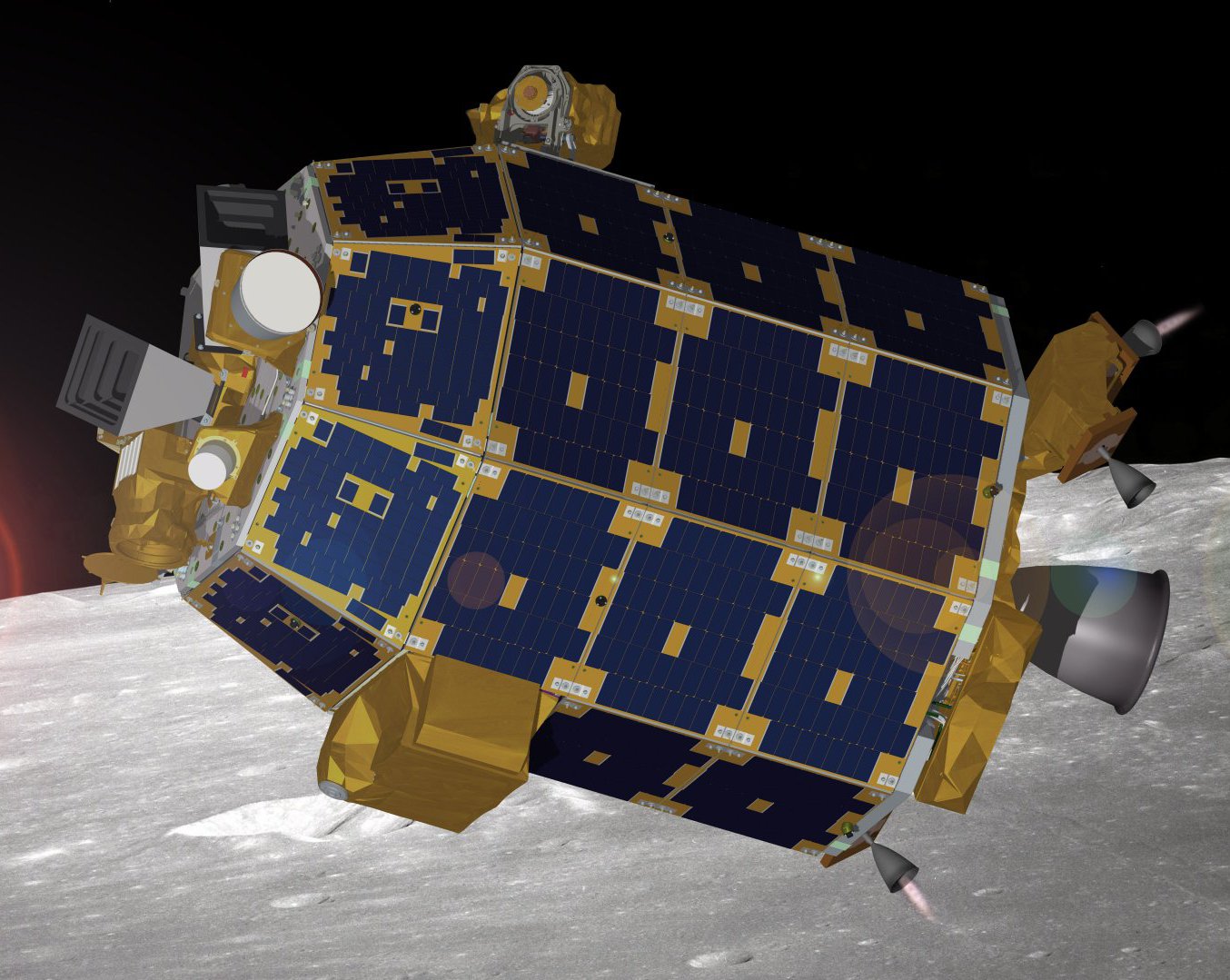
The Lunar Atmosphere and Dust Environment Explorer (LADEE; /ˈlædi/) was a NASA lunar exploration and technology demonstration mission. It was launched on a Minotaur V rocket from the Mid-Atlantic Regional Spaceport on September 7, 2013. During its seven-month mission, LADEE orbited the Moon's equator, using its instruments to study the lunar exosphere and dust in the Moon's vicinity. Instruments included a dust detector, neutral mass spectrometer, and ultraviolet-visible spectrometer, as well as a technology demonstration consisting of a laser communications terminal. The mission ended on April 18, 2014, when the spacecraft's controllers intentionally crashed LADEE into the far side of the Moon, which, later, was determined to be near the eastern rim of Sundman V crater.
LADEE was announced during the presentation of NASA's FY09 budget in February 2008. It was initially planned to be launched with the Gravity Recovery and Interior Laboratory (GRAIL) satellites.
Mechanical tests including acoustic, vibration and shock tests were completed prior to full-scale thermal vacuum chamber testing at NASA's Ames Research Center in April 2013. During August 2013, LADEE underwent final balancing, fuelling and mounting on the launcher, and all pre-launch activities were complete by August 31, ready for the launch window which opened on September 6.
NASA Ames was responsible for the day-to-day functions of LADEE while the Goddard Space Flight Center operated the sensor suite and technology demonstration payloads as well as managing launch operations. The LADEE mission cost approximately $280 million, which included spacecraft development and science instruments, launch services, mission operations, science processing and relay support.
The Moon may have a tenuous atmosphere of moving particles constantly leaping up from and falling back to the Moon's surface, giving rise to a "dust atmosphere" that looks static but is composed of dust particles in constant motion. According to models proposed starting from 1956, on the daylit side of the Moon, solar ultraviolet and X-ray radiation is energetic enough to knock electrons out of atoms and molecules in the lunar soil. Positive charges build up until the tiniest particles of lunar dust (measuring 1 micrometre and smaller) are repelled from the surface and lofted anywhere from metres to kilometres high, with the smallest particles reaching the highest altitudes. Eventually they fall back toward the surface where the process is repeated. On the night side, the dust is negatively charged by electrons in the solar wind. Indeed, the "fountain model" suggests that the night side would charge up to higher voltages than the day side, possibly launching dust particles to higher velocities and altitudes. This effect could be further enhanced during the portion of the Moon's orbit where it passes through Earth's magnetotail; see Magnetic field of the Moon for more detail. On the terminator there could be significant horizontal electric fields forming between the day and night areas, resulting in horizontal dust transport.
Also, the Moon has been shown to have a "sodium tail" too faint to be detected by the human eye. It is hundreds of thousands of miles long, and was discovered in 1998 as a result of Boston University scientists observing the Leonid meteor storm. The Moon is constantly releasing atomic sodium gas from its surface, and solar radiation pressure accelerates the sodium atoms in the anti-sunward direction, forming an elongated tail which points away from the Sun. As of April 2013, it had not yet been determined whether ionized sodium gas atoms or charged dust are the cause of the reported Moon glows.
China's Chang'e 3 spacecraft, which was launched on December 1, 2013, and entered lunar orbit on December 6, was expected to contaminate the tenuous lunar exosphere with both propellant from engine firings and lunar dust from the vehicle's landing. While concern was expressed that this could disrupt LADEE's mission, such as its baseline readings of the Moon's exosphere, it instead provided additional science value since both the quantity and composition of the spacecraft's propulsion system exhaust were known. Data from LADEE was used to track the distribution and eventual dissipation of the exhaust and dust in the Moon's exosphere. It was also possible to observe the migration of water, one component of the exhaust, giving insight on how it is transported and becomes trapped around the lunar poles.
The LADEE mission was designed to address three major science goals:
Hub AI
LADEE AI simulator
(@LADEE_simulator)
LADEE
The Lunar Atmosphere and Dust Environment Explorer (LADEE; /ˈlædi/) was a NASA lunar exploration and technology demonstration mission. It was launched on a Minotaur V rocket from the Mid-Atlantic Regional Spaceport on September 7, 2013. During its seven-month mission, LADEE orbited the Moon's equator, using its instruments to study the lunar exosphere and dust in the Moon's vicinity. Instruments included a dust detector, neutral mass spectrometer, and ultraviolet-visible spectrometer, as well as a technology demonstration consisting of a laser communications terminal. The mission ended on April 18, 2014, when the spacecraft's controllers intentionally crashed LADEE into the far side of the Moon, which, later, was determined to be near the eastern rim of Sundman V crater.
LADEE was announced during the presentation of NASA's FY09 budget in February 2008. It was initially planned to be launched with the Gravity Recovery and Interior Laboratory (GRAIL) satellites.
Mechanical tests including acoustic, vibration and shock tests were completed prior to full-scale thermal vacuum chamber testing at NASA's Ames Research Center in April 2013. During August 2013, LADEE underwent final balancing, fuelling and mounting on the launcher, and all pre-launch activities were complete by August 31, ready for the launch window which opened on September 6.
NASA Ames was responsible for the day-to-day functions of LADEE while the Goddard Space Flight Center operated the sensor suite and technology demonstration payloads as well as managing launch operations. The LADEE mission cost approximately $280 million, which included spacecraft development and science instruments, launch services, mission operations, science processing and relay support.
The Moon may have a tenuous atmosphere of moving particles constantly leaping up from and falling back to the Moon's surface, giving rise to a "dust atmosphere" that looks static but is composed of dust particles in constant motion. According to models proposed starting from 1956, on the daylit side of the Moon, solar ultraviolet and X-ray radiation is energetic enough to knock electrons out of atoms and molecules in the lunar soil. Positive charges build up until the tiniest particles of lunar dust (measuring 1 micrometre and smaller) are repelled from the surface and lofted anywhere from metres to kilometres high, with the smallest particles reaching the highest altitudes. Eventually they fall back toward the surface where the process is repeated. On the night side, the dust is negatively charged by electrons in the solar wind. Indeed, the "fountain model" suggests that the night side would charge up to higher voltages than the day side, possibly launching dust particles to higher velocities and altitudes. This effect could be further enhanced during the portion of the Moon's orbit where it passes through Earth's magnetotail; see Magnetic field of the Moon for more detail. On the terminator there could be significant horizontal electric fields forming between the day and night areas, resulting in horizontal dust transport.
Also, the Moon has been shown to have a "sodium tail" too faint to be detected by the human eye. It is hundreds of thousands of miles long, and was discovered in 1998 as a result of Boston University scientists observing the Leonid meteor storm. The Moon is constantly releasing atomic sodium gas from its surface, and solar radiation pressure accelerates the sodium atoms in the anti-sunward direction, forming an elongated tail which points away from the Sun. As of April 2013, it had not yet been determined whether ionized sodium gas atoms or charged dust are the cause of the reported Moon glows.
China's Chang'e 3 spacecraft, which was launched on December 1, 2013, and entered lunar orbit on December 6, was expected to contaminate the tenuous lunar exosphere with both propellant from engine firings and lunar dust from the vehicle's landing. While concern was expressed that this could disrupt LADEE's mission, such as its baseline readings of the Moon's exosphere, it instead provided additional science value since both the quantity and composition of the spacecraft's propulsion system exhaust were known. Data from LADEE was used to track the distribution and eventual dissipation of the exhaust and dust in the Moon's exosphere. It was also possible to observe the migration of water, one component of the exhaust, giving insight on how it is transported and becomes trapped around the lunar poles.
The LADEE mission was designed to address three major science goals: