



Community hub
Recent from talks
Contribute something
Nothing was collected or created yet.
Linear-feedback shift register
View on Wikipedia
 | This article needs additional citations for verification. (March 2009) |
In computing, a linear-feedback shift register (LFSR) is a shift register whose input bit is a linear function of its previous state.
The most commonly used linear function of single bits is exclusive-or (XOR). Thus, an LFSR is most often a shift register whose input bit is driven by the XOR of some bits of the overall shift register value.
The initial value of the LFSR is called the seed, and because the operation of the register is deterministic, the stream of values produced by the register is completely determined by its current (or previous) state. Likewise, because the register has a finite number of possible states, it must eventually enter a repeating cycle. However, an LFSR with a well-chosen feedback function can produce a sequence of bits that appears random and has a very long cycle.
Applications of LFSRs include generating pseudo-random numbers, pseudo-noise sequences, fast digital counters, and whitening sequences. Both hardware and software implementations of LFSRs are common.
The mathematics of a cyclic redundancy check, used to provide a quick check against transmission errors, are closely related to those of an LFSR.[1] In general, the arithmetics behind LFSRs makes them very elegant as an object to study and implement. One can produce relatively complex logics with simple building blocks. However, other methods, that are less elegant but perform better, should be considered as well.
Fibonacci LFSRs
[edit]
The bit positions that affect the next state are called the taps. In the diagram the taps are [16,14,13,11]. The rightmost bit of the LFSR is called the output bit, which is always also a tap. To obtain the next state, the tap bits are XOR-ed sequentially; then, all bits are shifted one place to the right, with the rightmost bit being discarded, and that result of XOR-ing the tap bits is fed back into the now-vacant leftmost bit. To obtain the pseudorandom output stream, read the rightmost bit after each state transition.
- A maximum-length LFSR produces an m-sequence (i.e., it cycles through all possible 2m − 1 states within the shift register except the state where all bits are zero), unless it contains all zeros, in which case it will never change.
- As an alternative to the XOR-based feedback in an LFSR, one can also use XNOR.[2] This function is an affine map, not strictly a linear map, but it results in an equivalent polynomial counter whose state is the complement of the state of an LFSR. A state with all ones is illegal when using an XNOR feedback, in the same way as a state with all zeroes is illegal when using XOR. This state is considered illegal because the counter would remain "locked-up" in this state. This method can be advantageous in hardware LFSRs using flip-flops that start in a zero state, as it does not start in a lockup state, meaning that the register does not need to be seeded in order to begin operation.
The sequence of numbers generated by an LFSR or its XNOR counterpart can be considered a binary numeral system just as valid as Gray code or the natural binary code.
The arrangement of taps for feedback in an LFSR can be expressed in finite field arithmetic as a polynomial mod 2. This means that the coefficients of the polynomial must be 1s or 0s. This is called the feedback polynomial or reciprocal characteristic polynomial. For example, if the taps are at the 16th, 14th, 13th and 11th bits (as shown), the feedback polynomial is

The "one" in the polynomial does not correspond to a tap – it corresponds to the input to the first bit (i.e. x0, which is equivalent to 1). The powers of the terms represent the tapped bits, counting from the left. The first and last bits are always connected as an input and output tap respectively.
The LFSR is maximal-length if and only if the corresponding feedback polynomial is primitive over the Galois field GF(2).[3][4] This means that the following conditions are necessary (but not sufficient):
- The number of taps is even.
- The set of taps is setwise co-prime; i.e., there must be no divisor other than 1 common to all taps.
Tables of primitive polynomials from which maximum-length LFSRs can be constructed are given below and in the references.
There can be more than one maximum-length tap sequence for a given LFSR length. Also, once one maximum-length tap sequence has been found, another automatically follows. If the tap sequence in an n-bit LFSR is [n, A, B, C, 0], where the 0 corresponds to the x0 = 1 term, then the corresponding "mirror" sequence is [n, n − C, n − B, n − A, 0]. So the tap sequence [32, 22, 2, 1, 0] has as its counterpart [32, 31, 30, 10, 0]. Both give a maximum-length sequence.
An example in C is below:
#include <stdint.h>
unsigned lfsr_fib(void)
{
    uint16_t start_state = 0xACE1u;  /* Any nonzero start state will work. */
    uint16_t lfsr = start_state;
    uint16_t bit;                    /* Must be 16-bit to allow bit<<15 later in the code */
    unsigned period = 0;

    do
    {   /* taps: 16 14 13 11; feedback polynomial: x^16 + x^14 + x^13 + x^11 + 1 */
        bit = ((lfsr >> 0) ^ (lfsr >> 2) ^ (lfsr >> 3) ^ (lfsr >> 5)) & 1u;
        lfsr = (lfsr >> 1) | (bit << 15);
        ++period;
    }
    while (lfsr != start_state);

    return period;
}
If a fast parity or popcount operation is available, the feedback bit can be computed more efficiently as the dot product of the register with the characteristic polynomial:
bit = parity(lfsr & 0x002Du);, or equivalentlybit = popcnt(lfsr & 0x002Du) /* & 1u */;. (The& 1uturns the popcnt into a true parity function, but the bitshift laterbit << 15makes higher bits irrelevant.)
If a rotation operation is available, the new state can be computed as
lfsr = rotateright((lfsr & ~1u) | (bit & 1u), 1);, or equivalentlylfsr = rotateright(((bit ^ lfsr) & 1u) ^ lfsr, 1);
This LFSR configuration is also known as standard, many-to-one or external XOR gates. The alternative Galois configuration is described in the next section.
Example in Python
[edit]A sample python implementation of a similar (16 bit taps at [16,15,13,4]) Fibonacci LFSR would be
start_state = 1 << 15 | 1
lfsr = start_state
period = 0

while True:
    # taps: 16 15 13 4; feedback polynomial: x^16 + x^15 + x^13 + x^4 + 1
    bit = (lfsr ^ (lfsr >> 1) ^ (lfsr >> 3) ^ (lfsr >> 12)) & 1
    lfsr = (lfsr >> 1) | (bit << 15)
    period += 1
    if lfsr == start_state:
        print(period)
        break
Where a register of 16 bits is used and the xor tap at the fourth, 13th, 15th and sixteenth bit establishes a maximum sequence length.
Galois LFSRs
[edit]
Named after the French mathematician Évariste Galois, an LFSR in Galois configuration, which is also known as modular, internal XORs, or one-to-many LFSR, is an alternate structure that can generate the same output stream as a conventional LFSR (but offset in time).[5] In the Galois configuration, when the system is clocked, bits that are not taps are shifted one position to the right unchanged. The taps, on the other hand, are XORed with the output bit before they are stored in the next position. The new output bit is the next input bit. The effect of this is that when the output bit is zero, all the bits in the register shift to the right unchanged, and the input bit becomes zero. When the output bit is one, the bits in the tap positions all flip (if they are 0, they become 1, and if they are 1, they become 0), and then the entire register is shifted to the right and the input bit becomes 1.
To generate the same output stream, the order of the taps is the counterpart (see above) of the order for the conventional LFSR, otherwise the stream will be in reverse. Note that the internal state of the LFSR is not necessarily the same. The Galois register shown has the same output stream as the Fibonacci register in the first section. A time offset exists between the streams, so a different startpoint will be needed to get the same output each cycle.
- Galois LFSRs do not concatenate every tap to produce the new input (the XORing is done within the LFSR, and no XOR gates are run in serial, therefore the propagation times are reduced to that of one XOR rather than a whole chain), thus it is possible for each tap to be computed in parallel, increasing the speed of execution.
- In a software implementation of an LFSR, the Galois form is more efficient, as the XOR operations can be implemented a word at a time: only the output bit must be examined individually.
Below is a C code example for the 16-bit maximal-period Galois LFSR example in the figure:
#include <stdint.h>
unsigned lfsr_galois(void)
{
    uint16_t start_state = 0xACE1u;  /* Any nonzero start state will work. */
    uint16_t lfsr = start_state;
    unsigned period = 0;

    do
    {
#ifndef LEFT
        unsigned lsb = lfsr & 1u;  /* Get LSB (i.e., the output bit). */
        lfsr >>= 1;                /* Shift register */
        if (lsb)                   /* If the output bit is 1, */
            lfsr ^= 0xB400u;       /*  apply toggle mask. */
#else
        unsigned msb = (int16_t) lfsr < 0;   /* Get MSB (i.e., the output bit). */
        lfsr <<= 1;                          /* Shift register */
        if (msb)                             /* If the output bit is 1, */
            lfsr ^= 0x002Du;                 /*  apply toggle mask. */
#endif
        ++period;
    }
    while (lfsr != start_state);

    return period;
}
The branch if (lsb) lfsr ^= 0xB400u;can also be written as lfsr ^= (-lsb) & 0xB400u; which may produce more efficient code on some compilers. In addition, the left-shifting variant may produce even better code, as the msb is the carry from the addition of lfsr to itself.
Galois LFSR parallel computation
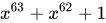
[edit]State and resulting bits can also be combined and computed in parallel. The following function calculates the next 64 bits using the 63-bit polynomial :
#include <stdint.h>

uint64_t prsg63(uint64_t lfsr) {
    lfsr = lfsr << 32 | (lfsr<<1 ^ lfsr<<2) >> 32;
    lfsr = lfsr << 32 | (lfsr<<1 ^ lfsr<<2) >> 32;
    return lfsr;
}
Non-binary Galois LFSR
[edit]Binary Galois LFSRs like the ones shown above can be generalized to any q-ary alphabet {0, 1, ..., q − 1} (e.g., for binary, q = 2, and the alphabet is simply {0, 1}). In this case, the exclusive-or component is generalized to addition modulo-q (note that XOR is addition modulo 2), and the feedback bit (output bit) is multiplied (modulo-q) by a q-ary value, which is constant for each specific tap point. Note that this is also a generalization of the binary case, where the feedback is multiplied by either 0 (no feedback, i.e., no tap) or 1 (feedback is present). Given an appropriate tap configuration, such LFSRs can be used to generate Galois fields for arbitrary prime values of q.
Xorshift LFSRs
[edit]As shown by George Marsaglia[6] and further analysed by Richard P. Brent,[7] linear feedback shift registers can be implemented using XOR and Shift operations. This approach lends itself to fast execution in software because these operations typically map efficiently into modern processor instructions.
Below is a C code example for a 16-bit maximal-period Xorshift LFSR using the 7,9,13 triplet from John Metcalf:[8]
#include <stdint.h>
unsigned lfsr_xorshift(void)
{
    uint16_t start_state = 0xACE1u;  /* Any nonzero start state will work. */
    uint16_t lfsr = start_state;
    unsigned period = 0;

    do
    {   // 7,9,13 triplet from http://www.retroprogramming.com/2017/07/xorshift-pseudorandom-numbers-in-z80.html
        lfsr ^= lfsr >> 7;
        lfsr ^= lfsr << 9;
        lfsr ^= lfsr >> 13;
        ++period;
    }
    while (lfsr != start_state);

    return period;
}
Matrix forms
[edit]Binary LFSRs of both Fibonacci and Galois configurations can be expressed as linear functions using matrices in (see GF(2)).[9] Using the companion matrix of the characteristic polynomial of the LFSR and denoting the seed as a column vector , the state of the register in Fibonacci configuration after steps is given by



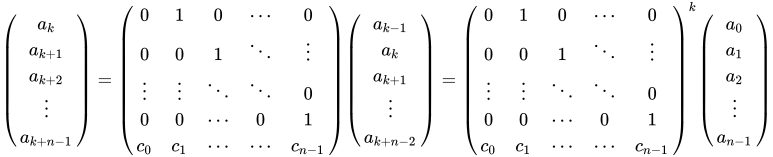
Matrix for the corresponding Galois form is :

For a suitable initialisation,
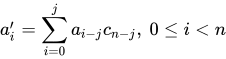
the top coefficient of the column vector :

gives the term ak of the original sequence.
These forms generalize naturally to arbitrary fields.
Example polynomials for maximal LFSRs
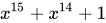
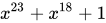
[edit]The following table lists examples of maximal-length feedback polynomials (primitive polynomials) for shift-register lengths up to 24. The formalism for maximum-length LFSRs was developed by Solomon W. Golomb in his 1967 book.[10] The number of different primitive polynomials grows exponentially with shift-register length and can be calculated exactly using Euler's totient function[11] (sequence A011260 in the OEIS).
| Bits (n) | Feedback polynomial | Taps | Taps (hex) | Period () |
|---|---|---|---|---|
| 2 | 11 | 0x3 | 3 | |
| 3 | 110 | 0x6 | 7 | |
| 4 | 1100 | 0xC | 15 | |
| 5 | 10100 | 0x14 | 31 | |
| 6 | 110000 | 0x30 | 63 | |
| 7 | 1100000 | 0x60 | 127 | |
| 8 | 10111000 | 0xB8 | 255 | |
| 9 | 100010000 | 0x110 | 511 | |
| 10 | 1001000000 | 0x240 | 1,023 | |
| 11 | 10100000000 | 0x500 | 2,047 | |
| 12 | 111000001000 | 0xE08 | 4,095 | |
| 13 | 1110010000000 | 0x1C80 | 8,191 | |
| 14 | 11100000000010 | 0x3802 | 16,383 | |
| 15 | 110000000000000 | 0x6000 | 32,767 | |
| 16 | 1101000000001000 | 0xD008 | 65,535 | |
| 17 | 10010000000000000 | 0x12000 | 131,071 | |
| 18 | 100000010000000000 | 0x20400 | 262,143 | |
| 19 | 1110010000000000000 | 0x72000 | 524,287 | |
| 20 | 10010000000000000000 | 0x90000 | 1,048,575 | |
| 21 | 101000000000000000000 | 0x140000 | 2,097,151 | |
| 22 | 1100000000000000000000 | 0x300000 | 4,194,303 | |
| 23 | 10000100000000000000000 | 0x420000 | 8,388,607 | |
| 24 | 111000010000000000000000 | 0xE10000 | 16,777,215 |









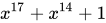
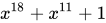


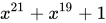
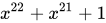

Output-stream properties
[edit]- Ones and zeroes occur in "runs". The output stream 1110010, for example, consists of four runs of lengths 3, 2, 1, 1, in order. In one period of a maximal LFSR, 2n−1 runs occur (in the example above, the 3-bit LFSR has 4 runs). Exactly half of these runs are one bit long, a quarter are two bits long, up to a single run of zeroes n − 1 bits long, and a single run of ones n bits long. This distribution almost equals the statistical expectation value for a truly random sequence. However, the probability of finding exactly this distribution in a sample of a truly random sequence is rather low[vague].
- LFSR output streams are deterministic. If the present state and the positions of the XOR gates in the LFSR are known, the next state can be predicted.[12] This is not possible with truly random events. With maximal-length LFSRs, it is much easier to compute the next state, as there are only an easily limited number of them for each length.
- The output stream is reversible; an LFSR with mirrored taps will cycle through the output sequence in reverse order.
- The value consisting of all zeros cannot appear. Thus an LFSR of length n cannot be used to generate all 2n values.
Applications
[edit]LFSRs can be implemented in hardware, and this makes them useful in applications that require very fast generation of a pseudo-random sequence, such as direct-sequence spread spectrum radio. LFSRs have also been used for generating an approximation of white noise in various programmable sound generators.
Uses as counters
[edit]The repeating sequence of states of an LFSR allows it to be used as a clock divider or as a counter when a non-binary sequence is acceptable, as is often the case where computer index or framing locations need to be machine-readable.[12] LFSR counters have simpler feedback logic than natural binary counters or Gray-code counters, and therefore can operate at higher clock rates. However, it is necessary to ensure that the LFSR never enters a lockup state (all zeros for a XOR based LFSR, and all ones for a XNOR based LFSR), for example by presetting it at start-up to any other state in the sequence. It is possible to count up and down with a LFSR. LFSR have also been used as a Program Counter for CPUs, this requires that the program itself is "scrambled" and it done to save on gates when they are a premium (using fewer gates than an adder) and for speed (as a LFSR does not require a long carry chain).
The table of primitive polynomials shows how LFSRs can be arranged in Fibonacci or Galois form to give maximal periods. One can obtain any other period by adding to an LFSR that has a longer period some logic that shortens the sequence by skipping some states.
Uses in cryptography
[edit]LFSRs have long been used as pseudo-random number generators for use in stream ciphers, due to the ease of construction from simple electromechanical or electronic circuits, long periods, and very uniformly distributed output streams. However, an LFSR is a linear system, leading to fairly easy cryptanalysis. For example, given a stretch of known plaintext and corresponding ciphertext, an attacker can intercept and recover a stretch of LFSR output stream used in the system described, and from that stretch of the output stream can construct an LFSR of minimal size that simulates the intended receiver by using the Berlekamp-Massey algorithm. This LFSR can then be fed the intercepted stretch of output stream to recover the remaining plaintext.
Three general methods are employed to reduce this problem in LFSR-based stream ciphers:
- Non-linear combination of several bits from the LFSR state;
- Non-linear combination of the output bits of two or more LFSRs (see also: shrinking generator); or using Evolutionary algorithm to introduce non-linearity.[13]
- Irregular clocking of the LFSR, as in the alternating step generator.
Important LFSR-based stream ciphers include A5/1 and A5/2, used in GSM cell phones, E0, used in Bluetooth, and the shrinking generator. The A5/2 cipher has been broken and both A5/1 and E0 have serious weaknesses.[14][15]
The linear feedback shift register has a strong relationship to linear congruential generators.[16]
Uses in circuit testing
[edit] | This section needs additional citations for verification. (November 2022) |
LFSRs are used in circuit testing for test-pattern generation (for exhaustive testing, pseudo-random testing or pseudo-exhaustive testing) and for signature analysis.
Test-pattern generation
[edit]Complete LFSR are commonly used as pattern generators for exhaustive testing, since they cover all possible inputs for an n-input circuit. Maximal-length LFSRs and weighted LFSRs are widely used as pseudo-random test-pattern generators for pseudo-random test applications.
Signature analysis
[edit]In built-in self-test (BIST) techniques, storing all the circuit outputs on chip is not possible, but the circuit output can be compressed to form a signature that will later be compared to the golden signature (of the good circuit) to detect faults. Since this compression is lossy, there is always a possibility that a faulty output also generates the same signature as the golden signature and the faults cannot be detected. This condition is called error masking or aliasing. BIST is accomplished with a multiple-input signature register (MISR or MSR), which is a type of LFSR. A standard LFSR has a single XOR or XNOR gate, where the input of the gate is connected to several "taps" and the output is connected to the input of the first flip-flop. A MISR has the same structure, but the input to every flip-flop is fed through an XOR/XNOR gate. For example, a 4-bit MISR has a 4-bit parallel output and a 4-bit parallel input. The input of the first flip-flop is XOR/XNORd with parallel input bit zero and the "taps". Every other flip-flop input is XOR/XNORd with the preceding flip-flop output and the corresponding parallel input bit. Consequently, the next state of the MISR depends on the last several states opposed to just the current state. Therefore, a MISR will always generate the same golden signature given that the input sequence is the same every time. Recent applications[17] are proposing set-reset flip-flops as "taps" of the LFSR. This allows the BIST system to optimise storage, since set-reset flip-flops can save the initial seed to generate the whole stream of bits from the LFSR. Nevertheless, this requires changes in the architecture of BIST, is an option for specific applications.
Uses in digital broadcasting and communications
[edit]Scrambling
[edit]To prevent short repeating sequences (e.g., runs of 0s or 1s) from forming spectral lines that may complicate symbol tracking at the receiver or interfere with other transmissions, the data bit sequence is combined with the output of a linear-feedback register before modulation and transmission. This scrambling is removed at the receiver after demodulation. When the LFSR runs at the same bit rate as the transmitted symbol stream, this technique is referred to as scrambling. When the LFSR runs considerably faster than the symbol stream, the LFSR-generated bit sequence is called chipping code. The chipping code is combined with the data using exclusive or before transmitting using binary phase-shift keying or a similar modulation method. The resulting signal has a higher bandwidth than the data, and therefore this is a method of spread-spectrum communication. When used only for the spread-spectrum property, this technique is called direct-sequence spread spectrum; when used to distinguish several signals transmitted in the same channel at the same time and frequency, it is called code-division multiple access.
Neither scheme should be confused with encryption or encipherment; scrambling and spreading with LFSRs do not protect the information from eavesdropping. They are instead used to produce equivalent streams that possess convenient engineering properties to allow robust and efficient modulation and demodulation.
Digital broadcasting systems that use linear-feedback registers:
- ATSC Standards (digital TV transmission system – North America)
- DAB (Digital Audio Broadcasting system – for radio)
- DVB-T (digital TV transmission system – Europe, Australia, parts of Asia)
- NICAM (digital audio system for television)
Other digital communications systems using LFSRs:
- Intelsat business service (IBS)
- Intermediate data rate (IDR)
- HDMI 2.0
- SDI (Serial Digital Interface transmission)
- Data transfer over PSTN (according to the ITU-T V-series recommendations)
- CDMA (Code Division Multiple Access) cellular telephony
- 100BASE-T2 "fast" Ethernet scrambles bits using an LFSR
- 1000BASE-T Ethernet, the most common form of Gigabit Ethernet, scrambles bits using an LFSR
- PCI Express
- SATA[18]
- Serial Attached SCSI (SAS/SPL)
- USB 3.0
- IEEE 802.11a scrambles bits using an LFSR
- Bluetooth Low Energy Link Layer is making use of LFSR (referred to as whitening)
- Satellite navigation systems such as GPS and GLONASS. All current systems use LFSR outputs to generate some or all of their ranging codes (as the chipping code for CDMA or DSSS) or to modulate the carrier without data (like GPS L2 CL ranging code). GLONASS also uses frequency-division multiple access combined with DSSS.
Other uses
[edit]LFSRs are also used in radio jamming systems to generate pseudo-random noise to raise the noise floor of a target communication system.
The German time signal DCF77, in addition to amplitude keying, employs phase-shift keying driven by a 9-stage LFSR to increase the accuracy of received time and the robustness of the data stream in the presence of noise.[19]
See also
[edit]References
[edit]- ^ Geremia, Patrick. "Cyclic Redundancy Check Computation: An Implementation Using the TMS320C54x" (PDF). Texas Instruments. p. 6. Retrieved October 16, 2016.
- ^ Linear Feedback Shift Registers in Virtex Devices
- ^ Gentle, James E. (2003). Random number generation and Monte Carlo methods (2nd ed.). New York: Springer. p. 38. ISBN 0-387-00178-6. OCLC 51534945.
- ^ Tausworthe, Robert C. (April 1965). "Random Numbers Generated by Linear Recurrence Modulo Two" (PDF). Mathematics of Computation. 19 (90): 201–209. doi:10.1090/S0025-5718-1965-0184406-1. S2CID 120804149.
- ^ Press, William; Teukolsky, Saul; Vetterling, William; Flannery, Brian (2007). Numerical Recipes: The Art of Scientific Computing, Third Edition. Cambridge University Press. p. 386. ISBN 978-0-521-88407-5.
- ^ Marsaglia, George (July 2003). "Xorshift RNGs". Journal of Statistical Software. 8 (14). doi:10.18637/jss.v008.i14.
- ^ Brent, Richard P. (August 2004). "Note on Marsaglia's Xorshift Random Number Generators". Journal of Statistical Software. 11 (5). doi:10.18637/jss.v011.i05. hdl:1885/34049.
- ^ Metcalf, John (22 July 2017). "16-Bit Xorshift Pseudorandom Numbers in Z80 Assembly". Retro Programming. Retrieved 5 January 2022.
- ^ Klein, A. (2013). "Linear Feedback Shift Registers". Stream Ciphers. London: Springer. pp. 17–18. doi:10.1007/978-1-4471-5079-4_2. ISBN 978-1-4471-5079-4.
- ^ Golomb, Solomon W. (1967). Shift register sequences. Laguna Hills, Calif.: Aegean Park Press. ISBN 978-0894120480.
- ^ Weisstein, Eric W. "Primitive Polynomial". mathworld.wolfram.com. Retrieved 2021-04-27.
- ^ a b Alfke, Peter (July 7, 1996). "Efficient Shift Registers, LFSR Counters, and Long Pseudo-Random Sequence Generators" (PDF). Xilinx Application Notes, XAPP 052. AMD Technical Information Portal.
- ^ A. Poorghanad, A. Sadr, A. Kashanipour" Generating High Quality Pseudo Random Number Using Evolutionary Methods", IEEE Congress on Computational Intelligence and Security, vol. 9, pp. 331-335, May, 2008 [1]
- ^ Barkam, Elad; Biham, Eli; Keller, Nathan (2008), "Instant Ciphertext-Only Cryptanalysis of GSM Encrypted Communication" (PDF), Journal of Cryptology, 21 (3): 392–429, doi:10.1007/s00145-007-9001-y, S2CID 459117, archived from the original (PDF) on 2020-01-25, retrieved 2019-09-15
- ^ Lu, Yi; Willi Meier; Serge Vaudenay (2005). "The Conditional Correlation Attack: A Practical Attack on Bluetooth Encryption". Advances in Cryptology – CRYPTO 2005. Lecture Notes in Computer Science. Vol. 3621. Santa Barbara, California, USA. pp. 97–117. CiteSeerX 10.1.1.323.9416. doi:10.1007/11535218_7. ISBN 978-3-540-28114-6.
{{cite book}}: CS1 maint: location missing publisher (link) - ^ RFC 4086 section 6.1.3 "Traditional Pseudo-random Sequences"
- ^ Martínez LH, Khursheed S, Reddy SM. LFSR generation for high test coverage and low hardware overhead. IET Computers & Digital Techniques. 2019 Aug 21.UoL repository
- ^ Section 9.5 of the SATA Specification, revision 2.6
- ^ Hetzel, P. (16 March 1988). Time dissemination via the LF transmitter DCF77 using a pseudo-random phase-shift keying of the carrier (PDF). 2nd European Frequency and Time Forum. Neuchâtel. pp. 351–364. Retrieved 11 October 2011.
Further reading
[edit]- https://web.archive.org/web/20161007061934/http://courses.cse.tamu.edu/csce680/walker/lfsr_table.pdf
- http://users.ece.cmu.edu/~koopman/lfsr/index.html — Tables of maximum length feedback polynomials for 2-64 bits.
- https://github.com/hayguen/mlpolygen — Code for generating maximal length feedback polynomials
External links
[edit]- Linear Feedback Shift Registers at the Wayback Machine (archived October 1, 2018) – LFSR theory and implementation, maximal length sequences, and comprehensive feedback tables for lengths from 7 to 16,777,215 (3 to 24 stages), and partial tables for lengths up to 4,294,967,295 (25 to 32 stages).
- International Telecommunication Union Recommendation O.151 (August 1992)
- Maximal Length LFSR table with length from 2 to 67.
- Pseudo-Random Number Generation Routine for the MAX765x Microprocessor
- http://www.ece.ualberta.ca/~elliott/ee552/studentAppNotes/1999f/Drivers_Ed/lfsr.html
- http://www.quadibloc.com/crypto/co040801.htm
- Simple explanation of LFSRs for Engineers
- Feedback terms
- General LFSR Theory
- An implementation of LFSR in VHDL.
- Simple VHDL coding for Galois and Fibonacci LFSR.
- mlpolygen: A Maximal Length polynomial generator Archived 2018-08-20 at the Wayback Machine
Linear-feedback shift register
View on GrokipediaFundamentals
Definition and Basic Operation
A linear-feedback shift register (LFSR) is a shift register whose input bit is a linear function of its previous state, typically implemented using exclusive-OR (XOR) operations on selected bits known as taps.[2] This structure produces a sequence of output bits that follows a linear recurrence relation and can exhibit pseudo-random properties when appropriately configured.[8] The basic components of an LFSR consist of a chain of flip-flops or memory cells connected in series to form the register stages, along with combinational logic—usually XOR gates—connected to specific tap positions that provide feedback to the input of the first stage.[4] The number of stages determines the length of the register, denoted as n bits, and the tap positions define the feedback polynomial that governs the sequence generation. In operation, the LFSR advances on each clock cycle by shifting all bits in one direction (commonly to the right), with the bit shifted out serving as the output, and a new input bit computed as the XOR of the designated tap bits from the current state being inserted at the opposite end.[8] This process maintains the linear recurrence, ensuring the state evolves deterministically yet appears unpredictable for non-trivial initial conditions and tap selections. For illustration, consider a basic 4-bit Fibonacci-style LFSR with taps on positions 3 and 4 (numbering positions 1 to 4 from left to right, corresponding to the primitive polynomial ), shifting right with feedback to the leftmost bit. The feedback is the XOR of bits in positions 3 and 4. Starting from initial state 1000:| Clock Cycle | State (bits 1-4) | Feedback (bit3 XOR bit4) | Output (bit4 before shift) |
|---|---|---|---|
| 0 (initial) | 1 0 0 0 | - | - |
| 1 | 0 1 0 0 | 0 XOR 0 = 0 | 0 |
| 2 | 0 0 1 0 | 0 XOR 0 = 0 | 0 |
| 3 | 1 0 0 1 | 1 XOR 0 = 1 | 0 |
| 4 | 1 1 0 0 | 0 XOR 1 = 1 | 1 |
Historical Development
The linear-feedback shift register (LFSR) originated in the mid-1950s as a tool for generating pseudorandom sequences in early computing applications, particularly for simulating randomness in digital systems using vacuum tube technology.[9] Solomon W. Golomb, while working at the Glenn L. Martin Company, initiated foundational research on shift register sequences in 1954, culminating in his 1955 technical report "Sequences with Randomness Properties," which first systematically described the properties of sequences produced by feedback shift registers over finite fields.[9] This work built on earlier mathematical foundations from the late 1940s, including shift registers in computing hardware and theoretical recurrences explored by figures like Øystein Ore and Marshall Hall, though much of the initial applied development occurred concurrently at institutions such as Bell Labs, Lincoln Lab, and the Jet Propulsion Laboratory (JPL).[9] In the 1960s, the theory of LFSRs was formalized and expanded, with N. Zierler contributing key insights through his 1959 paper "Linear Recurring Sequences," which analyzed the algebraic structure of such sequences and their periods. Golomb further consolidated these ideas in his seminal 1967 book Shift Register Sequences, establishing the mathematical framework for maximum-length LFSRs using primitive polynomials and promoting their use in pseudorandom number generation.[10] During this decade, LFSRs gained traction in error-correcting codes, notably in the decoding algorithms for BCH codes (introduced in 1959–1960) and Reed-Solomon codes (1960), where linear feedback mechanisms enabled efficient syndrome computation and error location.[11] The 1970s marked LFSRs' expansion into cryptography, driven by the recognition that primitive polynomials could produce long-period sequences suitable for stream ciphers, as detailed in works extending Golomb's theories to secure key generation.[12] By the 1980s, LFSRs transitioned to fully digital implementations amid the rise of VLSI technology, influenced by Moore's Law, which allowed for longer registers and integration into built-in self-test (BIST) schemes for chip verification.[13] This era saw widespread adoption in hardware testing, with LFSR-based pattern generators compacting responses for fault detection in complex integrated circuits.[14] Into the 1990s and beyond, LFSRs evolved with digital hardware advancements, remaining relevant through the 2010s in embedded systems and communications. Up to 2025, they continue to play roles in post-quantum cryptography hardware for pseudorandom generation and in FPGA-based implementations for AI accelerators, where efficient randomness supports training algorithms without major architectural shifts.[15][16]Configurations
Fibonacci LFSRs
In the Fibonacci configuration of a linear feedback shift register (LFSR), the feedback path is external to the main shift register chain, with the input bit to the first stage computed as the modulo-2 sum (XOR) of selected tap positions typically taken from the later stages of the register. This arrangement corresponds to the Fibonacci representation of the feedback polynomial, where the taps are determined by the non-zero coefficients of the polynomial excluding the highest-degree term.[17] The structure is particularly suited for generating serial output streams, as the feedback computation occurs outside the primary data path.[18] A standard n-bit Fibonacci LFSR consists of n D flip-flops connected in series, shifting data in one direction (commonly rightward), with the output bit taken from the least significant bit (LSB). The feedback is generated by XORing the bits at positions specified by the primitive feedback polynomial and fed back to the most significant bit (MSB). For example, consider a 4-bit Fibonacci LFSR defined by the primitive polynomial , which corresponds to taps on the LSB (bit 0) and the MSB (bit 3). The schematic features four flip-flops labeled b3 (MSB) to b0 (LSB), with an XOR gate combining b0 and b3 to produce the input for b3 on each clock cycle. This configuration produces a maximal-length sequence of period , cycling through all non-zero states.[18][8] To illustrate state evolution, consider a 3-bit Fibonacci LFSR with the primitive polynomial , corresponding to taps on bit 0 (LSB) and bit 2 (MSB). The register is denoted as [b2, b1, b0], shifting right on each clock (b0 becomes output, b1 shifts to b0, b2 to b1, and new b2 = b2 XOR b0 from previous state). Starting from initial state [0, 0, 1]:- Feedback = 0 XOR 1 = 1; shift right: new state [1, 0, 0]; output = 1
- Feedback = 1 XOR 0 = 1; shift right: new state [1, 1, 0]; output = 0
- Feedback = 1 XOR 0 = 1; shift right: new state [1, 1, 1]; output = 0
- Feedback = 1 XOR 1 = 0; shift right: new state [0, 1, 1]; output = 1
- Feedback = 0 XOR 1 = 1; shift right: new state [1, 0, 1]; output = 1
- Feedback = 1 XOR 1 = 0; shift right: new state [0, 1, 0]; output = 1
- Feedback = 0 XOR 0 = 0; shift right: new state [0, 0, 1]; output = 0 (returns to initial, period 7)
def fibonacci_lfsr(state, taps, num_bits):
    """
    Simulate one shift of a [Fibonacci](/page/Fibonacci) LFSR.
    state: integer representing current register state
    taps: list of tap positions (1-based, including length)
    num_bits: length of the LFSR
    Returns: new state and output bit
    """
    output = (state >> 0) & 1  # LSB as output
    feedback = 0
    for tap in taps:
        feedback ^= (state >> (num_bits - tap)) & 1
    new_state = ((state >> 1) | (feedback << (num_bits - 1))) & ((1 << num_bits) - 1)
    return new_state, output

# Example: 16-bit LFSR with taps for primitive polynomial
num_bits = 16
taps = [16, 14, 13, 11]  # Positions for x^16 + x^14 + x^13 + x^11 + 1
initial_state = 0xACE1  # Non-zero initial state

state = initial_state
sequence = []
for _ in range(20):  # Generate first 20 bits
    state, bit = fibonacci_lfsr(state, taps, num_bits)
    sequence.append(bit)

print("Output sequence:", sequence)  # Example output depends on initial state
def fibonacci_lfsr(state, taps, num_bits):
    """
    Simulate one shift of a [Fibonacci](/page/Fibonacci) LFSR.
    state: integer representing current register state
    taps: list of tap positions (1-based, including length)
    num_bits: length of the LFSR
    Returns: new state and output bit
    """
    output = (state >> 0) & 1  # LSB as output
    feedback = 0
    for tap in taps:
        feedback ^= (state >> (num_bits - tap)) & 1
    new_state = ((state >> 1) | (feedback << (num_bits - 1))) & ((1 << num_bits) - 1)
    return new_state, output

# Example: 16-bit LFSR with taps for primitive polynomial
num_bits = 16
taps = [16, 14, 13, 11]  # Positions for x^16 + x^14 + x^13 + x^11 + 1
initial_state = 0xACE1  # Non-zero initial state

state = initial_state
sequence = []
for _ in range(20):  # Generate first 20 bits
    state, bit = fibonacci_lfsr(state, taps, num_bits)
    sequence.append(bit)

print("Output sequence:", sequence)  # Example output depends on initial state
Galois LFSRs
In the Galois configuration, feedback is applied internally at each tap position through XOR gates integrated into the shift paths of the register, enabling efficient simulation of polynomial division over GF(2). The output bit, shifted out from one end of the register, serves as the feedback signal that is XORed with the bits arriving at the tap locations before they are stored in the subsequent flip-flops. This distributed feedback structure contrasts with external feedback approaches by allowing simultaneous computation across all bits, reducing the critical path length in hardware implementations.[19] A schematic for an n-bit Galois LFSR typically depicts a linear chain of n D-type flip-flops shifting leftward, with the leftmost flip-flop providing the output bit and the rightmost receiving a constant 0 input. XOR gates are inserted in the data paths leading to flip-flops at positions dictated by the nonzero coefficients of the characteristic polynomial (excluding the highest-degree term). For a 4-bit example using the primitive polynomial , the taps are at positions 4 (the output) and 1 (corresponding to the term). The diagram shows flip-flops labeled (left, MSB/output), , , (right, LSB/input), with connections as follows: constant 0 to an XOR gate whose output goes to D, and the other XOR input is Q (feedback); Q to an XOR gate whose output goes to D, and the other XOR input is Q; Q to D directly; Q to D directly. On each clock cycle, non-tap bits shift unchanged, while tap bits are modified by the feedback before shifting.[19] The state evolution in a Galois LFSR proceeds via parallel updates equivalent to multiplying the current state polynomial by modulo the characteristic polynomial. Representing the state as coefficients (where is the constant term), starting from initial state 0001 (polynomial 1):- Next state: → 0010
- Next: → 0100
- Next: → 1000
- Next: → 0011 (shifted coefficients with XOR at tap for the reduction)
- Next: → 0110
Mathematical Formulation
Matrix Representation
The state of a linear-feedback shift register (LFSR) of length is represented as a column vector over the finite field GF(2), where each denotes the bit in the -th position of the register at time step , with as the output bit and as the input bit, and all arithmetic is performed modulo 2.[23] In the Fibonacci configuration, the evolution of the state is modeled as a linear transformation via the companion matrix , an matrix over GF(2). The first rows of implement the shift operation, with 1's on the superdiagonal and 0's elsewhere, while the last row contains the feedback coefficients derived from the taps of the characteristic polynomial, such that a 1 in position indicates a tap at register position .[23][24] The state update equation is , where matrix-vector multiplication is standard over GF(2), and the process begins with an initial nonzero state vector .[23] For a concrete example, consider a 4-bit Fibonacci LFSR with characteristic polynomial , corresponding to feedback taps at positions 0 and 3 (with coefficients , , , ). The companion matrix is Starting with initial state , the next state is computed as This multiplication shifts the bits toward the output (lower indices) and inserts the feedback bit (XOR of and ) at the input end.[23][24] In the Galois configuration, the transition matrix models the distributed feedback, with 1's on the superdiagonal for the shift and feedback coefficients placed in the first column at rows corresponding to the tap positions (reversing the state bit order relative to Fibonacci for equivalence). This achieves the same sequence dynamics as the Fibonacci configuration when accounting for the reversed ordering, with feedback effectively distributed across stages in hardware. For the polynomial and reversed state convention, the matrix is The state update follows , producing equivalent output sequences to the Fibonacci LFSR under the ordering adjustment.[2]Characteristic Polynomials
The characteristic polynomial of a linear-feedback shift register (LFSR) of length is defined as over the finite field GF(2), where each coefficient corresponds to whether a feedback tap is present at position .[4][2] The constant term is always 1, reflecting the inherent feedback from the output bit (position 0), and the polynomial is monic with degree , matching the number of stages in the register.[4][25] In the Fibonacci configuration, the characteristic polynomial directly maps to the feedback taps: the powers of with nonzero coefficients (beyond the leading and constant terms) indicate the positions where the register bits are XORed to form the input to the first stage.[4][23] For the Galois configuration, the polynomial instead specifies the locations of XOR gates distributed along the shift path, each corresponding to a nonzero coefficient (adjusted for ordering), which achieves equivalent linear transformations but with potentially lower gate delay in hardware.[2][23] This polynomial governs the linear recurrence relation satisfied by the output sequence: for , where all operations are modulo 2, ensuring the sequence evolves deterministically from the initial state.[25][23] A representative example is the polynomial for a 5-bit LFSR, which has nonzero coefficients at , , and the constant term, corresponding to taps at positions 0 and 2 (numbering from the output end as position 0).[4][25] In the Fibonacci setup, this means XORing the bits at positions 0 and 2 to feedback into the register. The polynomial must be irreducible over GF(2) to avoid factorizations that would cause the LFSR to enter short cycles prematurely, thereby enabling longer periods up to ; further details on maximality appear in subsequent sections.[2][26][23]Variants and Extensions
Xorshift LFSRs
Xorshift generators, introduced by George Marsaglia in 2003, represent a class of pseudorandom number generators designed for high-speed software implementation on word-sized integers, such as 32-bit or 64-bit values. These generators maintain a state consisting of one or more words and update it through a sequence of bitwise shift and exclusive-or (XOR) operations, avoiding the need for explicit multiplication or division. By leveraging the efficiency of shift and XOR instructions on modern processors, xorshift methods achieve periods up to for state sizes of bits, making them suitable for applications requiring rapid generation of pseudorandom sequences.[27] The operation of a basic xorshift generator proceeds in three distinct steps applied sequentially to the state word. First, the state is XORed with a left-shifted version of itself by a fixed number of bits. Second, this result is XORed with a right-shifted version of the intermediate state. Finally, the output is XORed with another left-shifted version to complete the update. Although this process does not employ a traditional linear feedback mechanism involving taps across the entire register, it effectively implements a linear recurrence relation over the finite field GF(2).[27] A representative example is the 32-bit xorshift generator with shift parameters (13, 17, 5), which produces a maximal period of when seeded appropriately. The update can be expressed in pseudocode as follows:uint32_t xorshift32(uint32_t x) {
x ^= (x << 13);
x ^= (x >> 17);
x ^= (x << 5);
return x;
}
uint32_t xorshift32(uint32_t x) {
    x ^= (x << 13);
    x ^= (x >> 17);
    x ^= (x << 5);
    return x;
}
Non-Binary LFSRs
Linear-feedback shift registers (LFSRs) can be generalized to operate over arbitrary finite fields GF(q), where q = p^m for a prime p and positive integer m, extending the binary case where q = 2. In this non-binary setting, each stage of the register holds a symbol from GF(q) instead of a single bit, and the feedback function is a linear combination of the state symbols with coefficients in GF(q), using the field's addition and multiplication operations. This generalization allows for sequences with alphabet size q and potential periods up to q^n - 1 for an n-stage register, provided the characteristic polynomial is primitive over GF(q).[28][29] The structure of a non-binary LFSR closely resembles the binary Galois configuration, but with field operations replacing bitwise XOR and AND. In the Galois form, the register shifts symbols toward the output end, and the outgoing symbol is multiplied by the tap coefficients from the characteristic polynomial and added (in GF(q)) to the corresponding stages. For a degree-n primitive polynomial c(x) = x^n + c_{n-1} x^{n-1} + \cdots + c_1 x + c_0 over GF(q), the feedback from the output symbol s_0 is added to stage i after multiplication by c_i for each tap i. All arithmetic, including addition (which is vector XOR in the basis representation) and multiplication (via tables or composite operations), occurs modulo the field's defining relations.[28][30] Consider a 3-stage LFSR over GF(4), where GF(4) = {0, 1, \alpha, \alpha^2 = \alpha + 1} with \alpha a primitive element satisfying \alpha^3 = 1. Using the primitive polynomial x^3 + x^2 + x + \alpha over GF(4), the state is a vector \mathbf{s} = (s_2, s_1, s_0) \in \mathrm{GF}(4)^3, excluding the all-zero state for maximal period 63. In the Galois configuration (shifting toward s_0 as output), the next state \mathbf{s}' is s'_0 = s_1, s'_1 = s_2 + \alpha \cdot s_0, s'_2 = s_0 + s_0 + s_0 wait no: properly, for c(x) = x^3 + 1 \cdot x^2 + 1 \cdot x + \alpha, the feedbacks are: new input = s_2 + s_1 + \alpha s_0? For Galois, it's multiple taps: the shift is s'_2 = s_1 (input side s_2), but add c_2 s_0 to s'2, add c_1 s_0 to s'1, add c_0 s_0 to s'0? Standard Galois for non-binary is analogous: assuming shift right (s'{i} = s{i+1} for i=0 to n-2, s'{n-1} = sum c_j s_j or something. To correct, the update is governed by the companion matrix: No, for the polynomial x^3 + c_2 x^2 + c_1 x + c_0, the companion matrix is or depending on convention. For illustration, with initial state (0,0,1), the sequence can be computed using field operations at the taps.[31] Non-binary LFSRs find application in coding theory, particularly for encoding and decoding Reed-Solomon codes, where the syndrome computation and error locator polynomials are generated using LFSR-like structures over GF(2^m) to handle symbol errors efficiently. These LFSRs can achieve longer maximal periods than binary counterparts of equivalent bit length, enhancing sequence diversity for such uses. For practical implementation, especially in software, precomputed tables for GF(q) multiplication and inversion are essential to ensure efficiency, as direct computation can be costly for large m.[28][30]Properties
Periodicity and Maximal Length Sequences
The output of a linear-feedback shift register (LFSR) is a periodic binary sequence that repeats every clock cycles, where is the period, defined as the smallest positive integer such that the register state returns to its initial value. For an -stage LFSR over the finite field GF(2), the maximum achievable period is , corresponding to a maximal length sequence, also known as an m-sequence.[2] This length equals the number of non-zero states in the register, ensuring the sequence avoids repetition until all such states are exhausted.[32] The maximum period is attained if and only if the characteristic polynomial of degree is primitive over GF(2), meaning it is irreducible and one of its roots is a primitive element of the field extension GF(), generating the entire multiplicative group of order .[2] With a primitive polynomial and any non-zero initial state, the LFSR produces an m-sequence; the all-zero state, however, results in a constant zero output and is excluded from the cycle, preventing it from being reached or left under linear feedback.[4] Examples of primitive polynomials over GF(2) for small degrees , suitable for constructing maximal-length LFSRs, are listed in the following table (represented in standard form, with taps indicated by the degrees of non-constant terms):| Degree | Primitive Polynomial | Taps (octal notation) |
|---|---|---|
| 3 | 3,1 (0x3) | |
| 4 | 4,1 (0x3) | |
| 5 | 5,2 (0x5) | |
| 6 | 6,1 (0x3) | |
| 7 | 7,1 (0x3) | |
| 8 | 8,6,5,2 (0x69) | |
| 9 | 9,4 (0x9) | |
| 10 | 10,3 (0x13) | |
| 11 | 11,2 (0x15) | |
| 12 | 12,6,4,1 (0x27) | |
| 13 | 13,4,3,1 (0x1B) | |
| 14 | 14,10,6,1 (0x147) | |
| 15 | 15,1 (0x3) | |
| 16 | 16,12,3,1 (0x309) |