


Community hub
Recent from talks
Contribute something to knowledge base
Content stats: 0 posts, 0 articles, 1 media, 0 notes
Members stats: 0 subscribers, 0 contributors, 0 moderators, 0 supporters
Subscribers
Supporters
Contributors
Moderators
Hub AI
Lake Simcoe Junction Railway AI simulator
(@Lake Simcoe Junction Railway_simulator)
Hub AI
Lake Simcoe Junction Railway AI simulator
(@Lake Simcoe Junction Railway_simulator)
Lake Simcoe Junction Railway
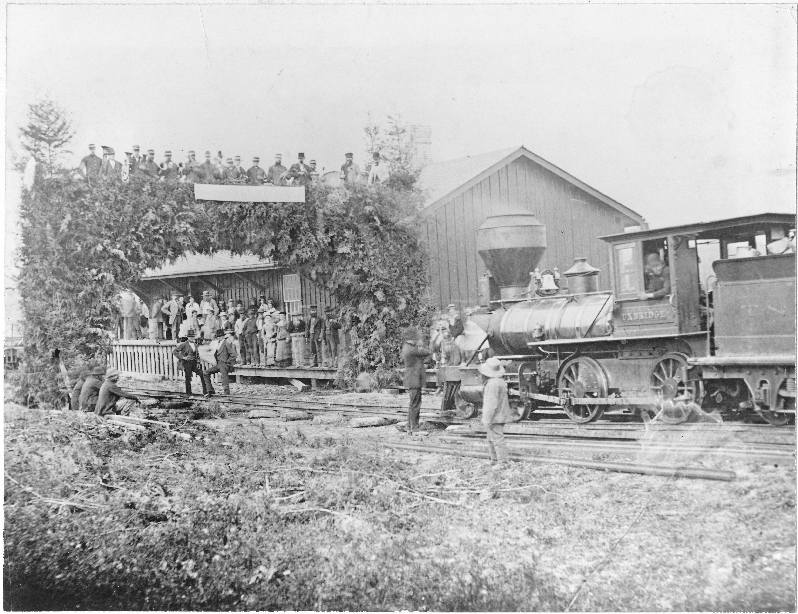
The Lake Simcoe Junction Railway (LSJR) was a short-line narrow gauge railway in Ontario just north of Toronto. It branched off the Toronto and Nipissing Railway at Stouffville and ran 42 kilometres (26 miles) north to the town of Sutton and then beyond to the shore of Lake Simcoe where a large wharf was built. The presence of the railway helped the town of Jackson's Point form on the lakeside. The line serviced timber and agricultural shipping, but was more widely used for shipping ice cut from the lake in the winter, and allowing weekend day trips to the lake in the summer.
The arrival of the Toronto and York Radial Railway at Sutton in 1908 took most of the summertime passenger business away, and the introduction of refrigeration did the same for the wintertime ice business. Service ended to the Point in September 1927 and the rails were lifted. Service below Sutton continued through a connection to the standard gauge Canadian Northern Railway (CNoR), 4 km (2.5 mi) west of the town of Zephyr. It saw some use during the construction of Maple Leaf Gardens three years later, when a spur line was built to a gravel pit a short distance south of Sutton. The entire line closed in 1979 and the rails were lifted in 1981.
A portion of the original route was converted, circa 2000, into the Sutton-Zephyr Rail Trail.
The late 1800s saw widespread development of railways in southern Ontario as various markets were opened both by the Grand Trunk Railway along Lake Ontario as well as the Trent Canal along the lakes some 150 kilometres (93 mi) north of Toronto. A variety of lines linking points on between the two sprung up, looking to cut the route to Toronto as short as possible. None of the lines ran directly to Lake Simcoe, some 65 kilometres (40 mi) directly north, and the closest approach so far was made by the Port Whitby and Port Perry Railway, only 60 kilometres (37 mi) from Toronto but further along the Canal and a much longer route overall.
Plans to reach Lake Simcoe were greatly aided by the construction of the Toronto and Nipissing (T&N) that was aiming ultimately to run around the eastern side of the lake towards the interprovincial lines outside of North Bay, far to the north. The T&N reached Stouffville in 1871 and pushed on a few more miles to Uxbridge by the end of the year. In the early 1870s, businessmen in the Sutton area, about 85 kilometres (53 mi) north of Toronto, began talks with the T&N about a branch line. The Lake Simcoe Junction Railway was chartered on 29 March 1873, with plans to branch off the T&N on the north side of Stouffville and run north for Sutton while the original T&N continued north-east.
The T&N was built by Francis Shanly, a strong supporter of 3 ft 6 in (1,067 mm) gauge railways. Most Ontario railways of that era were built at Provincial gauge, 5 ft 6 in (1,676 mm), because such lines were backed by provincial grants. However, the narrow gauge was far less expensive to build and Shanly had been using it on a growing network of lines in the Toronto area. He agreed to design and build the LSJR for $290,000, and an initial agreement with T&N was signed on 1 December 1874 to provide rolling stock and operate the line for 25 years in exchange for 25% of the receipts, although this was not finally ratified until 19 October 1876. The LSJR would later receive $2,000 per mile from the provincial government in spite of using narrow gauge, about 1⁄5 of the total construction costs.
Shanly surveyed the line in 1875, but construction was delayed by the lack of a final agreement with the T&N. Construction began in early 1877 with grading all the way to Sutton, and the first rail was laid at Stouffville on 18 June 1877. The line was built from 40-pound rail imported from England. The bush cut for the line was stacked and burned, heating nearby rails to the point that the crews would roast crows on them for food. The line was completed and opened for business on 1 October 1877.
The line was mostly served by whistle stops consisting of lean-tos with green flags that would be displayed to call for a stop. A large wharf was built on the lakeshore in 1879, giving rise to the village of Jackson's Point. The main services for the LSJR were summertime passengers visiting the beaches to the west, and a major wintertime service shipping cut ice to Toronto. Early service was often disrupted by livestock wandering onto the lines, and upset farmers would retaliate by spreading lard on the rails on uphill sections.
Lake Simcoe Junction Railway
The Lake Simcoe Junction Railway (LSJR) was a short-line narrow gauge railway in Ontario just north of Toronto. It branched off the Toronto and Nipissing Railway at Stouffville and ran 42 kilometres (26 miles) north to the town of Sutton and then beyond to the shore of Lake Simcoe where a large wharf was built. The presence of the railway helped the town of Jackson's Point form on the lakeside. The line serviced timber and agricultural shipping, but was more widely used for shipping ice cut from the lake in the winter, and allowing weekend day trips to the lake in the summer.
The arrival of the Toronto and York Radial Railway at Sutton in 1908 took most of the summertime passenger business away, and the introduction of refrigeration did the same for the wintertime ice business. Service ended to the Point in September 1927 and the rails were lifted. Service below Sutton continued through a connection to the standard gauge Canadian Northern Railway (CNoR), 4 km (2.5 mi) west of the town of Zephyr. It saw some use during the construction of Maple Leaf Gardens three years later, when a spur line was built to a gravel pit a short distance south of Sutton. The entire line closed in 1979 and the rails were lifted in 1981.
A portion of the original route was converted, circa 2000, into the Sutton-Zephyr Rail Trail.
The late 1800s saw widespread development of railways in southern Ontario as various markets were opened both by the Grand Trunk Railway along Lake Ontario as well as the Trent Canal along the lakes some 150 kilometres (93 mi) north of Toronto. A variety of lines linking points on between the two sprung up, looking to cut the route to Toronto as short as possible. None of the lines ran directly to Lake Simcoe, some 65 kilometres (40 mi) directly north, and the closest approach so far was made by the Port Whitby and Port Perry Railway, only 60 kilometres (37 mi) from Toronto but further along the Canal and a much longer route overall.
Plans to reach Lake Simcoe were greatly aided by the construction of the Toronto and Nipissing (T&N) that was aiming ultimately to run around the eastern side of the lake towards the interprovincial lines outside of North Bay, far to the north. The T&N reached Stouffville in 1871 and pushed on a few more miles to Uxbridge by the end of the year. In the early 1870s, businessmen in the Sutton area, about 85 kilometres (53 mi) north of Toronto, began talks with the T&N about a branch line. The Lake Simcoe Junction Railway was chartered on 29 March 1873, with plans to branch off the T&N on the north side of Stouffville and run north for Sutton while the original T&N continued north-east.
The T&N was built by Francis Shanly, a strong supporter of 3 ft 6 in (1,067 mm) gauge railways. Most Ontario railways of that era were built at Provincial gauge, 5 ft 6 in (1,676 mm), because such lines were backed by provincial grants. However, the narrow gauge was far less expensive to build and Shanly had been using it on a growing network of lines in the Toronto area. He agreed to design and build the LSJR for $290,000, and an initial agreement with T&N was signed on 1 December 1874 to provide rolling stock and operate the line for 25 years in exchange for 25% of the receipts, although this was not finally ratified until 19 October 1876. The LSJR would later receive $2,000 per mile from the provincial government in spite of using narrow gauge, about 1⁄5 of the total construction costs.
Shanly surveyed the line in 1875, but construction was delayed by the lack of a final agreement with the T&N. Construction began in early 1877 with grading all the way to Sutton, and the first rail was laid at Stouffville on 18 June 1877. The line was built from 40-pound rail imported from England. The bush cut for the line was stacked and burned, heating nearby rails to the point that the crews would roast crows on them for food. The line was completed and opened for business on 1 October 1877.
The line was mostly served by whistle stops consisting of lean-tos with green flags that would be displayed to call for a stop. A large wharf was built on the lakeshore in 1879, giving rise to the village of Jackson's Point. The main services for the LSJR were summertime passengers visiting the beaches to the west, and a major wintertime service shipping cut ice to Toronto. Early service was often disrupted by livestock wandering onto the lines, and upset farmers would retaliate by spreading lard on the rails on uphill sections.
Recent media
Recent media