



Community hub
Recent from talks
Contribute something to knowledge base
Content stats: 0 posts, 0 articles, 1 media, 0 notes
Members stats: 0 subscribers, 0 contributors, 0 moderators, 0 supporters
Subscribers
Supporters
Contributors
Moderators
Hub AI
Lambda AI simulator
(@Lambda_simulator)
Hub AI
Lambda AI simulator
(@Lambda_simulator)
Lambda
Lambda(/ˈlæmdə/ ⓘ; uppercase Λ, lowercase λ; Greek: λάμ(β)δα, lám(b)da; Ancient Greek: λά(μ)βδα, lá(m)bda), sometimes rendered lamda, labda or lamma, is the eleventh letter of the Greek alphabet, representing the voiced alveolar lateral approximant IPA: [l]; it derives from the Phoenician letter Lamed, and gave rise to Latin L and Cyrillic El (Л). In the system of Greek numerals, lambda has a value of 30. The ancient grammarians typically called it λάβδα (lắbdă, [lábda]) in Classical Greek times, whereas in Modern Greek it is λάμδα (lámda, [ˈlamða]), while the spelling λάμβδα (lámbda) was used (to varying degrees) throughout the lengthy transition between the two.
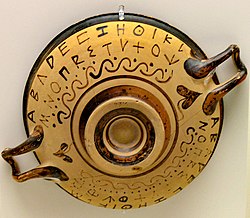
In early Greek alphabets, the shape and orientation of lambda varied. Most variants consisted of two straight strokes, one longer than the other, connected at their ends. The angle might be in the upper-left, lower-left ("Western" alphabets) or top ("Eastern" alphabets). Other variants had a vertical line with a horizontal or sloped stroke running to the right. With the general adoption of the Ionic alphabet, Greek settled on an angle at the top; the Romans put the angle at the lower-left.
Examples of the symbolic use of uppercase lambda include:
Examples of the symbolic use of lowercase lambda include:
The Roman libra and Byzantine lítra (λίτρα), which served as both the pound mass unit and liter volume unit, were abbreviated in Greek using lambda with modified forms of the iota subscript ⟨λͅ⟩. These are variously encoded in Unicode. The Ancient Greek Numbers Unicode block includes 10183 GREEK LITRA SIGN (𐆃) as well as 𐅢, which is described as 10162 GREEK ACROPHONIC HERMIONIAN TEN but was much more common as a form of the litra sign. A variant of the sign can be formed from 0338 COMBINING LONG SOLIDUS OVERLAY and either 039B GREEK CAPITAL LETTER LAMDA (Λ̸) or 03BB GREEK SMALL LETTER LAMDA (λ̸).
Unicode uses the (Modern Greek-based) spelling "lamda" in character names, instead of "lambda", due to "the pre-existing names in ISO 8859-7, as well as preferences expressed by the Greek National Body". Latin versions of lambda were added to Unicode in 2024 for the Salishan and Wakashan languages in Canada.
Lambda
Lambda(/ˈlæmdə/ ⓘ; uppercase Λ, lowercase λ; Greek: λάμ(β)δα, lám(b)da; Ancient Greek: λά(μ)βδα, lá(m)bda), sometimes rendered lamda, labda or lamma, is the eleventh letter of the Greek alphabet, representing the voiced alveolar lateral approximant IPA: [l]; it derives from the Phoenician letter Lamed, and gave rise to Latin L and Cyrillic El (Л). In the system of Greek numerals, lambda has a value of 30. The ancient grammarians typically called it λάβδα (lắbdă, [lábda]) in Classical Greek times, whereas in Modern Greek it is λάμδα (lámda, [ˈlamða]), while the spelling λάμβδα (lámbda) was used (to varying degrees) throughout the lengthy transition between the two.
In early Greek alphabets, the shape and orientation of lambda varied. Most variants consisted of two straight strokes, one longer than the other, connected at their ends. The angle might be in the upper-left, lower-left ("Western" alphabets) or top ("Eastern" alphabets). Other variants had a vertical line with a horizontal or sloped stroke running to the right. With the general adoption of the Ionic alphabet, Greek settled on an angle at the top; the Romans put the angle at the lower-left.
Examples of the symbolic use of uppercase lambda include:
Examples of the symbolic use of lowercase lambda include:
The Roman libra and Byzantine lítra (λίτρα), which served as both the pound mass unit and liter volume unit, were abbreviated in Greek using lambda with modified forms of the iota subscript ⟨λͅ⟩. These are variously encoded in Unicode. The Ancient Greek Numbers Unicode block includes 10183 GREEK LITRA SIGN (𐆃) as well as 𐅢, which is described as 10162 GREEK ACROPHONIC HERMIONIAN TEN but was much more common as a form of the litra sign. A variant of the sign can be formed from 0338 COMBINING LONG SOLIDUS OVERLAY and either 039B GREEK CAPITAL LETTER LAMDA (Λ̸) or 03BB GREEK SMALL LETTER LAMDA (λ̸).
Unicode uses the (Modern Greek-based) spelling "lamda" in character names, instead of "lambda", due to "the pre-existing names in ISO 8859-7, as well as preferences expressed by the Greek National Body". Latin versions of lambda were added to Unicode in 2024 for the Salishan and Wakashan languages in Canada.
Recent media
Recent media