


Lambda
View on Wikipedia | ||||||||||||||||||||||||||||||||||||||||||||||||
| Greek alphabet | ||||||||||||||||||||||||||||||||||||||||||||||||
|---|---|---|---|---|---|---|---|---|---|---|---|---|---|---|---|---|---|---|---|---|---|---|---|---|---|---|---|---|---|---|---|---|---|---|---|---|---|---|---|---|---|---|---|---|---|---|---|---|
|
||||||||||||||||||||||||||||||||||||||||||||||||
| History | ||||||||||||||||||||||||||||||||||||||||||||||||
|
||||||||||||||||||||||||||||||||||||||||||||||||
| Diacritics and other symbols | ||||||||||||||||||||||||||||||||||||||||||||||||
| Related topics | ||||||||||||||||||||||||||||||||||||||||||||||||

Lambda(/ˈlæmdə/ ⓘ;[1] uppercase Λ, lowercase λ; Greek: λάμ(β)δα, lám(b)da; Ancient Greek: λά(μ)βδα, lá(m)bda), sometimes rendered lamda,[2] labda[2] or lamma,[2] is the eleventh letter of the Greek alphabet, representing the voiced alveolar lateral approximant IPA: [l]; it derives from the Phoenician letter Lamed, and gave rise to Latin L and Cyrillic El (Л). In the system of Greek numerals, lambda has a value of 30. The ancient grammarians typically called it λάβδα (lắbdă, [lábda]) in Classical Greek times,[3] whereas in Modern Greek it is λάμδα (lámda, [ˈlamða]), while the spelling λάμβδα (lámbda) was used (to varying degrees) throughout the lengthy transition between the two.
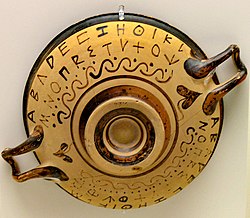
In early Greek alphabets, the shape and orientation of lambda varied.[4] Most variants consisted of two straight strokes, one longer than the other, connected at their ends. The angle might be in the upper-left, lower-left ("Western" alphabets) or top ("Eastern" alphabets). Other variants had a vertical line with a horizontal or sloped stroke running to the right. With the general adoption of the Ionic alphabet, Greek settled on an angle at the top; the Romans put the angle at the lower-left.

Symbol
[edit]Upper-case letter Λ
[edit]Examples of the symbolic use of uppercase lambda include:
- The lambda particle is a type of subatomic particle in subatomic particle physics.
- Lambda is the set of logical axioms in the axiomatic method of logical deduction in first-order logic.
- Uppercase Lambda is often used as a stylized form of uppercase A, especially in science fiction.
- There is a poetical allusion to the use of Lambda as a shield blazon by the Spartans.[citation needed][5]
- Lambda is the von Mangoldt function in mathematical number theory.[6]
- Lambda denotes the de Bruijn–Newman constant which is closely connected with Riemann's hypothesis.[7]
- In statistics, lambda is used for the likelihood ratio.
- In statistics, Wilks's lambda is used in multivariate analysis of variance (MANOVA analysis) to compare group means on a combination of dependent variables.[8]
- In the spectral decomposition of matrices, lambda indicates the diagonal matrix of the eigenvalues of the matrix.
- In computer science, lambda is the time window over which a process is observed for determining the working memory set for a digital computer's virtual memory management.
- In astrophysics, lambda represents the likelihood that a small body will encounter a planet or a dwarf planet leading to a deflection of a significant magnitude. An object with a large value of lambda is expected to have cleared its neighbourhood, satisfying the current definition of a planet.[9]
- In crystal optics, lambda is used to represent a lattice period.
- In electrochemistry, lambda denotes the "equivalent conductance" of an electrolyte solution.[10]
- In cosmology, lambda is the symbol for the cosmological constant, a term added to some dynamical equations to account for the accelerating expansion of the universe.[11]
- In optics, lambda denotes the grating pitch of a Bragg reflector.[12]
- In politics, the lambda is the symbol of Identitarianism, a white nationalist movement that originated in France before spreading out to the rest of Europe and later on to North America, Australia and New Zealand. The Identitarian lambda represents the Battle of Thermopylae.
Lower-case letter λ
[edit]
Examples of the symbolic use of lowercase lambda include:
- λ indicates the wavelength of any wave, especially in physics, electrical engineering, and mathematics.[13]
- In evolutionary algorithms, λ indicates the number of offspring that would be generated from μ current population in each generation. The terms μ and λ are originated from evolution strategy notation.[14]
- λ indicates the radioactivity decay constant in nuclear physics and radioactivity. This constant is very simply related (by a multiplicative constant) to the half-life of any radioactive material.
- In probability theory, λ represents the density of occurrences within a time interval, as modelled by the Poisson distribution.[15]
- In mathematical logic and computer science, λ is used to introduce anonymous functions expressed with the concepts of lambda calculus.
- λ indicates an eigenvalue in the mathematics of linear algebra.
- In the physics of particles, lambda indicates the thermal de Broglie wavelength[16]
- In the physics of electric fields, lambda sometimes indicates the linear charge density of a uniform line of electric charge (measured in coulombs per meter).
- Lambda denotes a Lagrange multiplier in multi-dimensional calculus.[17]
- In solid-state electronics, lambda indicates the channel length modulation parameter of a MOSFET.[18]
- In ecology, lambda denotes the long-term intrinsic growth rate of a population.[19] This value is often calculated as the dominant eigenvalue of the age/size class matrix.
- In formal language theory and in computer science, lambda denotes the empty string.[20]
- Lambda is a nonstandard symbol in the International Phonetic Alphabet for the voiced alveolar lateral affricate [dɮ].[21]
- Lambda denotes the Lebesgue measure in mathematical set theory.[22]
- The Goodman and Kruskal's lambda in statistics indicates the proportional reduction in error when one variable's values are used to predict the values of another variable.[23]
- Lambda denotes the oxygen sensor in a vehicle that measures the air-to-fuel ratio in the exhaust gases of an internal-combustion engine.[24]
- A Lambda 4S solid-fuel rocket was used to launch Japan's first orbital satellite in 1970.[25]
- Lambda denotes the failure rate of devices and systems in reliability theory, and it is measured in failure events per hour. Numerically, this lambda is also the reciprocal of the mean time between failures.[26]
- In criminology, lambda denotes an individual's frequency of offences.[27]
- In electrochemistry, lambda also denotes the ionic conductance of a given ion (the composition of the ion is generally shown as a subscript to the lambda character).
- In neurobiology, lambda denotes the length constant (or exponential rate of decay) of the electric potential across the cell membrane along a length of a nerve cell's axon.
- In the science and technology of heat transfer, lambda denotes the heat of vaporization per mole of material (a.k.a. its "latent heat").[28]
- In the technology and science of celestial navigation, lambda denotes the longitude as opposed to the Roman letter "L", which denotes the latitude.
- A block style lambda is used as a recurring symbol in the Valve computer game series Half-Life,[29] referring to the Lambda Complex of the fictional Black Mesa Research Facility, as well as making appearances in the sequel Half-Life 2, and its subsequent prequel Half-Life: Alyx as an in-universe symbol of resistance.[30]
- In 1970, a lowercase lambda was chosen by Tom Doerr as the symbol of the New York chapter of the Gay Activists Alliance.[31][32] The lambda symbol became associated with gay liberation[33][34] and recognized as an LGBTQ symbol for some time afterwards, being used as such by the International Gay Rights Congress in Edinburgh.[35]
- Golomb–Dickman constant[36]
- In continuum mechanics, lambda represents one of the Lamé parameters, which is a material property that arises in stress-strain relationships.
Litra symbol
[edit]The Roman libra and Byzantine lítra (λίτρα), which served as both the pound mass unit and liter volume unit, were abbreviated in Greek using lambda with modified forms of the iota subscript ⟨λͅ⟩. These are variously encoded in Unicode. The Ancient Greek Numbers Unicode block includes 10183 GREEK LITRA SIGN (𐆃) as well as 𐅢, which is described as 10162 GREEK ACROPHONIC HERMIONIAN TEN[37] but was much more common as a form of the litra sign. A variant of the sign can be formed from 0338 COMBINING LONG SOLIDUS OVERLAY and either 039B GREEK CAPITAL LETTER LAMDA (Λ̸) or 03BB GREEK SMALL LETTER LAMDA (λ̸).[38]
Unicode
[edit]Unicode uses the (Modern Greek-based) spelling "lamda" in character names, instead of "lambda", due to "the pre-existing names in ISO 8859-7, as well as preferences expressed by the Greek National Body".[39] Latin versions of lambda were added to Unicode in 2024 for the Salishan and Wakashan languages in Canada.[40]
- U+039B Λ GREEK CAPITAL LETTER LAMDA (Λ)[41]
- U+03BB λ GREEK SMALL LETTER LAMDA (λ)
- U+1D27 ᴧ GREEK LETTER SMALL CAPITAL LAMDA
- U+2C96 Ⲗ COPTIC CAPITAL LETTER LAULA
- U+2C97 ⲗ COPTIC SMALL LETTER LAULA
- U+A7DA LATIN CAPITAL LETTER LAMBDA
- U+A7DB LATIN SMALL LETTER LAMBDA
- U+1038D 𐎍 UGARITIC LETTER LAMDA
- U+1D6B2 𝚲 MATHEMATICAL BOLD CAPITAL LAMDA[a]
- U+1D6CC 𝛌 MATHEMATICAL BOLD SMALL LAMDA
- U+1D6EC 𝛬 MATHEMATICAL ITALIC CAPITAL LAMDA
- U+1D706 𝜆 MATHEMATICAL ITALIC SMALL LAMDA
- U+1D726 𝜦 MATHEMATICAL BOLD ITALIC CAPITAL LAMDA
- U+1D740 𝝀 MATHEMATICAL BOLD ITALIC SMALL LAMDA
- U+1D760 𝝠 MATHEMATICAL SANS-SERIF BOLD CAPITAL LAMDA
- U+1D77A 𝝺 MATHEMATICAL SANS-SERIF BOLD SMALL LAMDA
- U+1D79A 𝞚 MATHEMATICAL SANS-SERIF BOLD ITALIC CAPITAL LAMDA
- U+1D7B4 𝞴 MATHEMATICAL SANS-SERIF BOLD ITALIC SMALL LAMDA
- ^ The MATHEMATICAL characters should only be used in math. Stylized Greek text should be encoded using the normal Greek letters, with markup and formatting to indicate text style.
See also
[edit]
- Barred lambda - ƛ
- El (Cyrillic) – Л, л
- Fraser alphabet#Consonants
- Greek letters used in mathematics, science, and engineering
- Half-Life (series)
- Samsung, an electronics company that uses the glyph "Λ" in its logo as a styled "A".
References
[edit]- ^ "lambda". Pronunciation. Oxford English Dictionary (Online ed.). Oxford University Press. doi:10.1093/OED/7055602338. (Subscription or participating institution membership required.)
- ^ a b c "lambda". Forms. Oxford English Dictionary (Online ed.). Oxford University Press. doi:10.1093/OED/1663278936. (Subscription or participating institution membership required.)
- ^ Herbert Weir Smyth. A Greek Grammar for Colleges. I.1.c
- ^ "Epigraphic Sources for Early Greek Writing". Poinikastas.CSAD.ox.ac.uk. Retrieved 2011-10-03.
- ^ Philodemus (2003). On Poems. Oxford University Press. p. 212. ISBN 9780199262854.
- ^ Deza, Elena (2023). Perfect and amicable numbers. Selected chapters of number theory : special numbers. New Jersey: World Scientific. p. 79. ISBN 978-981-12-5962-3.
The von Mangold function Λ(n) is defined as…
- ^ Broughan, Kevin A. (2024). Equivalents of the Riemann hypothesis. Volume 3: Further steps towards resolving the Riemann hypothesis / Kevin Broughan (University of Waikato, New Zealand). Encyclopedia of mathematics and its applications. Cambridge, UK; New York; Port Melbourne, Victoria; New Delhi; Singapore: Cambridge University Press. p. 63. ISBN 978-1-009-38480-3.
Now we can give the definition of the de Bruijn–Newman constant Λ.
- ^ Everitt, Brian (2011). An introduction to applied multivariate analysis with R. Use R! Ser. Torsten Hothorn. New York: Springer New York. ISBN 978-1-4419-9649-7.
In the current case of one-way MANOVA, it can be shown that the LR test statistic is a monotone function of what is called Wilks' lambda (Λ, capital Greek letter lambda):
- ^ Wilkinson, John (2016). The Solar System in Close-Up. Astronomers' Universe Ser. Cham: Springer International Publishing AG. p. 7. ISBN 978-3-319-27627-4.
American planetary scientists Alan Stern and Harold Levison introduced a parameter Λ (lambda) to express the likelihood of a body "clearing the neighborhood around its orbit".
- ^ Kuhn, Reinhard; Hoffstetter-Kuhn, Sabrina (1993). Capillary electrophoresis: principles and practice. Springer Laboratory. Berlin Heidelberg: Springer. p. 12. ISBN 978-0-387-56434-0.
According to the first Kohlrausch law, anions and cations contribute independently to the conductance, which means that the equivalent conductance Λ is the sum of the…
- ^ Liddle, Andrew R. (2015). An introduction to modern cosmology (Third ed.). Chichester, West Sussex: John Wiley and Sons, Inc. p. 55. ISBN 978-1-118-50214-3.
The cosmological constant Λ appears in the Friedman equation as an extra term,
- ^ Pal, Bishnu, ed. (2010). Frontiers in Guided Wave Optics and Optoelectronics. Erscheinungsort nicht ermittelbar: IntechOpen. p. 352. ISBN 978-953-7619-82-4.
The circular Bragg grating on the bottom DBR gives high reflection for Bragg wavelength which is decided, for first order grating in slab hollow waveguide [25], by the following equation… where Λ is grating pitch.
- ^ Nelkon, Michael (1977). Fundamentals of Physics. St. Albans, Hertfordshire: Hart-Davis Educational. p. 329.
- ^ Baragona, Roberto (2011). Evolutionary statistical procedures: an evolutionary computation approach to statistical procedures designs and applications. Statistics and computing. Francesco Battaglia, Irene Poli. Berlin: Springer. p. 16. ISBN 978-3-642-16217-6.
…, and λ is the number of offsprings at each generation:
- ^ Panik, Michael J. (2005). Advanced statistics from an elementary point of view. Boston: Elsevier/Academic Press. p. 260. ISBN 978-0-12-088494-0.
Since λ is the mean number of occurrences per unit time of the Poisson process,
- ^ Tabatabaian, Mehrzad; Rajput, R. K. (2018). Advanced thermodynamics: fundamentals, mathematics, applications. Dulles, Virginia Boston, Massachusetts New Delhi: Mercury Learning and Information. p. 434. ISBN 978-1-936420-27-8.
A gas of atoms reaches quantum degeneracy when the matter waves of neighbouring atoms overlap – i.e. when the thermal de Broglie wavelength, λ, which means as the temperature falls,…
- ^ Ito, Kazufumi (2008). Lagrange multiplier approach to variational problems and applications. Advances in Design and Control. K. Kunisch, Society for Industrial and Applied Mathematics. Philadelphia, Pa: Society for Industrial and Applied Mathematics (SIAM, 3600 Market Street, Floor 6, Philadelphia, Pennsylvania 19104). pp. xii. ISBN 978-0-89871-649-8.
Here the Lagrange multiplier λ is treated like an independent variable just like y and u.
- ^ Wiegerink, Remco J. (1993). Analysis and synthesis of MOS translinear circuits. The Kluwer international series in engineering and computer science; Analog circuits and signal processing. Boston: Kluwer Academic. p. 21. ISBN 978-0-7923-9390-0.
Channel length modulation in an MOS transistor causes the drain current to be dependent on the drain voltage.… and λ the channel-length modulation parameter.
- ^ Li, Xue-Zhi; Yang, Junyuan; Martcheva, Maia (2020). Age Structured Epidemic Modeling. Interdisciplinary Applied Mathematics. Cham: Springer International Publishing AG. p. 7. ISBN 978-3-030-42495-4.
λ* is called the Malthusian parameter or intrinsic growth rate.
- ^ Tourlakis, George J. (2024). Discrete mathematics: a concise introduction. Synthesis lectures on mathematics & statistics. Cham: Springer. p. 37. ISBN 978-3-031-30487-3.
The symbols prevalent in the literature used to denote the empty string are ϵ or λ. We will choose λ…
- ^ International Phonetic Association (2021). Handbook of the International Phonetic Association: a guide to the use of the international phonetic alphabet (22. printing ed.). Cambridge: Cambridge University Press. p. 179. ISBN 978-0-521-63751-0.
λ lambda voiceless dental or alveolar lateral fricative Not IPA usage
- ^ Bierens, Herman J. (2004). Introduction to the mathematical and statistical foundations of econometrics. Themes in modern econometrics. New York: Cambridge University Press. p. 19. ISBN 978-0-521-83431-5.
This function λ is called the Lebesgue measure on ,...
- ^ Leong, Frederick; Austin, James T. (2024). The psychology research handbook: a guide for graduate students and research assistants (Third ed.). Thousand Oaks London New Delhi Singapore: Sage. p. 280. ISBN 978-1-4522-1767-3.
If the independent and dependent variables are nominal, the contingency coefficient, Cramer's V, or Goodman–Kruskal's λ may be chosen.
- ^ Ribbens, William B. (2017). Understanding automotive electronics: an engineering perspective (8th ed.). Oxford: Elsevier/Butterworth-Heinemann, an imprint of Elsevier. p. 215. ISBN 978-0-12-810434-7.
As a result, one of the most significant automotive engine sensors in use today is the exhaust gas oxygen (EGO) sensor. This sensor is often called a lambda sensor from the Greek letter lambda (λ), which is commonly used to denote the equivalence ratio (as defined in chapter 4):
- ^ "Encyclopedia Astronautica: Lambda". Astronautix.com. Archived from the original on 2012-10-22. Retrieved 2012-12-18.
- ^ Geng, Hwaiyu (2021). Data center handbook: plan, design, build, and operations of a smart data center (2nd ed.). Hoboken: Wiley. p. 278. ISBN 978-1-119-59753-7.
Commonly, the failure rate is assumed to be constant and written as λ.
- ^ Farrington, David; Kazemian, Lila; Piquero, Alex R., eds. (2019). The Oxford handbook of developmental and life-course criminology. The Oxford handbooks in criminology and criminal justice. New York: Oxford University Press. p. 74. ISBN 978-0-19-020137-1.
In order to evaluate acceleration and deceleration in criminal activity over the life-course, it is first necessary to determine the individual crime rate, or lambda (λ), for each offender of interest.
- ^ Wankat Separation Process Engineering 2nd ed, Prentice Hall
- ^ "Half-Life on Steam". store.steampowered.com. Valve. Retrieved 2017-01-02.
- ^ "Half-Life 2 on Steam". store.steampowered.com. Valve. Retrieved 2017-01-02.
- ^ Rapp, Linda (2004). "Gay Activists Alliance" (PDF). glbtq.com.
- ^ "1969, The Year of Gay Liberation". The New York Public Library. June 2009. Retrieved 17 November 2018.
- ^ Goodwin, Joseph P. (1989). "It Takes One to Know One". More Man Than You'll Ever Be: Gay Folklore and Acculturation in Middle America. Indiana University Press. p. 26. ISBN 978-0253338938.
- ^ Rapp, Linda (2003). "Symbols" (PDF). glbtq.com.
- ^ Haggerty, George E., ed. (2000). Gay Histories and Cultures: An Encyclopedia (Encyclopedia of Gay Histories and Cultures, Volume II) (1 ed.). London: Garland Publishing. p. 529. ISBN 0-8153-1880-4. OCLC 750790369.
- ^ Weisstein, Eric W. "Golomb-Dickman Constant Continued Fraction". mathworld.wolfram.com. Retrieved 2025-01-31.
- ^ Unicode Ancient Greek Numbers block.
- ^ "Thesaurus Linguae Graecae" (PDF). Stephanus.TLG.UCI.edu. Archived from the original (PDF) on 2011-07-16.
- ^ "Unicode Mail List Archive: RE: Greek letter "LAMDA"?".
- ^ Humchitt, Robyn; Jacquerye, Denis; King, Kevin (2023-07-17). "L2/23-191: Proposal to Encode 3 Additional Latin Characters for Wakashan and Salishan Languages to the Unicode Standard" (PDF).
- ^ "HTML 4.01 Specification. 24. Character entity references in HTML 4". World Wide Web Consortium.

Lambda
View on GrokipediaEtymology and Historical Development
Phoenician and Proto-Sinaitic Origins
The Proto-Sinaitic script, an early consonantal alphabet attested in approximately 30–40 inscriptions from sites such as Serabit el-Khadim in the Sinai Peninsula and Wadi el-Hol in Egypt, dates primarily to the Middle Bronze Age, with the earliest examples from around the 19th century BCE.[5] This script employed an acrophonic principle, where symbols represented initial consonants of Semitic words for depicted objects, often adapted from Egyptian hieroglyphs encountered by West Semitic workers in mining regions. The glyph for the /l/ phoneme derived from the Proto-Semitic term *lamd- or *lamid-, denoting an "ox-goad" or shepherd's staff used to prod livestock, rendered as a pictographic hooked or curved line resembling the tool's shape.[6] From this Proto-Sinaitic form, the symbol evolved through intermediate Proto-Canaanite variants into the standardized Phoenician letter lamed (𐤋) by the early 1st millennium BCE, around 1050 BCE, as evidenced in inscriptions from Phoenician city-states like Byblos and Tyre.[7] The Phoenician lamed retained the staff-like curvature, symbolizing its etymological root in the goad—a pointed stick with a hook—while serving as a consonant for the lateral approximant /l/ in Semitic languages. This form's name, lāmed, directly echoes the verbal root meaning "to prick," "sting," or "incite," reflecting the tool's practical function in herding.[6] Linguistic evidence links lamed's development to broader Semitic alphabetic traditions, with parallels in Hebrew lamed (ל) and Aramaic forms, all tracing to the same Proto-Sinaitic innovation that abstracted hieroglyphic signs into phonetic letters without retaining logographic meanings.[7] Inscriptions confirm the glyph's consistency as a rightward-leaning hook in Phoenician usage, distinguishing it from adjacent letters like mem (𐤌) while preserving the original pictographic intent.[6]Adoption into the Greek Alphabet
The Greek letter lambda (Λ, λ), representing the voiced alveolar lateral approximant /l/, was adopted as part of the broader adaptation of the Phoenician alphabet by Greek-speaking communities during the late 9th to early 8th century BCE. This process involved borrowing 22 consonantal signs from the Phoenician script, including lamed (𐤋), and repurposing some as vowels while retaining lambda's consonantal value.[8][9] The adoption likely occurred through trade and cultural contacts in the Aegean and Levant, with Euboean Greeks playing a key role in early transmission.[10] Earliest attestations of lambda appear in fragmentary inscriptions from Euboea, such as graffiti on pottery from Lefkandi and Eretria dated to approximately 775–750 BCE, which align with Phoenician letter forms from circa 800–750 BCE.[10] These early usages often mirrored the Phoenician lamed's vertical shaft with a crook at the top or base, reflecting Proto-Canaanite influences, though variations like inverted orientations emerged in Attic contexts.[11][10] The letter's name, lambda (or archaic λάβδα/labda), directly derives from lamed, underscoring the phonological and graphic continuity.[12] By the mid-8th century BCE, lambda was standardized in position as the 11th letter in most regional Greek alphabets, facilitating its use in epic poetry and dedications like the Nestor's Cup inscription.[8] Local variants persisted until the Ionic alphabet's widespread adoption around 400 BCE, but the core form and sound value remained stable from the initial borrowing.[9] This integration marked a pivotal shift from syllabic Linear B to a true alphabetic system, enabling precise representation of Greek phonemes.[8]Graphical and Phonetic Forms
Uppercase Form Λ
The uppercase form of lambda, denoted Λ, consists of two diagonal strokes joined at an acute angle at the apex, forming an inverted V shape open at the base. This angular configuration distinguishes it from the Phoenician lamed, from which it derives, and reflects adaptations made during the Greek alphabet's development around 800 BCE. In epigraphic contexts, such as inscriptions on pottery and stone from the geometric period, lambda typically appears with the right stroke longer than the left, though proportions varied by dialect.[13] By the classical era (5th–4th centuries BCE), the form standardized to a more symmetric Λ, as evidenced in Attic decree inscriptions where the letter's sharp vertex and equal-length legs facilitated clear readability in monumental script. This version persisted in Hellenistic and Roman-era texts, including the Rosetta Stone (196 BCE), where lambda maintains the chevron-like structure without added serifs or curves.[14] In uncial manuscripts from the 4th century CE onward, such as those in early Christian codices, the uppercase lambda retained its triangular essence but occasionally featured thicker strokes or slight rounding for calligraphic flow, though the core geometry remained unchanged until the advent of minuscule scripts in the 9th century CE. Modern typographic renderings, encoded as U+039B in Unicode since 1991, preserve this ancient form across sans-serif and serif fonts, ensuring consistency in digital and print media.Lowercase Form λ
The lowercase form of lambda, denoted as λ, represents a cursive evolution from the angular uppercase Λ, featuring a rightward vertical stem connected at the top to a leftward descending curve that forms a subtle loop or hook. This shape, distinct for its fluidity and compactness, facilitates rapid handwriting and denser textual arrangement compared to majuscule forms.[15] Developed within the Byzantine minuscule script, λ emerged around the 9th century CE as scribes shifted from uncial bookhands to smaller, more efficient letterforms to conserve parchment in manuscript production. Early minuscule lambdas often incorporated rounded uncial traits, such as softened angles, before standardizing into the looped descender visible in later medieval codices by the 10th-11th centuries.[16][17] In paleographic analysis, the form's design derives from abbreviated cursive strokes: typically initiated with a downward left curve from the apex, followed by an upward connection to the right stem, enabling ligatures in continuous writing. Variants in medieval scripts include lunate influences or elongated tails, reflecting regional scribal practices in Byzantine monasteries.[18]Variant Forms and Archaic Representations
In early Greek epigraphy, prior to the alphabet's standardization in the 4th century BC, the letter lambda appeared in diverse graphical forms reflecting regional scribal practices and adaptations from its Phoenician predecessor, lamed (𐤋). Common archaic variants consisted of two unequal straight strokes connected at the top or bottom, with orientations varying by dialect; for example, early Attic inscriptions uniquely employed an inverted lambda (꒓), departing from the semitic original's hooked profile.[10] This inversion, attested in pottery and stone inscriptions from the 7th–6th centuries BC, likely arose from right-to-left writing conventions persisting in some Ionian and Attic contexts.[10] Other representations included L-like forms with the shorter stroke at the base, resembling the Latin L, or V-shaped configurations with the apex downward, seen in Euboean and Corinthian artifacts around 700–600 BC.[19] Two-storey variants featured a curved link between the strokes, adding fluidity in transitional scripts. These epigraphic differences, evidenced in over 100 archaic inscriptions cataloged from sites like Cumae and Athens, highlight lambda's evolution toward the equilateral uppercase Λ by the Classical period, as local variants converged under Ionian influence.[19] The letter's name also exhibited archaic variation, attested as λάβδα (lábda) in early sources alongside the standard λάμβδα (lámda), possibly indicating phonetic shifts or orthographic preferences in pre-Classical Greek.[12] In later Hellenistic cursive scripts, lambda simplified into looped or elongated forms for speed, as preserved in papyri from the 3rd century BC onward, though these remained non-standard until Byzantine minuscule developments.Encoding and Digital Representation
Unicode and Character Encoding
The uppercase Greek letter lambda (Λ) is encoded in Unicode as U+039B GREEK CAPITAL LETTER LAMDA.[20] Its lowercase counterpart (λ) is U+03BB GREEK SMALL LETTER LAMDA.[21] Both belong to the Greek and Coptic block (U+0370 to U+03FF), introduced in Unicode 1.1 in June 1993 to support the Greek alphabet alongside Coptic extensions.[22] These code points ensure consistent representation across Unicode-compliant systems, with no combining characters required for standard forms. In UTF-8, the dominant Unicode Transformation Format, uppercase lambda encodes as the two-byte sequence 0xCE 0x9B, while lowercase lambda uses 0xCE 0xBB.[20] [21] UTF-16 represents them as single 16-bit units: 0x039B and 0x03BB, respectively.[23] [22] These encodings facilitate rendering in digital text, mathematics, and programming, where lambda often denotes functions or variables; for instance, source code in languages like Python can include "\u03BB" for literal insertion.[22] Prior to Unicode's widespread adoption, Greek lambda lacked standardization in 7-bit ASCII (1963–1968), which covered only basic Latin characters.[24] 8-bit extensions like ISO/IEC 8859-7 (1987), designed for Greek, mapped uppercase lambda to 0xCB and lowercase to 0xEB.[25] Similarly, Windows-1253 (code page 1253, introduced circa 1993) assigned them to decimal 203 and 235.[26] These legacy mappings persist for compatibility but risk mojibake in mismatched decoders, underscoring Unicode's role in resolving encoding fragmentation since the 1990s.[27]Typography in Printing and Digital Design
In early printing, the Greek letter lambda was rendered through typefaces modeled on humanist manuscripts, with the first significant Greek founts appearing in the late 15th century. Aldus Manutius's 1495 edition of Aristotle featured intricate designs incorporating ligatures, where lowercase lambda often connected fluidly with adjacent characters to emulate scribal continuity.[28] These early types prioritized calligraphic expressiveness over uniformity, resulting in variable stroke widths and orientations for lambda's stems.[29] A pivotal advancement occurred in 1806 with Richard Porson's Greek typeface, which introduced a "headless" lowercase lambda by eliminating the traditional seriffed headstroke on the upper arm, enhancing overall regularity and reducing visual clutter in dense text.[29] This simplification influenced 19th-century standards, such as those by Ambroise Firmin Didot in the 1790s, where uppercase Λ adopted a more geometric, inscriptional form akin to Latin A minus the crossbar, while lowercase λ balanced open counters for better ink distribution on press.[28] Mechanized typesetting in the 20th century, via Monotype's Series 90 and 91, preserved these traits in hot-metal composition, with lambda's open structure demanding precise kerning to maintain rhythm.[29] Digital typography preserves and extends these principles, with lambda glyphs designed for cross-script harmony in polytonic Greek extensions of Latin fonts. Uppercase Λ remains structurally simple, facilitating italic slanting without distortion, while lowercase λ typically features a curved shoulder descending to a hooked leg, whose radius adjusts for typeface weight—broader in light variants for elegance, straighter in bold for impact.[30] As an open character, lambda requires meticulous white space modulation in digital rendering to avoid uneven texture, particularly in sans-serif families where geometric constraints limit cursive flourishes.[28] Modern OpenType implementations support stylistic sets, though lambda seldom varies beyond standard and italic forms, prioritizing legibility in mathematical and linguistic contexts over ornamental alternates.[30]Role in the Greek Language
Phonetic Value and Pronunciation
In Ancient Greek, the letter lambda (λ) represented the phoneme /l/, articulated as the voiced alveolar lateral approximant [l], akin to the clear "l" in English words like "leaf" rather than the darker [ɫ] found in English "full".[31] This pronunciation was uniform across major dialects, including Attic and Ionic, with no significant variation in place of articulation or manner, as evidenced by comparative reconstructions from Indo-European cognates and papyrological evidence of orthographic consistency.[32] In Modern Standard Greek (Demotic), lambda retains the phonetic value /l/, pronounced as [l] in most contexts, maintaining the alveolar approximant quality without devoicing or frication.[31] While regional dialects, such as those in Crete or the Cyclades, occasionally exhibit palatalization to [ʎ] (a laminal postalveolar approximant) before front vowels like /i/ or /e/, standard urban pronunciations in Athens and Thessaloniki adhere strictly to [l], as confirmed by phonetic studies of broadcast media and educational corpora from the 20th and 21st centuries.[33] In geminate clusters (λλ), the sound may lengthen to [lː] or marginally palatalize in casual speech, but this does not alter the core phonemic role of lambda as the sole grapheme for /l/ in the orthography.[32]Usage in Ancient and Modern Greek Orthography
In ancient Greek orthography, lambda (uppercase Λ, lowercase λ) served to represent the phoneme /l/, the voiced alveolar lateral approximant, in all positions within words. It appeared in native vocabulary such as ἥλιος (hḗlios, "sun"), pronounced approximately as [hɛ́lios], and ελαία (elaía, "olive"), [elaía], reflecting a clear lateral sound without palatalization. The letter's name exhibited spelling variants including λάμβδα (lámda), λάμδα (lámda), and λάβδα (lávda), derived from its pronunciation. Double lambda (λλ) indicated gemination, articulated as a prolonged [lː], as in historical pronunciations of words like Ἑλλὰς (Hellás, "Greece"). Orthographic consistency across dialects standardized lambda for the /l/ sound, with no alternative letters employed for this phoneme.[33][34] In modern Greek orthography, lambda retains its role in denoting /l/, transcribed as a clear [l] akin to the English "l" in "light," used in terms like λεμόνι (lemóni, "lemon") and λαός (laós, "people"). Before sequences such as /ia/, /ie/, /io/, or /iu/, it undergoes palatalization to [ʎ], a palatal lateral approximant, yielding pronunciations like [ˈiʎos] for ήλιος (íljos, "sun"). The doubled λλ, etymologically preserving ancient gemination, is spelled in words like Ελλάδα (Elláda, "Greece"), but in standard Athenian Demotic, it simplifies to [l] as [eˈlaða], whereas Cypriot dialects maintain [lː] as [elˈlaða]. The 1982 orthographic reform, adopting monotonic script, preserved lambda's form and phonetic assignment without alteration, ensuring continuity from classical usage in contemporary writing.[33][35]Mathematical and Logical Applications
Lambda Calculus and Functional Programming Foundations
Lambda calculus is a formal system in mathematical logic for expressing computation through function abstraction (λx.M, denoting a function that takes argument x and returns the term M) and application (M N, applying function M to argument N), developed by Alonzo Church at Princeton University starting in 1932 as a tool for analyzing mathematical logic.[36] Church formalized its reduction rules, particularly β-reduction where (λx.M) N reduces to M with x substituted by N (avoiding variable capture), enabling step-by-step evaluation of expressions.[37] By 1936, Church employed lambda calculus to prove the undecidability of the Entscheidungsproblem, demonstrating that no general algorithm exists for determining the truth of all first-order logic statements, a result independent of Alan Turing's concurrent work on Turing machines.[36] The system's Turing-completeness arises from its ability to encode natural numbers (e.g., Church numerals: 0 as λf.λx.x, successor as λn.λf.λx.f (n f x)), booleans, and recursion via fixed-point combinators like the Y combinator (Y = λf.(λx.f (x x)) (λx.f (x x))), allowing simulation of arbitrary recursive functions without explicit loops.[37] This equivalence to Turing machines supports the Church-Turing thesis, positing that lambda-definable functions precisely capture the notion of effective computability, as Church argued in 1935 that any computable function on natural numbers is λ-definable.[38][36] Untyped lambda calculus permits self-application and infinite reductions, highlighting limitations like the halting problem's undecidability, while typed variants (e.g., simply typed lambda calculus introduced by Church in 1940) enforce termination and type safety through Curry-Howard correspondence, linking proofs to inhabited types.[39] Lambda calculus underpins functional programming by modeling computation as pure function composition and application, eschewing mutable state and side effects in favor of immutable data and higher-order functions (functions as arguments or returns).[40] Early influence appears in John McCarthy's Lisp (defined 1958, implemented 1960), which adopted lambda notation for defining functions and supports list processing via applicative-order evaluation akin to normal-order reduction strategies.[41] It also inspired Algol 60's call-by-name mechanism, evaluating arguments only on demand, mirroring lazy evaluation in lambda terms.[41] Modern functional languages like ML (1973), Haskell (1990), and Scala extend these ideas with lazy evaluation, monads for handling effects, and pattern matching, all traceable to lambda abstraction's emphasis on referential transparency and equational reasoning.[42] For instance, anonymous functions in languages like Python (added 2006 via lambda keyword) or Java (2014 lambdas) directly echo lambda expressions, enabling concise higher-order operations such as mapping:map :: (a -> b) -> [a] -> [b]
map f [] = []
map f (x:xs) = f x : map f xs
map abstracts iteration over lists without imperative loops.[41] This paradigm prioritizes composability and provability, as terms reduce equivalently under substitution, facilitating optimizations like supercombinators in compilers.[43]
Eigenvalues, Variables, and Other Notations
In linear algebra, the symbol λ denotes an eigenvalue of a square matrix, defined as a scalar satisfying $ A \mathbf{v} = \lambda \mathbf{v} $ for some nonzero eigenvector $ \mathbf{v} $. This standard notation facilitates solving the characteristic equation $ \det(A - \lambda I) = 0 $, which determines the eigenvalues.[44][45]The letter λ also represents the Lagrange multiplier in constrained optimization problems within multivariable calculus. For maximizing $ f(\mathbf{x}) $ subject to $ g(\mathbf{x}) = c $, the method introduces λ via the Lagrangian $ \mathcal{L}(\mathbf{x}, \lambda) = f(\mathbf{x}) + \lambda (c - g(\mathbf{x})) $, with stationarity conditions $ \nabla f = \lambda \nabla g $ and $ g = c $. Here, λ quantifies the sensitivity of the objective to constraint perturbations.[46][47]
Beyond these, λ functions as a generic variable or parameter in diverse mathematical settings, including differential equations and analysis, where it parameterizes solutions or denotes constants distinct from primary variables. In number theory, λ(n) specifically indicates the Liouville function, given by $ \lambda(n) = (-1)^{\Omega(n)} $, where $ \Omega(n) $ counts the total prime factors of n with multiplicity; this function aids in estimating sums over divisors.[48]
Scientific and Engineering Applications
Wavelength in Physics and Optics
In physics, wavelength denotes the spatial period of a wave, defined as the distance between two consecutive corresponding points of the same phase, such as crests or troughs.[49] This property is universally represented by the Greek letter lambda (λ), a convention established in early wave theory and standardized across scientific literature.[49] The wavelength λ relates inversely to the wave's frequency f via the formula λ = v / f, where v is the phase speed of the wave in the medium; for electromagnetic waves in vacuum, this simplifies to λ = c / f, with c as the speed of light (approximately 2.998 × 10^8 m/s).[49] [50] In optics, λ quantifies the scale of light wave interactions, determining phenomena like diffraction and interference patterns. For instance, in Young's double-slit experiment, constructive interference occurs when the path difference between waves from two slits is an integer multiple of λ (δ = mλ, m = 0, 1, 2, ...), producing bright fringes separated by distances proportional to λ / d on a screen, where d is slit spacing.[51] Destructive interference yields dark fringes at δ = (m + 1/2)λ. In single-slit diffraction, the first minimum forms at sinθ ≈ λ / a, where a is slit width, illustrating how shorter wavelengths enable finer resolution.[52] Diffraction gratings exploit λ for spectral dispersion, with the grating equation d sinθ = mλ governing maxima, where d is groove spacing; this allows separation of wavelengths differing by Δλ ≈ λ / (m N), with N grooves, achieving resolving powers up to 10^5 or higher in precision instruments.[53] Applications include astronomical spectroscopy, where λ identifies elemental emission lines (e.g., hydrogen's Balmer series peaks near 656 nm for Hα), and laser optics, where monochromatic λ ensures tight beam focusing limited by diffraction (spot size ≈ λ / NA, NA numerical aperture).[54] Shorter λ in ultraviolet or X-ray optics enhances resolution in microscopy and crystallography, as per Abbe's limit d ≈ λ / (2 NA).[53]Decay Constants, Cosmology, and Quantum Uses
In nuclear physics, the Greek letter λ denotes the decay constant in the exponential law governing radioactive decay, where the rate of decay is given by $ \frac{dN}{dt} = -\lambda N $, with $ N $ representing the number of undecayed nuclei.[55] This constant quantifies the intrinsic probability per unit time for a single nucleus to decay, independent of external conditions, and relates to the half-life $ T_{1/2} $ via $ \lambda = \frac{\ln 2}{T_{1/2}} \approx \frac{0.693}{T_{1/2}} $.[56] For example, carbon-14 has a half-life of approximately 5730 years, yielding $ \lambda \approx 1.21 \times 10^{-4} $ per year, enabling precise dating in archaeology and geochronology.[57] In cosmology, the uppercase lambda Λ symbolizes the cosmological constant introduced by Albert Einstein in 1917 to modify his field equations of general relativity, $ R_{\mu\nu} - \frac{1}{2} R g_{\mu\nu} + \Lambda g_{\mu\nu} = \frac{8\pi G}{c^4} T_{\mu\nu} $, aiming to permit a static universe model prevailing at the time.[58] Einstein later regarded Λ as his "greatest blunder" after Edwin Hubble's 1929 observations revealed cosmic expansion, prompting its removal; however, revived in the late 1990s by supernova data indicating accelerating expansion, Λ now represents a uniform vacuum energy density driving this acceleration, comprising about 68% of the universe's energy budget in the ΛCDM model.[59] [60] In quantum mechanics, λ frequently denotes wavelength, particularly in the de Broglie relation $ \lambda = \frac{h}{p} $, where $ h $ is Planck's constant and $ p $ is momentum, positing wave-particle duality for matter such that massive particles exhibit wave-like interference when $ \lambda $ approaches atomic scales.[61] This formula underpins phenomena like electron diffraction, confirmed experimentally in 1927 by Davisson and Germer, and extends to applications in electron microscopy, where shorter $ \lambda $ for high-energy electrons enables sub-angstrom resolution.[62] Additionally, λ appears in quantum field theory for coupling constants, such as the fine-structure parameter in QED, though its primary quantum role emphasizes spatial periodicity in wave functions.[63]Symbolic and Cultural Significance
Military and Spartan Heritage
The uppercase Greek letter lambda (Λ) is traditionally linked to the Spartan military tradition, purportedly painted on the convex bronze shields (aspis) of hoplite warriors to signify Lakedaimōn (Λακεδαίμων), the Dorian Greek name for their homeland encompassing Laconia and the city-state of Sparta. This emblem underscored the Spartans' emphasis on collective identity and unbreakable phalanx cohesion, where dropping one's shield equated to cowardice and potential execution under the rigor of Lycurgan discipline. The symbol's adoption is thought to date to the mid-5th century BC, possibly during the Peloponnesian War (431–404 BC), aligning with Sparta's rising hegemony over Dorian allies.[64] The sole ancient literary attestation derives from fragment 394 of Polemoi ("Wars"), a lost comedy by Athenian playwright Eupolis (c. 446–411 BC), quoted in a 10th-century AD Byzantine lexicon: it depicts Spartan troops advancing with lambda-adorned shields in a battle context, likely mocking their uniformity amid Athenian rivalries. No earlier historians like Herodotus (c. 484–425 BC) or Thucydides (c. 460–400 BC) reference this specific blazon, despite detailing Spartan campaigns such as Thermopylae (480 BC).[65] Archaeological evidence remains elusive; while hoplite shields from other Greek poleis bear personalized or divine motifs (e.g., gorgons or owls on Athenian examples), no verified Spartan artifacts display the lambda, with the earliest potential iconographic hints appearing in much later medieval sources or speculative reconstructions. Scholars thus view the tradition as plausible given Greek practices of regional sigils but caution against overreliance on a single comedic source, which may blend fact with Athenian caricature for humorous effect. The lambda's enduring Spartan association has nonetheless influenced modern military iconography, including badges of Hellenic Army units evoking the warrior ethos.[65][64]Modern Political and Social Appropriations
In the early 1970s, following the Stonewall riots, the Greek letter lambda was adopted as a symbol by the New York City Gay Activists Alliance, proposed by member Tom Doerr to represent unity under oppression and resistance to societal norms.[66] Doerr drew on associations including the Spartans' use of lambda for communal solidarity and its denotation of wavelength, symbolizing light emerging from darkness.[67] This usage gained international recognition in December 1974 when the International Gay Rights Congress in Edinburgh declared it the symbol for gay and lesbian rights, emphasizing themes of change and collective strength.[68] The symbol appeared on buttons, flags, and publications, persisting in LGBTQ+ contexts despite later diversification of pride icons.[66] Since the 2010s, the lambda has been appropriated by the Identitarian movement, a pan-European network originating in France's Génération Identitaire around 2012, which promotes the preservation of indigenous European cultures and opposes large-scale non-European immigration.[69] Groups like Austria's Identitäre Bewegung and Germany's branch have stylized the lambda on shields or flags, invoking the Spartan stand at Thermopylae in 480 BCE as a metaphor for defending homeland against demographic replacement.[70] Identitarian leaders, such as Martin Sellner, have referenced Spartan heritage in speeches and propaganda to frame migration as an existential invasion, with the symbol appearing at protests from Vienna to Chemnitz in 2018.[70] This adoption extends to North American white nationalist circles, where lambda motifs signal ethnocultural defense, though the movement's small scale—estimated at thousands of active members across Europe—relies on online amplification for visibility.[70] Critics from advocacy organizations label it a hate symbol due to overlaps with exclusionary rhetoric, but adherents describe it as a reclaiming of pre-modern European valor.[71]Computing and Technological Uses
Lambda Expressions in Programming Languages
Lambda expressions, also referred to as lambda functions or anonymous functions, enable the inline definition of small, unnamed functions in programming languages, typically consisting of input parameters, a delimiter such as an arrow operator, and a single expression or block that computes a result. This construct supports higher-order functions—those that accept or return other functions—and facilitates patterns like mapping, filtering, and reducing data structures without declaring separate named functions. By allowing functions to be treated as first-class citizens, lambda expressions promote concise code and functional programming styles, where computation is expressed through function composition rather than imperative loops or object-oriented boilerplate.[72][73] The concept traces its practical implementation to the Lisp programming language, developed by John McCarthy, whose 1960 paper introduced lambda as the core mechanism for defining functions over symbolic expressions, directly inspired by but extending lambda calculus principles. In Lisp, a lambda expression takes the form(lambda (parameters) body), which evaluates to a function object that can be applied immediately or stored. This approach influenced early functional languages: for instance, ML (1973) used fun bindings for anonymous functions, while Haskell (1990) employs \x -> expr syntax, making lambdas essential for pure functional computation and type-safe abstractions.[74][75]
Adoption in mainstream imperative languages accelerated in the 1990s and 2010s to address verbosity in callbacks and event handling. Python introduced lambda functions in version 1.0, released in November 1994, which are anonymous functions created with the lambda keyword for short, one-off functions. The syntax is lambda parameters: expression, where the body consists of a single expression and cannot include statements such as loops, if/else blocks as statements, or return. Examples include lambda x: x * 2 to double an input, lambda a, b: a + b to sum two arguments, and conditional expressions like lambda x: x.upper() if isinstance(x, str) else x. They enable concise iteration over lists for operations like mapping, filtering, sorting, and grouping by categories, commonly used with higher-order functions such as map, filter, sorted(key=lambda...), and itertools.groupby(): for instance, list(map(lambda x: x**2, [1, 2, 3])) returns [1, 4, 9]; list(filter(lambda x: x % 2 == 0, [1, 2, 3, 4])) returns [2, 4]; sorted(['apple', 'banana', 'cherry'], key=lambda x: len(x)) sorts by string length; and, for grouping products by category in a catalog, after sorting a list of product tuples (e.g., [('apple', 'fruit'), ('carrot', 'vegetable'), ('banana', 'fruit')]), itertools.groupby(sorted_products, key=lambda p: p[1]) yields iterables for each category. This limitation to single expressions maintains simplicity while supporting concise data transformations.[76][77] C++ added lambda expressions in the ISO/IEC 14882:2011 standard (C++11), using [capture](params) { body } to support closures that capture local variables by value or reference, enhancing generic algorithms in the Standard Template Library such as std::sort or std::for_each.[73] Java incorporated them in Java SE 8, released March 18, 2014, via (params) -> expression or statement blocks, targeting functional interfaces like Runnable or Comparator to streamline stream processing and parallel operations, reducing anonymous inner class verbosity by up to 90% in common cases.
list(map(lambda x: x**2, [1, 2, 3])) # Returns [1, 4, 9], squaring numbers in the list
Python example: squaring numbers in a list
numbers = [1, 2, 3] squares = list(map(lambda x: x**2, numbers)) # [1, 4, 9]
```cpp
// C++ example: sorting vector with custom comparator
std::vector<int> vec = {3, 1, 4};
std::sort(vec.begin(), vec.end(), [](int a, int b) { return a > b; });  // Descending order
// Java example: filtering even numbers in a stream
List<Integer> numbers = Arrays.asList(1, 2, 3, 4);
List<Integer> evens = numbers.stream()
    .filter(n -> n % 2 == 0)
    .collect(Collectors.toList());  // [2, 4]