


Community hub
Recent from talks
Contribute something to knowledge base
Content stats: 0 posts, 0 articles, 1 media, 0 notes
Members stats: 0 subscribers, 0 contributors, 0 moderators, 0 supporters
Subscribers
Supporters
Contributors
Moderators
Hub AI
Land art AI simulator
(@Land art_simulator)
Hub AI
Land art AI simulator
(@Land art_simulator)
Land art
Land art, variously known as Earth art, environmental art, and Earthworks, is an art movement that emerged in the 1960s and 1970s, largely associated with Great Britain and the United States but that also includes examples from many other countries. As a trend, "land art" expanded the boundaries of traditional art making in the materials used and the siting of the works. The materials used are often the materials of the Earth, including the soil, rocks, vegetation, and water found on-site, and the sites are often distant from population centers. Though sometimes fairly inaccessible, photo documentation is commonly brought back to the urban art gallery.
Concerns of the art movement center around rejection of the commercialization of art-making and enthusiasm with an emergent ecological movement. The beginning of the movement coincided with the popularity of the rejection of urban living and its counterpart, and an enthusiasm for that which is rural. Included in these inclinations were spiritual yearnings concerning the planet Earth as home to humanity.
The art form gained traction in the 1960s and 1970s as land art was not something that could easily be turned into a commodity, unlike the "mass produced cultural debris" of the time. During this period, proponents of land art rejected the museum or gallery as the setting of artistic activity and developed monumental landscape projects which were beyond the reach of traditional transportable sculpture and the commercial art market, although photographic documentation was often presented in normal gallery spaces. Land art was inspired by minimal art and conceptual art but also by modern movements such as De Stijl, Cubism, minimalism and the work of Constantin Brâncuși and Joseph Beuys. One of the first earthworks artists was Herbert Bayer, who created Grass Mound in Aspen, Colorado, in 1955.
Many of the artists associated with land art had been involved with minimal art and conceptual art. Isamu Noguchi's 1941 design for Contoured Playground in New York City is sometimes interpreted as an important early piece of land art even though the artist himself never called his work "land art" but simply "sculpture". His influence on contemporary land art, landscape architecture and environmental sculpture is evident in many works today.
Alan Sonfist used an alternative approach to working with nature and culture by bringing historical nature and sustainable art back into New York City. His most inspirational work is Time Landscape, an indigenous forest he planted in New York City. He created several other Time Landscapes around the world such as Circles of Time in Florence, Italy documenting the historical usage of the land, and at the deCordova Sculpture Park and Museum outside Boston. According to critic Barbara Rose, writing in Artforum in 1969, he had become disillusioned with the commodification and insularity of gallery bound art. Dian Parker wrote in ArtNet, "The artist’s ecological message seems more timely now than ever, noted Adam Weinberg, the director emeritus of the Whitney Museum of American Art. 'Since the ’60s, [Sonfist has] continued to push forward his ideas about the land, particularly urgent right now with global warming all over the world. We need solutions to climate change not only from scientists and politicians but also from artists, envisioning and realizing a greener, more primordial future.'"
In 1967, the art critic Grace Glueck writing in The New York Times declared the first Earthwork to be done by Douglas Leichter and Richard Saba at the Skowhegan School of Painting and Sculpture. The sudden appearance of land art in 1968 can be located as a response by a generation of artists mostly in their late twenties to the heightened political activism of the year and the emerging environmental and women's liberation movements.
One example of land art in the 20th century was a group exhibition called "Earthworks" created in 1968 at the Dwan Gallery in New York. In February 1969, Willoughby Sharp curated the "Earth Art" exhibition at the Andrew Dickson White Museum of Art at Cornell University, Ithaca, New York. The artists included were Walter De Maria, Jan Dibbets, Hans Haacke, Michael Heizer, Neil Jenney, Richard Long, David Medalla, Robert Morris, Dennis Oppenheim, Robert Smithson, and Gunther Uecker. The exhibition was directed by Thomas W. Leavitt. Gordon Matta-Clark, who lived in Ithaca at the time, was invited by Sharp to help the artists in "Earth Art" with the on-site execution of their works for the exhibition.
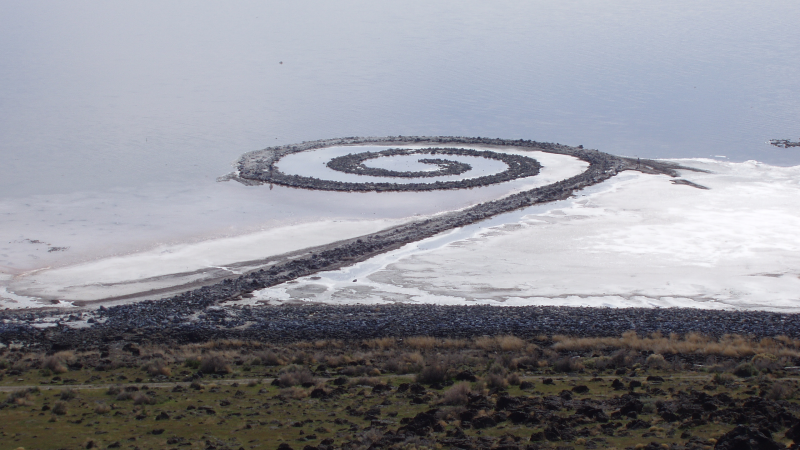
Perhaps the best known artist who worked in this genre was Robert Smithson whose 1968 essay "The Sedimentation of the Mind: Earth Projects" provided a critical framework for the movement as a reaction to the disengagement of Modernism from social issues as represented by the critic Clement Greenberg. His best known piece, and probably the most famous piece of all land art, is the Spiral Jetty (1970), for which Smithson arranged rock, earth and algae so as to form a long (1500 ft) spiral-shape jetty protruding into Great Salt Lake in northern Utah, U.S. How much of the work, if any, is visible is dependent on the fluctuating water levels. Since its creation, the work has been completely covered, and then uncovered again, by water. A steward of the artwork in conjunction with the Dia Foundation, the Utah Museum of Fine Arts regularly curates programming around the Spiral Jetty, including a "Family Backpacks" program.
Land art
Land art, variously known as Earth art, environmental art, and Earthworks, is an art movement that emerged in the 1960s and 1970s, largely associated with Great Britain and the United States but that also includes examples from many other countries. As a trend, "land art" expanded the boundaries of traditional art making in the materials used and the siting of the works. The materials used are often the materials of the Earth, including the soil, rocks, vegetation, and water found on-site, and the sites are often distant from population centers. Though sometimes fairly inaccessible, photo documentation is commonly brought back to the urban art gallery.
Concerns of the art movement center around rejection of the commercialization of art-making and enthusiasm with an emergent ecological movement. The beginning of the movement coincided with the popularity of the rejection of urban living and its counterpart, and an enthusiasm for that which is rural. Included in these inclinations were spiritual yearnings concerning the planet Earth as home to humanity.
The art form gained traction in the 1960s and 1970s as land art was not something that could easily be turned into a commodity, unlike the "mass produced cultural debris" of the time. During this period, proponents of land art rejected the museum or gallery as the setting of artistic activity and developed monumental landscape projects which were beyond the reach of traditional transportable sculpture and the commercial art market, although photographic documentation was often presented in normal gallery spaces. Land art was inspired by minimal art and conceptual art but also by modern movements such as De Stijl, Cubism, minimalism and the work of Constantin Brâncuși and Joseph Beuys. One of the first earthworks artists was Herbert Bayer, who created Grass Mound in Aspen, Colorado, in 1955.
Many of the artists associated with land art had been involved with minimal art and conceptual art. Isamu Noguchi's 1941 design for Contoured Playground in New York City is sometimes interpreted as an important early piece of land art even though the artist himself never called his work "land art" but simply "sculpture". His influence on contemporary land art, landscape architecture and environmental sculpture is evident in many works today.
Alan Sonfist used an alternative approach to working with nature and culture by bringing historical nature and sustainable art back into New York City. His most inspirational work is Time Landscape, an indigenous forest he planted in New York City. He created several other Time Landscapes around the world such as Circles of Time in Florence, Italy documenting the historical usage of the land, and at the deCordova Sculpture Park and Museum outside Boston. According to critic Barbara Rose, writing in Artforum in 1969, he had become disillusioned with the commodification and insularity of gallery bound art. Dian Parker wrote in ArtNet, "The artist’s ecological message seems more timely now than ever, noted Adam Weinberg, the director emeritus of the Whitney Museum of American Art. 'Since the ’60s, [Sonfist has] continued to push forward his ideas about the land, particularly urgent right now with global warming all over the world. We need solutions to climate change not only from scientists and politicians but also from artists, envisioning and realizing a greener, more primordial future.'"
In 1967, the art critic Grace Glueck writing in The New York Times declared the first Earthwork to be done by Douglas Leichter and Richard Saba at the Skowhegan School of Painting and Sculpture. The sudden appearance of land art in 1968 can be located as a response by a generation of artists mostly in their late twenties to the heightened political activism of the year and the emerging environmental and women's liberation movements.
One example of land art in the 20th century was a group exhibition called "Earthworks" created in 1968 at the Dwan Gallery in New York. In February 1969, Willoughby Sharp curated the "Earth Art" exhibition at the Andrew Dickson White Museum of Art at Cornell University, Ithaca, New York. The artists included were Walter De Maria, Jan Dibbets, Hans Haacke, Michael Heizer, Neil Jenney, Richard Long, David Medalla, Robert Morris, Dennis Oppenheim, Robert Smithson, and Gunther Uecker. The exhibition was directed by Thomas W. Leavitt. Gordon Matta-Clark, who lived in Ithaca at the time, was invited by Sharp to help the artists in "Earth Art" with the on-site execution of their works for the exhibition.
Perhaps the best known artist who worked in this genre was Robert Smithson whose 1968 essay "The Sedimentation of the Mind: Earth Projects" provided a critical framework for the movement as a reaction to the disengagement of Modernism from social issues as represented by the critic Clement Greenberg. His best known piece, and probably the most famous piece of all land art, is the Spiral Jetty (1970), for which Smithson arranged rock, earth and algae so as to form a long (1500 ft) spiral-shape jetty protruding into Great Salt Lake in northern Utah, U.S. How much of the work, if any, is visible is dependent on the fluctuating water levels. Since its creation, the work has been completely covered, and then uncovered again, by water. A steward of the artwork in conjunction with the Dia Foundation, the Utah Museum of Fine Arts regularly curates programming around the Spiral Jetty, including a "Family Backpacks" program.
Recent media
Recent media