


Community hub
Recent from talks
Contribute something
Nothing was collected or created yet.
Robert Smithson
View on Wikipedia

Key Information


Robert Smithson (January 2, 1938 – July 20, 1973) was an American artist known for sculpture and land art who often used drawing and photography in relation to the spatial arts. His work has been internationally exhibited in galleries and museums and is held in public collections. He was one of the founders of the land art movement whose best known work is the Spiral Jetty (1970).
Early life and education
[edit]Smithson was born in Passaic, New Jersey, and spent his childhood in Rutherford until he was nine. In Rutherford, the poet and physician William Carlos Williams was Smithson's pediatrician. When Smithson was nine, his family moved to the Allwood section of Clifton.[1] He studied painting and drawing in New York City at the Art Students League of New York from 1954 to 1956[2] and then briefly at the Brooklyn Museum Art School.[3][4]
Career
[edit]Early work
[edit]He primarily identified as a painter during this time, and his early exhibited artworks had a wide range of influences, including science fiction, Catholic art and Pop art.[5] He produced drawings and collage works that incorporated images from natural history, science fiction films, classical art, religious iconography, and pornography including "homoerotic clippings from beefcake magazines".[6] Paintings from 1959 to 1962 explored "mythical religious archetypes" and were also based on Dante's Divine Comedy such as the paintings from 1959 Wall of Dis and The Inferno, Purgatory and Paradise, that correspond to the Divine Comedy's three-part structure.[5][7]
After a break from the art world, Smithson reemerged in 1964 as a proponent of the minimalist movement.[8] His new work abandoned the preoccupation with the body that had been common in his earlier work, and he began to use glass sheet and neon lighting tubes to explore visual refraction and mirroring.[8] His wall-mounted sculpture Enantiomorphic Chambers was made of steel and mirrors and created the optical effect of a "pointless vanishing-point".[9] Crystalline structures and the concept of entropy became of interest to him and informed a number of sculptures completed during this period, including Alogon 2, (1966) composed of ten units, the title of which refers to the Greek word for an unnamable, irrational number.[8] Smithson's interest in entropy led him to write about a future in which "the universe will burn out into an all-encompassing sameness".[9] His ideas on entropy also addressed culture, "the urban sprawl and the infinite number of housing developments of the post war boom have contributed to the architect of entropy". He called these urban/suburban sprawls "slurbs."[9] Smithson viewed entropy as a form of transformation of society and culture, which is shown in his artwork, for example, the non-site pieces. Smithson became affiliated with artists who were identified with the minimalist or Primary Structures movement, such as Nancy Holt (whom he married), Robert Morris and Sol LeWitt.[10]
Later work
[edit]Non-sites
[edit]In 1967 Smithson began exploring industrial areas around New Jersey and was fascinated by the sight of dump trucks excavating tons of earth and rock that he described in an essay as the equivalents of the monuments of antiquity.[9] This resulted in the series of 'non-sites' in which earth and rocks collected from a specific area are installed in the gallery as sculptures, often combined with mirrors or glass. Works from this period include Eight-Part Piece (Cayuga Salt Mine Project) (1969) and Map of Broken Clear Glass (Atlantis) (1969).[8] In September 1968, Smithson published the essay "A Sedimentation of the Mind: Earth Projects" in Artforum that promoted the work of the first wave of land art artists, and in 1969 he began producing land art pieces to further explore concepts gained from his readings of William S. Burroughs, J. G. Ballard, and George Kubler.[9] The journeys he undertook were central to his practice as an artist, and his non-site sculptures often included maps and aerial photos of a particular location, as well as the geological artifacts displaced from those sites.[7][9] Of these travels, several on-site works were produced including Mirror Displacements[8] a series of photographs that illustrated his essay "Incidents of Mirror Travels in the Yucatan" (1969).[9]
Writings
[edit]Smithson produced theoretical and critical writing in addition to visual art. In addition to essays his writings included visual-text formats such as the 2D paper work A Heap of Language, which sought to show how writing might become an artwork. In his essay Incidents of Mirror-Travel in the Yucatan Smithson documents a series of temporary sculptures made with mirrors at particular locations around the Yucatan Peninsula.[11] Part travelogue, part critical rumination, the article highlights Smithson's concern with the temporal as a cornerstone of his work.[12]
Other theoretical writings explore the relationship of a piece of art to its environment, from which he developed his concept of sites and non-sites. A site was a work located in a specific outdoor location, while a non-site was a work which could be displayed in any suitable space, such as an art gallery. Spiral Jetty is an example of a sited work, while Smithson's non-site pieces frequently consist of photographs of a particular location, often exhibited alongside some material (such as stones or soil) removed from that location.[13]
As a writer, Smithson was interested in applying the Dialectical method and mathematical impersonality to art that he outlined in essays and reviews for Arts Magazine and Artforum and for a period was better known as a critic than as an artist. Some of Smithson's later writings recovered 18th- and 19th-century conceptions of landscape architecture which influenced the pivotal earthwork explorations which characterized his later work. He eventually joined the Dwan Gallery, whose owner Virginia Dwan was an enthusiastic supporter of his work.[14] In the late 1960s Smithson's work was published in 0 to 9 magazine, an avant-garde publication which experimented with language and meaning-making.
Frederick Law Olmsted's influence
[edit]Smithson's interest in the temporal is explored in his writings in part through the recovery of the ideas of the picturesque. His essay Frederick Law Olmsted and the Dialectical Landscape was written in 1973 after Smithson had seen an exhibition curated by Elizabeth Barlow Rogers at the Whitney Museum entitled Frederick Law Olmsted's New York as the cultural and temporal context for the creation of his late-19th-century design for Central Park.[9][12] In examining the photographs of the land set aside to become Central Park, Smithson saw the barren landscape that had been degraded by humans before Olmsted constructed the complex 'naturalistic' landscape that was viscerally apparent to New Yorkers in the 1970s. Smithson was interested in challenging the prevalent conception of Central Park as an outdated 19th-century picturesque aesthetic in landscape architecture that had a static relationship within the continuously evolving urban fabric of New York City. In studying the writings of 18th- and 19th-century picturesque treatise writers Gilpin, Price, Knight and Whately, Smithson recovers issues of site specificity and human intervention as dialectic landscape layers, experiential multiplicity, and the value of deformations manifest in the picturesque landscape.[12] Smithson further implies in this essay that what distinguishes the picturesque is that it is based on real land.[15] For Smithson, a park exists as "a process of ongoing relationships existing in a physical region".[15] Smithson was interested in Central Park as a landscape which by the 1970s had weathered and grown as Olmsted's creation, and was layered with new evidence of human intervention.[9]
Now the Ramble has grown up into an urban jungle, and lurking in its thickets are "hoods, hobos, hustlers, and homosexuals," and other estranged creatures of the city .... Walking east, I passed graffiti on boulders ... On the base of the Obelisk along with the hieroglyphs there are also graffiti. ... In the spillway that pours out of the Wollman Memorial Ice Rink, I noticed a metal grocery cart and a trash basket half-submerged in the water. Further down, the spillway becomes a brook choked with mud and tin cans. The mud then spews under the Gapstow Bridge to become a muddy slough that inundates a good part of The Pond, leaving the rest of The Pond aswirl with oil slicks, sludge, and Dixie cups.[16]
In revisiting the 18th- and early 19th-century treatises of the picturesque, which Olmsted interpreted in his practice, Smithson exposes threads of an anti-aesthetic anti-formalist logic and a theoretical framework of the picturesque that addressed the dialectic between the physical landscape and its temporal context. By re-interpreting and re-valuing these treatises, Smithson was able to broaden the temporal and intellectual context for his own work, and to offer renewed meaning for Central Park as an important work of modern art and landscape architecture.[12]
Industrial ruins and disrupted landscapes
[edit]While Smithson did not find "beauty" in the evidence of abuse and neglect, he did see the state of things as demonstrative of the continually transforming relationships between humans and landscape. He claimed, "the best sites for 'earth art' are sites that have been disrupted by industry, reckless urbanization, or nature's own devastation."[17] Smithson became particularly interested in the notion of industrial decay within the spectrum of anti-aesthetic dynamic relationships which he saw present in the picturesque landscape. In his proposal to make process art out of the dredging of The Pond in Central Park, Smithson sought to insert himself into the dynamic evolution of the park.[18] While in earlier 18th-century formal characterizations of the pastoral and the sublime, something like a "gash in the ground" or pile of rocks, if encountered by a "leveling improver", as described by Price, would have been smoothed over and the area terraformed into a more aesthetically pleasing contour.[19] For Smithson, it was not necessary that the disruption become a visual aspect of a landscape; by his anti-formalist logic, more important was the temporal scar worked over by natural or human intervention. He saw parallels to Olmsted's Central Park as a "sylvan" green overlay on the depleted landscape that preceded his Central Park [20] Defending himself against allegations that he and other earth artists "cut and gouge the land like Army engineers", Smithson, in his own essay, charges that one of such opinions "failed to recognize the possibility of a direct organic manipulation of the land.." and would "turn his back on the contradictions that inhabit our landscapes".[21]
Significant works
[edit]Spiral Jetty
[edit]
Spiral Jetty (1970) is a work of land art in the form of a 1,500-foot-long (460 m), 15-foot-wide (4.6 m) counterclockwise spiral of local basalt rocks and mud, forming a jetty that juts from the shore of the Great Salt Lake near Rozel Point in Utah. Over the years it has accumulated a patina of salt crystals when the level of the lake is low.[9] Some art historians consider the Spiral Jetty to be the most important work by Smithson. He documented the construction of the sculpture in a 32-minute color film also titled Spiral Jetty.[9][8] Smithson wrote that he deliberately chose the site due to its proximity to a derelict oil jetty. In later years oil and gas extraction has threatened the area.[22]
Partially Buried Woodshed
[edit]Partially Buried Woodshed (1970) is an earthwork created at Kent State University in Kent, Ohio.[23] The work consisted of a derelict woodshed on campus that he covered with earth until the central beam broke, illustrating the concept of entropy. By 2018, only a mound of dirt and the structure's concrete foundation remain. An informational plaque is located in a small wooded area immediately behind the Liquid Crystal Institute building on the Kent State University main campus.[24]
Broken Circle/Spiral Hill
[edit]
In 1971 Smithson created Broken Circle/Spiral Hill in Emmen, the Netherlands[25] as part of the Sonsbeek art festival. The subject of the 1971 Sonsbeek exhibition was Beyond Lawn and Order (Dutch: Buiten de perken). The Broken Circle earthwork was built in a quarry lake 10-to-15 feet deep. It was 140 feet in diameter, with the canal 12 feet wide, and built of white and yellow sand. The accompanying Spiral Hill is made of earth, black topsoil, and white sand, and is 75 feet in diameter at its base.[8][26] The work is still being maintained and occasionally opened for visitors.
Unrealized projects
[edit]
During his lifetime, Smithson created several proposals for projects that were unrealized, either due to their visionary nature, lack of support or their impracticality. Between 1966 and 1967 he produced Proposals for the Dallas-Fort Worth Regional Airport as concepts for "aerial art", monumental-scaled earthworks to be seen by air travelers.[8] In 1970 Smithson created a series of drawings for Floating Island: To Travel around Manhattan Island. The proposed project consisted of a barge containing broken concrete or glass to be pulled by a tugboat around Manhattan. Other versions of the project were of a barge filled with earth and planted with trees and other vegetation.[8] In 1971 he drew Towards the Development of a "Cinema Cavern", a design for a theater to be built inside a cave with spelunkers as the intended audience.[10] In 1973 he designed the Bingham Canyon Reclamation Project, a visionary proposal for the three-mile-wide (4.8 km) copper pit mine in Utah owned by the Kennecott Copper Corporation. The mining company responded negatively to the proposal and it was never built.[8]
Collections
[edit]The work of Robert Smithson is held in numerous public collections around the world including the Museum of Modern Art, New York,[27] the Smithsonian American Art Museum,[28] Solomon R. Guggenheim Museum, New York,[29] the Tate Modern, London, the Whitney Museum of American Art, New York,[30] among others.[10]
Death and legacy
[edit]
On July 20, 1973, Smithson, a photographer and the pilot died in a light aircraft crash while inspecting the site of Amarillo Ramp on the ranch of Stanley Marsh 3 near Amarillo, Texas, in a Beechcraft Baron E55; the National Transportation Safety Board attributed the accident to the pilot's failure to maintain airspeed, with distraction being a contributing factor.[31][32][33] The work was subsequently completed by Smithson's widow Nancy Holt, Richard Serra and Tony Shafrazi. It was originally built to rise from a shallow artificial lake, but the lake later dried up, and the earthwork has become overgrown and eroded.[32][34]
Smithson has a following among many contemporary artists. Artists Tacita Dean, Sam Durant, Renée Green, Lee Ranaldo, Vik Muniz, Mike Nelson, and the Bruce High Quality Foundation have all made homages to Smithson's works.
In 2017 the Holt/Smithson Foundation was founded to preserve, through public service, the investigative spirit of the two artists who "developed innovative methods of exploring our relationship with the planet, and expanded the limits of artistic practice." The goal of the foundation is to "increase awareness of both artists' creative legacies".[35]
Gallery
[edit]-
 Broken Circle, Emmen, The Netherlands
 -
 Spiral Hill, Emmen, The Netherlands
 -
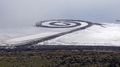 Spiral Jetty, Utah, US
 -
 Partially Buried Woodshed plaque, Kent, OH, US
 -
 Partially Buried Woodshed remains, Kent, OH, US


References
[edit]- ^ Cummings, Paul, "Interview with Robert Smithson", Archive of American Artists oral history webpage, conducted July 14 and 19, 1972. Retrieved July 16, 2013.
- ^ Paul, Serge (December 20, 2021). "Robert Smithson: Birth of an Artist". Linea (Art Students League of New York). Retrieved January 3, 2022.
- ^ Chilvers, Ian & Glaves-Smith, John eds., Dictionary of Modern and Contemporary Art , Oxford: Oxford University Press, 2009. p. 664
- ^ McGill, Douglas C. (December 22, 1984). "Museum Closing Art School". The New York Times. ISSN 0362-4331. Retrieved November 9, 2020.
- ^ a b Tsai, Eugenie (1991). Robert Smithson Unearthed: Drawings, Collages, Writings. New York: Columbia University Press. ISBN 0-231-07259-7.
- ^ From the Earth, but Never Limited by It, NY Times, 2005, retrieved October 21, 2009
- ^ a b Roberts, Jennifer L. (2004). Mirror Travels: Robert Smithson and History. New Haven: Yale University Press. ISBN 0-300-09497-3.
- ^ a b c d e f g h i j Hobbs, Robert (1981). Robert Smithson: Sculpture. Ithaca, NY: Cornell University Press. ISBN 0-8014-1324-9.
- ^ a b c d e f g h i j k Smithson, Robert (1979). Holt, Nancy (ed.). The Writings of Robert Smithson: Essays with Illustrations. New York NY: New York University Press. ISBN 9780814733943.
- ^ a b c Reynolds, Ann (2003). Robert Smithson: Learning from New Jersey and Elsewhere. Cambridge, MA: MIT Press. ISBN 0-262-18227-0.
- ^ (Smithson 1969),
- ^ a b c d Martin, Timothy D. "Robert Smithson and the Anglo-American Picturesque" (PDF). Getty (2011). Retrieved June 11, 2019.
- ^ "Sight/non-sight: Robert Smithson and photography, 1997 | Chris McAuliffe". June 28, 2014. Retrieved March 16, 2019.
- ^ "Virginia Dwan". Robert Rauschenberg Foundation. September 16, 2016. Retrieved March 16, 2019.
- ^ a b (Smithson 1996, p. 160).
- ^ (Smithson 1996, pp. 169–170).
- ^ (Smithson 1996, p. 165).
- ^ (Smithson 1996, p. 170).
- ^ (Smithson 1996, p. 159)
- ^ (Smithson 1996, p. 158).
- ^ (Smithson 1996, p. 163).
- ^ Johnson, Kirk (March 28, 2008). "Plans to Mix Oil Drilling and Art Clash in Utah". New York Times. Retrieved June 17, 2019.
- ^ "Partially Buried Woodshed". RobertSmithson.com. Archived from the original on March 4, 2018. Retrieved October 4, 2018.
- ^ "Robert I. Smithson, Partially Buried Woodshed papers". Kent State University Special Collections and Archives. April 2017. Retrieved October 3, 2018.
- ^ Tuchman, Phyllis (January 27, 2017). "How Do You Sell a Work of Art Built Into the Earth?". The New York Times. Retrieved January 31, 2017.
- ^ Shanken, Edward A. (2013). "Broken Circle &/ Spiral Hill?: Smithson's spirals, pata- physics, syzygy and survival" (PDF). Technoetic Arts: A Journal of Speculative Research. 11 (1): 3–14. doi:10.1386/tear.11.1.3_1. Retrieved June 17, 2019.
- ^ "Robert Smithson". Museum of Modern Art Collections. Retrieved June 17, 2019.
- ^ "Robert Smithson". Smithsonian American Art Museum Collection. Retrieved June 17, 2019.
- ^ "Robert Smithson". Guggenheim Museum Collection. Retrieved June 17, 2019.
- ^ "Robert Smithson". Whitney Museum of American Art Collection. Retrieved June 17, 2019.
- ^ "Robert Smithson, 35, A Sculptor, Is Dead". The New York Times. New York City. July 24, 1973.
- ^ a b "Amarillo Ramp". visitamarillo.com. Retrieved February 13, 2021.
- ^ "FTW74AF004". National Transportation Safety Board. Retrieved February 13, 2021.
- ^ "Amarillo Ramp". Holt/Smith Foundation. Retrieved February 13, 2021.
- ^ "Holt/Smithson Foundation". Holt-Smithson Foundation.
Bibliography
[edit]- Halley, Peter (May 1981), "Beat, Minimalism, New Wave, and Robert Smithson", Arts Magazine, New York
- Halley, Peter (1985), Robert Smithson: The Early Work 1959 - 1962, New York: Diane Brown Gallery, OCLC 11987681
- Busch, Julia M. (1974), A Decade of Sculpture: the New Media in the 1960s, Philadelphia: The Art Alliance Press, ISBN 0-87982-007-1, OCLC 804815
- Kimmelman, Michael (June 24, 2005), "Sculpture From the Earth, But Never Limited by It", The New York Times. Retrieved June 2, 2007.
- Smithson, Robert (1969), "Incidents of mirror-travel in the Yucatan", Artforum, vol. VIII, no. 1, ISSN 0004-3532, OCLC 1514329
- Smithson, Robert (1996), Flam, Jack D. (ed.), Robert Smithson: The Collected Writings, Berkeley: University of California Press, OCLC 32853450
- Roberts, Jennifer L. (September 2000), "Landscapes of Indifference: Robert Smithson and John Lloyd Stephens in Yucatan", The Art Bulletin
- Ingrid Commandeur and Trudy van Riemsdijk-Zandee: Robert Smithson: Art in Continual Movement. Alauda Publications, Amsterdam (2012), ISBN 978-90-815314-8-1
- Schwendener, Martha (June 29, 2012), "New Jersey Images, Unbound by Galleries", New York Times
- Crow, Thomas (2005), Robert Smithson (exhibition catalog), Los Angeles and Berkeley, California: The Museum of Contemporary Art, Los Angeles and the University of California Press, Berkeley, ISBN 0-520-24408-7
External links
[edit]
| International | |
|---|---|
| National | |
| Academics | |
| Artists | |
| People | |
| Other | |

Robert Smithson
View on GrokipediaBiography
Early life and education
Robert Smithson was born Robert Irving Smithson on January 2, 1938, in Passaic, New Jersey, to parents Irving Smithson and Susan Duke Smithson.[7] [8] The family relocated shortly after his birth to Rutherford, New Jersey, and later to Clifton when Smithson was nine years old, where his suburban surroundings began shaping his perceptions of industrial and natural landscapes.[5] From an early age, he demonstrated a strong interest in drawing and visual arts, influenced by his environment in northern New Jersey.[9] Smithson attended high school in Clifton during the mid-1950s, supplementing his studies with part-time art classes in New York City, including sessions at institutions such as the Art Students League.[10] [1] [11] These experiences exposed him to urban artistic circles and diverse techniques in painting and graphics, fostering his initial experiments with abstract forms.[11] He did not enroll in a formal college program, instead pursuing independent artistic development through practical engagement and observation.[10]Personal life and relationships
Smithson married artist Nancy Holt on December 15, 1963.[12] Holt, also born in 1938, specialized in land art, conceptual works, and filmmaking, and the couple frequently collaborated on artistic endeavors, including site explorations that influenced their respective practices.[13] They resided primarily in New York City, immersing themselves in the contemporary art community amid the rise of minimalism and earthworks.[1] The marriage lasted until Smithson's death on July 20, 1973, when he was 35 years old.[5] He perished in a small plane crash near Amarillo, Texas, during an aerial survey for the proposed earthwork Amarillo Ramp.[14] Holt, who never remarried, subsequently oversaw the completion of Amarillo Ramp with assistance from artists Richard Serra and Tony Shafrazi, and managed Smithson's estate for the remainder of her life.[10] No children resulted from the union, and Smithson's personal relationships beyond his marriage remain undocumented in primary biographical accounts.[12]Artistic Evolution
Early experiments in painting and sculpture
Smithson commenced his artistic practice in the late 1950s, primarily through paintings, drawings, and collages influenced by science fiction, popular culture, poetry, and art historical references. After receiving a scholarship to study at the Art Students League in New York City in 1954, he moved to the city in 1957 and held his first solo exhibition that year in art dealer Alan Brilliant's apartment, displaying paintings and works on paper.[5][1] In 1959, Smithson mounted his debut public solo exhibition at the Artists' Gallery in New York, featuring 16 paintings characterized in contemporary reviews as "painted collages" that incorporated literary and fantastical motifs, including dinosaurs and flesh-eating imagery. These works reflected his engagement with surreal and narrative elements drawn from New Jersey landscapes and broader cultural sources. A 1961 solo exhibition at Galleria George Lester in Rome extended these explorations to themes of Western civilization's origins and artistic precedents.[5][12][15] By the mid-1960s, Smithson shifted toward sculpture, producing quasi-minimalist pieces in 1964 using industrial materials such as metal and mirrored plexiglass to create geometric forms. These early sculptural experiments, which he exhibited at the American Express Pavilion during the 1965 New York World's Fair, marked a departure from two-dimensional media toward abstracted, site-oriented constructions that prefigured his later critiques of institutional display.[5][1][16]Engagement with minimalism and institutional critique
In the mid-1960s, Smithson produced sculptures incorporating geometric forms and industrial materials akin to those of minimalist artists such as Donald Judd and Carl Andre, but he infused them with crystalline structures and reflective elements to evoke entropy and displacement rather than pure objecthood.[17] His early works, including pieces with mirrors and glass, echoed minimalism's emphasis on materiality and viewer perception while challenging its perceived stasis by introducing notions of fragmentation and site-specificity.[18] By 1968, Smithson developed the Non-Sites series, consisting of steel bins filled with geological materials collected from specific outdoor locations, such as Non-Site (Palisades-Edgewater, N.J.), which abstracted landscape elements into gallery-contained forms.[19] These works engaged minimalism's dialectic of form and space but critiqued its confinement to indoor, commodifiable objects by establishing a conceptual tension between the "site" (the raw, entropic external environment) and the "non-site" (the sanitized gallery representation), thereby questioning the minimalist object's isolation from temporal decay and contextual reality.[17][20] Smithson viewed such indoor displays as limiting art's potential, arguing that minimalism's focus on immediate presence overlooked the dialectical processes of accumulation and erosion inherent in natural and industrial sites.[21] Smithson's institutional critique intensified through actions that bypassed traditional exhibition venues, such as the 1967 Asphalt Rundown, where liquid asphalt was poured into an Italian quarry, emphasizing process and site over gallery commodification.[17] In his 1972 essay "Cultural Confinement," he contended that curators and museums impose artificial limits on art, treating exhibitions as static containers that suppress artists' autonomy and the work's engagement with broader cultural entropy, rather than allowing site-determined expansions.[22][23] This perspective positioned institutions as "spaces of cultural confinement," where minimalist objects were reduced to inert commodities, prompting Smithson to advocate for art's dispersal into unpredictable, non-institutional terrains.[24] His mirror displacements, like the 1969 Yucatan Mirror Displacements, further exemplified this by scattering mirrors in remote landscapes to shatter perceptual unity and institutional framing, reflecting fragmented environs that defied gallery-bound minimalism.[25]Development of earthworks and site-specific interventions
In the mid-1960s, Smithson began transitioning from studio-based sculptures influenced by minimalism to explorations of landscape and entropy, prompted by trips to disrupted industrial sites such as quarries in New Jersey.[17] These excursions, starting around 1966, informed his conception of "sites" as expansive, mutable outdoor locations with "open limits," contrasting with the "closed limits" of gallery spaces.[17] By 1967, he documented entropic urban peripheries in projects like The Monuments of Passaic, New Jersey, photographing construction sites and sandboxes as ruins-in-progress, emphasizing decay over permanence.[17][10] This shift culminated in the development of the site/nonsite dialectic in 1968, where nonsites—indoor installations comprising bins of earth, rocks, and maps from specific locales—served as abstract representations of absent sites, bridging gallery art with external interventions.[5][17] Exemplified by Nonsite (Franklin, New Jersey), these works used geological samples to evoke the site's temporal processes, challenging minimalism's static forms by incorporating real-world materials and documentation like photographs and coordinates.[5] Smithson's writings, such as "Entropy and the New Monuments" (1966) and "A Sedimentation of the Mind: Earth Projects" (1968), theorized this approach, drawing on crystallography and industrial decay to argue for art's integration with landscape entropy rather than isolation in institutions.[5][10] Early site-specific interventions emerged through exhibitions like Earth Works at Dwan Gallery in 1968 and Earth Arts at Cornell University in 1969, where Smithson presented indoor earthworks using sand, gravel, and mirrors to simulate outdoor displacements.[5] These paved the way for outdoor actions in 1969, including Asphalt Rundown in a Roman quarry, where 300 tons of hot asphalt were poured downhill to merge with the terrain, and Glue Pour in a Canadian gravel pit, testing material flow and site transformation via industrial processes.[10][5] By selecting marginal, post-industrial locations, Smithson emphasized causal interactions between human intervention and natural entropy, rejecting pristine landscapes for sites already marked by disruption.[17] This methodology extended to conceptual mappings, such as Six Stops on a Section (1968), a 63-mile transect across New Jersey documented via photographs and samples, highlighting the dialectic's mobility.[17] Smithson's earthworks developed as anti-monumental responses to institutional constraints, prioritizing impermanence and viewer engagement with remote scales over commodifiable objects.[10] Projects like Site/Nonsite: Bayonne, Line of Wreckage (1968) incorporated broken concrete from urban debris, underscoring his preference for "collapsing systems" over idealized forms.[17] This phase, spanning 1966–1969, laid the groundwork for larger-scale interventions by 1970, integrating machinery, geology, and photography to realize site-specific art as a dynamic, site-determined practice.[5][17]Theoretical Framework
Core concepts: Entropy, sites, and non-sites
Smithson's engagement with entropy drew from thermodynamic principles, particularly the second law describing irreversible increases in disorder, which he applied to critique minimalist sculpture's apparent permanence. In his 1966 essay "Entropy and the New Monuments," published in Artforum in June 1967, he argued that contemporary works by artists like Donald Judd and Sol LeWitt embodied entropic tendencies through their crystalline forms and inevitable decay, contrasting them with classical monuments aspiring to eternity.[26] Smithson viewed entropy not as decline but as a generative force in art, evident in industrial ruins and geological processes, where structures devolve into "mistakes and dead-ends" over time, fostering a "new kind of monumentality" aligned with vectoral geometry and crystallography rather than heroic stasis.[26][27] Central to this framework were Smithson's distinctions between sites and non-sites, introduced in his 1968 series of works and elaborated in writings such as "A Provisional Theory of Nonsites." A site referred to the "physical, raw reality" of an outdoor location—often marginal landscapes like quarries, landfills, or industrial wastelands in New Jersey—selected for their entropic qualities of erosion, accumulation, and temporal flux.[28][29] In contrast, a non-site was an indoor installation comprising abstracted fragments—such as bins of quarried stone, sand, or maps—from the site, functioning as a "three-dimensional logical picture" that displaced and represented the site's entropy within the gallery's sterile space.[28][30] These concepts operated dialectically: non-sites negated the gallery's perceptual autonomy by directing attention outward to the site, while sites gained conceptual depth through their partial abstraction in non-sites, embodying energy dissipation akin to entropic processes.[19] For instance, in Nonsite (Franklin, New Jersey) (1968), Smithson transported zinc mine tailings into galvanized steel bins accompanied by a site map, creating a tension between the materials' geological origin and their commodified display, underscoring entropy's role in cultural and spatial fragmentation.[31] This dialectic critiqued institutional containment of art, privileging the site's uncontrolled decay over the non-site's ordered mimicry, and influenced later earthworks by integrating theoretical abstraction with material displacement.[10][32]Writings on landscape, ruins, and cultural entropy
Smithson's essay "Entropy and the New Monuments," published in Artforum in June 1966, posits that modern art and architecture, particularly minimalist works by artists such as Donald Judd, Dan Flavin, and Sol LeWitt, function as monuments to entropy rather than timeless ideals, utilizing materials like plastic and chrome to evoke energy dissipation and cultural stagnation.[26] He describes these forms as embodying "inactive history," contrasting with classical monuments by embracing inevitable decay, such as in the Union Carbide building's lobby, which he compares to a tomb-like ruin amid plastic exhibits symbolizing petrified rivers.[26] Landscapes of urban sprawl and "slurbs"—hybrid suburban-industrial zones—are presented as entropic terrains of sameness, where power blackouts and glassy structures foreshadow technological collapse and cultural homogenization.[26] In "A Tour of the Monuments of Passaic, New Jersey," published in Artforum in December 1967, Smithson chronicles a bus trip through Passaic's industrial fringes on October 30, 1967, identifying everyday sites like enormous sandboxes, concrete pipes, and the Great Pipe Monument as inverted ruins that initiate entropy from states of disuse rather than culminating in it.[33] These "monuments" in the suburban wasteland illustrate cultural entropy through stalled entropy in action, where barriers of development and forgotten infrastructure reflect a dialectic of construction and dissolution, devoid of heroic narratives.[34] The essay underscores Passaic's landscape as a site of perpetual limbo, with elements like wooden sidewalks and bridges embodying the slow dispersal of cultural energy into obsolescence.[35] Smithson's 1968 Artforum piece "A Sedimentation of the Mind: Earth Projects" integrates landscape with cognitive processes, arguing that the earth's surface and mental constructs disintegrate via sedimentation, mirroring entropy in both natural erosion and idea decomposition into "stones of unknowing."[36] He references ruined English abbeys and castles as landscapes where decay evokes artistic appreciation, countering Greenberg's view of their "gray and dim" allure, and critiques the technological aversion to rust as a bias favoring steel's false permanence over entropic ruin.[36] Cultural entropy emerges in this framework as a geological-mental affinity, where landscape gardens and earth projects disrupt linear time, depositing gritty reason from conceptual crystallizations and privileging raw processes like tar pools over sanitized forms.[36] Across these texts, Smithson reframes ruins not as failures of culture but as proactive emblems of entropy, challenging progressivist illusions by locating artistic vitality in landscapes of industrial decay and suburban entropy, where monuments arise from dispersion rather than aggregation.[37]Influences from Olmsted, crystallography, and industrial decay
Smithson's theoretical engagement with Frederick Law Olmsted centered on the landscape architect's dialectical approach to terrain, as articulated in his 1973 essay "Frederick Law Olmsted and the Dialectical Landscape," published posthumously in Artforum. He interpreted Olmsted's designs, such as Central Park—where an estimated ten million horse-cart loads of earth were relocated to reshape the site—as precursors to earthworks, emphasizing physical manipulation over idealized pastoralism.[38] Olmsted's integration of urban disruption and natural processes, including entropy through ongoing site transformations, resonated with Smithson's rejection of static monuments in favor of landscapes embodying contradiction and change, as seen in his own interventions like displacing earth in remote, altered environments.[38] Crystallography informed Smithson's conceptualization of time as non-biological and repetitive, drawing from crystal lattice structures that replicate molecularly without linear progression, a motif evident in his early rock-hunting expeditions and 1960s writings. He developed the "time-crystal" idea to denote suspended, deranged temporality—evoking vortices and infinite extension—contrasting organic decay with geometric abstraction, as in his 1969 Earth Art exhibition materials and 1971 work Rocks and Mirror Square II, which gridded Triassic basalt (aged 200–250 million years) via mirrors to simulate lattice infinity.[39] This influence bridged his site/nonsite dialectic, where crystalline displacement mapped entropy's stasis against geological strata, prioritizing structural repetition over evolutionary narratives.[39] Smithson's fascination with industrial decay stemmed from thermodynamic entropy, formalized in his June 1966 Artforum essay "Entropy and the New Monuments," where he critiqued modernist architecture's sterile uniformity as accelerating toward sameness and purposeless dispersal, per the Second Law of Thermodynamics. His September 30, 1967, "Tour of the Monuments of Passaic, New Jersey," documented deindustrialized sites—like polluted rivers and abandoned infrastructure—as "ruins in reverse," sites of dissipated energy and lost historical potential amid suburban sprawl.[26] [33] These observations shaped his preference for marginal, entropic loci over pristine venues, informing nonsites as abstracted remnants of decay and earthworks as engagements with material dissolution rather than preservation.[26]Major Works and Projects
Spiral Jetty (1970)
Robert Smithson constructed Spiral Jetty in April 1970 at Rozel Point on the northeastern shore of the Great Salt Lake in Utah.[3] The earthwork consists of black basalt rocks, earth, sand, and precipitated salt crystals displaced from the site, forming a counterclockwise coil extending 1,500 feet in length and 15 feet in width if unwound.[4] Smithson directed a crew using bulldozers to arrange over 6,000 tons of local basalt and lakebed materials into the spiral shape, which protrudes into the lake's shallow waters.[4] The work was built during a period of historically low water levels in the lake due to drought conditions.[4] The jetty's visibility has fluctuated with Great Salt Lake water levels, which are influenced by precipitation, evaporation, and regional hydrology. Following construction, rising lake levels submerged the structure in 1972, rendering it largely invisible for approximately 30 years.[40] It partially reemerged briefly in the mid-1990s before full visibility returned in 2002 amid another drought that receded the water.[41] As of 2022, the jetty remained exposed, though ongoing lake fluctuations continue to affect its appearance, with salt encrustations forming on the rocks during dry periods.[42] In Smithson's theoretical framework, Spiral Jetty exemplifies his concepts of entropy and site-specificity, where the artwork integrates with and deteriorates alongside its natural environment, embodying processes of decay and material transformation rather than static preservation.[43] He documented the project in a 1970 film and a 1972 essay titled "The Spiral Jetty," describing the work as a dialectic between site (the actual landscape) and non-site (abstract representations), heightened by the lake's crystalline formations and industrial remnants nearby.[44] The spiral form draws from prehistoric fossils, geological spirals, and Smithson's interest in crystallography and ruins, positioning the jetty as a counterpoint to urban entropy through its immersion in a remote, entropic ecosystem.[45] Since 1999, the Dia Art Foundation has owned the work, facilitating access via a dirt road while emphasizing its vulnerability to environmental changes.[4]Partially Buried Woodshed (1970)
Partially Buried Woodshed was created by Robert Smithson in January 1970 during a one-week artist residency at Kent State University in Kent, Ohio.[46] The work involved selecting an existing abandoned woodshed on campus and burying it under twenty truckloads of dirt piled against one side until the central roof beam cracked under the weight, initiating structural collapse.[47] This earthwork exemplified Smithson's interest in entropy and the natural processes of decay, transforming a utilitarian structure into a site of inevitable decomposition.[48] The piece aligned with Smithson's broader exploration of site-specific interventions, where he manipulated found structures to highlight themes of ruin and cultural entropy, distinct from traditional sculpture by emphasizing temporal transformation over permanence.[49] Prior to installation, Smithson had expressed a desire to bury buildings to observe their breakdown, viewing the act as a confrontation with architectural obsolescence amid industrial landscapes.[48] Created months before the May 4, 1970, Kent State shootings, in which National Guardsmen killed four students during anti-war protests, the work later acquired unintended symbolic resonance. Students interpreted the partially entombed shed as a metaphor for the buried victims, dubbing it an unofficial memorial and incorporating it into campus remembrance activities.[47] Smithson himself noted the beam's cracking as a marker of "death" in the structure's lifecycle, but the post-shooting associations amplified its role in collective mourning without his direct involvement.[49] Over time, the site deteriorated further: the woodshed was partially burned in 1975, likely by arson, leaving fragmented ruins amid overgrown earth.[48] Preservation debates ensued, with the Holt/Smithson Foundation advocating for its entropic integrity against restoration efforts that might contradict Smithson's conceptual intent. In 1984, the remaining structure was cleared anonymously, reducing the installation to its earthen mound and foundation.[50] Today, the site retains a commemorative plaque detailing the work's history, accessible on Kent State grounds as a relic of land art's impermanence.[51]Broken Circle/Spiral Hill (1971)
Broken Circle/Spiral Hill is an earthwork sculpture consisting of two interconnected elements: a semi-circular jetty known as Broken Circle, extending into a quarry lake, and an adjacent Spiral Hill rising from the surrounding terrain.[52] Constructed in 1971 in a sand quarry located in Emmen, Drenthe, Netherlands, the work measures 140 feet (42.6 meters) in diameter for the Broken Circle, with its central canal 12 feet (3.6 meters) wide and 10-15 feet (3-4.5 meters) deep, while the Spiral Hill has a base diameter of 75 feet (22.9 meters).[52] Materials include earth, topsoil, sand, water from the quarry lake, and a large glacial boulder positioned at the Broken Circle's center.[52] [53] The project was commissioned for the Sonsbeek outdoor sculpture exhibition, with Smithson invited by curator Wim Beeren, and completed in June 1971 through excavation into the quarry's shoreline and the side of a terminal moraine adjacent to an active sand-mining operation.[54] [53] Smithson oversaw the carving of dikes to form an interlocking canal and jetty in the Broken Circle, which was flooded by the lake, while the Spiral Hill was formed by piling earth into a conical mound with a counterclockwise spiraling path ascending to its summit, offering views of the quarry and water feature.[52] [53] This site-specific intervention represents Smithson's sole realized earthwork outside the United States and his only full-fledged "reclamation piece," integrating art with ongoing industrial extraction.[53] [55] Conceptually, the work embodies Smithson's interest in entropy and the transformation of postindustrial landscapes, positioning artists alongside miners as geological agents who reshape exhausted sites through irreversible processes akin to natural decay and reclamation.[52] [55] He advocated for earth art in such "devastated areas" to recycle land and water, critiquing economic abstractions that ignore material fluxes and proposing artistic interventions as mediators between destruction and renewal.[52] The juxtaposition of the static boulder, dynamic water, and artificial hill evokes prehistoric and industrial timescales, with the site's ongoing erosion underscoring entropic dissipation over preservation.[55] [53] Ownership remains private, but the work opened to the public in 2021 following preservation efforts, including a cultural-historical valuation in 2023 and its designation as a provincial monument by the Province of Drenthe in 2025.[53] [52] These measures address erosion and potential threats from resumed mining, aligning with Smithson's widow Nancy Holt's advocacy for restoration to maintain the site's integrity against natural and human-induced changes.[53]Additional Contributions
Films, photography, and unrealized proposals
Smithson produced films that documented his earthworks while exploring themes of entropy, geological time, and site-specific intervention. His best-known film, Spiral Jetty (1970, 32 minutes), was shot upon his return to New York after constructing the Utah earthwork in April 1970; it intercuts footage of the site's construction, black-and-white clips of industrial processes, and color sequences of the spiral's form amid fluctuating water levels, emphasizing dialectical tensions between creation and dissolution.[56] In collaboration with Nancy Holt, he created shorter works such as Swamp (1971, 6 minutes), which records their traversal of a New Jersey swamp using a rowboat to probe organic decay and stasis, and Mono Lake (filmed 1968, 20 minutes), depicting calcium carbonate formations and tufa towers in California to highlight crystalline entropy and non-anthropocentric landscapes.[57] Smithson also developed Hotel Palenque (1972), a narrated slide projection documenting ruins of a decaying Mexican hotel, functioning as a proto-cinematic essay on architectural entropy and cultural obsolescence, presented at the Whitney Museum.[58] Photography served as a core medium in Smithson's practice, often bridging his "sites" (actual landscapes) and "non-sites" (abstracted indoor displacements), with images functioning as maps, sequences, or reflective interventions rather than mere documentation. The Yucatan Mirror Displacements series (1969), comprising nine black-and-white photographs, records mirrors temporarily embedded in Yucatan jungle and beach terrains to fragment and multiply the environment, critiquing perceptual displacement and mirroring industrial fragmentation in natural contexts.[25] His photographic output included collages, montages, photostats, and sequences derived from original negatives, as cataloged in exhibitions emphasizing photography's role in inventing "many worlds" through ontological layering, distinct from straightforward representation.[59] These works, produced from the mid-1960s onward, integrated science fiction influences and Pop Art clippings into early collages, evolving into site explorations that paralleled his sculptural concerns with ruins and industrial decay.[60] Smithson's unrealized proposals extended his earthwork ambitions into speculative realms, often proposing interventions in remote or industrial sites that interrogated entropy, accessibility, and human scale against geological permanence. The Amarillo Ramp (proposed 1970), a 500-foot concrete spiral ramp ascending a Texas quarry pit, was designed as a continuous, non-monumental form to evoke vehicular entropy and site exhaustion; though unrealized during his lifetime due to logistical challenges, it was posthumously constructed in 1973 by the Holt/Smithson Foundation.[61] Earlier concepts included the Island of Broken Glass (circa 1969), envisioning 100 tons of shattered glass dumped on a Hudson River island to create a reflective, hazardous expanse mimicking crystalline growth and cultural debris accumulation, rejected for environmental and safety concerns.[62] Other schemes, such as Floating Island to Travel Around Manhattan Island (1970), proposed a barge with transplanted trees circling New York waterways to contrast urban stasis with natural flux, and a "Cinema Cavern" for immersive, spelunk-like film viewing amid underground entropy, both abandoned due to funding and feasibility issues.[63][64] These projects, sketched in writings and drawings, underscored Smithson's preference for provisional, site-contingent ideas over permanent realization, influencing later land art discourse on unbuilt potential.[65]Aerial art and conceptual extensions
In 1969, Robert Smithson published the essay "Aerial Art" in Studio International, proposing a new genre of land-based sculpture designed for perception from aircraft altitudes, emphasizing abstraction and the disorientation of scale induced by air travel.[66] He argued that such works should engage the total architectural environment of airports, transforming runways and terminals into sites where art blurs the boundaries between visible earthworks and conceptual remoteness, akin to viewing distant galaxies.[66] This framework extended his site/nonsite dialectic to aerial perspectives, where physical forms become abstract patterns discernible only from high altitudes, privileging entropy and industrial vastness over pedestrian accessibility.[67] Smithson's proposals for the Dallas-Fort Worth Regional Airport exemplified these ideas, envisioning earthworks integrated into 11,000-to-14,000-foot runways comparable in length to Central Park.[66] His own design featured triangular concrete pavements arranged in a scalable spiral pattern, while collaborators like Robert Morris suggested a 1,000-foot-radius sod-covered earth mound, Carl Andre a bomb crater or field of bluebonnets, and Sol LeWitt a buried concrete cube with undisclosed contents to prioritize idea over object.[66] These unrealized projects positioned airports as "artificial universes," where aerial photography and flight paths reveal shifting, non-objective landscapes, detached from ground-level naturalism.[66] The conceptual reach of aerial art influenced Smithson's earthworks, as seen in his use of airplane surveys to site projects like the Amarillo Ramp in Texas, a 140-foot-diameter concrete spiral completed posthumously in 1973 after his July 20, 1973, plane crash during aerial reconnaissance.[68] Films such as Spiral Jetty (1970) incorporated aerial footage to convey the work's environmental scale and temporal flux, interspersing maps and high-altitude shots with construction sequences.[45] Similarly, preparatory aerial drawings informed Broken Circle/Spiral Hill (1971), underscoring how flight enabled macroscopic views that intertwined microscopic details with geological entropy.[69] These extensions critiqued terrestrial art's limitations, advocating for works that embody the mobility and abstraction of modern aviation, where viewer detachment fosters a perceptual entropy mirroring cultural and physical decay.[67] Smithson's aerial focus anticipated land art's globalization, linking local sites to transnational scales via air routes, though environmental critiques later highlighted aviation's ecological footprint in amplifying such visions.[67]Criticisms and Controversies
Environmental impact and ecological debates
Smithson's Spiral Jetty (1970), constructed by displacing approximately 6,650 tons of black basalt rock and earth from the Great Salt Lake shoreline, involved temporary heavy machinery use but utilized exclusively local materials, resulting in negligible long-term alteration to the site's geology beyond the artwork's form.[70] The 1,500-foot-long spiral integrates with the lake's saline environment, periodically submerging under rising water levels—such as during the 30-year period from the mid-1970s to 2002—and reemerging amid droughts, reflecting natural hydrological cycles influenced by regional water management and climate variability rather than the artwork itself.[71] Similarly, Broken Circle/Spiral Hill (1971), sited in a pre-existing sand quarry in Emmen, Netherlands, repurposed disturbed land by excavating dikes to form interlocking water features, with no reported significant ecological disruption beyond initial earthmoving.[52] Ecological debates surrounding Smithson's earthworks center on their philosophical embrace of entropy over preservationist ideals, positioning them as exemplars of "negative ecology"—a framework that rejects anthropocentric sustainability narratives in favor of acknowledging irreversible decay and systemic limits amid the climate crisis.[71] Critics have labeled such interventions as potential ecological vandalism, arguing they disrupt fragile ecosystems like the Great Salt Lake's hypersaline conditions and avian habitats, though empirical evidence of measurable harm remains limited and contested.[72] Defenders, including analyses from art and environmental scholars, contend that Smithson's site-specific approach—favoring industrial wastelands and quarries—avoids pristine habitats and instead dialectically engages landscape processes, challenging the illusion of human control over nature.[70] Preservation efforts have intersected with broader ecological concerns, as seen in 2008 opposition to proposed oil drilling five miles from Spiral Jetty, where advocates cited risks to lake chemistry and bird populations, leveraging the artwork's visibility to amplify calls against resource extraction despite the state's assurances of safeguards.[73] The Dia Art Foundation, owner of Spiral Jetty, monitors site conditions without intervening in natural submersion, aligning with Smithson's intent for the work to evolve through environmental forces, though this stance fuels ongoing contention between artistic impermanence and institutional imperatives for accessibility.[70] For Broken Circle/Spiral Hill, recent high groundwater submersion since February 2024 has prompted restricted access via low-impact bus excursions, underscoring adaptive management to balance visitation with minimal additional disturbance.[74] These cases highlight how Smithson's projects provoke reevaluation of land art's ethical footprint, weighing aesthetic intervention against ecological realism without substantiating claims of outsized environmental degradation.[75]Institutional and accessibility critiques
Smithson's site-specific earthworks, by design placed in remote industrial or natural locales, have drawn criticism for their limited physical accessibility, which restricts direct engagement to a narrow subset of viewers capable of arduous travel. The Spiral Jetty (1970), constructed on a peninsula in Utah's Great Salt Lake, requires visitors to navigate roughly 40 miles from Corinne, Utah, including 15 miles of unpaved, often impassable roads that become treacherous in wet conditions, effectively barring access during much of the year due to weather and lake fluctuations.[76] This isolation has been described as rendering the work "extremely inaccessible to the majority of the population," prioritizing perceptual immediacy over democratic availability and thereby excluding those without vehicles, time, or physical mobility.[77] Such remoteness has fueled broader accusations of elitism inherent in land art practices, where experiential immersion demands resources—financial, logistical, and corporeal—that privilege affluent, able-bodied audiences over the general public, including urban dwellers, the disabled, or low-income individuals unable to commit to multi-day expeditions. Critics contend this contravenes ideals of art's public utility, transforming Smithson's dialectic of site and entropy into a barrier rather than an invitation, with photographic or filmic representations serving as proxies that dilute the work's intended somatic impact.[10] Similar issues plague other projects, like the Amarillo Ramp (1971–1982), reachable only by off-road vehicle across Texas ranchland, underscoring how Smithson's rejection of urban venues perpetuated exclusionary dynamics despite his stated aim to disrupt commodified art circuits.[77] Institutionally, Smithson's antagonism toward museums—famously likening them to "cultural confinement" and mausoleums for static objects—has been faulted for engendering preservation dilemmas that necessitate ironic reliance on the very apparatuses he scorned. His earthworks' vulnerability to erosion, submersion, and overgrowth, absent gallery climate controls, has prompted interventions by entities like the Dia Art Foundation, which acquired Spiral Jetty in 1999 and debated vegetation removal in 2003 to restore visibility, actions critics argue impose curatorial agency contrary to Smithson's embrace of uncontrollable site processes and entropy as integral to the artwork's temporality.[24] This tension reveals a perceived hypocrisy: while Smithson's nonsites and essays mounted a radical institutional critique by relocating "site" into gallery bins of abstracted materials, the resulting non-monumental fragility invites bureaucratic stewardship that commodifies decay, potentially neutralizing the works' anti-institutional thrust through funding-dependent upkeep.[78]Philosophical and aesthetic disagreements
Smithson's rejection of formalist aesthetics, particularly as articulated by critics like Michael Fried and Clement Greenberg, centered on his advocacy for theatricality and temporal experience over optical purity and object autonomy. In a 1967 letter to Artforum, Smithson lambasted Fried's essay "Art and Objecthood" for waging a "war" against what Fried deemed the inherent theatricality of minimalist "literalist" art, portraying Fried as a "fanatical puritan" whose stance privileged illusionistic absorption at the expense of real-world engagement.[79] Smithson countered that art should embrace entropy and site-specific dialectics, where viewer perception unfolds through physical displacement and decay rather than static contemplation, directly challenging Greenberg's emphasis on flatness and medium specificity as outdated constraints on sculpture's expansion into landscape and process.[80] Philosophically, Smithson's entropic worldview provoked disputes over its scientific accuracy and implications for art's relation to nature. Drawing from the second law of thermodynamics, Smithson posited entropy as an amoral force driving "new monuments" toward inevitable disorder, as outlined in his 1966 essay "Entropy and the New Monuments," where he envisioned ruins predating construction to underscore art's alignment with cosmic dissipation over human permanence.[26] Critics, however, contended that Smithson's application was more poetic myth than precise physics, with Carter Ratcliff noting in 2024 that Smithson treated entropy as a personal emblem of inexorable decline without mastering its thermodynamic foundations, potentially romanticizing industrial waste over rigorous causal analysis.[27] This stance also clashed with ecological perspectives; Smithson dismissed environmentalism as sentimental moralizing, favoring entropy's neutral dissolution, a view Jennifer Peeples critiqued in 2021 for undermining activist responses to site degradation by suspending ethical will in favor of passive observation.[71] Aesthetic debates further highlighted tensions in Smithson's site/non-site dialectic, which posited gallery-bound "nonsites"—containers of displaced earth—as abstract maps pointing to remote, entropic "sites," thereby fracturing traditional representation. While Smithson intended this 1968 formulation to negate institutional framing and evoke perceptual displacement, some interpreters argued it inadvertently commodified absent landscapes, reducing dialectical tension to ironic gallery artifacts without fully escaping modernist containment.[81] Others, like Robert Hobbs, emphasized its unresolvable dialectics as a deliberate provocation against resolved formalism, though this openness invited charges of conceptual vagueness, where the nonsite's abstraction risked prioritizing intellectual mapping over visceral site encounter.[30]Death and Immediate Aftermath
Plane crash and unfinished works
On July 20, 1973, Robert Smithson, aged 35, died in a light aircraft crash near Amarillo, Texas, while surveying a site for his earthwork project known as Amarillo Ramp.[68] The Cessna 310 also claimed the lives of the pilot, Gale Ray Rogers, and the accompanying photographer.[68] Smithson had chartered the flight to evaluate the terrain on a ranch approximately 10 miles northwest of Amarillo, where he had already begun preliminary site marking by placing stakes to indicate elevation changes for the planned 140-foot-diameter spiral ramp rising 15 feet.[6] At the time of the crash, Amarillo Ramp remained unfinished, with only initial sketches and measurements documented by Smithson, including a hand-drawn diagram outlining the structure's coiled form constructed from local basalt and earth.[77] Following his death, the project was completed in August 1973 under the direction of his widow, Nancy Holt, with assistance from sculptor Richard Serra and dealer Tony Shafrazi, adhering to Smithson's specifications using over 200 dump truck loads of material.[61] This posthumous realization preserved the work's conceptual integrity, though access was restricted to guided tours on private land until its public opening in 2013.[82] Beyond Amarillo Ramp, Smithson left numerous unrealized proposals at his death, including conceptual earthworks documented in hundreds of drawings and writings, such as plans for site-specific interventions in industrial landscapes and expansive mirror displacements.[77] These unfinished projects, often tied to his interests in entropy, geological time, and non-site theory, influenced subsequent land art practices but were never executed due to his abrupt demise.[83] The crash not only halted immediate work but also shifted focus to the preservation and interpretation of his completed oeuvre, with institutions like the Dia Art Foundation later emphasizing the contingency of site-based art amid such interruptions.[84]
Legacy and Ongoing Impact
Preservation efforts and collections
The Dia Art Foundation assumed stewardship of Spiral Jetty (1970) following its donation in 1999 by Nancy Holt, Smithson's widow, and the Estate of Robert Smithson.[84] The foundation implements ongoing conservation measures, including systematic photographic documentation to track environmental changes and structural integrity over time.[85] On December 17, 2024, Spiral Jetty was listed on the National Register of Historic Places, affirming its status as a significant cultural landmark amid challenges from fluctuating Great Salt Lake water levels.[86] [87] The Holt/Smithson Foundation plays a central role in preserving other earthworks, such as Amarillo Ramp (1973), completed posthumously and now exposed in a dried-up basin where erosion has modified its form, aligning with Smithson's conceptual embrace of site-specific decay.[68] For Broken Circle/Spiral Hill (1971) in Emmen, Netherlands, maintenance efforts sustain the dual earthwork created for the Sonsbeek exhibition, with public access and educational resources highlighting its integration into the landscape.[54] [53] These initiatives balance preservation against the transient nature of land art, often complicated by natural forces like drought and weathering.[88] Smithson's indoor sculptures, drawings, and non-site installations reside in prominent institutional collections. The Dia Art Foundation holds five late-1960s indoor earthworks constructed with sand, gravel, mirrors, and glass.[89] The Solomon R. Guggenheim Museum preserves works tied to his site explorations, while the Metropolitan Museum of Art includes pieces like Mirrored Ziggurat (1967).[1] [90] The Whitney Museum of American Art and Museum of Modern Art maintain holdings of his sculptures and conceptual proposals, supporting scholarly access to his broader oeuvre.[16] [91] Archival materials, including papers spanning 1905–1987 (primarily 1952–1987), are digitized and housed at the Smithsonian's Archives of American Art.[92]