


Community hub
Landau's problems
View on Wikipedia
At the 1912 International Congress of Mathematicians, Edmund Landau listed four basic problems about prime numbers. These problems were characterised in his speech as "unattackable at the present state of mathematics" and are now known as Landau's problems. They are as follows:
- Goldbach's conjecture: Can every even integer greater than 2 be written as the sum of two primes?
- Twin prime conjecture: Are there infinitely many primes p such that p + 2 is prime?
- Legendre's conjecture: Does there always exist at least one prime between consecutive perfect squares?
- Are there infinitely many primes p such that p − 1 is a perfect square? In other words: Are there infinitely many primes of the form n2 + 1?
As of 2025[update], all four problems are unresolved.
Progress toward solutions
[edit]Goldbach's conjecture
[edit]Goldbach's weak conjecture, every odd number greater than 5 can be expressed as the sum of three primes, is a consequence of Goldbach's conjecture. Ivan Vinogradov proved it for large enough n (Vinogradov's theorem) in 1937,[1] and Harald Helfgott extended this to a full proof of Goldbach's weak conjecture in 2013.[2][3][4]
Chen's theorem, another weakening of Goldbach's conjecture, proves that for all sufficiently large n, where p is prime and q is either prime or semiprime.[note 1] Bordignon, Johnston, and Starichkova,[5] correcting and improving on Yamada,[6] proved an explicit version of Chen's theorem: every even number greater than is the sum of a prime and a product of at most two primes. Bordignon and Starichkova[7] reduce this to assuming the Generalized Riemann hypothesis (GRH) for Dirichlet L-functions. Johnston and Starichkova give a version working for all n ≥ 4 at the cost of using a number which is the product of at most 395 primes rather than a prime or semiprime; under GRH they improve 395 to 31.[8]



Montgomery and Vaughan showed that the exceptional set of even numbers not expressible as the sum of two primes has a density zero, although the set is not proven to be finite.[9] The best current bounds on the exceptional set is (for large enough x) due to Pintz,[10][11] and under RH, due to Goldston.[12]


Linnik proved that large enough even numbers could be expressed as the sum of two primes and some (ineffective) constant K of powers of 2.[13] Following many advances (see Pintz[14] for an overview), Pintz and Ruzsa[15] improved this to K = 8. Assuming the GRH, this can be improved to K = 7.[16]
Twin prime conjecture
[edit]In 2013 Yitang Zhang showed[17] that there are infinitely many prime pairs with gap bounded by 70 million, and this result has been improved to gaps of length 246 by a collaborative effort of the Polymath Project.[18] Under the generalized Elliott–Halberstam conjecture this was improved to 6, extending earlier work by Maynard[19] and Goldston, Pintz and Yıldırım.[20]
In 1966 Chen showed that there are infinitely many primes p (later called Chen primes) such that p + 2 is either a prime or a semiprime.
Legendre's conjecture
[edit]It suffices to check that each prime gap starting at p is smaller than . A table of maximal prime gaps shows that the conjecture holds to 264 ≈ 1.8×10¹⁹.[21] A counterexample near that size would require a prime gap a hundred million times the size of the average gap.

Järviniemi,[22] improving on work by Heath-Brown[23] and by Matomäki,[24] shows that there are at most exceptional primes followed by gaps larger than ; in particular,


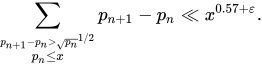
A result due to Ingham shows that there is a prime between and for every large enough n.[25]


Near-square primes
[edit]Landau's fourth problem asked whether there are infinitely many primes which are of the form for integer n. (The list of known primes of this form is A002496.) The existence of infinitely many such primes would follow as a consequence of other number-theoretic conjectures such as the Bunyakovsky conjecture and Bateman–Horn conjecture.

One example of near-square primes are Fermat primes. Henryk Iwaniec showed that there are infinitely many numbers of the form with at most two prime factors.[26][27] Ankeny[28] and Kubilius[29] proved that, assuming the extended Riemann hypothesis for L-functions on Hecke characters, there are infinitely many primes of the form with . Landau's conjecture is for the stronger . The best unconditional result is due to Harman and Lewis[30] and it gives . In 2024, Ben Green and Mehtaab Sawhney proved that infinitely many primes are of the form for any given or , noting that "the argument could surely be modified in a straightforward manner to handle arbitrary positive definite binary quadratic forms over ".[31]


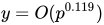


Grimmelt & Merikoski,[32] improving on previous works,[33][34][35][36][37][38] showed that there are infinitely many numbers of the form with greatest prime factor at least . Replacing the exponent with 2 would yield Landau's conjecture.

The Friedlander–Iwaniec theorem shows that infinitely many primes are of the form .[39]

Baier and Zhao[40] prove that there are infinitely many primes of the form with ; the exponent can be improved to under the Generalized Riemann Hypothesis for L-functions and to under a certain Elliott-Halberstam type hypothesis.


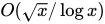
The Brun sieve establishes an upper bound on the density of primes having the form : there are such primes up to . Hence almost all numbers of the form are composite.

See also
[edit]Notes
[edit]- ^ A semiprime is a natural number that is the product of two prime factors.
References
[edit]- ^ Vinogradow, I. M. (November 2002). "Representation of an odd number as a sum of three primes". The Goldbach Conjecture. Series in Pure Mathematics. Vol. 4. World Scientific. pp. 61–64. doi:10.1142/9789812776600_0003. ISBN 978-981-238-159-0.
- ^ Helfgott, H.A. (2013). "Major arcs for Goldbach's theorem". arXiv:1305.2897 [math.NT].
- ^ Helfgott, H.A. (2012). "Minor arcs for Goldbach's problem". arXiv:1205.5252 [math.NT].
- ^ Helfgott, H.A. (2013). "The ternary Goldbach conjecture is true". arXiv:1312.7748 [math.NT].
- ^ Bordignon, Matteo; Johnston, Daniel R.; Starichkova, Valeriia (2022). "An explicit version of Chen's theorem". arXiv:2207.09452 [math.NT].
- ^ Yamada, Tomohiro (2015-11-11). "Explicit Chen's theorem". arXiv:1511.03409 [math.NT].
- ^ Bordignon, Matteo; Starichkova, Valeriia (2022). "An explicit version of Chen's theorem assuming the Generalized Riemann Hypothesis". arXiv:2211.08844 [math.NT].
- ^ Johnston, Daniel R.; Starichkova, Valeriia V. (2022). "Some explicit results on the sum of a prime and an almost prime". arXiv:2208.01229 [math.NT].
- ^ Montgomery, H. L.; Vaughan, R. C. (1975). "The exceptional set in Goldbach's problem" (PDF). Acta Arithmetica. 27: 353–370. doi:10.4064/aa-27-1-353-370.
- ^ Pintz, Janos (2018). "A new explicit formula in the additive theory of primes with applications II. The exceptional set in Goldbach's problem". arXiv:1804.09084 [math.NT].
- ^ Pintz, János. "An Approximate Formula for Goldbach's Problem with Applications" (PDF). mtak.hu.
- ^ Goldston, D.A. (1992). On Hardy and Littlewood's contribution to the Goldbach conjecture. Proceedings of the Amalfi Conference on Analytic Number Theory (Maiori, 1989). Università di Salerno. pp. 115–155.
- ^ Yu V Linnik, Prime numbers and powers of two, Trudy Matematicheskogo Instituta imeni VA Steklova 38 (1951), pp. 152-169.
- ^ János Pintz, Approximations to the Goldbach and twin prime problem and gaps between consecutive primes, Probability and Number Theory (Kanazawa, 2005), Advanced Studies in Pure Mathematics 49, pp. 323–365. Math. Soc. Japan, Tokyo, 2007.
- ^ Pintz, J.; Ruzsa, I. Z. (July 2020). "On Linnik's approximation to Goldbach's problem. II" (PDF). Acta Mathematica Hungarica. 161 (2): 569–582. doi:10.1007/s10474-020-01077-8. S2CID 225457520.
- ^ Heath-Brown, D.R.; Puchta, J.-C. (2002). "Integers Represented as a Sum of Primes and Powers of Two". arXiv:math/0201299.
- ^ Zhang, Yitang (May 2014). "Bounded gaps between primes". Annals of Mathematics. 179 (3): 1121–1174. doi:10.4007/annals.2014.179.3.7. ISSN 0003-486X.
- ^ D.H.J. Polymath (2014). "Variants of the Selberg sieve, and bounded intervals containing many primes". Research in the Mathematical Sciences. 1 (12) 12. arXiv:1407.4897. doi:10.1186/s40687-014-0012-7. MR 3373710. S2CID 119699189.
- ^ James, Maynard (2013). "Small gaps between primes". arXiv:1311.4600 [math.NT].
- ^ Alan Goldston, Daniel; Motohashi, Yoichi; Pintz, János; Yalçın Yıldırım, Cem (2006). "Small Gaps between Primes Exist". Proceedings of the Japan Academy, Series A. 82 (4): 61–65. arXiv:math/0505300. doi:10.3792/pjaa.82.61. S2CID 18847478.
- ^ Nicely, Thomas R. "First occurrence prime gaps". University of Lynchburg. Retrieved 2024-09-11.
- ^ Järviniemi, Olli (2022). "On large differences between consecutive primes". arXiv:2212.10965 [math.NT].
- ^ Heath-Brown, Roger (October 2020). "The Differences Between Consecutive Primes, V". International Mathematics Research Notices. 2021 (22): 17514–17562. arXiv:1906.09555. doi:10.1093/imrn/rnz295.
- ^ Matomaki, K. (2007). "Large differences between consecutive primes". The Quarterly Journal of Mathematics. 58 (4): 489–518. doi:10.1093/qmath/ham021. ISSN 0033-5606..
- ^ Ingham, A. E. (1937). "On the difference between consecutive primes". Quarterly Journal of Mathematics. 8 (1): 255–266. Bibcode:1937QJMat...8..255I. doi:10.1093/qmath/os-8.1.255.
- ^ Iwaniec, Henryk (1978). "Almost-primes represented by quadratic polynomials". Inventiones Mathematicae. 47 (2): 171–188. Bibcode:1978InMat..47..171I. doi:10.1007/BF01578070. ISSN 0020-9910. S2CID 122656097.
- ^ Lemke Oliver, Robert J. (2012). "Almost-primes represented by quadratic polynomials". Acta Arithmetica. 151 (3): 241–261. doi:10.4064/aa151-3-2. ISSN 0065-1036.
- ^ Ankeny, N. C. (October 1952). "Representations of Primes by Quadratic Forms". American Journal of Mathematics. 74 (4): 913–919. doi:10.2307/2372233. JSTOR 2372233.
- ^ Kubilius, J.P. (1955). "On a problem in the n-dimensional analytic theory of numbers". Viliniaus Valst. Univ. Mokslo dardai Chem. Moksly, Ser. 4: 5–43.
- ^ Harman, G.; Lewis, P. (2001). "Gaussian primes in narrow sectors". Mathematika. 48 (1–2): 119–135. doi:10.1112/S0025579300014388. S2CID 119730332.
- ^ Green, Ben; Sawhney, Mehtaab (2024). "Primes of the form $p^2 + nq^2$". arXiv:2410.04189 [math.NT].
- ^ Grimmelt, Lasse; Merikoski, Jori (2025). "On the greatest prime factor and uniform equidistribution of quadratic polynomials". arXiv:2505.00493 [math.NT].
- ^ Merikoski, Jori (2022). "Largest prime factor of ". Journal of the European Mathematical Society. 25 (4): 1253–1284. arXiv:1908.08816. doi:10.4171/jems/1216. ISSN 1435-9855.
- ^ de la Bretèche, Régis; Drappeau, Sary (2020). "Niveau de répartition des polynômes quadratiques et crible majorant pour les entiers friables". Journal of the European Mathematical Society. 22 (5): 1577–1624. arXiv:1703.03197. doi:10.4171/jems/951. ISSN 1435-9855. S2CID 146808221.
- ^ Jean-Marc Deshouillers and Henryk Iwaniec, On the greatest prime factor of , Annales de l'Institut Fourier 32:4 (1982), pp. 1–11.
- ^ Hooley, Christopher (July 1967). "On the greatest prime factor of a quadratic polynomial". Acta Mathematica. 117: 281–299. doi:10.1007/BF02395047.
- ^ Todd, John (1949). "A Problem on Arc Tangent Relations". The American Mathematical Monthly. 56 (8): 517–528. doi:10.2307/2305526. JSTOR 2305526.
- ^ J. Ivanov, Uber die Primteiler der Zahlen vonder Form A+x^2, Bull. Acad. Sci. St. Petersburg 3 (1895), 361–367.
- ^ Friedlander, John; Iwaniec, Henryk (1997). "Using a parity-sensitive sieve to count prime values of a polynomial". Proceedings of the National Academy of Sciences. 94 (4): 1054–1058. Bibcode:1997PNAS...94.1054F. doi:10.1073/pnas.94.4.1054. ISSN 0027-8424. PMC 19742. PMID 11038598..
- ^ Baier, Stephan; Zhao, Liangyi (2006). "Bombieri–Vinogradov type theorems for sparse sets of moduli". Acta Arithmetica. 125 (2): 187–201. arXiv:math/0602116. Bibcode:2006AcAri.125..187B. doi:10.4064/aa125-2-5. ISSN 0065-1036.
External links
[edit]Landau's problems
View on Grokipedia- Goldbach's conjecture: Every even integer greater than 2 can be expressed as the sum of two prime numbers. This problem, originally proposed by Christian Goldbach in 1742, has been verified computationally up to but lacks a general proof.[1][2]
- Twin prime conjecture: There are infinitely many pairs of prime numbers that differ by 2 (known as twin primes). Partial progress includes Yitang Zhang's 2013 result and subsequent improvements establishing infinitely many prime pairs differing by at most 246, with further theoretical advancements under additional assumptions.[1][2]
- Legendre's conjecture: For every positive integer , there exists at least one prime number between and . Formulated by Adrien-Marie Legendre in 1808, this has been confirmed for up to very large values, and Chen Jingrun proved in 1975 that there is always a prime or a product of two primes in this interval.[1][2]
- Primes of the form : There are infinitely many prime numbers of the form , where is a non-negative integer (examples include 2 for , 5 for , and 17 for ). First studied by Leonhard Euler in 1760, this conjecture is considered particularly resistant, with known primes becoming sparse as increases.[1][2]