Hubbry Logo
Natural densityNatural densityMain
Open search
Natural density
Community hub
Natural density
logo
7 pages, 0 posts
0 subscribers
Be the first to start a discussion here.
Natural density
Natural density
from Wikipedia

In number theory, natural density, also referred to as asymptotic density or arithmetic density, is a measure of how "large" a subset of the set of natural numbers is. It relies chiefly on the probability of encountering members of the desired subset when combing through the interval [1, n] as n grows large.

For example, it may seem intuitively that there are more positive integers than perfect squares, because every perfect square is already positive and yet many other positive integers exist besides. However, the set of positive integers is not in fact larger than the set of perfect squares: both sets are infinite and countable and can therefore be put in one-to-one correspondence. Nevertheless if one goes through the natural numbers, the squares become increasingly scarce. The notion of natural density makes this intuition precise for many, but not all, subsets of the naturals (see Schnirelmann density, which is similar to natural density but defined for all subsets of ).

If an integer is randomly selected from the interval [1, n], then the probability that it belongs to A is the ratio of the number of elements of A in [1, n] to the total number of elements in [1, n]. If this probability tends to some limit as n tends to infinity, then this limit is referred to as the asymptotic density of A. This notion can be understood as a kind of probability of choosing a number from the set A. Indeed, the asymptotic density (as well as some other types of densities) is studied in probabilistic number theory.

Definition

[edit]

A subset A of positive integers has natural density α if the proportion of elements of A among all natural numbers from 1 to n converges to α as n tends to infinity.

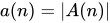
More explicitly, if one defines for any natural number n the counting function a(n) as the number of elements of A less than or equal to n, then the natural density of A being α exactly means that[1]

a(n)/nα as n → ∞.

It follows from the definition that if a set A has natural density α then 0 ≤ α ≤ 1.

Upper and lower asymptotic density

[edit]

Let be a subset of the set of natural numbers For any , define to be the intersection and let be the number of elements of less than or equal to .


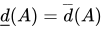
Define the upper asymptotic density of (also called the "upper density") by where lim sup is the limit superior.

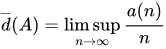
Similarly, define the lower asymptotic density of (also called the "lower density") by where lim inf is the limit inferior. One may say has asymptotic density if , in which case is equal to this common value.

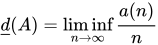
This definition can be restated in the following way: if this limit exists.[2]

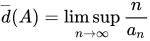
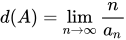
These definitions may equivalently[citation needed] be expressed in the following way. Given a subset of , write it as an increasing sequence indexed by the natural numbers: Then and if the limit exists.

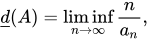
A somewhat weaker notion of density is the upper Banach density of a set This is defined as[citation needed]

Properties and examples

[edit]
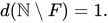
  • For any finite set F of positive integers, d(F) = 0.
  • If d(A) exists for some set A and Ac denotes its complement set with respect to , then d(Ac) = 1 − d(A).
    • Corollary: If is finite (including the case ),
  • If and exist, then
  • If is the set of all squares, then d(A) = 0.
  • If is the set of all even numbers, then d(A) = 0.5. Similarly, for any arithmetical progression we get
  • For the set P of all primes we get from the prime number theorem that d(P) = 0.
  • The set of all square-free integers has density More generally, the set of all nth-power-free numbers for any natural n has density where is the Riemann zeta function.
  • The set of abundant numbers has non-zero density.[3] Marc Deléglise showed in 1998 that the density of the set of abundant numbers is between 0.2474 and 0.2480.[4]
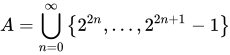
  • The set of numbers whose binary expansion contains an odd number of digits is an example of a set which does not have an asymptotic density, since the upper density of this set is whereas its lower density is
  • The set of numbers whose decimal expansion begins with the digit 1 similarly has no natural density: the lower density is 1/9 and the upper density is 5/9.[1] (See Benford's law.)
  • Consider an equidistributed sequence in and define a monotone family of sets: Then, by definition, for all .
  • If S is a set of positive upper density then Szemerédi's theorem states that S contains arbitrarily large finite arithmetic progressions, and the Furstenberg–Sárközy theorem states that some two members of S differ by a square number.

Other density functions

[edit]

Other density functions on subsets of the natural numbers may be defined analogously. For example, the logarithmic density of a set A is defined as the limit (if it exists)

Upper and lower logarithmic densities are defined analogously.

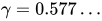
The intuition behind using in the summand comes from the fact that the harmonic series asymptotically approaches , where is the Euler–Mascheroni constant. Thus, this definition ensures that the logarithmic density of the natural numbers is .

For the set of multiples of an integer sequence, the Davenport–Erdős theorem states that the natural density, when it exists, is equal to the logarithmic density.[5]

See also

[edit]

Notes

[edit]

References

[edit]
Revisions and contributorsEdit on WikipediaRead on Wikipedia
from Grokipedia
In , the natural density (also known as asymptotic density) of a AA of the natural numbers N\mathbb{N} is a measure of its "size" relative to N\mathbb{N}, defined as the limit d(A)=limnA{1,2,,n}nd(A) = \lim_{n \to \infty} \frac{|A \cap \{1, 2, \dots, n\}|}{n}, provided this limit exists. This concept quantifies the proportion of natural numbers up to nn that belong to AA as nn grows arbitrarily large, capturing the intuitive notion of how "dense" AA is within the naturals. Key properties of natural density include that it takes values in [0,1][0, 1], with d(N)=1d(\mathbb{N}) = 1 and d()=0d(\emptyset) = 0; finite sets have density 0; and if ABA \subseteq B, then d(A)d(B)d(A) \leq d(B). It is invariant under finite symmetric differences, meaning d(A)=d(B)d(A) = d(B) if AA and BB differ by only finitely many elements, and it is finitely additive for : if AB=A \cap B = \emptyset and the densities exist, then d(AB)=d(A)+d(B)d(A \cup B) = d(A) + d(B). However, the limit defining d(A)d(A) does not always exist, in which case upper and lower densities can be considered as the limsup and liminf, respectively; natural density exists only when these coincide. Natural density plays a central role in , often used to study the distribution of primes, square-free integers, and other arithmetic sets. For instance, the set of square-free natural numbers—those not divisible by any perfect square other than 1—has natural density 6π20.6079\frac{6}{\pi^2} \approx 0.6079, a result originally due to Gegenbauer in 1885 and reflecting the probability that a random integer is square-free. When natural density fails to exist, related notions like Dirichlet density provide alternatives, which always agree with natural density when the latter is defined and are crucial for theorems such as the Chebotarev density theorem in .

Introduction

Overview

Natural density serves as a fundamental measure for assessing the "size" of subsets of the natural numbers, capturing their relative prevalence in the sequence of positive integers. Intuitively, for a subset AA of the natural numbers, the natural density represents the limiting proportion of elements from AA that appear among the first nn natural numbers as nn becomes arbitrarily large. This proportion offers a sense of how densely or sparsely the elements of AA are distributed along the number line. This measure can be interpreted probabilistically: if one selects a uniformly at random from the first nn numbers and lets nn tend to , the natural density corresponds to the probability that the selected number belongs to AA, assuming the limit exists. In contrast to simple finite counting, which fails to distinguish meaningful sizes for infinite sets, or , which equates all countably infinite subsets regardless of their distribution, natural density provides a finer asymptotic gauge of relative abundance. The concept presupposes basic familiarity with the natural numbers and limits from , employing asymptotic behavior—such as proportions evaluated at large nn—without requiring derivations of limiting processes. If the natural density exists for a , it necessarily falls within the interval [0, 1]; however, not all s possess a natural density, as the relevant proportions may oscillate indefinitely without converging, in which case upper and lower densities offer bounding refinements.

Historical development

The concept of natural density traces its origins to 19th-century developments in infinite series and , where early notions of proportional distribution among natural numbers began to emerge. A pivotal contribution came from in 1849, who computed the probability that two randomly selected natural numbers are coprime as 6π2\frac{6}{\pi^2}, introducing density-like ideas in the context of arithmetic progressions and the distribution of integers. The formalization of asymptotic density occurred in the early 20th century through the lens of probabilistic number theory, pioneered by and J. E. Littlewood between 1914 and 1920. Their work in probabilistic number theory during the early helped formalize the use of asymptotic density, particularly in the context of prime representations, where they employed to quantify the likelihood of certain prime configurations. Key milestones include Edmund Landau's extension to upper and lower asymptotic densities in his 1909 Handbuch der Lehre von der Verteilung der Primzahlen, which provided tools to handle sets where the standard limit does not exist. Additionally, the , independently proved by and Charles Jean de la Vallée Poussin in 1896, carried profound implications by establishing that the proportion of primes up to xx is asymptotically xlogx\frac{x}{\log x}, implying zero natural density for primes while refining their distribution. In the modern era, natural density played a central role in Endre Szemerédi's 1975 theorem, which asserts that any subset of the natural numbers with positive upper density contains arbitrarily long arithmetic progressions. Post-2000 applications in have further expanded its scope, as seen in the 2004 Green-Tao theorem, which uses ergodic methods to prove the existence of arbitrarily long arithmetic progressions among primes. The term "natural density" solidified in the mid-20th century, serving to distinguish this combinatorial measure from measure-theoretic densities in broader analysis.

Mathematical Foundations

Definition of natural density

In , the natural density of a ANA \subseteq \mathbb{N} of the natural numbers is defined as d(A)=limnA{1,2,,n}n,d(A) = \lim_{n \to \infty} \frac{|A \cap \{1, 2, \dots, n\}|}{n}, provided that the limit exists. This limit, when it exists, provides a measure of the asymptotic proportion of natural numbers belonging to AA. To formalize the notation, let a(n)=A{1,,n}a(n) = |A \cap \{1, \dots, n\}| denote the number of elements of AA up to nn. Then the natural density is given by d(A)=limna(n)n,d(A) = \lim_{n \to \infty} \frac{a(n)}{n}, if the limit converges. The existence of this limit is a necessary condition for d(A)d(A) to be defined, and when it exists, d(A)d(A) is a bounded between 0 and 1 inclusive. If d(A)d(A) exists and equals 0, then AA is an that is asymptotically negligible compared to N\mathbb{N}, such as sparse sets where elements grow sufficiently rapidly. Conversely, cofinite sets, which omit only finitely many natural numbers, have natural 1. The natural is translation-invariant under fixed shifts: for any fixed kk, d(A+k)=d(A)d(A + k) = d(A), where A+k={a+k:aA}A + k = \{ a + k : a \in A \}. However, it is not invariant under arbitrary perturbations, such as scalings or more complex transformations. When the limit defining d(A)d(A) fails to exist, upper and lower asymptotic densities serve as tools to quantify partial sizes of AA.

Upper and lower asymptotic densities

When the natural density of a ANA \subseteq \mathbb{N} fails to exist, the upper and lower asymptotic densities provide measures of its "size" that capture the limiting behavior through the supremum and infimum of the limit points of the proportions A[1,n]/n|A \cap [1,n]| / n as nn \to \infty. Specifically, the upper asymptotic density is defined as dˉ(A)=lim supnA[1,n]n,\bar{d}(A) = \limsup_{n \to \infty} \frac{|A \cap [1,n]|}{n}, and the lower asymptotic density as d(A)=lim infnA[1,n]n.\underline{d}(A) = \liminf_{n \to \infty} \frac{|A \cap [1,n]|}{n}. These quantities always satisfy 0d(A)dˉ(A)10 \leq \underline{d}(A) \leq \bar{d}(A) \leq 1, with the natural density existing d(A)=dˉ(A)\underline{d}(A) = \bar{d}(A). The difference between dˉ(A)\bar{d}(A) and d(A)\underline{d}(A) quantifies the oscillation in the growth of A[1,n]|A \cap [1,n]|, highlighting cases where the proportion does not converge. For instance, the set of positive integers whose decimal expansion begins with the digit 1 has no natural density, as its lower and upper asymptotic densities differ, though it possesses a Dirichlet density of log1020.3010\log_{10} 2 \approx 0.3010. Such examples demonstrate how asymptotic densities extend the natural density concept to non-convergent scenarios, where the limsup and liminf detect the range of accumulation points in the sequence of partial proportions. In , the upper asymptotic plays a key role in structural theorems; for example, asserts that any subset of the integers with positive upper contains a three-term . Moreover, the upper furnishes an upper bound on the growth of sets with zero lower , constraining their possible configurations in problems involving additive structure. Computationally, these densities can be estimated via Cesàro means applied to the sequence of partial proportions a(n)/na(n)/n, where the summability method aligns with the asymptotic behavior captured by the limsup and liminf.

Properties

Basic properties

Natural density exhibits several fundamental properties that follow directly from its definition as the limit of the proportion of elements up to nn as nn approaches . One key property is monotonicity: if ABNA \subseteq B \subseteq \mathbb{N}, and both sets have natural densities, then d(A)d(B)d(A) \leq d(B). This arises because the counting function for AA is always less than or equal to that for BB, preserving the inequality in the limit. The density of the complement is also well-behaved: if ANA \subseteq \mathbb{N} has natural density d(A)d(A), then its complement Ac=NAA^c = \mathbb{N} \setminus A has natural density d(Ac)=1d(A)d(A^c) = 1 - d(A). This property ensures that densities sum to 1 for complementary sets, mirroring the total measure of N\mathbb{N}. Consequently, any cofinite set (the complement of a finite set) has natural density 1, while finite sets have natural density 0. For , natural density is finitely additive under certain conditions: if AA and BB are disjoint subsets of N\mathbb{N} with natural densities d(A)d(A) and d(B)d(B), and d(A)+d(B)1d(A) + d(B) \leq 1, then d(AB)=d(A)+d(B)d(A \cup B) = d(A) + d(B). This additivity holds for finite collections of whose densities sum to at most 1, reflecting the additive nature of the underlying counting functions. However, natural density is not countably additive, unlike on the reals. A involves the countable disjoint union of singletons {n}\{n\} for nNn \in \mathbb{N}, each with density 0, whose union is N\mathbb{N} with density 1. This limitation highlights that natural density, while useful for asymptotic behavior, does not form a full measure in the sigma-additive sense.

Properties under union and complement

The natural density behaves in a controlled manner under set operations, though it is not a full due to lack of countable additivity. When the natural densities d(A)d(A) and d(B)d(B) exist, the density of their union satisfies the inequality d(AB)d(A)+d(B)d(A \cup B) \leq d(A) + d(B), while the density of their satisfies the superadditivity inequality d(AB)d(A)+d(B)1d(A \cap B) \geq d(A) + d(B) - 1. These bounds follow from the finite additivity of density for and the fact that (AB)[1,n]+(AB)[1,n]=A[1,n]+B[1,n]| (A \cup B) \cap [1,n] | + | (A \cap B) \cap [1,n] | = | A \cap [1,n] | + | B \cap [1,n] |. Combining with monotonicity (where AABA \subseteq A \cup B implies d(A)d(AB)d(A) \leq d(A \cup B)), the density of the union also satisfies max(d(A),d(B))d(AB)min(d(A)+d(B),1)\max( d(A), d(B) ) \leq d(A \cup B) \leq \min( d(A) + d(B), 1 ). For finite unions, these properties extend iteratively: for A1,,AkA_1, \dots, A_k with densities, d(i=1kAi)=i=1kd(Ai)d( \bigcup_{i=1}^k A_i ) = \sum_{i=1}^k d(A_i ), and the and monotonicity bounds apply to the general case by repeated application. For sets where the natural density may not exist, the upper and lower asymptotic densities provide extensions of these properties. The upper asymptotic density dˉ\bar{d} is subadditive under union: dˉ(AB)dˉ(A)+dˉ(B)\bar{d}(A \cup B) \leq \bar{d}(A) + \bar{d}(B), and finitely subadditive for multiple sets by . It also inherits monotonicity: ABA \subseteq B implies dˉ(A)dˉ(B)\bar{d}(A) \leq \bar{d}(B), yielding max(dˉ(A),dˉ(B))dˉ(AB)min(dˉ(A)+dˉ(B),1)\max( \bar{d}(A), \bar{d}(B) ) \leq \bar{d}(A \cup B) \leq \min( \bar{d}(A) + \bar{d}(B), 1 ). The lower asymptotic density d\underline{d} is superadditive under union: d(AB)d(A)+d(B)\underline{d}(A \cup B) \geq \underline{d}(A) + \underline{d}(B), with the bound adjusted to max(d(A),d(B))d(AB)1\max( \underline{d}(A), \underline{d}(B) ) \leq \underline{d}(A \cup B) \leq 1 following from monotonicity. For intersections, the upper density satisfies dˉ(AB)min(dˉ(A),dˉ(B))\bar{d}(A \cap B) \leq \min( \bar{d}(A), \bar{d}(B) ), while the lower density obeys d(AB)max(d(A)+d(B)1,0)\underline{d}(A \cap B) \geq \max( \underline{d}(A) + \underline{d}(B) - 1, 0 ). These extend iteratively to finite collections, preserving the lattice operations of union and intersection within bounds. Under complement, the upper and lower densities relate directly: the upper density of the complement is dˉ(Ac)=1d(A)\bar{d}(A^c) = 1 - \underline{d}(A), and the lower density of the complement is d(Ac)=1dˉ(A)\underline{d}(A^c) = 1 - \bar{d}(A). This relation ensures that the properties under union and intersection are consistent with complements, as AB=(AcBc)cA \cap B = (A^c \cup B^c)^c. For the Boolean algebra generated by a family of sets with defined densities, the induced upper and lower densities preserve the distributive lattice properties of unions and intersections via the above inequalities, but they do not form a full measure algebra due to failure of countable additivity and the non-trivial ideal of zero-density sets.

Examples and Illustrations

Arithmetic progressions and simple sets

One of the simplest examples of a set with positive natural density is the set of even natural numbers, A={2kkN}A = \{ 2k \mid k \in \mathbb{N} \}. The number of even numbers up to nn is n/2\lfloor n/2 \rfloor, so the proportion a(n)/n1/2a(n)/n \approx 1/2 as nn \to \infty, yielding d(A)=1/2d(A) = 1/2. More generally, consider an infinite with first term aa (where 0<ad0 < a \leq d) and common difference d1d \geq 1, given by B={a+kdk=0,1,2,}B = \{ a + kd \mid k = 0, 1, 2, \dots \}. This is the set of natural numbers congruent to aa modulo dd. The residues modulo dd are uniformly distributed among the natural numbers, so the proportion of elements in BB up to nn is approximately 1/d1/d. Specifically, the number of terms up to nn is (na)/d+1n/d\lfloor (n - a)/d \rfloor + 1 \approx n/d, and thus d(B)=1/dd(B) = 1/d. This derivation follows from the periodic nature of the progression, where each residue class modulo dd occurs equally often in the sequence of natural numbers. In contrast, bounded sets illustrate natural density zero. Any finite set FNF \subseteq \mathbb{N} has only finitely many elements, so for sufficiently large nn, F{1,,n}|F \cap \{1, \dots, n\}| is constant while the denominator nn grows without bound, giving d(F)=0d(F) = 0. Sparse sets like the powers of 2, C={2kk=0,1,2,}C = \{ 2^k \mid k = 0, 1, 2, \dots \}, also have density zero. The number of such powers up to nn is log2n+1log2n\lfloor \log_2 n \rfloor + 1 \approx \log_2 n, so the proportion log2n/n0|\log_2 n| / n \to 0 as nn \to \infty. This sparsity arises because the elements grow exponentially, outpacing linear growth in the denominator. A key distinction is that every infinite arithmetic progression with fixed difference dd has positive density 1/d>01/d > 0, due to its periodic structure. This contrasts with non-periodic sets, which may lack density altogether or have density zero despite being infinite, highlighting how regularity enables computability of natural density.

Sets from number theory

In , the set of prime numbers provides a classic example of a set with natural density zero. The establishes that the number of primes not exceeding nn, denoted π(n)\pi(n), satisfies π(n)nlnn\pi(n) \sim \frac{n}{\ln n} as nn \to \infty. Consequently, the ratio π(n)n0\frac{\pi(n)}{n} \to 0, confirming that the natural density of the primes is zero. Square-free integers, which are those not divisible by any perfect square other than 1, exhibit a positive natural density. This density equals 6π20.607927\frac{6}{\pi^2} \approx 0.607927, derived from the fact that the proportion of integers avoiding divisibility by p2p^2 for each prime pp is p(1p2)=1ζ(2)\prod_p (1 - p^{-2}) = \frac{1}{\zeta(2)}, where ζ(2)=π26\zeta(2) = \frac{\pi^2}{6} is the value of the Riemann zeta function at 2. The set of perfect squares also has natural density zero. The count of perfect squares up to nn is nn\lfloor \sqrt{n} \rfloor \sim \sqrt{n}
Add your contribution
Related Hubs
User Avatar
No comments yet.