Hubbry Logo
search
logo
1846562

Larry Andersen

logo
Community Hub0 Subscribers
Read side by side
from Wikipedia

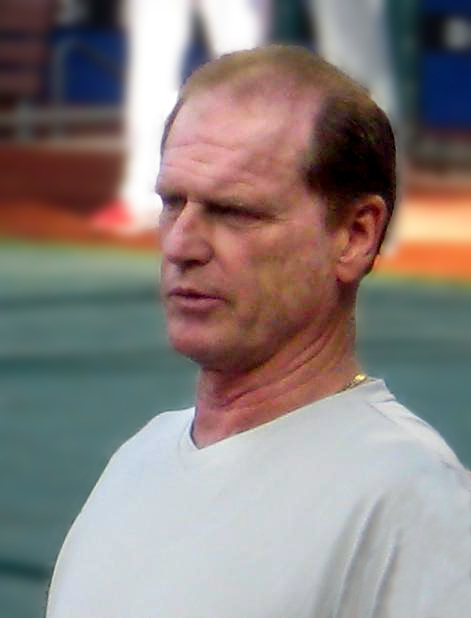
Larry Eugene Andersen (born May 6, 1953) is an American former relief pitcher in Major League Baseball and current radio color commentator for the Philadelphia Phillies. From 1975 through 1994, Andersen played for the Cleveland Indians (1975, 1977, 1979), Seattle Mariners (19811982), Philadelphia Phillies (19831986, 1993–1994), Houston Astros (19861990), Boston Red Sox (1990), and San Diego Padres (19911992).

Key Information

Playing and coaching career

[edit]

Andersen possessed an average fastball and outstanding slider. He was drafted out of high school in the seventh round (157th overall) of the 1971 Major League Baseball draft by the Cleveland Indians.[1] Andersen made his professional debut that year, posting a record of 1–3 with a 5.31 ERA in 11 games (five starts) with the Gulf Coast League Indians and the Single-A Reno Silver Sox of the California League.[2] He pitched in his first full season for Single-A Reno in 1972, going 4–14 with a 6.53 ERA in 124 innings, with a 1.80 WHIP in 27 games (19 starts).[2]

On September 5, 1975, Andersen made his major league debut for Cleveland, tossing a perfect seventh inning in an 11–2 loss to the Detroit Tigers.[3] In parts of three seasons with Cleveland, he appeared in a combined 22 games, and was 0–1 with a 5.40 ERA.[4]

On December 21, 1979, Andersen was traded to the Pittsburgh Pirates in exchange for John Burden and Larry Littleton.[4] He spent the entire 1980 season with the Triple-A Portland Beavers, going 5–7 with 15 saves and a 1.74 ERA in 52 relief appearances.[2]

After the 1980 season, Andersen was sent to the Seattle Mariners on October 29 as the player to be named later to complete an earlier trade for pitcher Odell Jones.[4] In his first full major league season, Andersen went 3–3 with five saves and a 2.66 ERA in 41 games with the Mariners.[4] However, his numbers took a turn in 1982, as he finished with one save and a 5.99 ERA in 40 relief appearances.[4]

During the 1982 season, Andersen pulled a prank on Mariners manager Rene Lachemann during a series in Chicago. Referred to as the ‘Mr. Jello’ caper, Andersen, along with teammates Richie Zisk and Joe Simpson moved all the furniture in the hotel suite into a bathroom, filled both toilets with jello and removed the mouthpiece from the phone. The trio were not revealed as the culprits until after the season ended.[5]

Andersen spent most of the 1983 season with Triple-A Portland, going 7–8 with 22 saves and a 2.05 ERA in 52 appearances.[2] On July 29, Andersen's contract was sold to the Philadelphia Phillies for future considerations.[6] He was immediately added to the Phillies' roster, and remained with the team for the rest of the season. In 17 games, Andersen was 1–0 with a 2.39 ERA. He pitched in Game 2 and 4 of the 1983 World Series (while Philadelphia lost in five games), pitching two innings each; he allowed a run in Game 2.[4]

In 1984, Andersen became a mainstay in the Phillies' bullpen, and finished with a 3–7 record, four saves and a 2.38 ERA in 64 relief appearances.[4] Andersen began the 1986 season with a 4.26 ERA in 10 games.[4] On May 13, 1986, he was released by the Phillies.[7]

Three days after he was released by the Phillies, Andersen was signed as a free agent by the Houston Astros.[4] On June 23, Andersen was the winning pitcher in a game in which he did not throw a strike to a single batter. While pitching to Cincinnati Reds catcher Bo Díaz in the top of the ninth inning, Andersen threw a wild pitch, and then tagged out Buddy Bell at home plate to end the inning. The Astros went on to win in the bottom of the ninth inning on a two-run home run by Glenn Davis.[8] Andersen appeared in 38 games to end the season, finishing 2–1 with one save and a 2.78 ERA.[4] Andersen also made two appearances during the 1986 NLCS, tossing five scoreless innings.[4]

On December 19, 1986, Andersen re-signed with the Astros as a free agent.[9] In 1987, Andersen arguably had his best season in the majors up to that point. He finished with a record of 9–5, a 3.45 ERA, 94 strikeouts, and 10123 innings pitched in 67 games. He set career highs in wins, innings pitched and strikeouts.[4] In 1989, Andersen recorded a career-low 1.54 ERA in 60 relief appearances.[4]

On August 30, 1990, Andersen was traded to the Boston Red Sox for minor league prospect Jeff Bagwell.[10] He made 15 relief appearances for the Red Sox in September, recording one save and a 1.23 ERA.[4] The trade is often regarded as one of the most lopsided trades in baseball history; Andersen spent one month with the Red Sox before becoming a free agent, while Bagwell went on to spend 15 seasons with the Astros and was later inducted into the National Baseball Hall of Fame and Museum in 2017.[11] In the 1990 American League Championship Series, he pitched an inning each in Game 1, 2, and 4. In Game 1, he was summoned in the seventh with the Sox leading 1-0. He gave up a walk and a hit before a flyball to center was deep enough for a sacrifice fly to tie the game. In the eighth, he gave up a leadoff single to José Canseco and was immediately pulled. The next two pitchers (Tom Bolton and Jeff Gray) proceeded to give up the run in the eighth and then seven more in the ninth as the Red Sox lost 9-1 that marked Andersen with the loss. The Athletics won the series in a sweep.[12]

On December 21, 1990, Andersen signed a two-year, $4.35 million contract with the San Diego Padres.[13] In 1991, he was 3–4 with a career-high 13 saves and a 2.30 ERA in 38 relief appearances. In 1992, Andersen was 1–1 with two saves and a 3.34 ERA in 34 relief appearances.[4]

On December 18, 1992, Andersen returned to the Phillies as a free agent, signing a one-year, $700,000 contract.[14] He enjoyed a productive season out of the Phillies bullpen, going 3–2 with a 2.92 ERA in 64 relief appearances. However, Andersen struggled in the postseason, recording a 15.43 ERA in the 1993 NLCS and a 9.82 ERA in the 1993 World Series.[4] On January 18, 1994, he returned to the Phillies on a minor league contract.[15] In his final major league season, Andersen went 1–2 with a 4.41 ERA in 29 relief appearances.[4]

In a 17-season career, Andersen posted a 40–39 record with 49 saves and a 3.15 ERA in 699 games pitched.[4] He is the only member of the Phillies to play in both the 1983 World Series and the 1993 World Series (Darren Daulton had been called up in September 1983, but did not make the post-season roster that year).

In 1995, Andersen was a player/coach for the Reading Phillies after he failed to make the Major League club out of Spring Training. He spent the following two seasons as the pitching coach for the Scranton/Wilkes-Barre Red Barons.

Philadelphia Phillies broadcasting

[edit]

Andersen joined the Philadelphia Phillies' broadcast team as a color commentator prior to the 1998 season, filling the position left vacant by the death of Richie Ashburn late in the 1997 campaign. Andersen worked on both television and radio from 1998 to 2006 before moving exclusively to radio in 2007. Early in his broadcasting tenure, Andersen occasionally provided television color commentary when the Phillies were featured regionally on Fox Saturday afternoon telecasts. During the 2007 season, he began doing play-by-play work on Phillies radio broadcasts during the fifth and sixth innings, but returned to full-time color commentary in 2008.

In 2012, Andersen was ranked #12 on the MLB Network Countdown of the Top 25 personalities in Major League Baseball history.[16]

References

[edit]

Further reading

[edit]
[edit]
Revisions and contributorsEdit on WikipediaRead on Wikipedia
from Grokipedia
Larry Andersen (born May 6, 1953) is an American former professional baseball relief pitcher who played in Major League Baseball (MLB) for 17 seasons from 1975 to 1994, appearing in 699 games with a career record of 40 wins, 39 losses, a 3.15 earned run average, and 49 saves across six teams: the Cleveland Indians, Seattle Mariners, Philadelphia Phillies, Houston Astros, Boston Red Sox, and San Diego Padres.[1] Andersen's playing career gained prominence in his mid-30s, particularly with the Astros and Phillies, where he contributed to three National League Championship Series appearances and two World Series teams in 1983 and 1993; he is notably remembered for being traded from the Astros to the Red Sox on August 30, 1990, in exchange for promising prospect Jeff Bagwell, a deal that became one of baseball's most lopsided trades in hindsight.[1][2] His journeyman role as a reliable middle reliever was complemented by his reputation as a clubhouse prankster and witty personality, which endeared him to teammates and fans.[1][3] Since 1998, Andersen has served as a radio color commentator for the Philadelphia Phillies, becoming the team's longest-tenured active broadcaster with 28 seasons as of 2025, though he has reduced his schedule since 2018 following prostate cancer surgery and further in 2022 to prioritize family time.[4][5] Known for his honest analysis, humor, and fan engagement—earning him the nickname "L.A."—Andersen has been a staple of Phillies broadcasts, calling key moments including the 2008 World Series championship.[2][5]

Early life and amateur career

Childhood and education

Larry Eugene Andersen was born on May 6, 1953, in Portland, Oregon, to Dale Andersen and Gae Lea (née Hammacher) Andersen.[1] His family was of Swedish ancestry, and his parents had married in 1949 after meeting in Nebraska, where his mother was from; his father, originally from Oregon, worked as a pilot for West Coast Airlines.[1] Andersen had an older sister, Linda, born in 1951.[1] Andersen's early years were spent in Portland, where he developed an early interest in sports, particularly baseball, influenced by his father's enthusiasm for the game and by watching stars like Willie Mays, Bob Gibson, and Mickey Mantle on television.[1] He often played catch with his father, who encouraged his athletic pursuits.[6] Tragedy struck on March 10, 1967, when Andersen was 13 years old; his father died in a plane crash near Klamath Falls, Oregon, along with three others, leaving the family to cope with the loss.[1] In the aftermath, his aunt, a devoted fan of the local Triple-A Portland Beavers, frequently took him to their games at Multnomah Stadium, fostering his passion for baseball as a source of comfort and direction during a difficult period.[1][6] The family later relocated to Bellevue, Washington, before Andersen entered high school.[1] He attended Interlake High School, which opened in 1968, beginning his studies there as a sophomore in the fall of that year and graduating in 1971.[1] Beyond academics, Andersen participated in multiple sports as extracurricular activities, including basketball and football, reflecting his broad athletic interests shaped by his Pacific Northwest upbringing.[6]

High school baseball and MLB draft

Andersen attended Interlake High School in Bellevue, Washington, where he excelled in multiple sports, contributing to the school's success in football, basketball, and baseball during his three years there. As a pitcher on the baseball team, he helped secure one league championship, showcasing his versatility and athletic talent on the mound. His standout performance came in the 1971 City vs. State All-Star Game, where he earned MVP honors for his pitching efforts, highlighting his potential as a professional prospect.[1] Andersen attracted attention from college recruiters, receiving a dual-sport scholarship offer from the University of Oregon for both baseball and football, reflecting his broad athletic abilities developed during his youth in the Pacific Northwest. However, his high school achievements drew professional scouts, leading to his selection by the Cleveland Indians in the 7th round (151st overall) of the 1971 MLB Draft.[1][7] Following the draft, Andersen signed with the Cleveland organization for a $10,000 bonus, facilitated by scout Loyd Christopher, and opted to turn professional rather than attend college, beginning his career in the minor leagues. This contract marked his entry into organized baseball, setting the stage for a long professional journey.[1]

Professional baseball career

Early professional years (1971–1982)

Andersen signed with the Cleveland Indians after being selected in the seventh round of the 1971 MLB Draft out of high school.[1] His professional career began in 1971 with the Reno Silver Sox of the Class A California League, where he posted a 1-0 record with a 6.75 ERA in seven appearances before a demotion to the rookie-level Gulf Coast League Indians, finishing 0-3 with a 3.00 ERA in four games.[1][8] In 1972, Andersen returned to Reno, struggling as a starter with a 4-14 record and 6.53 ERA over 124 innings in 27 games.[1][8] He showed improvement in 1973, achieving a 10-8 mark with a 3.95 ERA in 29 starts for the same team, earning a promotion to Double-A San Antonio Brewers of the Texas League in 1974, where he recorded 10-6 with a 3.83 ERA in 169 innings, including a no-hitter on June 1.[1][8] Advancing to Triple-A Oklahoma City 89ers of the American Association in 1975, Andersen went 10-11 with a 4.21 ERA in 23 starts, logging 10 complete games over 156 innings.[1][8] That September, he made his MLB debut with the Indians on the 5th, pitching 1 scoreless inning in relief (allowing one hit) during an 11-2 loss to the Detroit Tigers; he appeared in two more games that year, finishing 0-0 with a 4.76 ERA in 5.2 innings.[1][9] In 1976, Andersen started at Triple-A Toledo Mud Hens of the International League but struggled with a 0-2 record and 12.91 ERA in six games, leading to a demotion to Double-A Williamsport Tomahawks of the Eastern League, where he rebounded to 9-6 with a 2.71 ERA.[1][8] The following year, converted to a reliever at Toledo, he excelled with a 5-6 record, 1.94 ERA, and nine saves in 45 appearances, earning another call-up to Cleveland for 11 games (0-1, 3.14 ERA in 14.1 innings).[1][9][8] Andersen continued at the Triple-A level from 1978 to 1980, first with the Portland Beavers of the Pacific Coast League in 1978 (10-7, 3.45 ERA, 25 saves in 57 games, setting a league record for saves), then Tacoma Tugs in 1979 (10-6, 4.02 ERA in 27 games), and back to Portland in 1980 (5-7, 1.74 ERA, 15 saves in 52 games).[1][8] During his 1979 minor league stint, he made eight relief appearances for Cleveland (0-0, 7.56 ERA in 16.2 innings).[1][9] On December 21, 1979, the Indians traded him to the Pittsburgh Pirates for pitchers Larry Littleton and John Burden.[1][10] On October 29, 1980, the Pirates dealt Andersen to the Seattle Mariners to complete an earlier trade involving cash and a player to be named later.[1][11] With Seattle in 1981, Andersen established himself as a reliever, appearing in 41 games with a 3-3 record, five saves, and 2.66 ERA over 67.2 innings.[1][9] His performance regressed in 1982, posting a 0-0 record, one save, and 5.99 ERA in 40 games across 79.2 innings—the most innings pitched in a season without a decision in MLB history at the time—before a late-August shoulder injury sidelined him, requiring rehabilitation with the Triple-A Salt Lake City Gulls.[1][9][3] As a young reliever in his early major league stints, Andersen faced challenges adjusting to the higher competition level, evidenced by his inconsistent ERAs and limited appearances with Cleveland, alongside minor injuries like the 1982 shoulder issue that interrupted his development.[1]

Career peak and trades (1983–1990)

Andersen began his most consistent and productive stretch in Major League Baseball with the Philadelphia Phillies in 1983, establishing himself as a reliable middle reliever out of the bullpen. That year, he appeared in 17 games for Philadelphia, posting a 1-0 record with a 2.39 ERA over 26.1 innings pitched, contributing to the team's National League pennant win.[9] In the 1983 World Series against the Baltimore Orioles, Andersen pitched 4 innings across two appearances, allowing one earned run for a 2.25 ERA, though the Phillies lost the series to the Baltimore Orioles four games to one.[9] His role expanded in 1984, when he logged 64 appearances with a 3-7 record, 4 saves, and a strong 2.38 ERA in 90.2 innings, solidifying his value in high-leverage situations.[9] The 1985 season saw Andersen maintain a steady presence for Philadelphia, appearing in 57 games with a 3-3 record, 3 saves, and a 4.32 ERA over 73 innings, though his effectiveness dipped slightly amid the team's competitive NL East race.[9] Early in 1986, after just 10 appearances with the Phillies (0-0, 4.26 ERA in 12.2 innings), Andersen was released on May 13 and quickly signed as a free agent with the Houston Astros three days later.[10] With Houston, he immediately thrived, posting a 2-1 record, 1 save, and 2.78 ERA in 38 games and 64.2 innings, helping the Astros secure the NL West title.[9] In the 1986 National League Championship Series against the New York Mets, Andersen appeared in two games, pitching 5 scoreless innings to post a 0.00 ERA, though Houston fell in six games.[9] Andersen's tenure with the Astros from 1986 through 1990 marked his peak as a reliever, appearing in 268 games overall with a 22-16 record, 20 saves, and a 2.56 ERA across 410.1 innings, showcasing his command and durability in late-inning roles.[9] Standout seasons included 1987, with 67 appearances, 9 wins, 5 saves, and a 3.45 ERA in 101.2 innings; 1989, when he led the Astros' bullpen with a career-best 1.54 ERA in 60 games and 87.2 innings; and 1990, where he went 5-2 with 6 saves and a 1.95 ERA in 50 appearances before the trade deadline.[9] On August 30, 1990, the Astros traded Andersen to the Boston Red Sox in exchange for minor league prospect Jeff Bagwell, a move driven by Houston's need for infield depth amid injuries.[9] In his brief stint with Boston, Andersen provided immediate stability to the Red Sox bullpen, appearing in 15 games with a 0-0 record, 1 save, and an impressive 1.23 ERA over 22 innings, contributing to their AL East-winning season.[9] However, in the 1990 American League Championship Series against the Oakland Athletics, he struggled with a 6.00 ERA in 3 innings across three appearances as Boston was swept.[9] The trade proved transformative for the Astros, as Bagwell debuted late in 1990 and blossomed into a Hall of Fame first baseman, winning the 1994 National League MVP Award, earning three Silver Sluggers, and accumulating 449 home runs and 1,529 RBIs over 15 seasons in Houston, anchoring the franchise's success for over a decade.[12]

Final seasons (1991–1994)

After spending the 1990 season with the Boston Red Sox, Andersen signed a two-year, $4.35 million contract with the San Diego Padres prior to the 1991 season.[1] In 1991, he appeared in 38 games for the Padres, posting a 3-4 record with 13 saves and a 2.30 ERA over 47 innings pitched, though his season was interrupted by two stints on the disabled list due to a herniated disc in his back.[9] The following year, 1992, Andersen made 34 relief appearances for San Diego, going 1-1 with 2 saves and a 3.34 ERA in 35 innings, continuing to battle health issues that limited his effectiveness.[9] Across his two seasons with the Padres, he pitched in 72 games, compiling a 4-5 record, 15 saves, and a 2.82 ERA.[1] Andersen returned to the Philadelphia Phillies on January 18, 1993, signing an incentive-laden minor league contract that allowed him to earn a spot on the major league roster.[1] In a resurgent 1993 campaign, he appeared in 64 games for the Phillies, recording a 3-2 mark with a 2.92 ERA over 61.2 innings and contributing significantly to the team's National League East division title and National League Championship Series victory.[9] Notably, Andersen earned a save in Game 5 of the NLCS by striking out Ron Gant and Jeff Blauser to secure a 6-3 win over the Atlanta Braves, helping Philadelphia advance to the World Series.[1] However, in the World Series against the Toronto Blue Jays, he struggled in four appearances, allowing five earned runs in 3.2 innings for a 12.27 ERA as the Phillies fell in six games.[13] The 1994 season, shortened by a players' strike, marked Andersen's final year in the majors with the Phillies, where he pitched in 29 games and went 1-2 with a 4.41 ERA over 32.2 innings.[9] Following the season, Andersen announced his retirement at age 41, concluding a 25-year professional baseball career that began with his 1971 draft by the Cleveland Indians and included stints across multiple organizations.[1] Over his 15 major league seasons from 1975 to 1994, Andersen finished with a 40-39 record, 49 saves, a 3.15 ERA, 758 strikeouts, and appearances in 699 games, primarily as a reliable middle reliever.[1] Reflecting on his tenure, he described the 1993 Phillies run as "by far the greatest thrill of my baseball career."[1]

Post-playing career

Minor league coaching

Following his retirement from playing after the 1994 season, Andersen transitioned to coaching within the Philadelphia Phillies' minor league system. In 1995, he served as a player/coach for the Double-A Reading Phillies of the Eastern League, where he also made five relief appearances, posting a 6.23 ERA over 4.1 innings pitched.[1][8] The following year, 1996, Andersen continued as the full-time pitching coach for Reading, focusing on refining the mechanics and strategies of the team's young hurlers.[14] In 1997, Andersen advanced to the Triple-A level as pitching coach for the Scranton/Wilkes-Barre Red Barons, the Phillies' top affiliate in the International League. His primary responsibilities across these roles involved developing prospects by emphasizing pitch control, mental preparation, and game situation awareness to prepare them for major league demands.[15] Andersen's coaching tenure lasted just three seasons, concluding at the end of 1997 when he shifted to broadcasting after the sudden death of Phillies radio analyst Richie Ashburn in September of that year, leading to his appointment as the team's color commentator starting in 1998.[1]

Broadcasting career

Andersen joined the Philadelphia Phillies' radio broadcast team in 1998 as a color analyst, succeeding Richie Ashburn and partnering with veteran play-by-play announcer Harry Kalas.[16] He teamed with Scott Franzke starting in 2006 and continued in the role after Kalas's death in 2009.[17] Over his tenure, Andersen has provided commentary for more than 25 seasons, drawing on his experience as a former major league reliever to offer analysis during regular-season games, playoff appearances, and World Series runs, including memorable calls in high-stakes moments like J.T. Realmuto's game-tying homer in Game 1 of the 2022 World Series.[4][18] Known for his humorous quips, pull-no-punches honesty, and insightful breakdowns from a pitcher's viewpoint, Andersen's style emphasizes storytelling rooted in the realities of professional baseball, often blending levity with sharp critiques of player performance and strategy.[19] His approach has resonated with Philadelphia fans, earning praise for its authenticity during tense playoff broadcasts, such as the 2008 World Series championship and multiple postseason clinchers.[20] In 2022, at age 68, Andersen reduced his schedule to approximately 40 home games per season to manage his workload, though he remained active for marquee matchups.[21] This adjustment continued into 2025, when he served as the primary color commentator for the Phillies' National League Division Series home games against the Los Angeles Dodgers.[22] Andersen's contributions to sports broadcasting were recognized in 2012 when MLB Network ranked him 12th on its list of the top 25 personalities in Major League Baseball history.[1] In 2024, he was inducted into the Broadcast Pioneers of Philadelphia Hall of Fame for his enduring impact on local sports media.[23] Following the Phillies' 2025 NLDS exit, Andersen reflected in interviews on the team's execution flaws and offseason needs, underscoring his candid perspective on the franchise's championship aspirations.[5]

Personal life

Family and residence

Andersen was previously married and is the father of three grown children from that relationship: daughters Angela and Tania, and son Chase.[1] In 2012, he married Kristi in a ceremony attended by the Phillie Phanatic.[1] As of 2025, Andersen resides in the Philadelphia area with his wife.[24] During transitions in his long broadcasting career with the Phillies, Andersen has credited family support for helping him adjust, including reducing his schedule in recent years to spend more time with loved ones.[24]

Health challenges and philanthropy

In late 2018, Larry Andersen was diagnosed with an aggressive form of prostate cancer, which he underwent surgery to treat in December of that year.[25] By spring 2019, following a successful procedure, Andersen was declared cancer-free and returned to his broadcasting duties with renewed appreciation for life.[26] His public sharing of this experience has contributed to greater awareness of men's health issues, encouraging early detection and screening among peers.[26] In March 2025, Andersen underwent bladder surgery and recovered in Clearwater, Florida, missing the start of the Phillies' season but returning to the broadcast booth later that year.[24] Andersen serves as an ambassador for the Darren Daulton Foundation, which focuses on brain tumor awareness and support for affected families in honor of former Phillies teammate Darren Daulton.[27] In this role, he actively participates in foundation events, including the 2025 Celebrity Guest Bartending fundraiser held on July 12 at Live! Casino in Philadelphia, where he joined other Phillies alumni to raise funds for brain cancer research and patient care.[28] Through these efforts, Andersen helps amplify the foundation's mission to provide resources and hope to those battling the disease. Andersen also engages in Phillies charity initiatives, such as serving holiday meals at Bethesda Project shelters for the homeless in Philadelphia, where he has volunteered alongside fellow broadcasters to deliver home-cooked dinners to residents.[29] In 2025, he contributed to the team's Phantastic Auction by offering a behind-the-scenes tour of Citizens Bank Park with fellow Phillies legend John Kruk, with proceeds benefiting Phillies Charities, Inc., and supporting youth baseball programs in the community.[30] These activities underscore his commitment to philanthropy, extending his influence to foster community support for health causes and access to baseball for young players.[31]

References

User Avatar
No comments yet.