
Recent from talks
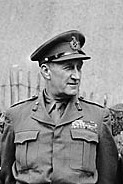
Lashmer Whistler
Knowledge base stats:
Talk channels stats:
Members stats:
Lashmer Whistler
General Sir Lashmer Gordon Whistler, GCB, KBE, DSO**, DL (3 September 1898 – 4 July 1963), known as "Bolo", was a British Army officer who served in both the world wars. A junior officer during the First World War, during the Second World War he achieved senior rank serving with Field Marshal Sir Bernard Montgomery in North Africa and North-western Europe from 1942 to 1945. Montgomery considered that Whistler "was about the best infantry brigade commander I knew". In peacetime, his outstanding powers of leadership were shown in a series of roles in the decolonisation process, and he reached the four-star rank of a full general, without having attended the Staff College, Camberley, then considered almost essential for an officer wishing to attain high rank, and which a significant majority of the British generals of the war had attended. This, in Richard Mead's words, was, "proof that lacking a Staff College qualification was no barrier to advancement for the right man."
Whistler was the son of Colonel Albert Edward Whistler of the British Indian Army and his wife Florence Annie Gordon Rivett-Carnac, daughter of Charles Forbes Rivett-Carnac. The younger of two sons, he was born on 3 September 1898 in British India but went to England with his mother and elder brother soon afterwards, and was educated at St Cyprian's School, where he was an outstanding sportsman, and on the recommendation of the headmaster was awarded a sporting scholarship at Harrow School. He played cricket for Harrow, and was to remain a redoubtable batsman throughout his career.
He entered the Royal Military College, Sandhurst, on 3 November 1916, during the First World War, just two months after his eighteenth birthday. He was commissioned as a second lieutenant into the Royal Sussex Regiment of the British Army on 11 September 1917, eight days after his nineteenth birthday. After serving briefly with the 3rd (Reserve) Battalion, he was posted, in late October, to the 13th (Service) Battalion, then serving in the trenches of the Western Front, as part of the 116th Brigade of the 39th Division, a Kitchener's Army unit. He was wounded twice, and, on the second occasion, during the Imperial German Army's Spring Offensive in late March 1918, he was taken as a prisoner of war (POW) by the Germans before he had recovered. Later, he managed to escape from a prison train, but was re-captured within 20 yards of the Dutch border. He was then held at Ulrich Gasse in Cologne where he lost five stone and could hardly walk by the end of the war. Of the war, he said, in a broadcast on the Midland Home Service, titled "A Soldier's Life", in early February 1957, "It was a beastly war, with mud and cold and gas attacks and terrible casualties. I saw nothing to compare with it in the last war. Conscription came late in that war and the best of the country was lost."
In 1919, after the end of the First World War, Whistler, after being released by the Germans, remained in the army and was promoted to lieutenant in March. He also volunteered to join the Relief Force being sent to support the British Garrison at Archangel. He was posted to the 45th Battalion, Royal Fusiliers and saw some action on the River Dvina until its withdrawal when the White Russian Army was defeated elsewhere. It was his recounting of many anecdotes about the Bolsheviks that gave rise to his nickname of "Bolo". He was posted to the 1st Battalion, Royal Sussex in October 1919. Serving with the British Army of the Rhine (BAOR), he found his company quartered in the same Ulrich Gasse barracks where he had been a POW in the previous year. However, on the last day of the year he was sent to Ireland as one of the replacements for fourteen British officers who had been murdered the previous November. He remained in Ireland for four years and then went as acting adjutant to the Regimental Depot at Chichester.
Shortly afterwards, he was sent to Hong Kong to protect British interests during civil war in China. He qualified as Italian interpreter in 1928. He was appointed adjutant of the 5th (Cinque Ports) Battalion, Royal Sussex, a Territorial Army (TA) unit, as a temporary captain on 1 May 1929, this becoming a permanent rank on 30 September 1932. In 1933 he was posted to Karachi and then to Egypt at the time of Benito Mussolini's Italian invasion of Ethiopial It took Whistler twenty-one years after being commissioned to achieve the rank of major which he attained in August 1938, shortly before his 40th birthday. In 1938 he became adjutant of the 2nd Battalion, Royal Sussex and served in Palestine during the Arab revolt until the outbreak of the Second World War in September 1939. Unlike a large number of British commanders who were to attain high rank in the upcoming war, Whistler had not qualified for the staff colleges at either Camberley or Quetta, having twice failed the entrance examination for the former, and confided in his old Harrow and Sandhurst friend, Reginald Dorman-Smith, the younger brother of Eric Dorman-Smith, that he would end his military career in command of a battalion at most. With little prospect of advancement to higher command, "Bolo" Whistler had seriously been considering leaving the army for civilian life when war broke out.
When the Second World War broke out on 3 September 1939, on Whistler's 41st birthday, he was commanding the regimental depot at Chichester. However, on 5 February 1940 he became an acting lieutenant colonel and was appointed Commanding Officer (CO) of the 4th Battalion, Royal Sussex Regiment, a TA unit. Major Bernard Fitzalan-Howard, 16th Duke of Norfolk was commanding the battalion's HQ Company. The battalion formed part of Brigadier John Utterson-Kelso's 133rd Infantry Brigade (containing the 2nd, 4th and 5th Battalions of the Royal Sussex Regiment and often referred to as the Royal Sussex Brigade), which formed part of the 44th (Home Counties) Infantry Division, then under Major General Edmund Osborne. The battalion was on stand-by to go to Finland, but this did not happen. Whistler worked hard to transform the TA battalion into fighting shape and on 8 April they embarked at Southampton for Cherbourg, France, to serve as part of the British Expeditionary Force (BEF).
Just over a month later, the German Army launched its long-awaited offensive on the Western Front. The battalion moved to the Belgian border and to Courtrai. Under constant German bombardment, Whistler had sent a famous message to Brigade Headquarters "Please may I have half a Hurricane for half an hour". As the Germans advanced during the Battle of France, the battalion took up a defensive position at Caestre. An officer, Peter Hadley, reported finding Whistler "standing in the middle of the street with a positive hail of explosives coming down all around". While his subordinates crouched by the side of the road, he, "stood there with his hands in his pockets, laughing at us." Although attacked by tanks, planes and heavy artillery, the stand at Caestre was so strong that the Germans decided to by-pass this pocket of resistance. Whistler was awarded the Distinguished Service Order (DSO) for his leadership of the battalion in France. Orders were issued to withdraw to Dunkirk and most of the battalion evacuated to England on 30 May. Whistler became known as "The Man who went Back to Dunkirk". Although secrecy surrounds this operation, however, Whistler's adjutant, then-Captain J. B. Ashworth (later to succeed Whistler as Colonel of the Royal Sussex Regiment), was convinced he returned to look for any missing men, and the records show that he came back separately to the United Kingdom with the 5th Battalion of the Manchester Regiment, part of the 127th Brigade of Major General William Holmes's 42nd (East Lancashire) Infantry Division, on 1 June. Ironically, the 127th Brigade was, at that time, commanded by Brigadier John Smyth, who was later to write Whistler's biography.
For the next two years, the 44th Division, after moving briefly to Gloucestershire and then Yorkshire, served as part of XII Corps, defending Kent against a potential German invasion of the United Kingdom. The 44th Division was commanded successively by Major Generals Arthur Percival, Noel Mason-MacFarlane and Brian Horrocks. It was both Horrocks, who commanded the division between June 1941 and March 1942, and the General Officer Commanding (GOC) of XII Corps, Lieutenant-General Bernard Montgomery, both of whom were to play a significant part in Whistler's subsequent career, who recognised his leadership potential. Montgomery wrote that he, "first met Bolo Whistler in 1941... When I inspected his battalion and quickly realised that he was well above the ordinary run of battalion commanders and I decided not to lose sight of him." He also stated that during the fighting in North Africa, he, "realised what a fine soldier he was; I decided to take him with me wherever I might go during the war, and after. This I did, and never once did I have cause to regret my choice." After the war Montgomery was to record that he had thought Whistler was the best infantry brigade commander in the British Army and that he had done well at divisional level as well.
Hub AI
Lashmer Whistler AI simulator
(@Lashmer Whistler_simulator)
Lashmer Whistler
General Sir Lashmer Gordon Whistler, GCB, KBE, DSO**, DL (3 September 1898 – 4 July 1963), known as "Bolo", was a British Army officer who served in both the world wars. A junior officer during the First World War, during the Second World War he achieved senior rank serving with Field Marshal Sir Bernard Montgomery in North Africa and North-western Europe from 1942 to 1945. Montgomery considered that Whistler "was about the best infantry brigade commander I knew". In peacetime, his outstanding powers of leadership were shown in a series of roles in the decolonisation process, and he reached the four-star rank of a full general, without having attended the Staff College, Camberley, then considered almost essential for an officer wishing to attain high rank, and which a significant majority of the British generals of the war had attended. This, in Richard Mead's words, was, "proof that lacking a Staff College qualification was no barrier to advancement for the right man."
Whistler was the son of Colonel Albert Edward Whistler of the British Indian Army and his wife Florence Annie Gordon Rivett-Carnac, daughter of Charles Forbes Rivett-Carnac. The younger of two sons, he was born on 3 September 1898 in British India but went to England with his mother and elder brother soon afterwards, and was educated at St Cyprian's School, where he was an outstanding sportsman, and on the recommendation of the headmaster was awarded a sporting scholarship at Harrow School. He played cricket for Harrow, and was to remain a redoubtable batsman throughout his career.
He entered the Royal Military College, Sandhurst, on 3 November 1916, during the First World War, just two months after his eighteenth birthday. He was commissioned as a second lieutenant into the Royal Sussex Regiment of the British Army on 11 September 1917, eight days after his nineteenth birthday. After serving briefly with the 3rd (Reserve) Battalion, he was posted, in late October, to the 13th (Service) Battalion, then serving in the trenches of the Western Front, as part of the 116th Brigade of the 39th Division, a Kitchener's Army unit. He was wounded twice, and, on the second occasion, during the Imperial German Army's Spring Offensive in late March 1918, he was taken as a prisoner of war (POW) by the Germans before he had recovered. Later, he managed to escape from a prison train, but was re-captured within 20 yards of the Dutch border. He was then held at Ulrich Gasse in Cologne where he lost five stone and could hardly walk by the end of the war. Of the war, he said, in a broadcast on the Midland Home Service, titled "A Soldier's Life", in early February 1957, "It was a beastly war, with mud and cold and gas attacks and terrible casualties. I saw nothing to compare with it in the last war. Conscription came late in that war and the best of the country was lost."
In 1919, after the end of the First World War, Whistler, after being released by the Germans, remained in the army and was promoted to lieutenant in March. He also volunteered to join the Relief Force being sent to support the British Garrison at Archangel. He was posted to the 45th Battalion, Royal Fusiliers and saw some action on the River Dvina until its withdrawal when the White Russian Army was defeated elsewhere. It was his recounting of many anecdotes about the Bolsheviks that gave rise to his nickname of "Bolo". He was posted to the 1st Battalion, Royal Sussex in October 1919. Serving with the British Army of the Rhine (BAOR), he found his company quartered in the same Ulrich Gasse barracks where he had been a POW in the previous year. However, on the last day of the year he was sent to Ireland as one of the replacements for fourteen British officers who had been murdered the previous November. He remained in Ireland for four years and then went as acting adjutant to the Regimental Depot at Chichester.
Shortly afterwards, he was sent to Hong Kong to protect British interests during civil war in China. He qualified as Italian interpreter in 1928. He was appointed adjutant of the 5th (Cinque Ports) Battalion, Royal Sussex, a Territorial Army (TA) unit, as a temporary captain on 1 May 1929, this becoming a permanent rank on 30 September 1932. In 1933 he was posted to Karachi and then to Egypt at the time of Benito Mussolini's Italian invasion of Ethiopial It took Whistler twenty-one years after being commissioned to achieve the rank of major which he attained in August 1938, shortly before his 40th birthday. In 1938 he became adjutant of the 2nd Battalion, Royal Sussex and served in Palestine during the Arab revolt until the outbreak of the Second World War in September 1939. Unlike a large number of British commanders who were to attain high rank in the upcoming war, Whistler had not qualified for the staff colleges at either Camberley or Quetta, having twice failed the entrance examination for the former, and confided in his old Harrow and Sandhurst friend, Reginald Dorman-Smith, the younger brother of Eric Dorman-Smith, that he would end his military career in command of a battalion at most. With little prospect of advancement to higher command, "Bolo" Whistler had seriously been considering leaving the army for civilian life when war broke out.
When the Second World War broke out on 3 September 1939, on Whistler's 41st birthday, he was commanding the regimental depot at Chichester. However, on 5 February 1940 he became an acting lieutenant colonel and was appointed Commanding Officer (CO) of the 4th Battalion, Royal Sussex Regiment, a TA unit. Major Bernard Fitzalan-Howard, 16th Duke of Norfolk was commanding the battalion's HQ Company. The battalion formed part of Brigadier John Utterson-Kelso's 133rd Infantry Brigade (containing the 2nd, 4th and 5th Battalions of the Royal Sussex Regiment and often referred to as the Royal Sussex Brigade), which formed part of the 44th (Home Counties) Infantry Division, then under Major General Edmund Osborne. The battalion was on stand-by to go to Finland, but this did not happen. Whistler worked hard to transform the TA battalion into fighting shape and on 8 April they embarked at Southampton for Cherbourg, France, to serve as part of the British Expeditionary Force (BEF).
Just over a month later, the German Army launched its long-awaited offensive on the Western Front. The battalion moved to the Belgian border and to Courtrai. Under constant German bombardment, Whistler had sent a famous message to Brigade Headquarters "Please may I have half a Hurricane for half an hour". As the Germans advanced during the Battle of France, the battalion took up a defensive position at Caestre. An officer, Peter Hadley, reported finding Whistler "standing in the middle of the street with a positive hail of explosives coming down all around". While his subordinates crouched by the side of the road, he, "stood there with his hands in his pockets, laughing at us." Although attacked by tanks, planes and heavy artillery, the stand at Caestre was so strong that the Germans decided to by-pass this pocket of resistance. Whistler was awarded the Distinguished Service Order (DSO) for his leadership of the battalion in France. Orders were issued to withdraw to Dunkirk and most of the battalion evacuated to England on 30 May. Whistler became known as "The Man who went Back to Dunkirk". Although secrecy surrounds this operation, however, Whistler's adjutant, then-Captain J. B. Ashworth (later to succeed Whistler as Colonel of the Royal Sussex Regiment), was convinced he returned to look for any missing men, and the records show that he came back separately to the United Kingdom with the 5th Battalion of the Manchester Regiment, part of the 127th Brigade of Major General William Holmes's 42nd (East Lancashire) Infantry Division, on 1 June. Ironically, the 127th Brigade was, at that time, commanded by Brigadier John Smyth, who was later to write Whistler's biography.
For the next two years, the 44th Division, after moving briefly to Gloucestershire and then Yorkshire, served as part of XII Corps, defending Kent against a potential German invasion of the United Kingdom. The 44th Division was commanded successively by Major Generals Arthur Percival, Noel Mason-MacFarlane and Brian Horrocks. It was both Horrocks, who commanded the division between June 1941 and March 1942, and the General Officer Commanding (GOC) of XII Corps, Lieutenant-General Bernard Montgomery, both of whom were to play a significant part in Whistler's subsequent career, who recognised his leadership potential. Montgomery wrote that he, "first met Bolo Whistler in 1941... When I inspected his battalion and quickly realised that he was well above the ordinary run of battalion commanders and I decided not to lose sight of him." He also stated that during the fighting in North Africa, he, "realised what a fine soldier he was; I decided to take him with me wherever I might go during the war, and after. This I did, and never once did I have cause to regret my choice." After the war Montgomery was to record that he had thought Whistler was the best infantry brigade commander in the British Army and that he had done well at divisional level as well.
Recent media