


Community hub
Recent from talks
Contribute something
Nothing was collected or created yet.
Arthur Percival
View on Wikipedia
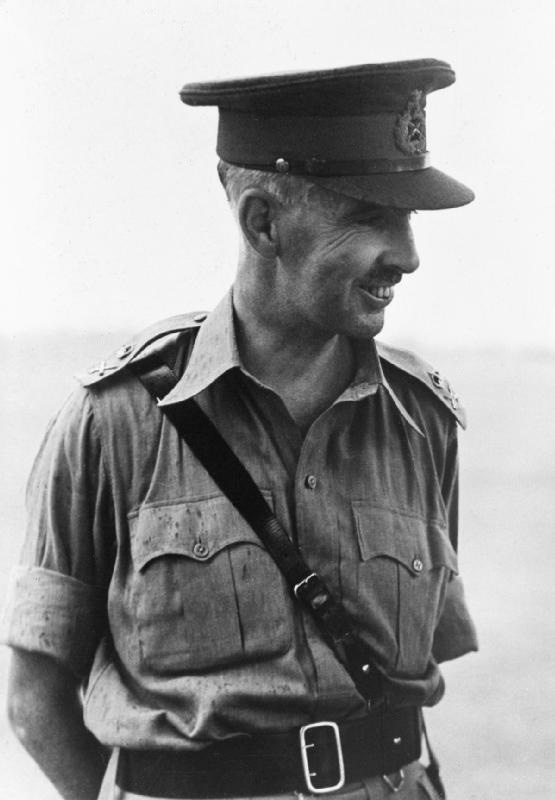
Lieutenant-General Arthur Ernest Percival, CB, DSO & Bar, OBE, MC, DL (26 December 1887 – 31 January 1966) was a British Army officer. He saw service in the First World War and built a successful military career during the interwar period, but is best known for his defeat in the Second World War, when Percival commanded British Commonwealth forces during the Malayan campaign, which culminated in a catastrophic defeat at the Battle of Singapore.
Key Information


Percival's surrender to the invading Imperial Japanese Army, which was the largest of its kind in British military history, significantly undermined Britain's prestige and military position in East Asia.[2][3] Some historians, such as Sir John Smyth, have argued that under-funding of British Malaya's defences and the inexperienced, under-equipped nature of the Commonwealth forces in Malaya, not Percival's leadership, were ultimately to blame for the defeat.[4]
Early days
[edit]Childhood and employment
[edit]Arthur Ernest Percival was born on 26 December 1887 in Aspenden Lodge, Aspenden near Buntingford in Hertfordshire, England, the second son of Alfred Reginald and Edith Percival (née Miller). His father was the land agent of the Hamel's Park estate and his mother came from a Lancashire cotton family.[5] By 1891 the family was living in nearby Thundridge at "Sprangewell" on Poles Lane, his father being listed as "Land Agent" in the 1891 census, although it is unclear if this is still for Hamel's Park, or for E.S. Hanbury's Poles estate (now "Hanbury Manor"), which is adjacent to Sprangewell.[6]
Percival was initially schooled locally in Bengeo. Then in 1901, he was sent to Rugby with his more academically successful brother, where he was a boarder in School House. A moderate pupil, he studied Greek and Latin but was described by a teacher as "not a good classic".[7] Percival's only qualification on leaving in 1906 was a higher school certificate. He was a more successful sportsman, playing cricket and tennis and running cross country.[8] He also rose to colour sergeant in the school's Volunteer Rifle Corps. However, his military career began at a comparatively late age: although a member of Youngsbury Rifle Club, he was working as a clerk for the iron ore merchants Naylor, Benzon & Company Limited in London, which he had joined in 1914, when the First World War broke out.[9]
Enlistment and First World War
[edit]Percival enlisted on the first day of the war as a private in the Officer Training Corps of the Inns of Court, at the age of 26, and was promoted after five weeks' basic training to temporary second lieutenant.[10] Nearly one third of his fellow recruits would be dead by the end of the war. By November Percival had been promoted to captain.[11] The following year he was dispatched to France with the newly formed 7th (Service) Battalion of the Bedfordshire Regiment (later the Bedfordshire and Hertfordshire Regiment),[10] which became part of the 54th Brigade, 18th (Eastern) Division, in February 1915. The first day of the Battle of the Somme (1 July 1916) left Percival unscathed, but in September he was badly wounded in four places by shrapnel, as he led his company in an assault on the Schwaben Redoubt, beyond the ruins of Thiepval village, and was awarded the Military Cross (MC), the citation for which reads:
For conspicuous gallantry in action. During the advance he showed fine leadership and determination under heavy shell and machine-gun fire. He worked unceasingly, with absolute disregard of danger, in completing every detail in the consolidation of the captured position.[5][12]

Percival took a regular commission as a captain with the Essex Regiment in October 1916,[13] whilst recovering from his injuries in hospital. He was appointed a temporary major in his original regiment.[14] In 1917, he became a battalion commander with the temporary rank of lieutenant-colonel.[15][16][17][18][19] During Germany's Spring Offensive, Percival led a counter-attack that saved a unit of French artillery from capture, winning a Croix de Guerre.[20] For a short period in May 1918, he acted as commander of the 54th Brigade. He was given brevet promotion to major,[21] and awarded the Distinguished Service Order (DSO), with his citation stating the following:
For conspicuous gallantry and devotion to duty during recent operations. He handled his battalion cleverly, showing power of command and knowledge of tactics. He set a fine example during several critical periods.[5][22]
He ended the war, which came to an end on 11 November 1918 due to the Armistice with Germany, as a respected soldier, described as "very efficient" and was recommended for the Staff College.[23]
Interwar period
[edit]Russia
[edit]Percival's studies were delayed in 1919 when he decided to volunteer for service with the Archangel Command of the British Military Mission during the North Russia intervention of the Russian Civil War. Acting as second-in-command of the 45th Royal Fusiliers, he earned a bar to his DSO in August, when his attack in the Gorodok operation along the Northern Dvina resulted in the British capture of 400 Red Army troops. The citation reads:
He commanded the Gorodok column on 9–10 August 1919, with great gallantry and skill, and owing to the success of this column the forces on the right bank of the Dvina were able to capture all its objectives. During the enemy counter-attack from Selmenga on Gorodok he handled his men excellently. The enemy were repulsed with great loss, leaving 400 prisoners in our hands.[24]
Ireland
[edit]
In 1920, Percival was deployed to Ireland and fought against the Irish Republican Army (IRA) during the Irish War of Independence, first as a company commander and later as the intelligence officer of the 1st Essex Regiment. He was stationed in Bandon and Kinsale in County Cork.[25] In December 1920 the Commander in Chief of British forces in Ireland (Nevil Macready) informed the British Cabinet that "official reprisals" had been authorized in areas under martial law.[26] Percival proved to be an energetic counterinsurgency commander who was noted for his aptitude for intelligence-gathering and establishment of bicycle infantry formations which acted as flying columns. He was also accused by several IRA prisoners of using torture during interrogations.[27][28] As a result, Percival became one of the most hated British commanders in Ireland at the time and survived three assassination attempts by the IRA.[29] The IRA had promised a £1,000 reward to whoever captured or killed Percival.[30]
Following the IRA killing of a Royal Irish Constabulary sergeant outside a Bandon church in July 1920, Percival captured Tom Hales, the commander of the IRA's 3rd Cork Brigade, and Patrick Harte, the brigade's quartermaster, for which he was given an OBE. Both Hales and Harte subsequently claimed they had been tortured while in custody, and according to IRA commander Tom Barry, Harte received a severe blow with a rifle butt to his temple causing a brain injury and died in a mental hospital in 1925 as a result.[31][32] British intelligence officer Ormonde Winter subsequently stated that Hales had informed on the IRA while in British custody and had invented his allegations to deflect attention away from his decision to provide the names of fellow IRA members in return for a lesser sentence.[33][34]
On 4 February 1921, while participating a raid carried out by British forces between Bandon and Kilbrittain, Percival shot and killed IRA volunteer Patrick Crowley Jr. When Crowley, who was being treated for appendicitis, tried to flee from a house in Maryboro, Percival chased him on foot and shot him in the back.[35] Barry later wrote that Percival was "easily the most vicious anti-Irish of all serving British officers".[36] David Lloyd George and Winston Churchill met Percival in 1921, when he was called as an expert witness during an inquiry into the Irish War of Independence.[37]
Percival would later deliver a series of lectures on his experiences in Ireland in which he stressed the importance of surprise and offensive action, intelligence-gathering, maintaining security and co-operation between different security forces.[38] Historian J. B. E. Hittle wrote that of all the British officers in Ireland "Percival stood out for his violent, sadistic behaviour towards IRA prisoners, suspects and innocent civilians... He also participated in reprisals, burning farms and businesses in response to IRA attacks.[39] Percival was said to regularly drive in the countryside in an open touring car so he could "have cockshots at farmers working in the fields".[40] It is possible that Percival was influenced by the then British Army Captain Bernard Montgomery who wrote to Percival regarding tactics he used to combat the Irish rebels: "My own view is that to win a war of this sort, you must be ruthless. Oliver Cromwell, or the Germans, would have settled it in a very short time.[41] Clifford Kinvig, Percival's biographer considers him to have been unfairly vilified by Irish republican propaganda due to being "tireless in his attempt to destroy the spirit of the people and the organisation of the IRA".[42]
Staff officer
[edit]Percival attended the Staff College, Camberley, from 1923[43] to 1924, which had Major-General Edmund Ironside as its Commandant, where he was taught by J. F. C. Fuller, who was one of the few sympathetic reviewers of his book, The War in Malaya, twenty-five years later. He impressed his instructors, who picked him out as one of eight students for accelerated promotion, and his fellow students who admired his cricketing skills. Following an appointment as major with the Cheshire Regiment, he spent four years with the Nigeria Regiment of the Royal West African Frontier Force in West Africa as a staff officer.[44][45] He was given brevet promotion to lieutenant-colonel in 1929.[46]

In 1930, Percival spent a year studying at the Royal Naval College, Greenwich. From 1931 to 1932, Percival was a General Staff Officer Grade 2, an instructor at the Staff College. The college's commandant was by now Major-General Sir John Dill, who became Percival's mentor over the next decade, helping to ensure his protégé's advancement. Dill regarded Percival as a promising officer and wrote that "he has an outstanding ability, wide military knowledge, good judgment and is a very quick and accurate worker" but added "he has not altogether an impressive presence and one may therefore fail, at first meeting him, to appreciate his sterling worth".[47] With Dill's support, Percival was appointed to command the 2nd Battalion, the Cheshire Regiment from 1932[48] to 1936, initially in Malta. In 1935, he attended the Imperial Defence College in London.[5]
Percival was made a full colonel in March 1936,[49] and until 1938[50] he was General Staff Officer Grade 1 in Malaya, the Chief of Staff to General Dobbie, the General Officer Commanding in Malaya. During this time, he recognised that Singapore was no longer an isolated fortress.[51] He considered the possibility of the Japanese landing in Thailand to "burgle Malaya by the backdoor[52] and conducted an appraisal of the possibility of an attack being launched on Singapore from the North, which was supplied to the War Office, and which Percival subsequently felt was similar to the plan followed by the Japanese in 1941.[53] He also supported Dobbie's unexecuted plan for the construction of fixed defences in Southern Johore. In March 1938, Percival returned to Britain and was (temporarily) promoted to brigadier on the General Staff, Aldershot Command.[54]
Second World War
[edit]
Percival was appointed brigadier, General Staff, of the I Corps, British Expeditionary Force, commanded by General Dill, from 1939 to 1940. He was then promoted to acting major-general,[55] and in February 1940 briefly became General Officer Commanding (GOC) of the 43rd (Wessex) Infantry Division.[56] He was made Assistant Chief of the Imperial General Staff at the War Office in 1940 but asked for a transfer to an active command after the Dunkirk evacuation.[57][58] Given command of the 44th (Home Counties) Division, he spent 9 months organising the protection of 62 miles (100 km) of the English coast from invasion.[59][56] He was appointed a Companion of the Order of the Bath (CB) in the 1941 King's Birthday Honours.[60]
Percival's early assessment of the vulnerability of Singapore
[edit]
In 1936, Major-General William Dobbie, then General Officer Commanding (Malaya), had made an inquiry into whether more forces were required on mainland Malaya to prevent the Japanese from establishing forward bases to attack Singapore. Percival, then his Chief Staff Officer, had been tasked to draw up a tactical assessment of how the Japanese were most likely to attack. In late 1937, his analysis had duly confirmed that north Malaya might become the critical battleground.[56] The Japanese were likely to seize the east coast landing sites on Thailand and Malaya in order to capture aerodromes and achieve air superiority. This could serve as a prelude to further Japanese landings in Johore to disrupt communications northwards and enable the construction of another main base in North Borneo. From there, the final sea and air assault could be launched against eastern Singapore – in particular the Changi area.[61]
General Officer Commanding (Malaya)
[edit]In April 1941 Percival was promoted to acting Lieutenant-General,[62] and was appointed General Officer Commanding (GOC) Malaya.[56] This was a significant promotion for him as he had never commanded an army corps although he had previous experience there.[56] He left Britain in a Sunderland flying boat and embarked on an arduous fortnight-long, multi-stage flight via Gibraltar, Malta, Alexandria (where he was delayed by the Anglo-Iraqi War), Basra, Karachi, and Rangoon, where he was met by an RAF transport.[53]
Percival had mixed feelings about his appointment, noting that "In going to Malaya I realised that there was the double danger either of being left in an inactive command for some years if war did not break out in the East or, if it did, of finding myself involved in a pretty sticky business with the inadequate forces which are usually to be found in the distant parts of our Empire in the early stages of a war."[59]
For much of the interwar period, Britain's defensive plan for Malaya had centred on the dispatch of a naval fleet to the newly built Singapore Naval Base. Accordingly, the army's role was to defend Singapore and Southern Johore. While this plan had seemed adequate when the nearest Japanese base had been 1,700 miles (2,700 km) away, the outbreak of war in Europe, combined with the partial Japanese occupation of the northern part of French Indochina and the signing of the Tripartite Pact by Germany, Italy, and Japan in September 1940, had underlined the difficulty of a sea-based defence. Instead it was proposed to use the RAF to defend Malaya, at least until reinforcements could be dispatched from Britain. This led to the building of airfields in northern Malaya and along its east coast and the dispersal of the available army units around the peninsula to protect them.[63]
On arrival, Percival set about training his inexperienced army; his Indian troops were particularly raw, with most of their experienced officers having been withdrawn to support the formation of new units as the Indian army expanded.[64] Relying upon commercial aircraft or the Volunteer air force to overcome the shortage of RAF planes, he toured the peninsula and encouraged the building of defensive works around Jitra.[65] A training manual approved by Percival, Tactical Notes on Malaya, was distributed to all units.[66]
In July 1941 when the Japanese occupied southern Indochina, Britain, the United States and the Netherlands imposed economic sanctions, freezing Japanese financial assets and cutting Japan from its supplies of oil, tin and rubber. The sanctions were aimed at pressuring Japan to abandon its involvement in China; instead, the Japanese government planned to seize the resources of South-East Asia from the European nations by force. Both the Japanese navy and army were mobilised, but for the moment an uneasy state of cold war persisted. British Commonwealth reinforcements continued to trickle into Malaya. On 2 December, the battleship HMS Prince of Wales and the battle-cruiser HMS Repulse, escorted by four destroyers, arrived in Singapore, the first time a battle fleet had been based there. (They were to have been accompanied by the aircraft carrier HMS Indomitable to provide air cover but she had run aground in the Caribbean en route.) The following day Rear-Admiral Spooner hosted a dinner attended by the newly arrived Commander-in-Chief Eastern Fleet, Admiral Sir Tom Phillips, and Percival.[67]
Japanese attack and British surrender
[edit]
On 8 December 1941 the Japanese 25th Army under the command of Lieutenant-General Tomoyuki Yamashita launched an amphibious assault on the Malay Peninsula (one hour before the attack on Pearl Harbor; the difference in date was because the two places lie on opposite sides of the International Date Line). That night the first Japanese invasion force arrived at Kota Bharu on Malaya's east coast. This was just a diversionary force, and the main landings took place the next day at Singora and Pattani on the south-eastern coast of Thailand, with troops rapidly deploying over the border into northern Malaya.
On 10 December Percival issued a stirring, if ultimately ineffective, Special Order of the Day:
In this hour of trial the General Officer Commanding calls upon all ranks Malaya Command for a determined and sustained effort to safeguard Malaya and the adjoining British territories. The eyes of the Empire are upon us. Our whole position in the Far East is at stake. The struggle may be long and grim but let us all resolve to stand fast come what may and to prove ourselves worthy of the great trust which has been placed in us.[68]

The Japanese advanced rapidly, and on 27 January 1942 Percival ordered a general retreat across the Johore Strait to the island of Singapore and organised a defence along the length of the island's 70-mile (110 km) coast line. But the Japanese did not dawdle, and on 8 February Japanese troops landed on the northwest corner of Singapore island. After a week of fighting on the island, Percival held his final command conference at 9 am on 15 February in the Battle Box of Fort Canning. The Japanese had already occupied approximately half of Singapore and it was clear that the island would soon fall. Having been told that ammunition and water would both run out by the following day, Percival agreed to surrender. The Japanese at this point were running low on artillery shells, but Percival did not know this.[69]
The Japanese insisted that Percival himself march under a white flag to the Old Ford Motor Factory in Bukit Timah to negotiate the surrender. A Japanese officer present noted that he looked "pale, thin and tired".[70] After a brief disagreement, when Percival insisted that the British keep 1,000 men under arms in Singapore to preserve order, which Yamashita finally conceded, it was agreed at 6:10 pm that all British Commonwealth troops would lay down their arms and cease resistance at 8:30 pm. This was in spite of instructions from Prime Minister Winston Churchill for prolonged resistance.[3]
A common view holds that 129,704 Allied personnel surrendered or were killed by fewer than 30,000 Japanese. However, the former figure includes nearly 50,000 troops captured or killed during the Battle of Malaya, and perhaps 15,000 base troops. Many of the other troops were tired and under-equipped following their retreat from the Malayan peninsula. Conversely, the latter number represents only the front-line troops available for the invasion of Singapore. British Commonwealth casualties in battle since 8 December amounted to 7,500 killed and 11,000 wounded. Japanese losses totalled more than 3,507 killed and 6,107 wounded.[71]
Culpability for the fall of Singapore
[edit]
Churchill viewed the fall of Singapore to be "the worst disaster and largest capitulation in British history." However, the British defence was that the Middle East and the Soviet Union had all received higher priorities in the allocation of men and material, so the desired air force strength of 300 to 500 aircraft was never reached, and whereas the Japanese invaded with over two hundred tanks, the British Army in Malaya did not have a single tank.[72] In The War in Malaya Percival himself cites this as the major factor for the defeat stating that the 'war material which might have saved Singapore was sent to Russia and the Middle East'. However he also concedes that Britain was engaged in 'a life and death struggle in the West' and that 'this decision, however painful and regrettable, was inevitable and right'.[73]
In 1918, Percival had been described as "a slim, soft spoken man... with a proven reputation for bravery and organisational powers"[74] but by 1945 this description had been turned on its head with even Percival's defenders describing him as "something of a damp squib".[75] The fall of Singapore switched Percival's reputation to that of an ineffective "staff wallah", lacking ruthlessness and aggression. Over six feet in height and lanky, with a clipped moustache and two protruding teeth, and unphotogenic, Percival was an easy target for a caricaturist, being described as "tall, bucktoothed and lightly built".[76] There was no doubt his presentation lacked impact as "his manner was low key and he was a poor public speaker with the cusp of a lisp".[77]

Air Chief Marshal Sir Robert Brooke-Popham, the Commander-in-Chief of the British Far East Command, refused Percival permission to launch Operation Matador, a pre-emptive invasion of Thailand, in advance of the Japanese landings there; he did not wish to run any risk of provoking the coming war. Brooke-Popham was accused by his detractors of not arguing forcefully for air reinforcements required to defend Malaya.[80]
Peter Wykeham suggested that the government in London was more to blame than any of the British commanders in the Far East. Despite repeated requests, the British government did not provide the necessary reinforcements and they denied Brooke-Popham – and therefore Percival – permission to enter neutral Thailand before it was too late to put in place forward defences.[81]
Moreover, Percival had difficulties with his subordinates Sir Lewis "Piggy" Heath, commanding Indian III Corps, and the independent-minded Gordon Bennett, commanding the Australian 8th Division. The former officer had been senior to Percival prior to his appointment as GOC (Malaya).[82][83]
Percival was ultimately responsible for the men who served under him, and with other officers – notably Major-General David Murray-Lyon, commander of the Indian 11th Infantry Division – he had shown a willingness to replace them when he felt their performance was not up to scratch. Perhaps his greatest mistake was to resist the building of fixed defences in either Johore or the north shore of Singapore, dismissing them in the face of repeated requests to start construction from his Chief Engineer, Brigadier Ivan Simson, with the comment "Defences are bad for morale – for both troops and civilians".[84][85]
Percival also insisted on defending the north-eastern shore of Singapore most heavily, against the advice of the Allied supreme commander in South East Asia, General Sir Archibald Wavell. Percival was perhaps fixed on his responsibilities for defending the Singapore Naval Base.[86] He also spread his forces thinly around the island and kept few units as a strategic reserve. When the Japanese attack came in the west, the Australian 22nd Brigade took the brunt of the assault.[87] Percival refused to reinforce them as he continued to believe that the main assault would occur in the north east.[88] The attacking Japanese were down to the last of their ammunition when Percival surrendered. Before surrendering, besides taking his own counsel, he consulted his own officers.[89]
In the post-war Percival Report (written in 1946, published in 1948) the "imminent collapse" of the water supply, estimated by David J. Murnane, the Municipal Water Engineer, on 14 February to occur within 24–48 hours, was highlighted as a direct cause for surrender.[90] According to oral history records, quoted by Louis Allen (author of Singapore 1941–42), Murnane asked for and was promised by General Percival "ten lorries and a hundred Royal Engineers" so he could fix the water supply leaks caused by Japanese bombing and shelling. He never got what he needed: Louis Allen says Murnane got 'one lorry and ten frightened Sikhs'. When confronted again, all that Percival delivered (on 14 February) was one lorry and ten Royal Engineers but it was too late.[91]
Captivity
[edit]Percival himself was briefly held prisoner in Changi Prison, where "the defeated GOC could be seen sitting head in hands, outside the married quarters he now shared with seven brigadiers, a colonel, his ADC and cook-sergeant. He discussed feelings with few, spent hours walking around the extensive compound, ruminating on the reverse and what might have been".[92] In the belief that it would improve discipline, he reconstituted a Malaya Command, complete with staff appointments, and helped occupy his fellow prisoners with lectures on the Battle of France.[93]

Along with the other senior British captives above the rank of colonel, Percival was removed from Singapore in August 1942. First he was imprisoned in Formosa and then sent on to Manchuria, where he was held with several dozen other VIP captives, including the American General Jonathan Wainwright, in a prisoner-of-war camp near Hsian, about 100 miles (160 km) to the north east of Mukden.[94]
As the war drew to an end, an OSS team removed the prisoners from Hsian. Percival was then taken, along with Wainwright, to stand immediately behind General Douglas MacArthur as he confirmed the terms of the Japanese surrender aboard USS Missouri in Tokyo Bay on 2 September 1945.[95][96] Afterwards, MacArthur gave Percival a pen he had used to sign the treaty.[97]
Percival and Wainwright then returned together to the Philippines to witness the surrender of the Japanese army there, which in a twist of fate was commanded by General Yamashita. Yamashita was momentarily surprised to see his former captive at the ceremony; on this occasion Percival refused to shake Yamashita's hand, angered by the mistreatment of POWs in Singapore. The flag carried by Percival's party on the way to Bukit Timah was also a witness to this reversal of fortunes, being flown when the Japanese formally surrendered Singapore back to Lord Louis Mountbatten.[98]
Later life
[edit]Percival returned to the United Kingdom in September 1945 to write his despatch at the War Office but this was revised by the UK Government and published only in 1948.[99] He retired from the army in 1946 with the honorary rank of lieutenant-general but the pension of his substantive rank of major-general.[100] Thereafter, he held appointments connected with the county of Hertfordshire, where he lived at Bullards in Widford: he was Honorary Colonel of 479th (Hertfordshire Yeomanry) Heavy Anti-Aircraft Regiment, Royal Artillery, (T.A.) from 1949 to 1954[101][102] and in 1951 was appointed as one of the Deputy Lieutenants of Hertfordshire.[103] He continued his relationship with the Cheshire Regiment being appointed Colonel of the Cheshire Regiment between 1950 and 1955;[104][105] an association continued by his son, Brigadier James Percival who became Colonel of the Regiment between 1992 and 1999.[106]
Percival was respected for the time he had spent as a Japanese prisoner of war. Serving as life president of the Far East Prisoners of War Association (FEPOW), he pushed for compensation for his fellow captives, eventually helping to obtain a token £5 million of frozen Japanese assets for this cause. This was distributed by the FEPOW Welfare Trust, on which Percival served as chairman.[107] He led protests against the film The Bridge on the River Kwai when it was released in 1957, obtaining the addition of an on-screen statement that the movie was a work of fiction. He also worked as president of the Hertfordshire British Red Cross and was made an Officer of the Venerable Order of Saint John in 1964.[108]
Percival died at the age of 78 on 31 January 1966, in King Edward VII's Hospital for Officers, Beaumont Street in Westminster, and is buried in the churchyard at Widford in Hertfordshire.[109]
Family
[edit]On 27 July 1927 Percival married Margaret Elizabeth "Betty" MacGregor Greer in Holy Trinity Church, Brompton. She was the daughter of Thomas MacGregor Greer of Tallylagan Manor, a Protestant linen merchant from County Tyrone in Northern Ireland. They had met during his tour of duty in Ireland but it had taken Percival several years to propose. They had two children. A daughter, Dorinda Margery, was born in Greenwich and in 1959 married Charles Mulholland, 4th Baron Dunleath. Alfred James MacGregor, their son, was born in Singapore and served in the British Army.[110]
Honours
[edit] Military Cross (MC) (1916)[111]
 Croix de Guerre (1918)
 Distinguished Service Order (DSO) (1918)[112]
- Distinguished Service Order (DSO*) (1920)[113]
 (OBE (Mil)) (1921)[114]
 Companion of the Order of the Bath (CB (Mil)) (1941)[115]
- Deputy Lieutenant (DL) (1951)[116]
 Officer of the Order of Saint John (OStJ) (1964)


_Ribbon.svg)

_ribbon_-vector.svg)
See also
[edit]Notes
[edit]- ^ The story that in the negotiation Yamashita thumped the table with his fists to intimidate for the Malaya Command to surrender is widely circulated but by 1991 at the latest it turned out to be a fiction. After declaration of death by hanging at the military tribunals in Philippines in 1945 Yamashita was interviewed by a Japanese journalist and mentioned the story in it.[78] He denied clearly the story that he coerced and/or intimidated Percival and asked the journalist to correct the fiction to the truth.[78] Besides we have another testimony by Kazushi Sugita, who was a staff officer of intelligence in the Japanese 25th Army at the time of Malayan campaign. [79] Sugita, the standing figure with moustache next to Yamashita in the photograph, served as a translator in the negotiation. Masayasu Hosaka, the well-known Japanese writer specializing to the history in wartime Japan of Shōwa period, interviewed him in 1991. In the interview Sugita also denied the story. According to him Yamashita asked Percival a question if Malaya command surrendered unconditionally, on the other hand, Percival repeatedly wanted for stationing 1,500 British soldiers to prevent from pillaging without answering it.[78] Because Percival did not reply to his question Yamashita finally asked Percival to answer it in Yes or No to make the discussion clear.[78]
References
[edit]- ^ "僑領紛紛反駁白思華誹謗報告政府不信華僑豈是華僑未盡衛土之責". Nanyang Siang Pau (in Chinese). 6 March 1948. p. 5.
- ^ Taylor, English History 1914–1945, p657
- ^ a b Morris, Farewell the Trumpets, p452
- ^ Smyth, Percival and the Tragedy of Singapore
- ^ a b c d "British Army officer histories". Unit Histories. Retrieved 23 June 2017.
- ^ Census of England and Wales, 1891. Public Record Office
- ^ Kinvig, Scapegoat: General Percival of Singapore, p. 5
- ^ Smith, Singapore Burning: Heroism and Surrender in World War II, p. 23
- ^ Pike, Francis (2015). Hirohito's War: The Pacific War, 1941–1945. Bloomsbury. ISBN 978-1472596703.
- ^ a b "No. 29058". The London Gazette (Supplement). 2 February 1915. pp. 1176–1179.
- ^ "No. 29050". The London Gazette. 26 January 1915. p. 802.
- ^ "No. 29824". The London Gazette (Supplement). 14 November 1916. pp. 11044–11063.
- ^ "No. 29783". The London Gazette. 13 October 1916. p. 9864.
- ^ "No. 30038". The London Gazette (Supplement). 27 April 1917. p. 4042.
- ^ "No. 30632". The London Gazette (Supplement). 12 April 1918. p. 4550.
- ^ "No. 31003". The London Gazette (Supplement). 8 November 1918. p. 13282.
- ^ "No. 31035". The London Gazette (Supplement). 26 November 1918. p. 14044.
- ^ "No. 31220". The London Gazette (Supplement). 7 March 1919. p. 3257.
- ^ "No. 32233". The London Gazette (Supplement). 18 February 1921. p. 1434.
- ^ Smith, p. 24
- ^ "No. 31092". The London Gazette (Supplement). 24 June 1921. pp. 15–16.
- ^ "No. 32371". The London Gazette (Supplement). 24 June 1921. p. 5096.
- ^ Keegan, Churchill's Generals, p. 257
- ^ "No. 31745". The London Gazette (Supplement). 20 January 1920. p. 923.
- ^ "Essex Regiment". National Army Museum. Archived from the original on 20 October 2016. Retrieved 19 October 2016.
- ^ Townshend, Charles (2006). Easter 1916 The Irish Rebellion. Penguin UK/Penguin Books Ltd. p. 149. ISBN 0141012161.
- ^ Thompson 2005, p. 69.
- ^ Statement by witness Patrick O'Brien, Bureau of Military History, http://www.bureauofmilitaryhistory.ie/r[permanent dead link] ... WS0812.pdf
- ^ Killeen, Richard (2007). A Short History of the Irish Revolution, 1912 to 1927: From the Ulster Crisis to the Formation of the Irish Free State. Gill Books.
- ^ "Arthur Percival". History Learning. 2024. Retrieved 26 June 2024.
- ^ Barry, Tom (2013). Guerilla Days In Ireland (2013 ed.). Mercier Press. ISBN 9781781171714.
- ^ Coogan, Tim Pat (1990). Michael Collins A Biography. Palgrave. p. 146. ISBN 0-312-29511-1.
- ^ Narratives: British Intelligence in Ireland 1920–21 – The Final Reports edited by Peter Hart, p. 82, ISBN 1-85918201-1
- ^ A Winter's Tale by Sir Ormonde Winter p. 300
- ^ O'Brien, Denis. "The Life and Death of Lieutenant Patrick Crowley Jr". Kilbrittain Historical Society. 7, 2023/2024: 153.
- ^ Guerilla Days in Ireland, pp. 57–58
- ^ Thompson 2005, pp. 69–70.
- ^ Sheehan, William (2005). British Voices from the Irish War of Independence 1918–1921: the words of British servicemen who were there. Collins Press, p. 167. ISBN 1903464897
- ^ Hittle, J. B. E. (October 2011). Michael Collins and the Anglo Irish War: Britain's Counter Insurgency Failure. Potomac Books. ISBN 978-1597975353.
- ^ Coogan, pg. 146
- ^ McGreevy, Ronan (10 January 2021). "Montgomery and the War of Independence – 'I regarded all civilians as Shinners'". Irish Times. Retrieved 25 July 2024.
- ^ Scapegoat: General Percival of Singapore by Clifford Kivnig p. 75 ISBN 185753171X Hardcover
- ^ "No. 32790". The London Gazette. 26 January 1923. p. 608.
- ^ "No. 33043". The London Gazette. 1 May 1925. p. 2921.
- ^ "No. 33470". The London Gazette. 26 February 1929. p. 1345.
- ^ "No. 33454". The London Gazette. 4 January 1929. p. 152.
- ^ Thompson 2005, p. 71.
- ^ "No. 33846". The London Gazette. 15 July 1932. p. 4627.
- ^ "No. 34264". The London Gazette. 13 March 1936. p. 1657.
- ^ "No. 34557". The London Gazette. 30 September 1938. pp. 6139–6140.
- ^ Hack and Blackburn, Did Singapore Have to Fall?: Churchill and the Impregnable Fortress, p. 39
- ^ Kinvig, p. 106
- ^ a b Percival, The War in Malaya, Chapter 1
- ^ "No. 34503". The London Gazette. 19 April 1938. p. 2594.
- ^ "No. 34800". The London Gazette (Supplement). 23 February 1940. p. 1151.
- ^ a b c d e Mead 2007, p. 345.
- ^ "No. 34855". The London Gazette (Supplement). 21 May 1940. p. 3091.
- ^ "No. 34895". The London Gazette (Supplement). 9 July 1940. p. 4273.
- ^ a b Percival, Chapter 2
- ^ "No. 35204". The London Gazette (Supplement). 27 June 1941. pp. 3735–3736.
- ^ Ong, Chit Chung (1997) Operation Matador : Britain's war plans against the Japanese 1918–1941. Singapore : Times Academic Press.
- ^ "No. 35160". The London Gazette (Supplement). 9 May 1941. p. 2731.
- ^ Percival, Chapter 3
- ^ Mead 2007, pp. 345–346.
- ^ Percival, Chapter 4
- ^ Tactical Notes on Malaya. Government of Indian Press. 1941.
- ^ Percival, Chapter 7
- ^ Percival, chapter 9
- ^ Thompson 2005, p. 356.
- ^ Warren, p. 265
- ^ Thompson 2005, pp. 9 & 424.
- ^ Kinvig.
- ^ The War in Malaya; Authur Percival p. 306
- ^ Kinvig, p. 47.
- ^ Kinvig, p. 242.
- ^ Warren, p. 29.
- ^ Kinvig, General Percival and the Fall of Singapore, p. 241.
- ^ a b c d Masayasu Hosaka (保阪正康) (28 February 2006). "シンガポール攻略とその歪んだ影". 昭和陸軍の研究・上巻. 朝日文庫. 朝日新聞出版. p. 512. ISBN 978-4-02-261500-8.
- ^ Masayasu Hosaka (保阪正康) (28 February 2006). "シンガポール攻略とその歪んだ影". 昭和陸軍の研究・上巻. 朝日文庫. 朝日新聞出版. p. 509. ISBN 978-4-02-261500-8.
- ^ Cox 2014, p. 45
- ^ Wykeham, Peter; Thomas Paul Ofcansky (January 2008). "Popham, Sir (Henry) Robert Moore Brooke". Oxford Dictionary of National Biography (online ed.). Oxford University Press. doi:10.1093/ref:odnb/32096. (Subscription, Wikipedia Library access or UK public library membership required.)
- ^ Diamond, Jon (17 June 2016). "General Arthur Percival: a Convenient Scapegoat?". Warfare History Network. Retrieved 27 May 2020.
- ^ Mead 2007, pp. 346–348.
- ^ Thompson 2005, p. 182.
- ^ Mead 2007, pp. 348–349.
- ^ Dixon, On the Psychology of Military Incompetence, p. 143.
- ^ Thompson 2005, p. 414.
- ^ Thompson 2005, p. 430.
- ^ "Operation Uranus: The Soviet Plan To Trap The Nazis At Stalingrad". YouTube. 22 March 2020.
- ^ "Prisoners of War of the Japanese 1942–1945". Pows-of-japan.net. Retrieved 28 November 2016.
- ^ Louis Allen (2013). Singapore 1941–1942: Revised Edition. Routledge. p. 11. ISBN 978-1135194185. Retrieved 28 November 2016.
- ^ Kinvig, p. 221
- ^ MacArthur, Surviving the Sword: Prisoners of the Japanese 1942–45, p. 188
- ^ Mancini, John (7 September 2016). "The OSS' Operation Cardinal: Locating General Jonathan Wainwright". Warfare History Network. Retrieved 27 May 2020.
- ^ Battleship Missouri Memorial, "Surrender". Archived from the original on 9 November 2005. Retrieved 2 February 2006. , accessed 2 February 2006
- ^ Mead 2007, p. 348.
- ^ Warren, p. 286
- ^ Morris, p. 458
- ^ "No. 38215". The London Gazette. 20 February 1948. pp. 1245–1346.
- ^ "No. 37706". The London Gazette. 27 August 1946. p. 4347.
- ^ "No. 38762". The London Gazette. 18 November 1949. p. 5465.
- ^ Col J.D. Sainsbury, The Hertfordshire Yeomanry Regiments, Royal Artillery, Part 2: The Heavy Anti-Aircraft Regiment 1938–1945 and the Searchlight Battery 1937–1945; Part 3: The Post-war Units 1947–2002, Welwyn: Hertfordshire Yeomanry and Artillery Trust/Hart Books, 2003, ISBN 0-948527-06-4.
- ^ "No. 39412". The London Gazette. 18 December 1951. p. 6600.
- ^ "No. 38940". The London Gazette (Supplement). 13 June 1950. p. 3037.
- ^ "No. 40680". The London Gazette (Supplement). 6 January 1956. p. 208.
- ^ "The Cheshire Regiment". regiments.org. Archived from the original on 31 December 2006. Retrieved 11 July 2016.
{{cite web}}: CS1 maint: bot: original URL status unknown (link) - ^ MacArthur, p. 442.
- ^ "No. 43367". The London Gazette. 26 June 1964. pp. 5540–5542.
- ^ David Boey (10 June 2017). "Senang Diri: Battle for Malaya and Fall of Singapore 75th anniversary: Lieutenant General Arthur Ernest Percival remembered". Kementah.blogspot.com.au. Retrieved 27 May 2020.
- ^ "No. 51919". The London Gazette. 30 October 1989. p. 12507.
- ^ "No. 29824". The London Gazette (Supplement). 14 November 1916. p. 11063.
- ^ "No. 30901". The London Gazette (Supplement). 13 September 1918. p. 10871.
- ^ "No. 31745". The London Gazette (Supplement). 20 January 1920. p. 923.
- ^ "No. 32231". The London Gazette (Supplement). 15 February 1921. p. 1361.
- ^ "No. 35204". The London Gazette (Supplement). 1 July 1941. p. 3736.
- ^ "No. 39412". The London Gazette (Supplement). 18 December 1951. p. 6600.
Bibliography
[edit]- Barry, Tom, Guerilla Days in Ireland, Dublin, 1949
- Bose, Romen, "Secrets of the Battlebox: The role and history of Britain's Command HQ during the Malayan Campaign", Marshall Cavendish, Singapore, 2005 ISBN 978-9814328548
- Coogan, Tim Pat. "Michael Collins". ISBN 0-09-968580-9
- Cox, Jeffrey (2014). Rising Sun, Falling Skies: The disastrous Java Sea Campaign of World War II. Osprey. ISBN 978-1780967264.
- Dixon, Norman F, On the Psychology of Military Incompetence, London, 1976 ISBN 978-0712658898
- Hack, Karl and Blackburn, Kevin, Did Singapore Have to Fall?: Churchill and the Impregnable Fortress, Routledge Curzon, 2003, ISBN 0-415-30803-8
- Keegan, John (editor), Churchill's Generals, Abacus History, 1999, ISBN 0-349-11317-3
- Kinvig, Clifford, General Percival and the Fall of Singapore, in 60 Years On: the Fall of Singapore Revisited, Eastern University Press, Singapore, 2003 ISBN 978-9812102027
- Kingvig, Major-General Clifford (1996). Scapegoat: General Percival of Singapore. Brassey's. ISBN 978-1857531718.
- London Gazette
- MacArthur, Brian, Surviving the Sword: Prisoners of the Japanese 1942–45, Abacus, ISBN 0-349-11937-6
- Oxford Dictionary of National Biography, Volume 43, available at Oxford Dictionary of National Biography website
- Mead, Richard (2007). Churchill's Lions: A Biographical Guide to the Key British Generals of World War II. Stroud: Spellmount. ISBN 978-1-86227-431-0.
- Morris, James Farewell the Trumpets, Penguin Books, 1979 ISBN 978-0151304042
- Percival, Arthur Ernest The War in Malaya, London, Eyre & Spottiswoode, 1949. Extracts from the report used as the basis of this book are at [1] accessed 2 February 2006 and the references here are to this report
- Ryan, Meda. Tom Barry: IRA Freedom Fighter, Cork, 2003 ISBN 978-1856354806
- Smith, Colin, Singapore Burning: Heroism and Surrender in World War II, Penguin Books, ISBN 0-14-101036-3
- Smyth, John George, Percival and the Tragedy of Singapore, MacDonald and Company, 1971. ASIN B0006CDC1Q
- Taylor, A. J. P. English History 1914–1945, Oxford University Press, 1975 ISBN 978-0198217152
- Thompson, Peter (2005). The battle for Singapore : the true story of Britain's greatest military disaster. Portrait. ISBN 0-7499-5068-4. OCLC 61701639.
- Warren, Alan, Singapore 1942: Britain's Greatest Defeat, Hambledon Continuum, 2001, ISBN 1-85285-328-X
External links
[edit]

Arthur Percival
View on GrokipediaArthur Ernest Percival (26 December 1887 – 31 January 1966) was a British Army officer who rose to the rank of lieutenant general and commanded Allied forces in Malaya during the Japanese invasion of 1941–1942, overseeing the defense that ended in the capitulation of Singapore on 15 February 1942—the largest surrender in British history, involving over 80,000 troops.[1][2][3] Percival's early military service began in the First World War, where he fought on the Western Front with the Bedfordshire and Hertfordshire Regiment, earning the Military Cross for gallantry at the Battle of the Somme in 1916 and later the Distinguished Service Order for leadership in subsequent operations, alongside wounds sustained in combat.[1][4][5] His interwar career included staff roles and command in Ireland during the Irish War of Independence, where he contributed to intelligence efforts against Irish republican forces.[6] In the Second World War, as General Officer Commanding Malaya Command, Percival faced a numerically inferior but highly mobile Japanese force under General Tomoyuki Yamashita, hampered by strategic misjudgments at higher levels, including the prioritization of the European theater and insufficient air and naval support for the fortress of Singapore.[7][2] The rapid Japanese advance through Malaya and the subsequent encirclement of Singapore led to Percival's formal surrender to Yamashita, after which he endured over three years as a prisoner of war in Japanese captivity.[3] Postwar inquiries, such as the 1948 Percival Report, attributed the defeat to multiple systemic failures beyond his direct control, though he bore lasting reputational damage as a symbol of British imperial vulnerability in Asia.[7] Percival received honors including Companion of the Order of the Bath for his overall service.[8]
Early Life
Childhood and Education
Arthur Ernest Percival was born on 26 December 1887 in Aspenden, Hertfordshire, England, the second son of Alfred Reginald Percival, manager of a large estate, and Edith Percival.[9][10] He received his early education at a school in Bengeo, Hertfordshire, before attending Rugby School, a prominent English public institution historically noted for preparing students for military service.[10][11][12] Percival completed his schooling at Rugby around 1906, after which he entered civilian employment in London, reflecting the era's common path for public school graduates not immediately pursuing commissions.[5][11]Pre-Military Employment and Enlistment
Arthur Ernest Percival, born on 26 December 1887 in Aspenden, Hertfordshire, received his education at Rugby School, where he focused on Greek and Latin studies while participating in sports such as cricket, tennis, and cross-country running.[10] [13] Following his time at Rugby, Percival entered civilian employment as a clerk for an iron ore merchant firm in London, a position he held until the outbreak of the First World War.[14] [12] [5] On 4 August 1914, the day Britain declared war on Germany, Percival enlisted as a private in the Inns of Court Officer Training Corps at age 26, forgoing his civilian career to pursue military service.[15] His prior education and evident aptitude led to swift promotion; within weeks, he received a temporary commission as second lieutenant, and by November 1914, he had advanced to temporary captain while attached to the British Expeditionary Force.[7] [16] This rapid elevation reflected the urgent demand for officers in the early war months and Percival's capabilities, though he lacked formal pre-war military training.[7]First World War Service
Combat Experience in France
Percival deployed to France in late 1915 as a temporary second lieutenant with the 7th (Service) Battalion, Bedfordshire Regiment, part of the British Expeditionary Force.[15] He participated in trench warfare and preparatory actions leading into major offensives.[13] During the Battle of the Somme, which began on 1 July 1916, Percival served as a first lieutenant and survived the initial assaults unscathed.[15] On 7 August 1916, while leading his company in an attack on the Schwaben Redoubt beyond Thiepval village, he sustained severe shrapnel wounds in four places, requiring evacuation for treatment.[15] [14] For conspicuous gallantry and skillful handling of his unit during these operations, demonstrating strong command and tactical acumen, he was awarded the Military Cross.[17] Recovering from his injuries, Percival received a regular commission as captain in the Essex Regiment in October 1916.[15] He returned to front-line duty, rising to temporary major and then temporary lieutenant colonel, commanding battalions amid the ongoing attritional fighting and the German Spring Offensive of 1918.[14] In 1918, his leadership earned him the Distinguished Service Order, supplemented by the French Croix de Guerre for valor in joint operations.[18] Percival remained in France with the Allied forces until the armistice in November 1918 and demobilization in 1919.[9]Awards and Recognition
During the First World War, Percival was awarded the Military Cross in September 1916 for conspicuous gallantry during an advance, where he demonstrated fine leadership and determination despite heavy shelling and machine-gun fire.[4] This decoration recognized his actions as a captain in the 7th Battalion, Bedfordshire Regiment, amid the intense fighting on the Western Front, including participation in the Battle of the Somme where he was wounded.[7] In 1918, Percival received the Distinguished Service Order for his temporary command of the 54th Brigade during the German Spring Offensive, earning brevet promotion to major for effective leadership in countering the assault.[15] For a related counter-attack that prevented the capture of a French artillery unit amid the same offensive, he was additionally honored with the French Croix de Guerre.[4] These awards underscored his tactical acumen and bravery in defensive operations against superior enemy forces.[14]Interwar Career
Russian Civil War Intervention
Following the Armistice of 11 November 1918, Percival volunteered for service with the British North Russia Relief Force in early 1919, deployed to support the evacuation of Allied troops from the Archangel region amid advancing Bolshevik forces during the Russian Civil War.[7] He served as second-in-command of the 45th Battalion, Royal Fusiliers, under the Archangel Command of the British Military Mission, operating along the Northern Dvina River front.[15] On 9–10 August 1919, Percival commanded the Gorodok column during an offensive operation to secure positions on the right bank of the Dvina, demonstrating gallantry and tactical skill in coordinating infantry advances against Bolshevik positions.[4] His leadership enabled adjacent Allied forces to achieve their objectives, while his handling of troops during a subsequent Bolshevik counter-attack from Selmenga repelled the enemy with significant casualties inflicted, resulting in the capture of 400 Red Army prisoners.[4][15] For these actions, Percival was awarded a bar to his Distinguished Service Order, with the official citation commending his "great gallantry and skill" in command, which contributed to the column's success despite the broader challenges of the intervention's withdrawal phase.[4] This service marked one of his final combat engagements before returning to Britain, amid the Allied decision to fully evacuate North Russia by September 1919 due to unsustainable logistics and political pressures.[5]Service in Ireland
In 1920, during the Irish War of Independence, Major Arthur Percival was posted to Ireland with the 1st Battalion, Essex Regiment, initially serving as a company commander in Kinsale, County Cork. His unit conducted counter-insurgency operations against Irish Republican Army (IRA) guerrilla forces, which employed ambushes, assassinations, and attacks on British personnel and infrastructure to undermine Crown authority. Percival's role involved patrolling and responding to IRA flying columns, amid a conflict characterized by asymmetric warfare and reprisals on both sides.[19][13] Percival later assumed duties as the battalion's intelligence officer, prioritizing the collection of actionable intelligence to preempt IRA actions and protect British forces and loyalist communities. The Essex Regiment under his influence participated in key engagements, including the Battle of Crossbarry on 19 March 1921, where troops commanded by Percival arrived as one of the final British reinforcements but could only engage retreating IRA units at long range after the main ambush had concluded, resulting in the IRA's withdrawal with captured British arms. For his contributions to suppressing the insurgency, Percival received the Order of the British Empire (military division) on 17 January 1921.[4][20] Irish nationalist accounts have accused Percival of overseeing brutal tactics, including the alleged torture of captured IRA members such as Tom Hales and Patrick Harte, reflecting the harsh measures employed in counter-guerrilla operations. In 1921, Percival testified as an expert witness in a British inquiry into the Anglo-Irish War, meeting Winston Churchill and criticizing government policies like the post-1916 release of IRA prisoners, which he contended enabled organized reprisals against Royal Irish Constabulary officers involved in their prior arrests. He advocated for sustained offensive initiatives, surprise maneuvers, and enhanced intelligence cooperation to decisively counter the IRA's asymmetric threat.[19]Staff Roles and Malaya Planning
In the interwar period, Percival held several staff positions that honed his operational planning expertise. Following service in Ireland, he served as a staff officer in the Royal West African Frontier Force from approximately 1922 to 1926, rising from major to lieutenant colonel while focusing on administrative and logistical duties in colonial garrisons.[7] Promoted to colonel in 1936, Percival was appointed General Staff Officer Grade 1 (GSO1) of Malaya Command, effectively serving as chief of staff to General William Dobbie, the General Officer Commanding (GOC).[7][12] In this role, he analyzed the peninsula's terrain, assessed Japanese invasion threats, and contributed to contingency planning amid limited British resources and reliance on Singapore's naval base for deterrence.[7] In December 1937, Percival authored a defense appreciation outlining a plausible Japanese strategy: amphibious landings in northern Malaya or Thailand followed by a rapid overland advance southward to isolate Singapore, bearing close resemblance to the 1941-1942 reality.[12][7] He advocated reallocating limited forces for more flexible defenses, including airfield protections and potential preemptive moves into Thailand, but the plan was rejected by the War Office, which prioritized static fortifications around Singapore supplemented by expected naval reinforcements from Europe rather than robust land-based preparations.[12] Percival departed Malaya by late 1937, though some records extend his staff tenure into 1938.[12]Second World War Command
Appointment as GOC Malaya
In April 1941, Arthur Percival was promoted to acting lieutenant general and appointed General Officer Commanding (GOC) Malaya Command by Chief of the Imperial General Staff Sir John Dill, who had previously mentored him during the First World War.[7] This selection leveraged Percival's familiarity with the theater, stemming from his service as General Staff Officer Grade 1 (GSO1, chief of staff) to Malaya Command under Major General William Dobbie from 1936 to 1938, during which he contributed to defensive planning against potential Japanese threats.[7] The promotion bypassed numerous more senior officers, reflecting Dill's confidence in Percival's expertise for the increasingly tense Far East situation.[7] Percival formally assumed command on 16 May 1941, arriving in Singapore to oversee land forces responsible for defending the Malayan Peninsula and the fortress of Singapore.[21] As GOC, he held dual responsibility as both the senior army commander and overall ground defense coordinator in Malaya, operating under the broader Far East Command led by Air Chief Marshal Sir Robert Brooke-Popham.[22] At the time, Malaya Command comprised a mix of British, Indian, Australian, and local troops, totaling around 85,000 personnel, though inadequately equipped and trained for jungle warfare against a Japanese invasion.[21] Percival's immediate priorities included intensifying training and reinforcing defenses, amid warnings of Japanese expansionism, though resource constraints from Britain's commitments in Europe and the Middle East limited reinforcements.Pre-Invasion Assessments of Defenses
In the mid-1930s, while serving as a staff officer under Major-General W.G.S. Dobbie in Malaya, Lieutenant-Colonel Arthur Percival conducted detailed assessments of Singapore's strategic vulnerabilities, emphasizing the risk of an overland Japanese invasion from the north rather than a direct naval assault on the island. He argued that the peninsula's terrain, including secondary roads and jungle tracks, could be exploited by light, mobile Japanese forces—potentially bicycle-mounted infantry—advancing from landings in southern Thailand, bypassing presumed natural barriers like dense jungle and swamps. Percival recommended forward deployment of troops to secure key airfields and deny the enemy consolidation points, alongside enhanced northern fortifications and increased air and armored assets to counter such a maneuver.[12][7] In November 1937, Percival formalized these concerns in an appreciation written from a hypothetical Japanese perspective, outlining a campaign involving initial seizures of Thai territory for staging, followed by a rapid descent down Malaya's east coast to isolate Singapore. This analysis accurately anticipated the 1941-42 Japanese strategy, including the use of infiltration tactics and airfield captures, yet it was largely dismissed by Singapore and London authorities, who prioritized naval threats and viewed the northern approach as logistically prohibitive due to overreliance on outdated assumptions about impenetrable terrain. No significant reallocations followed, as British strategic focus remained on European commitments, leaving Malaya's defenses underfunded and oriented primarily toward seaward fixed positions like coastal artillery batteries facing south and east.[23][24] Upon assuming command as General Officer Commanding Malaya in May 1941, Percival inherited a force of roughly 85,000 troops across three understrength infantry divisions—primarily British, Indian, and Australian units—many acclimatized poorly to jungle warfare and equipped with obsolete gear, including no tanks or anti-tank weapons sufficient against anticipated Japanese armor. His immediate evaluation deemed the defenses inadequate for denying the peninsula to an invader, citing insufficient air cover (only 158 RAF aircraft, mostly outdated Hurricanes and Vanguards), limited artillery, and vulnerable forward airfields like Kota Bharu and Sungei Patani that required active ground protection. Percival pressed the War Office for reinforcements, including additional divisions, modern fighters, and engineer units to fortify northern passes and bridges, warning that passive defense of Singapore alone would cede air superiority and enable encirclement. However, priorities for the Middle East and Home Forces resulted in minimal additions, such as one Australian division arriving piecemeal, compelling a strategy of elastic defense in depth while preserving forces for the island fortress.[7][2] Percival's 1941 appreciations highlighted systemic shortcomings, including untrained reserves, supply line vulnerabilities along the single east-coast railway, and the psychological impact of incomplete preparations, which he viewed as potentially undermining troop morale without full commitment to forward operations like Operation Matador—a preemptive thrust into Thailand to block landings. Despite these insights, higher command's underestimation of Japanese resolve and capabilities, coupled with resource rationing, perpetuated a fortress mentality focused on Singapore's naval base, with northern land defenses relying on incomplete demolitions and river lines rather than robust field fortifications. This assessment reflected Percival's first-principles recognition of causal factors like mobility and air power in modern warfare, yet operational constraints limited implementation to reconnaissance patrols and ad hoc airfield defenses.[25][26]The Malayan Campaign and Japanese Advance
The Malayan Campaign began on 8 December 1941, when elements of the Japanese 25th Army under Lieutenant General Tomoyuki Yamashita launched invasions at Kota Bharu on Malaya's east coast and at Singora and Patani in southern Thailand, enabling an outflanking maneuver against British forward positions.[27] Lieutenant General Arthur Percival commanded Malaya Command's approximately 88,000 troops, comprising British, Indian, Australian, and local units, which initially outnumbered the invading Japanese force of around 60,000 but suffered from inadequate air support, limited armor, and troops unaccustomed to jungle warfare.[28][22] British defenses focused on the Jitra line in northern Malaya, held by the 11th Indian Division, but Japanese infantry assaults overwhelmed these positions on 11–12 December, inflicting heavy casualties and forcing a disorganized withdrawal; this defeat prompted Percival to evacuate all Allied aircraft from northern airfields to Singapore to prevent capture.[7] Percival ordered systematic demolitions of bridges and roads to impede the Japanese advance, yet Japanese engineers, supported by air superiority, quickly restored mobility, allowing the 25th Army to press southward using bicycles for rapid traversal of secondary tracks through difficult terrain.[27] Subsequent engagements, including the Battle of Kampar and the critical Slim River battle on 7 January 1942, saw further Allied routs; at Slim River, Japanese forces under surprise dawn attacks destroyed much of the 11th Indian Division's artillery and vehicles, collapsing the central front and exposing Kuala Lumpur.[22][29] Percival's strategy emphasized forward defense to buy time for reinforcements, but it resulted in fragmented engagements that eroded Allied cohesion, exacerbated by his reluctance to dismiss underperforming subordinates like III Corps commander Lieutenant General A. E. Heath despite evident command failures.[7] Japanese exploitation of interior routes bypassed coastal strongpoints, reaching Johore by late January after covering over 600 miles in under seven weeks with losses estimated at fewer than 5,000, contrasted against 9,000 Allied dead or missing.[27] On 30 January 1942, Percival authorized the final withdrawal across the Johore Strait to Singapore Island, abandoning the mainland after 70 days of retreat marked by superior Japanese tactical initiative and logistical improvisation.[22] This phase highlighted systemic British vulnerabilities, including pre-war underinvestment in Malayan defenses and overreliance on the island's naval gun batteries, which proved ineffective against landward threats.[2]Surrender at Singapore
On 15 February 1942, following intense fighting on Singapore Island that began with Japanese landings on 8 February, Lieutenant General Arthur Percival, commander of Allied forces in Malaya, decided to capitulate after consultations with his senior officers amid deteriorating conditions including water shortages, heavy artillery bombardment, and threats to civilian lives.[2] Percival's decision came despite a directive from Prime Minister Winston Churchill via General Archibald Wavell urging continued resistance to the last, but prioritized avoiding further futile losses given the collapsed defenses and low ammunition stocks. Percival dispatched a delegation under Brigadier T. W. Newbigging to seek an armistice with General Tomoyuki Yamashita, commander of the Japanese 25th Army, leading to a meeting at the Ford Motor Factory on Upper Bukit Timah Road.[30] Yamashita, whose forces numbered around 30,000 effective troops on the island after rapid advances that outmaneuvered larger Allied numbers, twice demanded unconditional surrender, bluffing about an imminent massive assault with reserves to mask his own ammunition and manpower constraints.[31] Percival, carrying the Union Jack, agreed to the terms at approximately 5:30 p.m. local time, with the formal document signed by 7:50 p.m., stipulating immediate cessation of hostilities, Allied disarmament, and confinement to quarters without specifying prisoner treatment details at that stage.[32] The surrender encompassed approximately 80,000 British, Australian, Indian, and other Allied troops, marking the largest capitulation in British military history and handing Japan control of the strategic fortress city without further ground assault.[33] Yamashita's terms included prohibitions on Allied violations, with threats of renewed offensives, though his army's forward momentum relied more on speed and deception than overwhelming numerical superiority.[31] The event underscored vulnerabilities in pre-war British preparations, as Singapore's fixed defenses faced northward from the sea while the Japanese advance came via Malaya's jungles.[2]Captivity and Release
Conditions in Japanese Captivity
Following the capitulation of Allied forces in Singapore on 15 February 1942, Percival was initially detained at Changi Prison alongside other senior British officers, where overcrowding affected approximately 85,000 prisoners in facilities designed for far fewer, leading to strained sanitation and early outbreaks of dysentery and malaria despite efforts by British medical staff to organize care with limited Japanese-supplied resources.[34] [12] Rations were progressively reduced to around 2,000 calories daily, insufficient for maintenance, resulting in widespread weight loss and nutritional deficiencies among officers, though relative privileges such as segregation from enlisted men mitigated some forced labor demands initially.[35] In August 1942, Percival and other officers above the rank of colonel were transferred from Singapore to prison camps in Formosa (Taiwan), enduring a voyage on unmarked vessels amid risks of submarine attack and onboard overcrowding that exacerbated dehydration and disease transmission.[12] Conditions in Formosan camps were marked by tropical humidity fostering insect infestations—fleas, bedbugs, and flies—compounded by inadequate water supplies and diets heavy in rice but deficient in proteins and vitamins, contributing to rampant beri-beri, malaria, and dysentery; mortality rates among British POWs there reached 20-30% from neglect rather than direct violence.[36] [37] Subsequently relocated to a special officers' compound in Hsinking (modern Changchun), Manchuria, by late 1942 or early 1943, Percival experienced harsher winters with temperatures dropping below -20°C, where inadequate heating, thin clothing, and uninsulated barracks led to frostbite and respiratory illnesses, though the camp's status as a "model" facility by Japanese standards provided marginally better shelter and reduced labor compared to enlisted sites like nearby Hoten-Mukden.[38] [39] Food allotments remained meager, often polished rice causing thiamine deficiency, with medical care limited to occasional Japanese inspections; isolation from external news and enforced propaganda sessions added psychological strain, yet officer status spared most from mine or factory labor prevalent elsewhere.[40] [41] Overall, Japanese non-adherence to Geneva Convention standards—evident in withheld Red Cross parcels and arbitrary punishments—resulted in cumulative health deterioration for Percival over three and a half years, though survival rates for senior officers exceeded those of ranks subjected to "hell ship" transports and frontline toil.[42][43]Liberation and Repatriation
In late August 1945, following Japan's announcement of surrender on August 15 after the atomic bombings and Soviet invasion, Lieutenant General Arthur Percival was liberated from a special prisoner-of-war camp in Hsian, Japanese-occupied Manchuria, by a U.S. Office of Strategic Services team.[38] He had been transferred there in 1944 after prior captivity in Changi Prison, Formosa (Taiwan), and other sites, enduring harsh conditions including extreme cold at Camp Hoten near Mukden.[5][12] Emaciated from over three years of imprisonment, Percival was invited by General Douglas MacArthur to attend the formal surrender ceremony on September 2, 1945, aboard the USS Missouri in Tokyo Bay, where he stood immediately behind MacArthur as Japanese representatives signed the instrument of surrender.[44][12] Percival was repatriated to the United Kingdom later that September, arriving to report on events and draft his official despatch on the Malayan Campaign at the War Office, which was later edited by government officials prior to publication.[16]Post-War Reflections and Later Life
Publication of Memoirs
Lieutenant-General Arthur Ernest Percival published his memoirs, The War in Malaya, in 1949 with Eyre & Spottiswoode in London.[45][46] The 336-page volume, illustrated with maps, offered Percival's firsthand perspective on the Malayan Campaign (December 1941–February 1942), detailing his role as General Officer Commanding Malaya, defensive preparations, tactical engagements, logistical constraints, and the decision to surrender Singapore on 15 February 1942 to Japanese forces under General Tomoyuki Yamashita.[47][48] In the memoirs, Percival attributed the Allied defeat primarily to systemic deficiencies, including Britain's pre-war neglect of Far Eastern defenses, insufficient air and armored support (with only limited Hurricane fighters arriving late), overreliance on Singapore's naval base assumptions, and the Japanese exploitation of Malaya's road network for rapid southward advances despite terrain challenges.[48] He emphasized the "back door" vulnerability via Thailand and northern Malaya, which bypassed fixed fortifications, and critiqued higher command's resource allocation favoring Europe over Asia, while defending his troop dispositions as constrained by orders to avoid offensive actions into neutral Thailand.[48] The publication, released four years after Percival's liberation from Japanese captivity in August 1945, served as a measured rebuttal to postwar scapegoating, including parliamentary inquiries and media portrayals framing him as the architect of "the greatest capitulation in British history."[16][7] Unlike more polemical accounts by subordinates or critics, Percival's tone remained professional and self-restrained, avoiding personal attacks and focusing on operational facts rather than revisionist blame-shifting, which some historians later viewed as unduly deferential amid evident strategic misjudgments at Whitehall.[7] The book drew on his official despatches and captivity notes but did not incorporate the separate 1946 Percival Report on Singapore's fall, which remained classified until 1948.[7]Family and Personal Life
Percival married Margaret Elizabeth "Betty" MacGregor Greer on 27 July 1927 at Holy Trinity Church, Brompton, London; she was the daughter of Thomas MacGregor Greer, a Protestant linen manufacturer from Carrickfergus, Northern Ireland.[9] The couple had two children: a daughter, Dorinda Margery Percival, who later married and became Lady Dunleath, and a son, Alfred James MacGregor Percival (known as James), born in Singapore and who rose to the rank of brigadier in the British Army.[5] Greer died in 1956.[9] Percival did not remarry and lived in retirement following his release from captivity, focusing on writing his memoirs and reflecting on his military career.[5] He maintained an interest in military history and veteran affairs until his death from bronchopneumonia on 31 January 1966 at his home in Westminster, London, aged 78.[12]Death and Honours
Lieutenant-General Arthur Ernest Percival died on 31 January 1966 at the King Edward VII Hospital for Officers in London, aged 78.[12][16] Percival's military service earned him multiple decorations, primarily for actions in the First World War. He received the Military Cross in 1916 for gallantry while serving as a captain with the Bedfordshire and Hertfordshire Regiment during the Battle of the Somme.[4][1] He was awarded the Distinguished Service Order in 1918 for leadership in operations near Arras, with a bar added later for further distinguished service.[4][5] Additional honours included the Officer of the Order of the British Empire (OBE) for interwar contributions, appointment as Companion of the Order of the Bath (CB) in recognition of his command in Malaya, and the French Croix de Guerre for allied cooperation.[4][5] He was mentioned in despatches five times during his career.[4] Percival also held the honorary rank of Deputy Lieutenant (DL) for Hertfordshire and was a member of the Order of Saint John (OStJ).[4]Legacy and Historical Debates
Achievements in Military Service
Arthur Percival's military achievements were most notable during the First World War, where he demonstrated gallantry and leadership. Commissioned as a temporary second lieutenant in the Bedfordshire and Hertfordshire Regiment in August 1914, he rapidly advanced to captain and participated in the Battle of the Somme in 1916. For his actions, he was awarded the Military Cross in 1918, cited for "conspicuous gallantry and devotion to duty" in handling his battalion with tactical acumen and setting a fine example during critical periods.[4] He sustained five wounds during the war and received a brevet promotion to major.[5] Additionally, he earned the French Croix de Guerre for his service.[5] Following the Armistice, Percival volunteered for the North Russian Relief Force in the Archangel Expeditionary Force during the Allied intervention in the Russian Civil War. In January 1920, he commanded the Gorodok column in operations from 9-10 November 1919, earning the Distinguished Service Order for his leadership in combat against Bolshevik forces, during which his unit captured approximately 400 prisoners.[4] This bar to his DSO underscored his continued effectiveness in expeditionary operations.[13] In the interwar period, Percival's career reflected professional competence through key appointments and promotions. Selected for the Staff College at Camberley from 1923 to 1924 upon recommendation, he impressed superiors and received accelerated promotion. He later served as an instructor there from 1931, commanded the 2nd Battalion, Cheshire Regiment from 1932 to 1934, and attended the Imperial Defence College in 1935.[21] These roles, culminating in his promotion to lieutenant general in 1940, highlighted his rising stature in the British Army prior to the Second World War.[13]