Hubbry Logo
Y-interceptY-interceptMain
Open search
Y-intercept
Community hub
Y-intercept
logo
8 pages, 0 posts
0 subscribers
Be the first to start a discussion here.
Y-intercept
Y-intercept
from Wikipedia
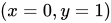
Graph with the -axis as the horizontal axis and the -axis as the vertical axis. The -intercept of is indicated by the red dot at .

In analytic geometry, using the common convention that the horizontal axis represents a variable and the vertical axis represents a variable , a -intercept or vertical intercept is a point where the graph of a function or relation intersects the -axis of the coordinate system.[1] As such, these points satisfy .

Using equations

[edit]

If the curve in question is given as the -coordinate of the -intercept is found by calculating . Functions which are undefined at have no -intercept.

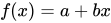
If the function is linear and is expressed in slope-intercept form as , the constant term is the -coordinate of the -intercept.[2]
Multiple -intercepts

[edit]

Some 2-dimensional mathematical relationships such as circles, ellipses, and hyperbolas can have more than one -intercept. Because functions associate -values to no more than one -value as part of their definition, they can have at most one -intercept.

-intercepts

[edit]

Analogously, an -intercept is a point where the graph of a function or relation intersects with the -axis. As such, these points satisfy . The zeros, or roots, of such a function or relation are the -coordinates of these -intercepts.[3]

Functions of the form have at most one -intercept, but may contain multiple -intercepts. The -intercepts of functions, if any exist, are often more difficult to locate than the -intercept, as finding the -intercept involves simply evaluating the function at .

In higher dimensions

[edit]

The notion may be extended for 3-dimensional space and higher dimensions, as well as for other coordinate axes, possibly with other names. For example, one may speak of the -intercept of the current–voltage characteristic of, say, a diode. (In electrical engineering, is the symbol used for electric current.)

See also

[edit]

References

[edit]
Revisions and contributorsEdit on WikipediaRead on Wikipedia
from Grokipedia
The y-intercept is the point at which the or curve intersects the y-axis, occurring when the independent variable x=0x = 0 in a two-dimensional . This intersection point is denoted as (0,b)(0, b), where bb represents the value of the dependent variable yy at that location. In the context of linear functions, the y-intercept provides a fundamental reference for graphing and analyzing the behavior of straight lines. For linear equations, the y-intercept is explicitly featured in the slope-intercept form y=mx+by = mx + b, where mm denotes the (the rate of change of yy with respect to xx) and bb is the y-intercept. Substituting x=0x = 0 into this equation yields y=by = b, confirming the intercept value. This form is particularly useful for quickly sketching lines or predicting values, as it directly reveals both the steepness and the vertical starting point on the y-axis. To determine the y-intercept from a general linear equation, such as ax+by=cax + by = c, one can solve for yy when x=0x = 0, resulting in y=c/by = c/b (assuming b0b \neq 0). Graphically, it is identified by tracing the curve to where it crosses the y-axis. The y-intercept holds significance in various applications, including economics (e.g., fixed costs in cost functions) and physics (e.g., initial conditions in motion equations), as it often represents baseline or starting values independent of the independent variable.

Basic Concepts

Definition

The provides the foundational framework for graphing functions in two dimensions, consisting of a horizontal axis known as the x-axis and a vertical axis known as the y-axis, which intersect at a at the origin point (0, 0). This system allows points in the plane to be represented as ordered pairs (x, y), where x denotes the horizontal distance from the origin along the x-axis and y denotes the vertical distance along the y-axis. The y-intercept of a graph is defined as the point at which the graph intersects or crosses the y-axis, corresponding to the coordinate (0, b) where x = 0. For any function f(x)f(x), the y-intercept is the value f(0)=bf(0) = b, representing the output of the function when the input is zero. Although the concept is most frequently applied to linear functions, where it identifies the starting point on the y-axis before any change in x, it extends to nonlinear functions as well, provided the graph intersects the y-axis at a single or identifiable point. In linear equations, the y-intercept serves as a key alongside the , which describes the line's direction. For example, in the y=2x3y = 2x - 3, substituting x=0x = 0 yields y=3y = -3, so the y-intercept occurs at the point (0, -3).

Geometric Interpretation

The y-intercept represents the point where a straight line intersects the vertical y-axis of a Cartesian coordinate plane, providing a visual anchor for the line's position relative to the origin. Geometrically, this occurs at coordinates (0, b), marking the vertical distance from the origin along the y-axis before the line extends horizontally in either direction. This point serves as the initial reference for understanding the line's orientation and elevation on the graph, emphasizing how the line "starts" its traversal from the y-axis without any x-displacement. In plotting a line, the y-intercept holds practical significance by establishing the starting height on the y-axis, allowing graphers to locate the first point efficiently and then apply the to sketch the rest of the line. For instance, if b = 2, one begins at (0, 2), which intuitively conveys the line's baseline position amid the plane's grid. This approach simplifies visualization, as the y-intercept directly informs the vertical offset, making it easier to compare lines or predict their behavior near x = 0. Consider a simple diagram of a Cartesian plane: horizontal x-axis and vertical y-axis intersecting at the origin (0, 0), with tick marks for scale. A straight line crosses the y-axis at (, b), labeled clearly as the y-intercept, while extending upward or downward with a consistent tilt, highlighting the line's pivot at this axis point. Such illustrations underscore the y-intercept's role in bridging algebraic equations to spatial representation. Notably, vertical lines, represented by equations of the form x = c where c ≠ 0, possess no y-intercept because they run parallel to the y-axis and never cross it, as their x-value remains constant and nonzero. This exception illustrates the y-intercept's dependence on the line's ability to intersect the y-axis at x = 0.

Calculation Methods

From Slope-Intercept Form

The slope-intercept form of a is expressed as y=mx+by = mx + b, where mm represents the of the line and bb is the y-intercept, the point where the line crosses the y-axis. To extract the y-intercept from this form, first ensure the equation is rewritten in the standard slope-intercept arrangement y=mx+by = mx + b, isolating yy on one side if necessary. The constant term bb then directly identifies the y-intercept without further computation. This identification is confirmed by substituting x=0x = 0 into the equation: y=m(0)+by=b\begin{align*} y &= m(0) + b \\ y &= b \end{align*} Thus, when x=0x = 0, y=by = b, aligning with the y-intercept as the function value at zero. The slope-intercept form offers the most straightforward method for determining the y-intercept, as it explicitly presents bb without requiring substitution or algebraic manipulation beyond initial rearrangement. For example, in the equation y=3x+7y = -3x + 7, the y-intercept is b=7b = 7, meaning the line intersects the y-axis at (0,7)(0, 7).

From General Linear Equations

The general linear equation of a line in two variables is given by ax+by+c=0ax + by + c = 0, where aa, bb, and cc are constants, and b0b \neq 0 to ensure the line is not vertical. To find the y-intercept, substitute x=0x = 0 into the equation, yielding by+c=0by + c = 0, so y=c/by = -c/b. This point (0,c/b)(0, -c/b) represents where the line crosses the y-axis. A common variant is the standard form Ax+By=CAx + By = C, which can be rewritten as Ax+ByC=0Ax + By - C = 0 to match the general form. To determine the y-intercept, set x=0x = 0, resulting in By=CBy = C, or y=C/By = C/B provided B0B \neq 0. Alternatively, convert the equation to slope-intercept form by isolating yy: divide through by BB to get y=(A/B)x+C/By = (-A/B)x + C/B, where the y-intercept is the constant term C/BC/B. This algebraic manipulation confirms the intercept without graphing. For equations in point-slope form, yy1=m(xx1)y - y_1 = m(x - x_1), where mm is the slope and (x1,y1)(x_1, y_1) is a point on the line, rearrange to slope-intercept form: y=mxmx1+y1y = mx - m x_1 + y_1, so the y-intercept is y1mx1y_1 - m x_1. This process highlights how the intercept depends on the given point and slope. Horizontal lines, expressed as y=ky = k for some constant kk, have a y-intercept of kk since they intersect the y-axis at every point along the line, but conventionally at (0,k)(0, k). Vertical lines, of the form x=hx = h, do not intersect the y-axis in the standard sense and thus have no y-intercept, as they are parallel to it. As an example, consider the equation 2x+3y=62x + 3y = 6. Setting x=[0](/page/0)x = [0](/page/0) gives 3y=63y = 6, so y=2y = 2, and the y-intercept is ([0](/page/0),2)([0](/page/0), 2). This direct substitution method applies broadly to general forms.

X-Intercept

The x-intercept of a function f(x)f(x) is the point (a,[0](/page/0))(a, [0](/page/0)) on the graph where f(a)=[0](/page/0)f(a) = [0](/page/0), indicating the location where the graph crosses or touches the x-axis. For a represented by the equation y=mx+by = mx + b, the x-intercept occurs where y=[0](/page/0)y = [0](/page/0), so the graph intersects the horizontal axis at that point. To calculate the x-intercept from the slope-intercept form y=mx+by = mx + b (where mm is the and bb is the y-intercept), set y=0y = 0 and solve for xx: 0=mx+b    x=bm0 = mx + b \implies x = -\frac{b}{m} This holds provided m0m \neq 0, as a zero slope would indicate a horizontal line. Geometrically, the x-intercept marks the horizontal position along the x-axis where the line crosses from one side to the other, providing a key reference point for understanding the line's placement in the coordinate plane. For lines passing through the origin (where b=0b = 0), the x-intercept is at 0, meaning the line intersects the x-axis at the origin itself. In contrast, horizontal lines of the form y=ky = k with k0k \neq 0 do not cross the x-axis and thus have no x-intercept. Consider the y=2x4y = 2x - 4; setting y=0y = 0 gives 0=2x40 = 2x - 4, so x=2x = 2, and the x-intercept is the point (2,0)(2, 0). This example illustrates how the x-intercept reveals where the line returns to the baseline (x-axis), complementing the y-intercept's role in showing the vertical starting point on the y-axis.

Multiple Y-Intercepts

While linear functions intersect the y-axis at exactly one point, providing a single y-intercept, more general relations or non-function graphs can intersect the y-axis at multiple points, resulting in multiple y-intercepts./03%3A_Graphing_Lines/3.03%3A_Graph_Using_Intercepts)/01%3A_Relations_and_Functions/1.02%3A_Relations) This multiplicity arises because relations do not adhere to the vertical line test, allowing multiple y-values for the same x-value, including at x=0. To find the y-intercepts of such a relation, substitute x=0 into the equation and solve for y, which may yield multiple real solutions depending on the equation's form. For instance, conic sections like circles and ellipses often exhibit this behavior when their centers are positioned such that the y-axis passes through them./01%3A_Relations_and_Functions/1.02%3A_Relations) A classic example is the equation of a circle centered at the origin, given by x2+y2=r2,x^2 + y^2 = r^2, where r is the . Setting x=0 yields y^2 = r^2, so y = r or y = -r, producing two y-intercepts at (0, r) and (0, -r), provided r > 0. This symmetric highlights how the crosses the y-axis twice, contrasting with the single crossing of linear graphs./01%3A_Relations_and_Functions/1.02%3A_Relations) In parametric or polar representations of , multiple y-intercepts can also appear if the parameterization traces the y-axis more than once, though the underlying relation determines the distinct points. Such cases underscore the distinction from functions, where the y-intercept is uniquely f(0) if defined, emphasizing the role of graphical multiplicity in broader ./01%3A_Relations_and_Functions/1.02%3A_Relations)

Extensions and Applications

In Higher Dimensions

The concept of the y-intercept extends naturally to higher-dimensional spaces, where lines become planes in three dimensions and hyperplanes in nn dimensions. In three-dimensional space, a plane is defined by the general equation ax+by+cz=dax + by + cz = d, where aa, bb, cc, and dd are constants, and the normal vector is (a,b,c)(a, b, c). To find the y-intercept, set x=0x = 0 and z=0z = 0, which simplifies the equation to by=dby = d, yielding y=d/by = d/b provided b0b \neq 0. This point (0,d/b,0)(0, d/b, 0) represents the intersection of the plane with the y-axis. In nn-dimensional , a is an (n1)(n-1)-dimensional affine subspace given by the equation a1x1+a2x2++anxn=ba_1 x_1 + a_2 x_2 + \dots + a_n x_n = b, where (a1,,an)(a_1, \dots, a_n) is vector and bb is a scalar. Assuming the y-coordinate corresponds to x2x_2, the y-intercept is found by setting all other coordinates xi=0x_i = 0 for i2i \neq 2, resulting in a2x2=ba_2 x_2 = b and thus x2=b/a2x_2 = b / a_2 if a20a_2 \neq 0. Geometrically, this intercept is the unique point where the intersects the y-axis, which is the line along the x2x_2-direction with all other coordinates zero. If the is parallel to the y-axis—meaning the normal vector has zero component in the y-direction (a2=0a_2 = 0)—there is no y-intercept unless b=0b = 0, in which case the entire y-axis lies on the ; otherwise, the does not intersect the y-axis at all. For the standard case where a20a_2 \neq 0, the intercept is unique and well-defined. For example, consider the plane 2x+3y+4z=62x + 3y + 4z = 6 in three dimensions. Setting x=0x = 0 and z=0z = 0 gives 3y=63y = 6, so y=2y = 2, and the y-intercept occurs at (0,2,0)(0, 2, 0). This calculation aligns with the general method and illustrates the intersection in coordinate space.

Practical Uses

In physics, the y-intercept in equations of motion represents the initial position of an object, such as the starting height in vertical displacement models. For instance, in the kinematic equation for position as a function of time, y=v0t+y0y = v_0 t + y_0, the term y0y_0 is the y-intercept, indicating the object's position at t=0t = 0. In , the y-intercept of a linear cost function denotes fixed costs, which are expenses incurred regardless of production volume. For a C=mx+bC = m x + b, where CC is total and xx is units produced, the intercept bb captures baseline or overhead costs like rent and salaries. In statistics, the y-intercept in a linear model gives the predicted value of the dependent variable when the independent variable equals zero. In the model y^=β0+β1x\hat{y} = \beta_0 + \beta_1 x, β0\beta_0 is the intercept, representing the expected response at x=0x = 0, which helps interpret baseline outcomes in predictive analyses. In , y-intercepts in curves account for systematic offsets or biases in instruments, ensuring accurate scaling of outputs. During , a linear fit's y-intercept adjusts for zero-point errors, such as baseline readings in or sensors, improving data reliability in applications like dynamometers or tools. A non-zero y-intercept in data models from scientific experiments often signals an underlying or measurement offset, rather than a true zero baseline, prompting adjustments to eliminate systematic errors. For example, in a of versus time, the y-intercept estimates the initial at the start of (t=0t = 0), providing context for cooling or heating trends while highlighting any issues if unexpected.

References

Add your contribution
Related Hubs
User Avatar
No comments yet.