Hubbry Logo
Lemon drop (candy)Lemon drop (candy)Main
Open search
Lemon drop (candy)
Community hub
Lemon drop (candy)
logo
8 pages, 0 posts
0 subscribers
Be the first to start a discussion here.
Lemon drop (candy)
Lemon drop (candy)
from Wikipedia
Lemon drop
Alternative namesLemonHeads
TypeConfectionery
Place of originEngland
Main ingredientsSugar, flavoring (lemon), food coloring

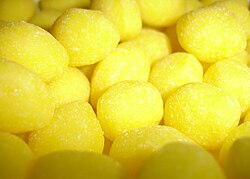
A lemon drop is a sugar coated, lemon-flavored candy that is typically colored yellow and often shaped like a lemon. They can be sweet or have a more sour flavor. Lemon drops are made by boiling sugar, water and cream of tartar until it reaches the hard crack stage. As the mixture cools, lemon flavor is added. The candy is then rolled into long ropes, cut into small pieces and rolled in sugar. Lemon drops originated in England, where confectioners learned that adding acid such as lemon juice to the boiled sugar mixture prevented sugar from crystallizing.[1]

The term "lemon drop" is also occasionally applied to lemon-flavored throat lozenges, and is the namesake of a cocktail consisting of lemon juice, vodka and sugar.

Modern lemon drops, like most hard candies we know today, descend from ancient medicinal lozenges. 18th century advances in sugar technology made hard sugar concoctions possible.

See also

[edit]

References

[edit]
Revisions and contributorsEdit on WikipediaRead on Wikipedia
from Grokipedia
A lemon drop is a type of known for its bright yellow color, intense flavor, and coating, which provides a balance of sweet and tart tastes often enjoyed as a treat or lozenge. Lemon drops originated in during the early , when confectioners discovered that incorporating acids such as juice into boiled mixtures helped prevent and achieve a smooth, glossy texture. In the United States, an early precursor known as the —a similar unflavored hard —was developed around 1806 by the Spencer family in , and later produced by Ye Olde Pepper Candy Companie, which remains operational today. Historically, these candies were sold in drugstores as medicinal aids to mask unpleasant flavors or soothe sore throats, evolving from ancient -infused sweets used in and beyond. Modern lemon drops are typically manufactured by boiling a mixture of sugar, corn syrup, and water—often with cream of tartar to inhibit crystallization—until it reaches the hard-crack stage at approximately 300–310°F (149–154°C), then infusing it with citric acid, lemon oil or juice, and yellow coloring before pouring, cooling, cutting into shapes, and coating with granulated sugar. Common ingredients include corn syrup, sugar, citric acid, lemon juice from concentrate, lemon oil, malic acid, titanium dioxide for color, and Yellow 5, as seen in popular brands like Brach's. Variations may include sanded exteriors for added texture or fizzy centers in styles like Sherbet Lemons, and they continue to be widely produced and consumed globally for their nostalgic appeal and potential benefits in relieving dry mouth or aiding digestion.

History

Origins in Europe

The origins of lemon drop candies trace back to early 19th-century innovations in British confectionery, where English confectioners discovered that incorporating derived from lemon juice into boiled could inhibit crystallization, yielding transparent, durable hard candies. This technique, essential for producing clear boiled sweets, emerged as refining and boiling methods advanced during the , allowing for consistent high-temperature cooking without the grainy texture that plagued earlier attempts. By the and , drops had become a staple in the , crafted as straightforward boiled confections infused with natural extracts or essences to impart a sharp, tangy profile. Production typically involved clarifying loaf , it to the "crack" (around 150–155°C), and swiftly adding juice or to stabilize the mixture before pouring and shaping into small drops on oiled surfaces or using drop pans for uniformity. These early drops were often sold loose by weight in shops, reflecting the era's growing demand for affordable, portable treats amid rising imports from colonial sources. The specific form of drops crystallized during the Victorian period in Britain, building on broader traditions of fruit-flavored preserves but distinguishing itself through the precise acid- balance that created a glossy, non-sticky finish. Recipes emphasized the tart essence to counteract the inherent sweetness of the base, promoting both flavor harmony and digestive appeal in an age when candies doubled as mild remedies. For instance, one method rubbed the yellow rind of lemons onto rough to extract oils, then blended this with clarified and for color, heating gently to a dropping consistency before forming the candies to dry for hours. Nineteenth-century British cookbooks documented these processes in detail, underscoring the tart flavor's role in elevating simple boils into refined confections suitable for households and commercial vendors alike. Works like Gunter's Modern Confectioner (1861) described boiling to the crack stage, flavoring with essence, and preventing graining via addition, while The Complete Confectioner, Pastry-Cook, and Baker (1864) outlined variations such as drops flavored with , rolled and dusted for texture. These texts highlight how lemon drops evolved from experimental sweets into a Victorian favorite, prized for their clarity and zesty contrast to overly sweet alternatives.

Popularization in North America

Lemon drop candies were introduced to the U.S. market in the late 1800s by immigrant confectioners, particularly English and German settlers who brought European recipes for hard sugar candies to urban centers like and New York. By the , these treats had achieved widespread availability through penny candy stores, where they were sold in bulk for a cent apiece, making them accessible to children and working-class families across the country. The candy's popularity surged during the of the 1930s, when it served as an affordable, shelf-stable indulgence amid economic hardship, offering a small luxury for just a few cents. Production ramped up in established factories, including those in , a longstanding hub for American since the mid-19th century. During , lemon drops remained a favored treat due to their durability and non-perishable nature, providing comfort both at home and in as shortages affected more perishable sweets. Key milestones in the 1930s and 1940s included the expansion of dedicated production lines by American companies specializing in hard candies; for instance, Claeys Candy Company, founded in 1919 in , scaled up manufacturing of old-fashioned lemon drops using traditional methods to meet growing demand. This period solidified lemon drops as a staple in North American confectionery, with similar adoption in through imported and local production mirroring U.S. trends. In mid-20th-century , lemon drops developed strong regional associations, particularly as holiday gifts in decorative tins during and as popular school treats traded among children during recess. Their tangy flavor and compact form made them ideal for sharing in classrooms and family gatherings, embedding them in everyday cultural rituals from the Northeast to the Midwest.

Composition and Production

Key Ingredients

The primary base for lemon drop candies is granulated , typically , which provides the and characteristic of hard candies when boiled to the hard crack stage. is essential during production to dissolve the sugar and form a base, facilitating the even cooking process that achieves the desired amorphous glassy structure. serves as a key acidic component, imparting the signature tart flavor while also acting as an anti-crystallization agent to maintain smoothness; alternatively, natural juice can fulfill this role by supplying both acidity and subtle fruit notes. Flavor enhancers in lemon drops primarily include lemon oil, derived from lemon peels for a concentrated citrus aroma, or artificial lemon essence, which replicates this profile through synthetic compounds like esters and aldehydes. may be added for additional sourness, enhancing the balance against the sugar's sweetness without overpowering the lemon notes. Optional additives include , which prevents graininess by interfering with sugar crystal formation during cooling, ensuring a glossy, uniform texture. Cream of tartar () is also commonly used as an anti-crystallization agent in traditional and homemade recipes. Malic acid may be included for extra tartness, and for opacity in some commercial varieties. Yellow food dyes, such as FD&C Yellow No. 5, are commonly used to achieve the vibrant hue, while coarse can be applied to exteriors for a sanded variety that adds tactile contrast and subtle crunch. Historically, early 19th-century recipes for lemon drops relied on natural lemon juice and for , as seen in formulations from onward. Post-1950s, the industry shifted toward synthetic lemon flavors due to lower costs, greater availability, and improved consistency in , though natural options persist in artisanal varieties.

Manufacturing Techniques

The manufacturing of lemon drop candies begins with the process, where a mixture of , , and often is heated to the hard crack stage, typically reaching temperatures of –310°F (149–154°C), to evaporate and achieve the desired glassy texture. This stage ensures the syrup reaches a content below 5%, preventing while promoting transparency and hardness upon cooling. In industrial settings, is applied during —such as at 165 mmHg for several minutes—to further reduce and temperatures without compromising clarity. , typically added at 0.1–1.0% by weight toward the end of or just before cooling, imparts the tartness and helps achieve a glossy, transparent finish by adjusting the to 3.0–4.0 while minimizing inversion. Flavor incorporation follows during the cooling phase, where extracts or oils are mixed in at around 145°C (293°F) or lower to preserve volatile compounds essential for the profile. This step is followed by , often through pulling the warm mass or treatment, which incorporates or expels air to remove impurities and bubbles, resulting in a smoother, clearer . Traditional methods involve manual pulling on cooling tables to enhance and uniformity. Once cooled to 70–85°C (158–185°F), the syrup is formed into drops by pouring into starch trays or molds for traditional batch production, allowing the candy to set into individual shapes, or using automated drop rollers for precision. In modern facilities, continuous lines employ depositors—such as piston or servo-driven systems—to extrude uniform drops onto cooling belts, achieving outputs of thousands per hour with minimal waste. An optional coating of granulated sugar, known as sanding, is then applied to the cooled drops to balance tartness and add texture, often via tumbling in sugar drums. Quality control emphasizes testing for moisture content, ideally maintained under 2–3% using methods like , to ensure shelf stability and prevent stickiness or graining. Production has evolved since the early from batch cooking, which improved clarity over open-fire methods, to continuous processes in coil cookers and cooling tunnels for higher efficiency and consistency in large-scale operations.

Varieties and Forms

Traditional Hard Candies

Traditional lemon drop candies are small, drop-shaped hard confections, typically in color and coated with a fine layer of for added texture and visual appeal. These candies measure approximately 1-1.5 cm in diameter, featuring a smooth, glossy surface that reflects their boiled base. The texture of traditional lemon drops is characterized by a hard, brittle exterior resembling , which dissolves gradually in the mouth to release flavor over several minutes. This provides a balanced taste profile of intense sweetness from and , countered by tartness from and natural flavoring, without any fillings or soft centers. The low of 3-4 enhances the sour notes, creating a refreshing sensation. Due to their low moisture content of 2-3%, traditional lemon drops maintain stability in a glassy amorphous state, offering a typical of about 1 year or more when stored in airtight containers at . This low prevents microbial growth and crystallization, making them suitable for bulk packaging and long-term distribution. Plain lemon drops have served as iconic penny candy staples since the early , embodying affordable everyday snacking in general stores and confectioneries across . Originating from 19th-century European traditions, they were prized for their portability and simplicity, often sold individually for a to children and adults alike.

Modern and Regional Variants

In the , sherbet represent a popular filled variant of the traditional drop, featuring a hard yellow candy shell enclosing a fizzy sherbet center made from and of soda, which creates an effervescent burst upon reaching the core; this style originated in the 1800s as a playful evolution of basic hard candies. Italian imports like Perle di Sole offer another filled option with a tangy fizzy center that provides a contrasting dissolving texture against the crisp exterior, enhancing the overall for a more indulgent experience. Coated hybrids have introduced textural innovations to lemon drops, with sanded versions featuring a coarse exterior that adds a satisfying crunch while balancing the candy's sour lemon profile. These sanded drops, often lightly dusted for subtle abrasion, contrast the smooth traditional form by emphasizing tactile enjoyment. Sour-coated lemon drops are coated in powder for an amplified pucker that caters to adventurous palates seeking heightened intensity. Regional specialties showcase cultural adaptations, as seen in German-style lemon drops from brands like Hermann the German, which emphasize intense, oil-extracted essence for a bold, lingering tartness rooted in Bavarian traditions. In Asian markets, particularly , spicy- fusions blend the classic drop with chili heat, creating a hybrid that merges tangy sourness with a warming spice for an exotic twist popular in international export lines. Post-2010 innovations reflect health-conscious trends, with low-sugar variants using alternative sweeteners like to reduce calorie content while preserving the lemon drop's zesty character, and organic options from producers like YumEarth incorporating , non-GMO ingredients free from artificial dyes. These adaptations, emerging around 2012, prioritize and dietary inclusivity without compromising flavor authenticity.

Commercial Aspects

Notable Brands

Claey's Candy, founded in 1919 in , by Jerome C. Claeys, is renowned for its classic sanded lemon drops that emphasize natural lemon flavors through traditional recipes using lemon oil and dusting for a tangy-sweet balance. In November 2025, the company relocated to a larger facility to support increased production of its hard candies. The family-owned company produces approximately 15,000 to 16,000 pounds of hard candies daily, including these unwrapped lemon drops ideal for bulk display in candy jars. Early 20th-century American brands like Choward's, established in the 1930s in New York City by Charles Howard, specialized in bulk formats such as lemon mints that offer a hard candy shell with a refreshing citrus profile, often sold unwrapped for convenient snacking or medicinal use. Similarly, King Leo Confections, originating in 1901, contributed to the tradition of pure sugar-based hard candies, though primarily known for peppermint. Internationally, , the German confectionery giant founded in 1920, offers gummy-lemon hybrids like its Ginger Lemon candies, which combine chewy texture with tart lemon and subtle ginger notes for a modern twist on the classic drop. In , , established in 1927 by Harry Lea in , produces lemon-flavored candies such as Sherbet Lemons, which feature a fizzy center in a hard shell, highlighting regional preferences for varied textures. In August 2025, the company acquired Lagoon Confectioners and revived the Sherbet Lemons product line. As a market leader, has dominated the lemon drop segment through acquisitions in the , including the merger with Farley's & Sathers that incorporated brands like and , the latter introduced in 1960 and now producing over 2 million pieces daily as a signature hard-shelled lemon candy. Ferrara's overall annual output exceeds 800 million pounds of confections, underscoring its scale in delivering traditional and innovative lemon drops to global markets.

Packaging and Market Availability

Lemon drop candies were traditionally packaged and sold loose in small paper bags or barrels at local drug stores and general stores in the early , often as penny for individual purchase. This format allowed for easy dispensing and reflected their origins as medicinal lozenges, with early examples like the Salem sold by weight or count from horse-drawn wagons in starting in 1806. In the mid-20th century, packaging shifted toward more structured formats, including cellophane-wrapped rolls and bags to preserve freshness and facilitate bulk retail, evolving further to tubs and resealable containers by the for home and commercial use. Modern packaging emphasizes convenience, with individually wrapped sticks in packs of 20 to 50 pieces, multi-bag sets (such as four 6-ounce bags totaling 24 ounces), and clear bags tied with bows for gifting or display. Distribution channels for lemon drop candies include supermarkets and hypermarkets like and Metro Market, where they are stocked in standard candy aisles; bulk bins at discount grocers such as ; convenience stores; and specialty candy shops like Abdallah Candies. Online availability expanded significantly in the 2000s through platforms like Amazon, with bulk cases shipped from U.S. distribution centers, enabling global export to and via and import networks. Market trends show steady availability in a competitive confectionery sector, with the hard-boiled category experiencing a 6.9% decline in U.S. to over $1 billion for the 52 weeks ending May 18, 2025, amid shifts toward healthier or novelty options. Seasonal spikes occur during holidays, boosting demand in retail and channels, while pricing remains affordable at $1 to $3 per standard 8- to 12-ounce pack as of 2025. Notable brands like and contribute to this accessibility through widespread supermarket distribution of their 9-ounce bags and similar formats.

Nutritional Profile and Consumption

Nutritional Content

A standard serving of lemon drop candy is typically 4 pieces, weighing about 17 grams, which provides approximately 70 calories, nearly all derived from carbohydrates in the form of sugars. Nutritional values may vary slightly by and formulation. The macronutrient profile per serving includes 0 grams of total fat, 0 grams of protein, and 16 grams of total carbohydrates, of which 11 grams are sugars with no . Sodium content is minimal at 5 milligrams. Micronutrient contributions are negligible, with no significant amounts of vitamins or minerals; for instance, from flavoring is present only in trace quantities, contributing less than 2% of the daily value due to processing, and other nutrients like calcium, iron, and are at 0% daily value. Lemon drop candies are generally gluten-free and free of nuts as primary ingredients, though potential cross-contamination may occur in manufacturing facilities that process , , soy, eggs, , or .

Health and Dietary Notes

Lemon drop candies pose health risks primarily due to their high sugar content and acidity from , which can contribute to when overconsumed and erode through prolonged exposure. The CDC recommends limiting added sugars to less than 10% of daily calories, or about 50 grams (12 teaspoons) on a 2,000-calorie diet, suggesting to 1-2 servings of such candies per day to stay within these guidelines. The in these candies lowers oral pH, increasing the potential for , particularly if sucked slowly or consumed frequently. Traditional lemon drop candies are generally vegan-friendly, lacking animal-derived components like that are common in some other confections. However, their high profile from makes them unsuitable for keto or low-carb diets. Sugar-free options, sweetened with artificial alternatives like or sugar alcohols, emerged in the 1990s to support diabetic and weight-management needs. These candies serve best as occasional treats, but individuals prone to acid reflux should limit intake, as can trigger or worsen symptoms by irritating the .

References

Add your contribution
Related Hubs
User Avatar
No comments yet.