




Community hub
Recent from talks
Contribute something to knowledge base
Content stats: 0 posts, 0 articles, 1 media, 0 notes
Members stats: 0 subscribers, 0 contributors, 0 moderators, 0 supporters
Subscribers
Supporters
Contributors
Moderators
Lens (vertebrate anatomy)
The lens, or crystalline lens, is a transparent biconvex structure in most land vertebrate eyes. Relatively long, thin fiber cells make up the majority of the lens. These cells vary in architecture and are arranged in concentric layers. New layers of cells are recruited from a thin epithelium at the front of the lens, just below the basement membrane surrounding the lens. As a result the vertebrate lens grows throughout life. The surrounding lens membrane referred to as the lens capsule also grows in a systematic way, ensuring the lens maintains an optically suitable shape in concert with the underlying fiber cells. Thousands of suspensory ligaments are embedded into the capsule at its largest diameter which suspend the lens within the eye. Most of these lens structures are derived from the epithelium of the embryo before birth.
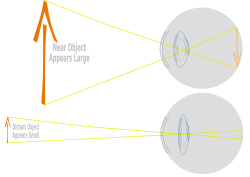
Along with the cornea, aqueous, and vitreous humours, the lens refracts light, focusing it onto the retina. In many land animals the shape of the lens can be altered, effectively changing the focal length of the eye, enabling them to focus on objects at various distances. This adjustment of the lens is known as accommodation (see also below). In many fully aquatic vertebrates, such as fish, other methods of accommodation are used, such as changing the lens's position relative to the retina rather than changing the shape of the lens. Accommodation is analogous to the focusing of a photographic camera via changing its lenses. In land vertebrates the lens is flatter on its anterior side than on its posterior side, while in fish the lens is often close to spherical.
Accommodation in humans is well studied and allows artificial means of supplementing our focus, such as glasses, for correction of sight as we age. The refractive power of a younger human lens in its natural environment is approximately 18 dioptres, roughly one-third of the eye's total power of about 60 dioptres. By age 25 the ability of the lens to alter the light path has reduced to 10 dioptres and accommodation continues to decline with age.
The lens is located towards the front part of the vertebrate eye, called the anterior segment, which includes the cornea and iris positioned in front of the lens. The lens is held in place by the suspensory ligaments (Zonule of Zinn), attaching the lens at its equator to the rest of the eye through the ciliary body. Behind the lens is the jelly-like vitreous body which helps hold the lens in place. At the front of the lens is the liquid aqueous humour which bathes the lens with nutrients and other things. Land vertebrate lenses usually have an ellipsoid, biconvex shape. The front surface is less curved than the back. In a human adult, the lens is typically about 10 mm in diameter and 4 mm thick, though its shape changes with accommodation and its size grows throughout a person's lifetime.
The lens has three main parts: the lens capsule, the lens epithelium, and the lens fibers. The lens capsule is a relatively thick basement membrane forming the outermost layer of the lens. Inside the capsule, much thinner lens fibers form the bulk of the lens. The cells of the lens epithelium form a thin layer between the lens capsule and the outermost layer of lens fibers at the front of the lens but not the back. The lens itself lacks nerves, blood vessels, or connective tissue. Anatomists will often refer to positions of structures in the lens by describing it like a globe of the world. The front and back of the lens are referred to as the anterior and posterior "poles", like the North and South poles. The "equator" is the outer edge of the lens often hidden by the iris and is the area of most cell differentiation. As the equator is not generally in the light path of the eye, the structures involved with metabolic activity avoid scattering light that would otherwise affect vision.
The lens capsule is a smooth, transparent basement membrane that completely surrounds the lens. The capsule is elastic and its main structural component is collagen. It is presumed to be synthesized by the lens epithelium and its main components in order of abundance are heparan sulfate proteoglycan (sulfated glycosaminoglycans (GAGs)), entactin, type IV collagen and laminin. The capsule is very elastic and so allows the lens to assume a more spherical shape when the tension of the suspensory ligaments is reduced. The human capsule varies from 2 to 28 micrometres in thickness, being thickest near the equator (peri-equatorial region) and generally thinner near the posterior pole. The photos from electron and light microscopes show an area of the capsule lens equator where the capsule grows and adjacent to where thousands of suspensory ligaments attach. Attachment must be strong enough to stop the ligaments being detached from the lens capsule. Forces are generated from holding the lens in place and the forces added to during focusing. While the capsule is thinnest at the equator where its area is increasing, the anterior and posterior capsule is thinner than the area of ligament attachment.
The lens epithelium is a single layer of cells at the front of the lens between the lens capsule and the lens fibers. By providing the lens fibers with nutrients and removing waste, the cells of the epithelium maintain lens homeostasis. As ions, nutrients, and liquid enter the lens from the aqueous humour, Na+/K+-ATPase pumps in the lens epithelial cells pump ions out of the lens to maintain appropriate lens osmotic concentration and volume, with equatorially positioned lens epithelium cells contributing most to this current. The activity of the Na+/K+-ATPases keeps water and current flowing through the lens from the poles and exiting through the equatorial regions.
The cells of the lens epithelium also divide into new lens fibers at the lens equator. The lens lays down fibers from when it first forms in embryo until death.
Lens (vertebrate anatomy)
The lens, or crystalline lens, is a transparent biconvex structure in most land vertebrate eyes. Relatively long, thin fiber cells make up the majority of the lens. These cells vary in architecture and are arranged in concentric layers. New layers of cells are recruited from a thin epithelium at the front of the lens, just below the basement membrane surrounding the lens. As a result the vertebrate lens grows throughout life. The surrounding lens membrane referred to as the lens capsule also grows in a systematic way, ensuring the lens maintains an optically suitable shape in concert with the underlying fiber cells. Thousands of suspensory ligaments are embedded into the capsule at its largest diameter which suspend the lens within the eye. Most of these lens structures are derived from the epithelium of the embryo before birth.
Along with the cornea, aqueous, and vitreous humours, the lens refracts light, focusing it onto the retina. In many land animals the shape of the lens can be altered, effectively changing the focal length of the eye, enabling them to focus on objects at various distances. This adjustment of the lens is known as accommodation (see also below). In many fully aquatic vertebrates, such as fish, other methods of accommodation are used, such as changing the lens's position relative to the retina rather than changing the shape of the lens. Accommodation is analogous to the focusing of a photographic camera via changing its lenses. In land vertebrates the lens is flatter on its anterior side than on its posterior side, while in fish the lens is often close to spherical.
Accommodation in humans is well studied and allows artificial means of supplementing our focus, such as glasses, for correction of sight as we age. The refractive power of a younger human lens in its natural environment is approximately 18 dioptres, roughly one-third of the eye's total power of about 60 dioptres. By age 25 the ability of the lens to alter the light path has reduced to 10 dioptres and accommodation continues to decline with age.
The lens is located towards the front part of the vertebrate eye, called the anterior segment, which includes the cornea and iris positioned in front of the lens. The lens is held in place by the suspensory ligaments (Zonule of Zinn), attaching the lens at its equator to the rest of the eye through the ciliary body. Behind the lens is the jelly-like vitreous body which helps hold the lens in place. At the front of the lens is the liquid aqueous humour which bathes the lens with nutrients and other things. Land vertebrate lenses usually have an ellipsoid, biconvex shape. The front surface is less curved than the back. In a human adult, the lens is typically about 10 mm in diameter and 4 mm thick, though its shape changes with accommodation and its size grows throughout a person's lifetime.
The lens has three main parts: the lens capsule, the lens epithelium, and the lens fibers. The lens capsule is a relatively thick basement membrane forming the outermost layer of the lens. Inside the capsule, much thinner lens fibers form the bulk of the lens. The cells of the lens epithelium form a thin layer between the lens capsule and the outermost layer of lens fibers at the front of the lens but not the back. The lens itself lacks nerves, blood vessels, or connective tissue. Anatomists will often refer to positions of structures in the lens by describing it like a globe of the world. The front and back of the lens are referred to as the anterior and posterior "poles", like the North and South poles. The "equator" is the outer edge of the lens often hidden by the iris and is the area of most cell differentiation. As the equator is not generally in the light path of the eye, the structures involved with metabolic activity avoid scattering light that would otherwise affect vision.
The lens capsule is a smooth, transparent basement membrane that completely surrounds the lens. The capsule is elastic and its main structural component is collagen. It is presumed to be synthesized by the lens epithelium and its main components in order of abundance are heparan sulfate proteoglycan (sulfated glycosaminoglycans (GAGs)), entactin, type IV collagen and laminin. The capsule is very elastic and so allows the lens to assume a more spherical shape when the tension of the suspensory ligaments is reduced. The human capsule varies from 2 to 28 micrometres in thickness, being thickest near the equator (peri-equatorial region) and generally thinner near the posterior pole. The photos from electron and light microscopes show an area of the capsule lens equator where the capsule grows and adjacent to where thousands of suspensory ligaments attach. Attachment must be strong enough to stop the ligaments being detached from the lens capsule. Forces are generated from holding the lens in place and the forces added to during focusing. While the capsule is thinnest at the equator where its area is increasing, the anterior and posterior capsule is thinner than the area of ligament attachment.
The lens epithelium is a single layer of cells at the front of the lens between the lens capsule and the lens fibers. By providing the lens fibers with nutrients and removing waste, the cells of the epithelium maintain lens homeostasis. As ions, nutrients, and liquid enter the lens from the aqueous humour, Na+/K+-ATPase pumps in the lens epithelial cells pump ions out of the lens to maintain appropriate lens osmotic concentration and volume, with equatorially positioned lens epithelium cells contributing most to this current. The activity of the Na+/K+-ATPases keeps water and current flowing through the lens from the poles and exiting through the equatorial regions.
The cells of the lens epithelium also divide into new lens fibers at the lens equator. The lens lays down fibers from when it first forms in embryo until death.
Recent media
Recent media